-
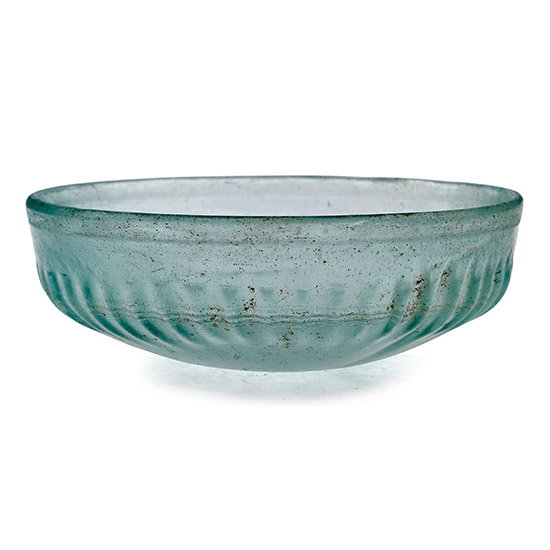
Roman Pillar-Moulded Pale Green Glass Bowl
1st century B.C.-1st century A.D.Estimate: £1,500 - 2,000 (+bp*)
Bids: 7 | Current Bid: £650
Shallow bowl with moulded pillar detailing on the outer face. 142 grams, 12.6 cm wide
Acquired from Millennium Antiquities, Lancashire, UK, in 2001. From the collection of a Bedfordshire, UK, lady. Accompanied by an original Millennium Antiquities certificate of authenticity dated 13 October 2001.
Ribbed bowls were typical cast tableware belonging to the early Imperial period, and parallels have been found throughout the Roman provinces and beyond. In Cyprus, as elsewhere in the eastern half of the Empire, bowls with short, close-set ribs concentrated around the middle of the body constitute a large group. -
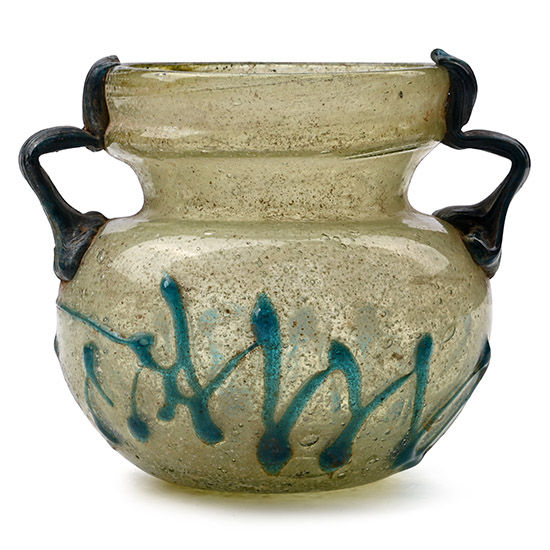
Roman Green Glass Jar with Blue Handles and Zig-Zag Trail
Circa 4th-5th century A.D.Estimate: £1,000 - 1,400 (+bp*)
Bids: 9 | Current Bid: £260
Bulbous body with funicular neck and ribbed mouth, applied blue handles and trail decoration on the body. 98.9 grams, 95 mm wide
Acquired from Shirley Warren Antique Glass, Surrey, UK, in 1993 with reference no.4155/4083. From the collection of a Bedfordshire, UK, lady. Accompanied by an original Shirley Warren invoice no.2388 dated 18 September 1993.
This is a common form of jar with trailed ornaments, and numerous examples have been found in the Syro-Palestinian Region (Beit Fajjar, Jerusalem, Grave A at Ain Nabrud, etc). -
.jpg)
Large Roman Glass Amphora with Trail
3rd century A.D.Estimate: £1,200 - 1,700 (+bp*)
Opening Bid: £600
With broad rounded shoulder, piriform body tapering to a stub foot, cylindrical neck and flared rim with rolled edge, applied twisted green glass handles (one partly absent); slightly iridescent surface. 125 grams, 21.2 cm
Acquired on the UK art market, 1990s. Private collection, New York, USA. -
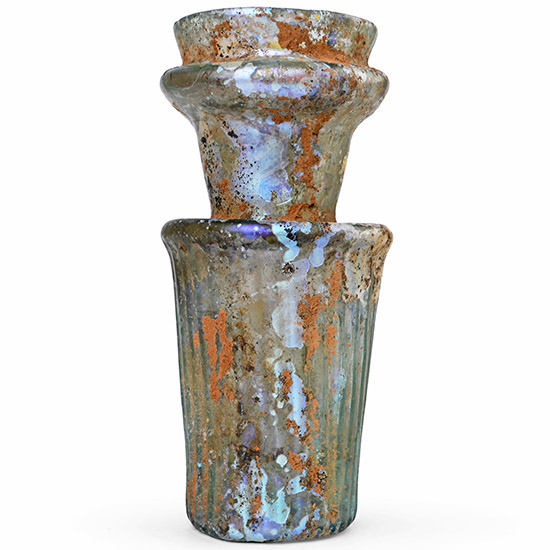
Roman Ribbed Glass Vessel
3rd century A.D.Estimate: £400 - 600 (+bp*)
Opening Bid: £200
The body with fine ribs and a dimpled base, a carinated shoulder and a funicular neck with a raised collar below the rim. 98.3 grams, 13.1 cm
From an important London, UK, collection 1980-2020.
The vessel likely originates from a Syrian or Palestinian workshop, characterised by a neck shape featuring a collar and a yellow glass tint. The vessel's form establishes an upper chronological limit of the mid-3rd century AD, while the relatively high quality of the glass precludes dating it any later than the end of that century. -
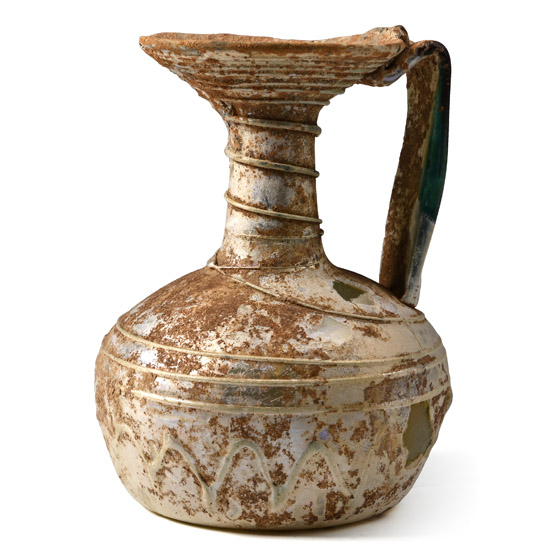
Roman Glass Jug with Trail
1st-4th century A.D.Estimate: £1,500 - 2,000 (+bp*)
Opening Bid: £750
Squat body with domed shoulder, tubular neck and broad flared rim, applied strap handle, applied trail to neck and shoulder, dimple base. 53 grams, 96 mm high
Acquired on the UK art market, 1990s. Private collection, New York, USA. -
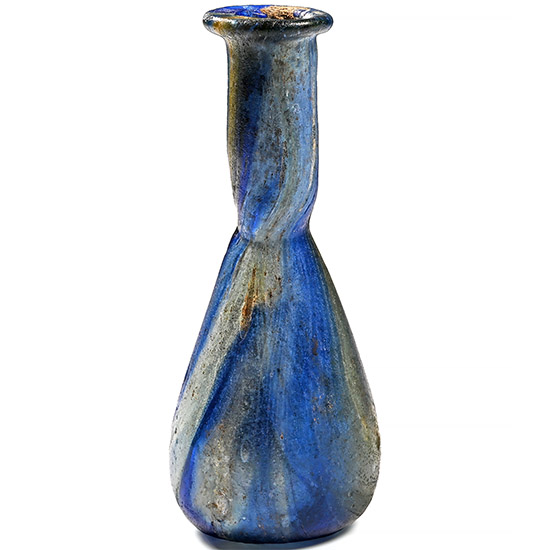
Roman Marbled Blue Glass Toilet Bottle
1st-2nd century A.D.Estimate: £1,000 - 1,400 (‡+bp*)
Bids: 5 | Current Bid: £1,100
An iridescent unguentarium with piriform body, tubular neck with everted rolled rim. 19.7 grams, 83 mm
Acquired on the European art market in 2001.
This typology was produced mainly in Egypt (Karanis class XIII.B). They were characteristic of the Eastern Mediterranean as well, and characterised by the irregular curved depression on the underside of the base and by the narrow cylindrical neck with slight constriction at the bottom. -
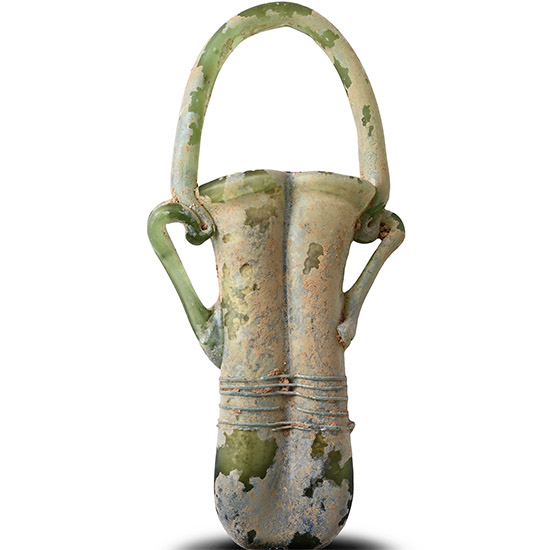
Roman Glass Double Unguentarium
2nd-3rd century A.D.Estimate: £400 - 600 (+bp*)
Opening Bid: £200
With rolled rim to each tapering tube, applied trail detailing to each Lower body, lateral angled handles and a large applied loop handle above; iridescent surface; accompanied by a custom-made display stand. 87.5 grams, 15.6 cm
From an important London, UK, collection 1980-2020. -
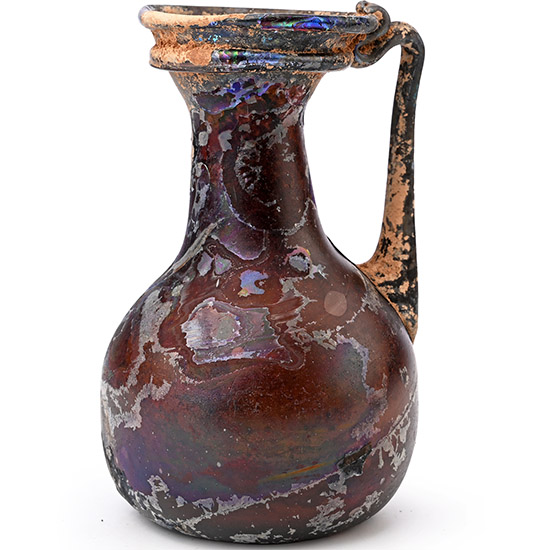
Roman Aubergine Glass Pitcher
3rd-4th century A.D.Estimate: £400 - 600 (+bp*)
Opening Bid: £200
Comprising a bulbous body with a dimple base and a funicular neck with an applied band below the rim and a handle to the rear. 93.2 grams, 10.8 cm
From an important London, UK, collection 1980-2020.
The pitcher shows the style of production of the Roman Rhine workshops. Several hundred vessels with applied decoration are known from the Roman Rhineland. The numerous finds from graves and the evidence of glass furnaces in Cologne suggest that a large proportion of these vessels were produced in local workshops, then spread throughout the empire. -
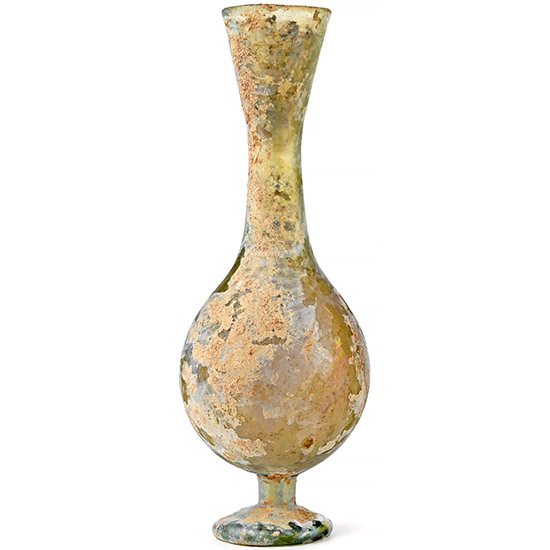
Roman Footed Glass Vessel
3rd century A.D.Estimate: £400 - 600 (+bp*)
Opening Bid: £200
Bulbous body with a flaring foot and a tall funicular neck. 59.6 grams, 16.7 cm
From an important London, UK, collection 1980-2020.
This bottle originates from an Eastern workshop; however, the high quality of the glass and the grinding away of the pontil mark suggest a date in the early 3rd century AD. -
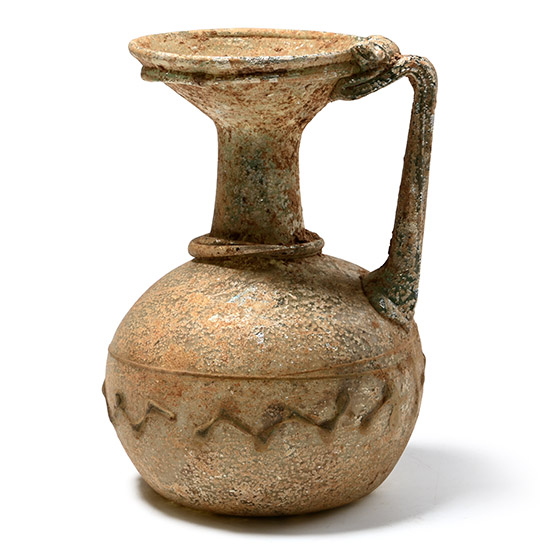
Roman Iridescent Glass Pitcher with Trail
3rd-4th century A.D.Estimate: £500 - 700 (+bp*)
Opening Bid: £150
Bulbous body with an applied zig-zag trail and a circumferential band above, and an applied collar at the base of the tubular neck and another beneath the flaring mouth, with a strap handle to the rear. 76 grams, 10.7 cm
Acquired in the 1990s from London dealerships and auction houses. From the Lonson collection.
In Ancient Rome, there were two different types of pitchers: the urcei used for water or the oinochoae, used for wine. They were employed to serve liquids at banquets, pour water for handwashing (probably the purpose of this urceus), and to store everyday goods. -
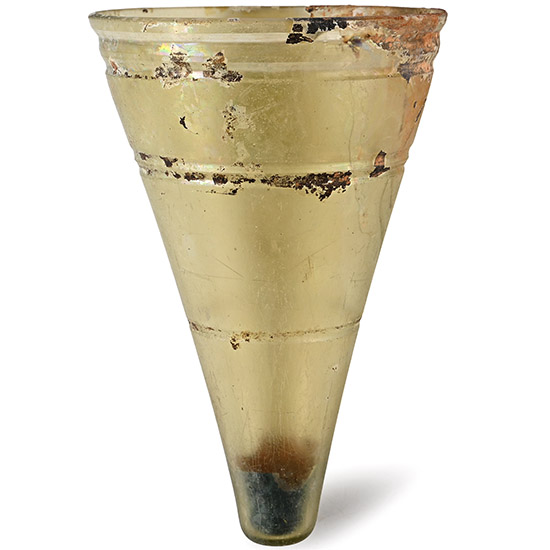
Large Roman Cut-Glass Beaker
4th-5th century A.D.Estimate: £1,500 - 2,000 (+bp*)
Opening Bid: £750
With a thick conical body and a pontil base, five horizontal grooves cut around the outer face of the body; traces of iridescence. 288 grams, 18.8 cm
Dr Jutaro Kawabe, Nagoya, Japan, his collection formed in the 1960s-1970s. with Hoshigaoka Gallery until the late 1990s. Private collection, London, UK. This lot has been checked against the Interpol Database of stolen works of art and is accompanied by search certificate number no.13277-254062. -
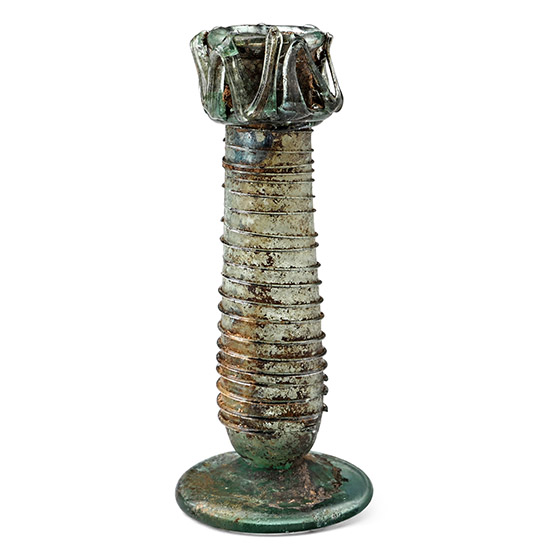
Roman Glass Vessel with Applied Trails
1st-4th century A.D.Estimate: £400 - 600 (+bp*)
Bids: 1 | Current Bid: £300
Candlestick type vessel with tall tubular neck with applied trail decoration, applied cagework around the mouth. 37.1 grams, 98 mm
From an important London, UK, collection 1980-2020.

