-
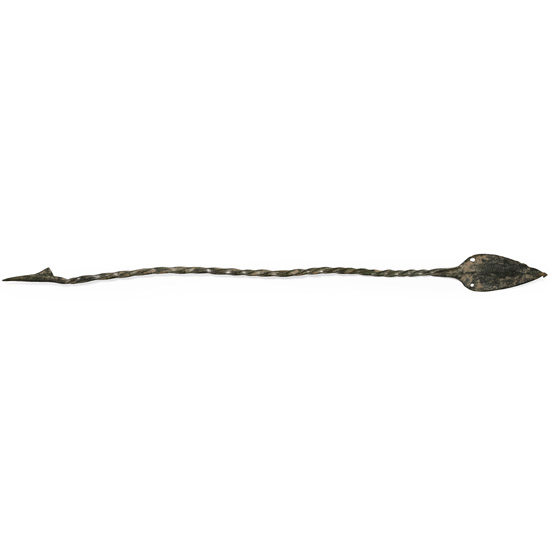
Late Roman Bronze Medical Instrument
4th century A.D.Estimate: £120 - 170 (+bp*)
Opening Bid: £60
Comprising a long twisted shaft with a barbed finial and a leaf-shaped spatulate implement at the other end. 18.2 grams, 28.2 cm
Acquired on the UK art market. Private collection, Suffolk. -
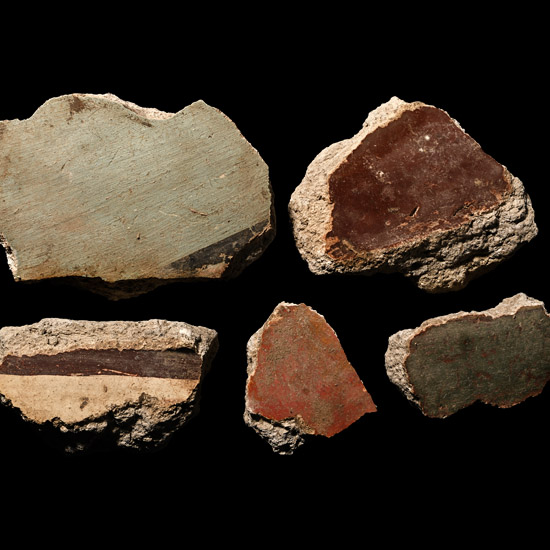
Roman Fresco Wall Plaster Collection
1st century A.D.Estimate: £50 - 70 (+bp*)
Opening Bid: £5
Fragments of wall plaster with rendered surface painted with mainly Pompeii red, pale blue, brown and white detailing; some with an impression of timber laths to the reverse. 1.46 kg total, 7.9-16 cm
Acquired in the 19th century. Ex Jeger collection, Switzerland. UK gallery, early 2000s.
These small fragments, for analogies with the fragments of Pompeii, seem to belong to the second style of Roman painting, red panels representing highlight and shadow, decorated with vegetal interlaces. A red grenade fillet probably framed some panels. A fragment shows alternate blue and red colours over a cream background, maybe pertinent to a socle. -
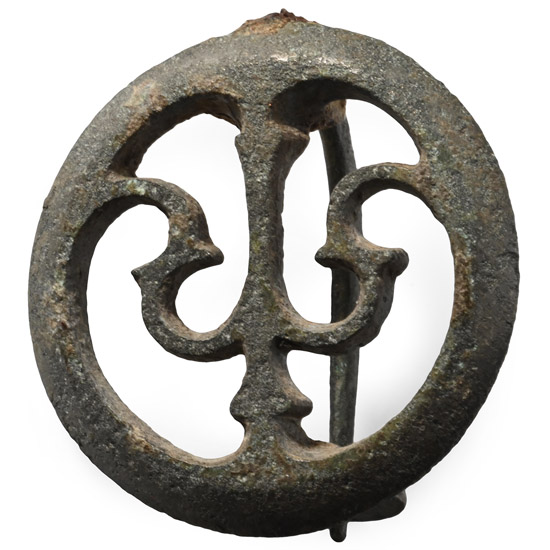
Roman Bronze Military Plate Brooch
2nd-3rd century A.D.Estimate: £50 - 70 (+bp*)
Bids: 2 | Current Bid: £15
With an openwork body formed of volute scrolls, a pin and a catchplate to the reverse. 14 grams, 35 mm
From the private coin collection of a West London, UK, gentleman, formed since the mid 1980s. -
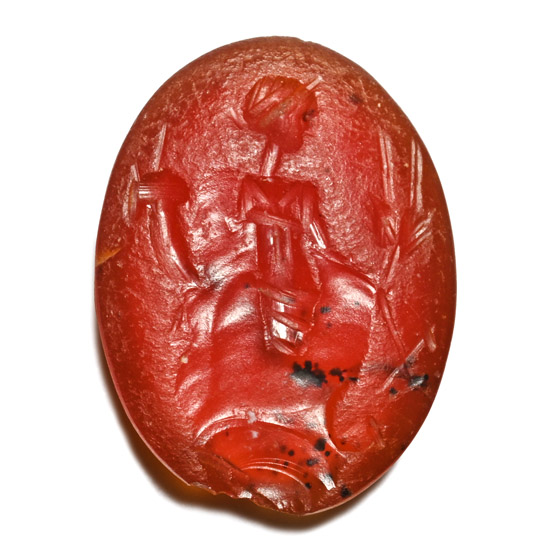
Roman Carnelian Gemstone with Fortuna
2nd-3rd century A.D.Estimate: £200 - 300 (+bp*)
Bids: 2 | Current Bid: £16
Biconvex type with incuse design of Fortuna standing with a cornucopia; supplied with a museum-quality impression. 0.59 grams, 13 mm
From the private collection of a European gentleman (1942-2024), formed since the 1970s. -
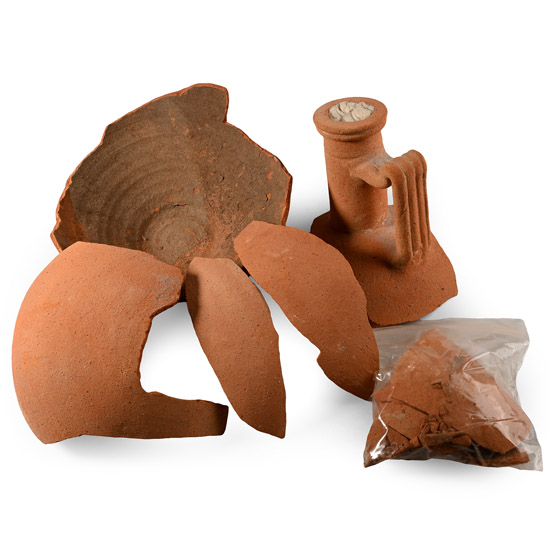
Large Complete Roman Redware Flagon in Pieces for Restoration
2nd-4th century A.D.Estimate: £50 - 70 (+bp*)
Bids: 1 | Current Bid: £5
Complete set of fragments comprising a flagon with flared foot, tubular neck and strap handle. 782 grams total, 3-17 cm
From the private collection of Mr Brian Edwards, New Malden, Surrey, UK, formed from the late 1970s-early 1980s; thence by descent. -
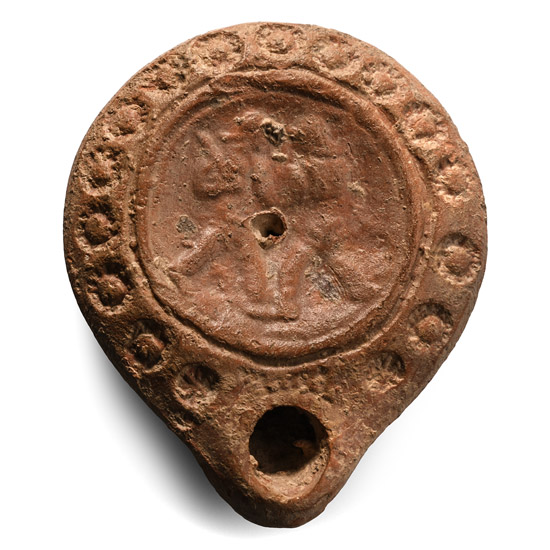
Roman Terracotta Oil Lamp with Fighting Gladiators
2nd century A.D.Estimate: £200 - 300 (+bp*)
Opening Bid: £100
Broad and squat with short stub nozzle, concentric rings to the base, row of impressed annulets to the shoulder, discus with central filler hole; low-relief scene of two murmillo gladiators in combat. 62 grams, 82 mm
From a German private collection, 1980s. Property of an Essex, UK, gentleman. -
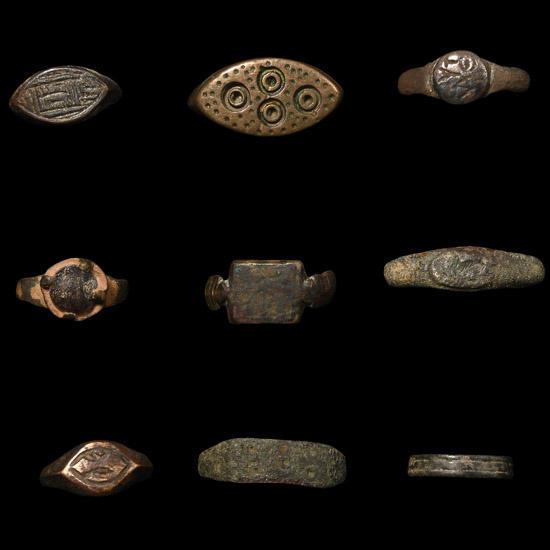
Roman to Medieval Bronze Ring Group
1st-16th century A.D.Estimate: £60 - 80 (+bp*)
Bids: 2 | Current Bid: £10
Comprising: a large ring with a lentoid bezel bearing four ring-and-dot motifs; a slender ring with a rectangular bezel with five ring-and-dot motifs; a ring with a rectangular bezel with traces of niello; a ring with angled shoulders and a circular bezel with a Greek inscription; a slender ring with a circular ring set with a round cabochon; a flat-section ring with grooved circumferential lines; a ring with angled shoulders; a ring with keeled hoop and a lentoid bezel; a ring with keeled hoop and lentoid bezel with linear motifs. 30.3 grams total, 15-25 mm
From the private collection of a European gentleman (1942-2024), formed since the 1970s. -
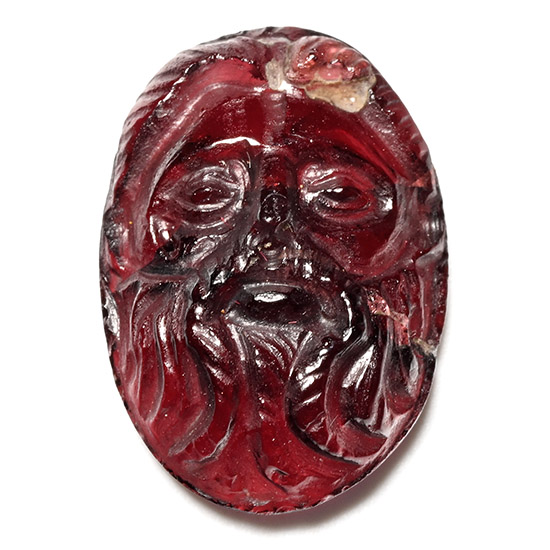
Roman Garnet Cameo of a Philosopher
2nd-3rd century A.D.Estimate: £350 - 450 (+bp*)
Opening Bid: £175
Domed upper face with the head of a mature male with a full beard and a deep frown line between the eyebrows, concave underside. 1.2 grams, 14 mm
UK private collection before 2000. London collection, acquired on the UK art market. -
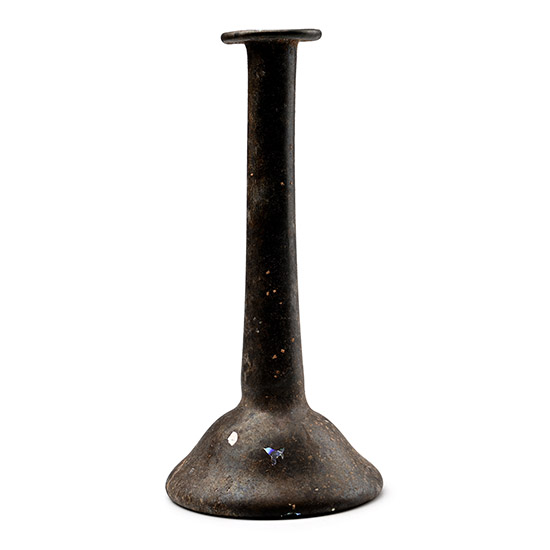
Roman Tall Glass Flask
Circa 1st-4th century A.D.Estimate: £80 - 100 (+bp*)
Opening Bid: £44
Comprising a squat conical body with a dimple at the base, long tubular neck with wide rim. 27 grams, 15 cm
From a London, UK, collection of glass, 1970-2000s. -
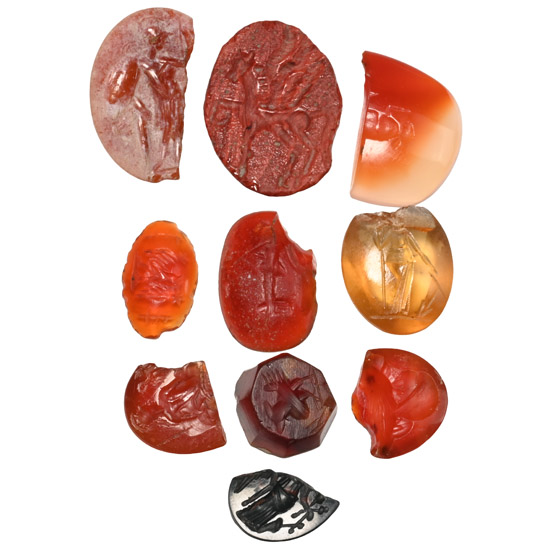
Roman Gemstone Group
2nd-3rd century A.D.Estimate: £150 - 200 (+bp*)
Bids: 1 | Current Bid: £5
Including a warrior with a long shield, a standing figure with a spear, Isis Minerva with cornucopia and rudder and other types; nine supplied with a museum-quality impression. 5.05 grams total, 9-16 mm
From the private collection of a European gentleman (1942-2024), formed since the 1970s. -
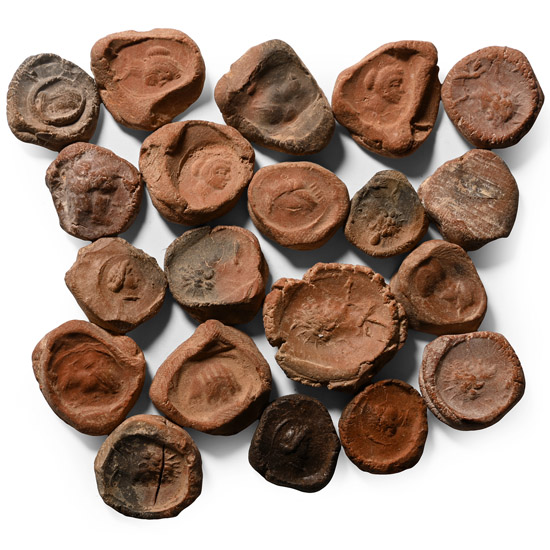
Roman Terracotta Bullae, Tesserae or Token Group
3rd century B.C.-1st century A.D.Estimate: £100 - 140 (+bp*)
Opening Bid: £5
A mixed group of ceramic bullae, tesserae or theatre tokens bearing low-relief motifs, mainly consisting of profile busts of deities. 34.8 grams total, 15-24 mm
From the private collection of a European gentleman (1942-2024), formed since the 1970s.
The term 'tessera' was used in Roman times to convey the Greek term σύμβολον (token). Small tiles are known as tokens, often shaped like coins, made of metal (copper, lead, iron), clay, bone, wood, or glass, stamped as well as engraved. The tokens, however, are not exclusively coin-shaped, as the Latin term 'tessera' refers to a four-sided shape. Tokens and tesserae seem to have been used both in Athens and Rome for the distribution of goods. According to written sources, the term ‘token’ is identified with credentials of the official authorities. They have also been interpreted as tokens of identity, as entrance tickets to theatre performances, tribunals or assemblies of citizens, archival material of seal engraving, as pawns in games, Charon’s obols and even as amulets. -
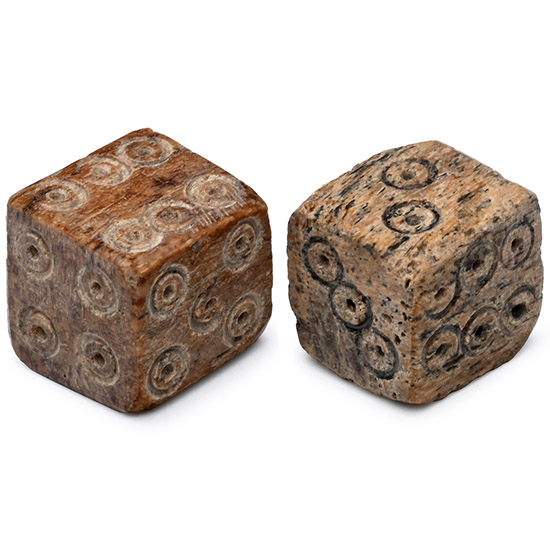
Roman Bone Gaming Dice Pair
1st-4th century A.D.Estimate: £60 - 80 (+bp*)
Bids: 2 | Current Bid: £15
Pair of cuboid gaming dice with ring-and-dot markings disposed 1:6, 2:5, 3:4. 2.9 grams total, 9-10 mm
Ex German art market, 2000s. Acquired from an EU collector living in London. From the collection of a Surrey, UK, gentleman.

