-
.jpg)
Roman Bronze Statuette of Resting Hercules
3rd century A.D.Estimate: £4,000 - 6,000 (+bp*)
Opening Bid: £2,000
Depicted as lar and modelled nude in a standing pose with the right hand resting on the handle of his club, left arms supporting the lionskin mantle; hair cut short and beard textured. 715 grams, 15.5 cm
Acquired on the UK art market, 1990s. Private collection, New York, USA. Accompanied by an academic report by Dr Raffaele D'Amato. This lot has been checked against the Interpol Database of stolen works of art and is accompanied by search certificate number no.13295-255447.
The position of the statuette, belonging to the typology of ‘resting’ Hercules, is unconventional, probably belonging to a more archaic period prototype (Reinach, 1897, p.211,7). By the late 300s or early 200s B.C., the depiction of Hercules wearing the lion's skin over his head had fallen out of favour in Greek art. A worshipper probably placed this statuette in a sanctuary as an offering to the deity, or in his house as a symbol of protection. The majority of small Hercules statuettes are ex-votos, and the donors were possibly herdsmen, considering his function as protector of the flocks. Statuettes of the god found in provinces like Gallia, Britannia, or Pannonia might have appealed to Italic soldiers serving further north and could easily have been carried with them on campaign. -
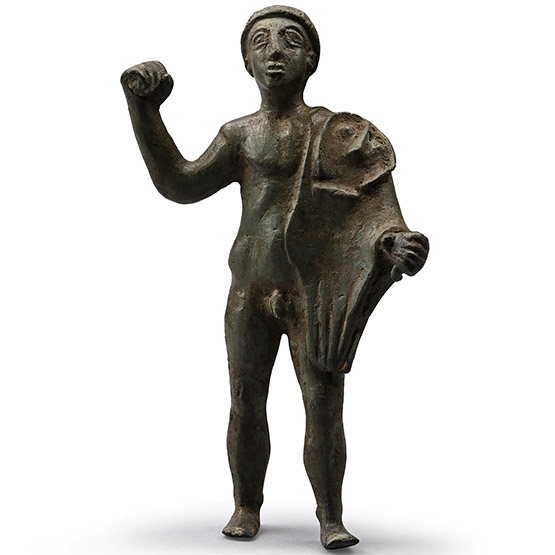
Etrusco-Italic Bronze Figure of Young Hercules
Archaic Style, circa 4th-3rd century B.C.Estimate: £2,500 - 3,500 (‡+bp*)
Opening Bid: £1,250
Modelled in the round figure standing in advancing pose with the right hand raised and fist clenched; left shoulder and arm covered with the skin of the Nemean lion and left hand modelled hollow; hair cut short and textured. 307 grams, 12 cm
Acquired in the mid 1980s-1990s. Private collection, Switzerland, thence by descent. Private collection, since the late 1990s. Accompanied by an academic report by Dr Raffaele D'Amato. This lot has been checked against the Interpol Database of stolen works of art and is accompanied by a search certificate number no.12515-232159.
There were several cult sites of Hercules in Etruria and old Latium, particularly in the Sabellian region, and the bronze statuettes discovered here exhibit a wide range of styles. Etruscan bronzes of the half-god usually represent him with the lion skin draped over his arm (Metropolitan accession number 96.9.419). -
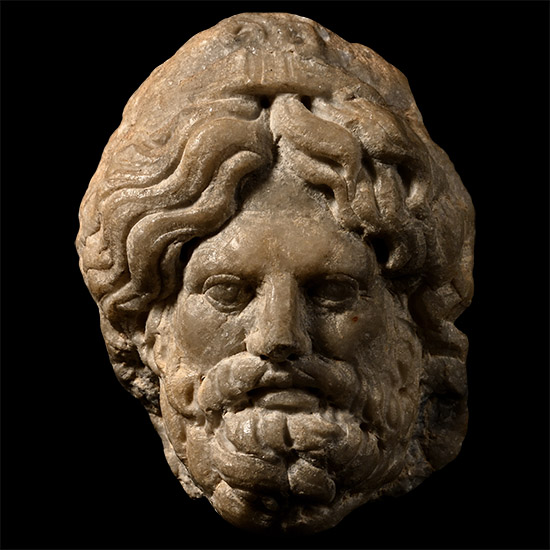
Roman Marble Head of Jupiter
1st-2nd century A.D.Estimate: £1,200 - 1,700 (+bp*)
Bids: 1 | Current Bid: £700
Modelled in the half-round with luxuriant curls to the hair and beard, strong nose and brow with lentoid eyes; undercut modelling to the nose, mouth and hair; large mounting socket to the right side of the brow and smaller beneath the chin. 574 grams, 10.5 cm
The father of Christopher Frederick, a general practitioner based in Brighton, East Sussex, who acquired it prior to 1969. Thence by descent to his son, Christopher Frederick, Brighton, East Sussex. Acquired from the above by the present owner. -
.jpg)
Roman Marble Left Foot from a Sculpture
2nd century A.D.Estimate: £3,000 - 4,000 (+bp*)
Bids: 1 | Current Bid: £3
Comprising an elegantly carved lower part of the calf and foot, a detailed rendering of the toes; the proportions suggesting that the subject was a child or a young woman; mounted on a custom-made display stand. 771 grams total, 15 cm high including stand
Nicolas Koutoulakis (1910-1996), thence by descent. Ex Galerie Dominique Thirion, Brussels, 1990s. Private collection of Mr K.A., France. with Kallos Gallery, London, UK. Accompanied by an academic report by Dr Raffaele D'Amato. This lot has been checked against the Interpol Database of stolen works of art and is accompanied by a search certificate number no.13010-246748.
The foot was a prominent feature on sculptures: more susceptible to weathering and the ravages of time than a head or a torso, the fragments that survive are often badly damaged. It is also possible that this piece belonged to a sculpture created via the acrolith technique, in which the sculptor focused his attention solely on the unclothed parts of the figure, which were made from a more valuable material than the rest of the piece. -
.jpg)
Roman Vessel with Actor's Mask Handle
Early 3rd century A.D.Estimate: £2,000 - 3,000 (‡+bp*)
Opening Bid: £1,000
A squat jar in lead-rich copper-alloy with concentric rings to the base, bulbous body, trefoil mouth with egg-and-dart detailing, strap handle with vine-leaf detailing, actor's mask at the lower end and a lion's head with open mouth at the other. 695 grams, 13.2 cm
Acquired on the Swiss art market, 2001. Private European collection. Accompanied by an academic report by Dr Raffaele D'Amato. This lot has been checked against the Interpol Database of stolen works of art and is accompanied by search certificate number no.12586-232162.
This type of vessel (spouted jugs with trefoil mouth) was part of Roman and provincial bronze instrumentum domesticum, i.e. culinary or domestic utility ware. The typology was assigned by H.U. Nuber to the E type (Millingen type), pieces characterised by a trefoil, highly splayed rim, a short neck and usually a spherical body. -
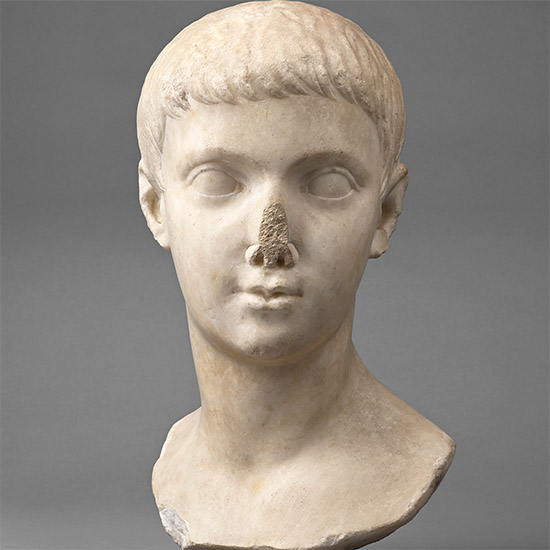
Roman Marble Portrait of Drusus the Younger
13 B.C.-23 A.D.Estimate: £10,000 - 14,000 (+bp*)
Bids: 4 | Current Bid: £9,000
Finely carved bust of Drusus, son of Emperor Tiberius; the hair shaped in a mop of short locks combed forward towards the brow; the features adolescent with soft lips and smooth skin; the nose chipped; mounted on a custom-made stand. 15.15 kg total, 35 cm high including stand
Previously mounted in an 18th-19th century bust. Private collection, Northern England, acquired in the 1980s. This lot has been checked against the Interpol Database of stolen works of art and is accompanied by search certificate number no.13361- 259006.
The facial features of the sculpture reveal the physiognomic characteristics of a Julio-Claudian prince; specifically, Drusus the Younger, supported by comparisons with coin portraits. -
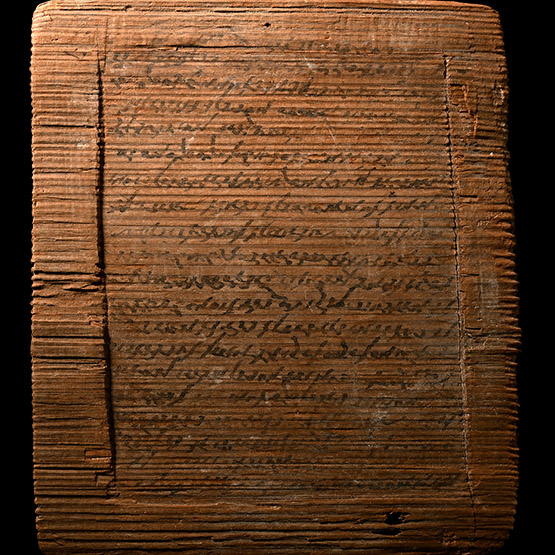
Roman Wooden Tablet with 'Pactum Dotis' Marriage Contract
First half of 4th century A.D.Estimate: £1,500 - 2,000 (+bp*)
Bids: 20 | Current Bid: £950
Rectangular wooden tablet, probably cedarwood, the inner side with a recessed panel inscribed with 20 lines of inked text in Roman cursive script, two small holes, the bigger in the upper rim, the smaller in the centre of the lower rim; the flat outer side inscribed with 14 lines of inked text; in a good state of preservation with signs of age and parts of the text barely visible. 27 grams, 14 x 16.1 cm
Acquired by Albert Sfez in the early 1950s. Formerly the property of Monsieur Alain Sfez, a Belgian collector; acquired by gift from his father, Albert Sfez, in 1965. Acquired by a London dealer in 1973. From an important London collection since 1975; thence by descent. Accompanied by a copy of an illustrated academic report by Professor Dr phil. Peter Rothenhöfer.
Professor Dr Peter Rothenhöfer, Department of History (Zhuhai Campus) states: 'This important tablet shows that its use was apparently not restricted to the administrative sphere but widely spread in civic life and used for private purposes. As handwritten documents from the late 3rd and 4th century AD are quite rare, this tablet is generally of great importance for the history of Latin palaeography. The text is fluently written and shows a uniform typeface. Typical features of ancient writing can be observed: The text is continuously written without any separation between words (scriptio continua), sentences have no dots at the end.' Wax tablets written in Greek or Latin, were used by Romans as account registers (codices accepti et expensi); for transactions (for example, the tablets of the banker Lucius Caecilius Iucundus found in Pompeii); for lists of goods, inventories, and notes to be kept and archived; for Roman magistrates to annotate the salient events of their bureaucratic activities; for writing letters; for drawing up legal texts of various kinds: legacies, declarations of births and citizenship, reports of trials and diplomata militaria. -
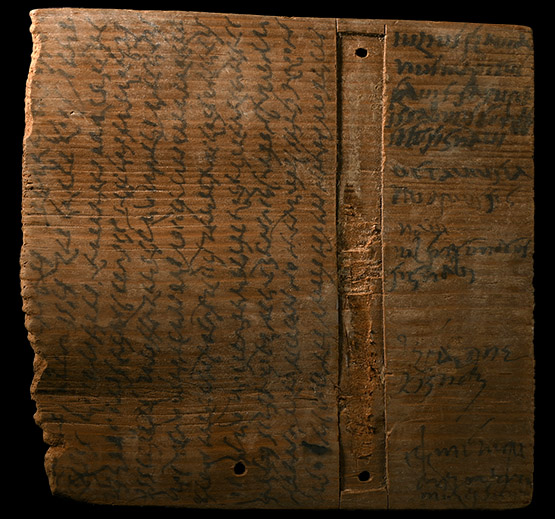
Roman Wooden Tablet with Marriage Pact Between Iulius Flavianus and the Mother of the Bride, Aurelia Salvia
322 A.D.Estimate: £1,500 - 2,000 (+bp*)
Bids: 19 | Current Bid: £950
Rectangular wooden tablet, probably cedarwood, the outer side divided by a sulcus into a smaller part with names of witnesses and a greater part with 11 lines of inked text in Roman cursive script; three small holes near the rim, two in the sulcus, one on the right rim; the inner side with a recessed panel filled with wax with traces of writing; in an excellent state of preservation with signs of age. 24.97 grams, 13.5 x 14 cm
Acquired by Albert Sfez in the early 1950s. Formerly the property of Monsieur Alain Sfez, a Belgium collector; acquired by gift from his father Albert Sfez, in 1965. Acquired by a London dealer in 1973. From an important London collection since 1975; thence by descent. Accompanied by a copy of an illustrated academic report by Professor Dr phil. Peter Rothenhöfer.
Professor Dr Peter Rothenhöfer, Department of History (Zhuhai Campus) states: 'This important tablet shows that its use was apparently not restricted to the administrative sphere but widely spread in civic life and used for private purposes. As handwritten documents from the late 3rd and 4th century AD are quite rare, this tablet is generally of great importance for the history of Latin palaeography. The text is fluently written and shows a uniform typeface. Typical features of ancient writing can be observed: The text is continuously written without any separation between words (scriptio continua), sentences have no dots at the end.' Wax tablets written in Greek or Latin, were used by Romans as account registers (codices accepti et expensi); for transactions (for example, the tablets of the banker Lucius Caecilius Iucundus found in Pompeii); for lists of goods, inventories, and notes to be kept and archived; for Roman magistrates to annotate the salient events of their bureaucratical activities; for writing letters; for drawing up legal texts of various kinds: legacies, declarations of births and citizenship, reports of trials and diplomata militaria; and especially testaments in private civil law. -
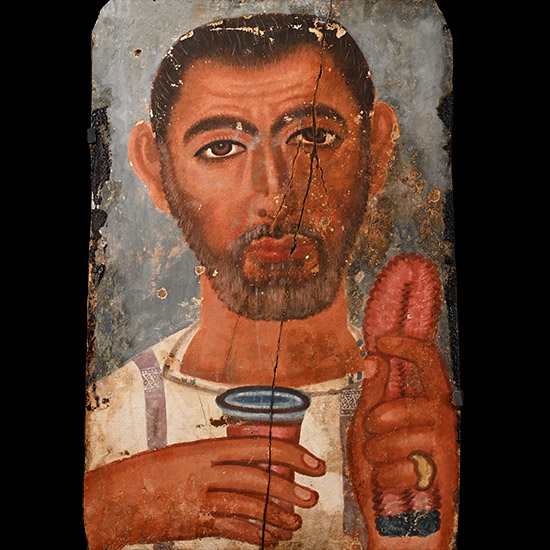
Roman Fayum Wooden Portrait of a Bearded Man
Egypt, 3rd-4th century A.D.Estimate: £18,000 - 24,000 (‡+bp*)
Bids: 1 | Current Bid: £10,000
An intimate portrait depicting a middle-aged man with a slightly doleful expression, receding hair with grey flecks, and a furrowed brow, wearing a white tunic with lilac-coloured clavi (vertical stripes) and white stitching over a white undertunic; holding a glass vessel containing red liquid in his right hand, most probably wine, whilst his left hand cradles a garland of roses, a ring visible on the little finger of his left hand; the figure set against a pale blue background, painted in tempera on a wooden panel; set in a glazed display frame. 8.53 kg total, 50 x 37.5 cm including frame
International art market, by at least 1997. with Sotheby’s, London, 12 June 1997, Western Asiatic Antiquities and Cylinder Seals from the Erlenmeyer Collection (Part II), no.338 (£40,000-£50,000). Private collection of an Italian scholar, New York. Accompanied by a copy of an Art Loss Register certificate no.S00271547. Accompanied by copies of the relevant Sotheby's catalogue pages. This lot has been checked against the Interpol Database of stolen works of art and is accompanied by search certificate number no.13315-257736.
From the late 19th century onwards, a large number of painted wooden portraits began to appear on the European and American art market, originating from the Fayum region of Egypt, to the southwest of Cairo, where wealthy Romano-Egyptian families buried their dead. Following ancient custom, the mummified body was fitted with a painted wood portrait over its face, preserving the likeness of the deceased for eternity. In 1887, over three hundred such portraits were acquired by the Austrian dealer Theodor Graf (1840–1903) from the cemetery of Er-Rubayat, on the northeast side of the Fayum. Portraits from this area are characteristically identifiable by their clipped upper corners and the undertunics worn by the subjects, both features present in this work. During his lifetime, Graf sold ninety of these portraits, with the remainder disposed of by his heirs after his death. Examples from his collection entered many of the world's great institutions, including the Staatliche Museen zu Berlin, the National Gallery, London, and the British Museum, London. Two particularly close comparanda are of note. A portrait of a boy holding a garland and a glass vessel containing liquid, also from Er-Rubayat, is held in the Brooklyn Museum (see The Brooklyn Museum Handbook, Brooklyn, 1967, p. 100). An even closer parallel exists in the J. Paul Getty Museum, Malibu, likewise from Er-Rubayat (see E. Doxiadis, The Mysterious Fayum Portraits: Faces from Ancient Egypt, 1995, p. 221, no. 7; and S. Walker and M. Bierbrier, Ancient Faces: Mummy Portraits from Roman Egypt, exhibition catalogue, London, 1997, p. 102, no. 95). Significantly, the distinguished scholar Dr Klaus Parlasca attributed both the Brooklyn and Getty portraits to a single anonymous master he designated as the Brooklyn Painter, and some years ago suggested that the present portrait may be attributed to the same hand. Should this attribution hold, this work joins a small and distinguished group of panels recognised as the output of one of the most accomplished artists working in Roman Egypt. -
.jpg)
Roman Bronze Pyre on Base Dedicated by Aurelius Rufus
Circa 3rd century A.D.Estimate: £1,000 - 1,400 (+bp*)
Bids: 18 | Current Bid: £750
Model of an altar with tiered flames, separate socle base with flared base and pointillé Greek inscription in two lines: 'AYPHΛ [vine leaf] POYΦΟC THEω ΦΑΛ / [/]AMAE ZAMΕΝΟC ]ANETHEKEN': for 'Aurelius Rufus dedicated this for the god FAL ... The Roman name of the dedicant as well as the letter forms point most probably to the 3rd century A.D. 731 grams, 11.5 cm
Ex collection, before 1980. Private collection, Netherlands. -
.jpg)
Roman Bronze Figure of Hercules with Lion-Skin Headdress
2nd century B.C.Estimate: £700 - 900 (+bp*)
Opening Bid: £350
Depicting Hercules in heroic nudity, standing with his legs slightly apart, the right leg set back and the left, slightly bent, advanced outward; his right arm raised, the forearm bent at a right angle, while the clenched hand originally held a club, now lost; the left arm extending forward and supporting the lion skin; the left hand, also clenched, probably held a further attribute; the stylised lion skin draped over the hero's head, terminating in two pointed flaps at either side, and fastened across the chest with the so-called 'Heracles knot', beneath which the forepaws of the lion are rendered with deeply incised claw; accompanied by a display stand. 443 grams total, 14 cm including stand
The surface retains a thick, undisturbed green patina. Minor losses are present and may plausibly be interpreted as the result of ritual damage in antiquity.
Acquired in Germany before 2000s. English private collection. Bertolami Fine Art, London, Auction 85, 14 December 2020, no.11. This lot has been checked against the Carabinieri Database of stolen works of art.
The sculpture reproduces the iconographic type of the charging Hercules, a motif widely attested in ancient Italy, particularly in the Umbro-Sabellian region, and ultimately derived from the Magna Graecia artistic tradition. The widespread adoption of this iconographic scheme, repeated with only minor variations, reflects the development of local cults dedicated to the hero, who was at times assimilated to indigenous deities. It has also been suggested that this type ultimately derives from a bronze original identified as the Herakles Alexikakos, attributed to the Argive sculptor Hageladas, active between the late 6th and early 5th century B.C. -
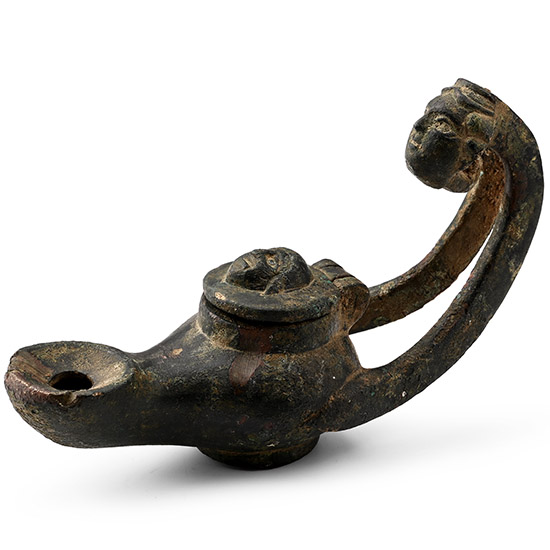
Roman Bronze Oil Lamp with Masks
1st-2nd century A.D.Estimate: £1,000 - 1,400 (+bp*)
Bids: 4 | Current Bid: £800
With an elongated body, long nozzle with a rounded tip; raised rim to filling hole with hinged lid bearing a mask with sockets to the eyes for silver inserts; handle curved and terminating in a female mask with hair dressed in tiers, eyes recessed to be inlaid with silver; broad nozzle with cup and raised rim; socket to underside for mounting on a stand. 560 grams, 15.5 cm
From the collection of a gentleman, acquired on the London art market in the 1990s.
The lamp is crafted in a very fine style, probably in a classical form from the 1st or 2nd century. It belongs to a type known and widespread in the Mediterranean, with parallels in Paris, Madrid, the museums of Cadiz, Tarragona, and Aquileia.

