-
.jpg)
Roman Carnelian Gemstone Collection with Jupiter Effigies
1st century B.C.Estimate: £500 - 700 (+bp*)
Opening Bid: £250
Comprising three oval intaglios, one with a domed base and each featuring a profile bust, one wearing a modius and one wearing a laurel wreath; supplied with museum-quality impressions. 1.08 grams total, 9-14 mm
UK private collection, acquired on the English market in the 2000s. -
.jpg)
Roman Imperial and Sasanian Carved Nicolo Gemstone Collection
2nd-5th century A.D.Estimate: £1,200 - 1,700 (+bp*)
Opening Bid: £625
Comprising seven oval intaglios with various motifs, including a winged horse, an Italic female profile bust, a zebu, a winged lion(?), a standing eagle, an advancing figure carrying an animal, a satyr or a man with lagobolon and grapebunch; supplied with a museum-quality impression. 3.8 grams total, 8-12 mm
UK private collection, acquired on the English market in the 2000s. -
.jpg)
Roman Garnet Cameo of Eros the Greek God of Love
1st century A.D. or laterEstimate: £700 - 900 (+bp*)
Opening Bid: £350
Discoid in plan with a high-relief plastic head of Cupid (Greek Eros). 0.42 grams, 8 mm
Private English collection, formed between the late 1970s and early 1990s. Private collection, London, UK.
The finely engraved head on the cameo represents a young child, probably intended as Eros (Cupid). Such depictions were produced in numerous variations to illustrate the stages of childhood and the capacity of children to undertake meaningful or symbolic actions. The high relief type appears to have been especially popular and was probably derived from metalwork, like the plaster medallion from Begram, Afghanistan. -
.jpg)
Large Roman Carnelian Gemstone with Hercules
1st-2nd century A.D.Estimate: £400 - 600 (+bp*)
Bids: 3 | Current Bid: £11
Ellipsoid type with incuse design of Hercules standing under the tree of Hesperides, holding one of the apples; repaired; supplied with a museum-quality impression. 3.2 grams, 25 mm
From the private collection of a European gentleman (1942-2024), formed since the 1970s. -
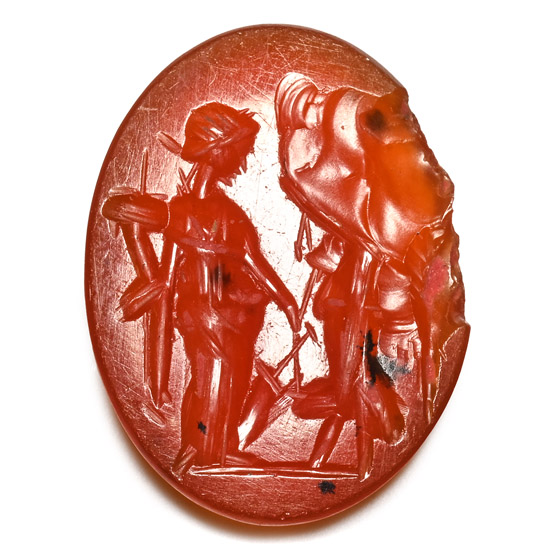
Roman Carnelian Gemstone with Goddesses
1st-2nd century A.D.Estimate: £300 - 400 (+bp*)
Bids: 3 | Current Bid: £15
Tabular type with incuse design of Fortuna standing with a cornucopia and rudder, goddess Victory before her holding tainia, the tips of her wings visible; edge chipped; supplied with a museum-quality impression. 1.02 grams, 17 mm
From the private collection of a European gentleman (1942-2024), formed since the 1970s.
A group of carnelian intaglios found in the Snettisham Hoard, Norfolk, comprised subjects like Fortuna, Diana, Spes, a modius with corn, a bird and a dolphin, from the mid-2nd century A.D. -
.jpg)
Roman Carnelian Onyx Gemstone with Hermes
2nd century A.D.Estimate: £500 - 700 (+bp*)
Opening Bid: £250
Domed body layered horizontally, an engraved figure of standing Hermes facing right, wearing a petasos and holding a caduceus. 2.44 grams, 16 mm
Old French collection, 1980s. UK private collection, acquired in the French art market. -
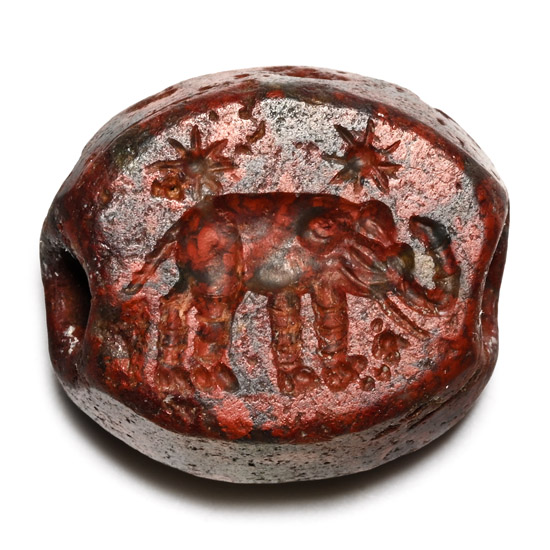
Roman Red Variegated Gemstone with Elephant
3rd century A.D.Estimate: £600 - 800 (+bp*)
Bids: 4 | Current Bid: £55
Scaraboid type with incuse design to the underside of an elephant with stars above; supplied with a museum-quality impression. 3.04 grams, 17 mm
From the private collection of a European gentleman (1942-2024), formed since the 1970s.
The Romans first encountered elephants in Pyrrhos' army, and the representation of elephants in Roman art begins from this period. Victorious emperors like Caesar and Vespasian celebrated elephants on their coins. Apart from the celebration of elephants as ‘war machines’, the image of elephants was linked to other aspects in the Roman Imperial Period. Before becoming emperor, Elagabalus was one of the priests of Helios-Sun worship in Emesa. He had elephant depictions on his coins during his reign. The elephants raise their heads to the sun when the sun rises. Thus, the sun is represented on the gemstone together with the elephant. -
.jpg)
Roman Bronze Marriage Mirror with Facing Busts and Inscription
Circa 4th century A.D.Estimate: £400 - 600 (+bp*)
Bids: 3 | Current Bid: £440
Discoid in plan with a beaded rim and concentric rings; at the centre, two draped busts, a male and a female, with faint remains of inscription surrounding; the other side polished and tinned. 130 grams, 91 mm
UK private collection before 2000. London collection, acquired on the UK art market.
The image on the back of the mirror depicts an imperial couple from the 4th century. The type of diadem worn by the male figure, clad in a paludamentum and cuirass, and the man's profile suggest a depiction of Constantine and Fausta, or of Constantine and his mother Helena. -
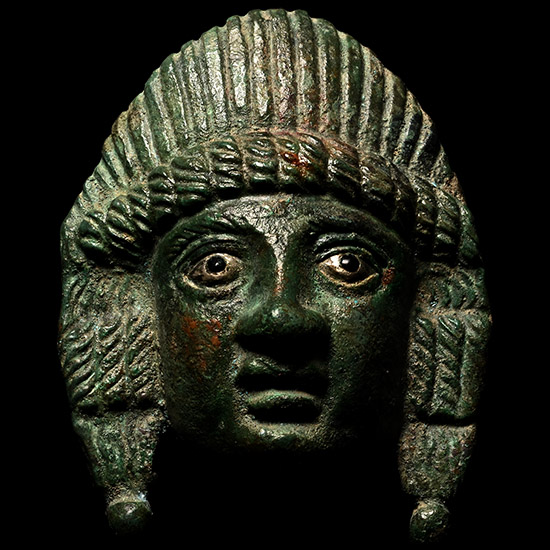
Roman Bronze Theatrical Mask Mount
2nd-4th century A.D.Estimate: £500 - 700 (+bp*)
Opening Bid: £250
Modelled in the half-round with large eyes and hair arranged in orderly curls, applied silver panels to the eyes and enamel pupils. 57.3 grams, 64 mm
Ex German art market, 2000s. Acquired from an EU collector living in London. From the collection of a Surrey, UK, gentleman. -
.jpg)
Roman Bronze Head of an Emperor
2nd century A.D.Estimate: £800 - 1,000 (‡+bp*)
Opening Bid: £444
Hollow-formed with long neck, abundant thick hair and beard, broad mouth; probably intended to represent an emperor. 440 grams, 10 cm
Acquired by a Swiss family in the mid-1980s to late 1990s, thence by descent. Private collection, Switzerland, since the late 1990s.
The portrait seems to be a provincial bronze representing Hadrian, apparently aged around 30, recognisable from his incipient beard, moustache and distinctive physiognomy. However, the portrait is in an extremely provincial style, exemplified by the wide spacing of the eyes. The beard is lightly incised, and the highly stylised curls around the front of the head give way to simple incised locks on the back. -
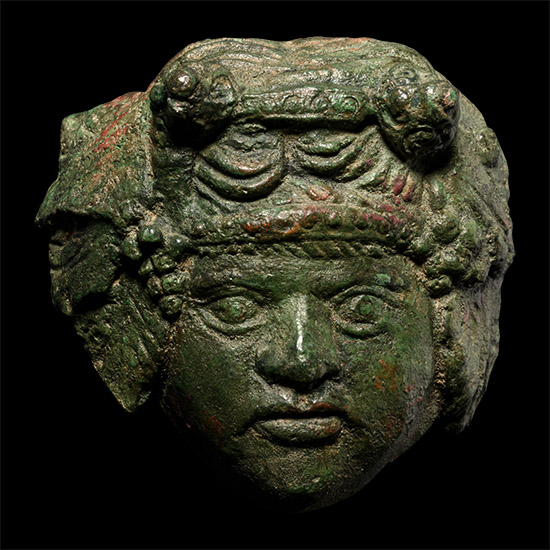
Roman Bronze Head of Dionysus Mount
1st-2nd century A.D.Estimate: £400 - 600 (+bp*)
Bids: 4 | Current Bid: £360
Large convex mount depicting the head of the god of wine, shown facing with rounded cheeks and staring eyes, large vine leaves with bunches of grapes framing his face; ferrous spike on the reverse. 103 grams, 61 mm
Ex German art market, 2000s. Acquired from an EU collector living in London. From the collection of a Surrey, UK, gentleman. -
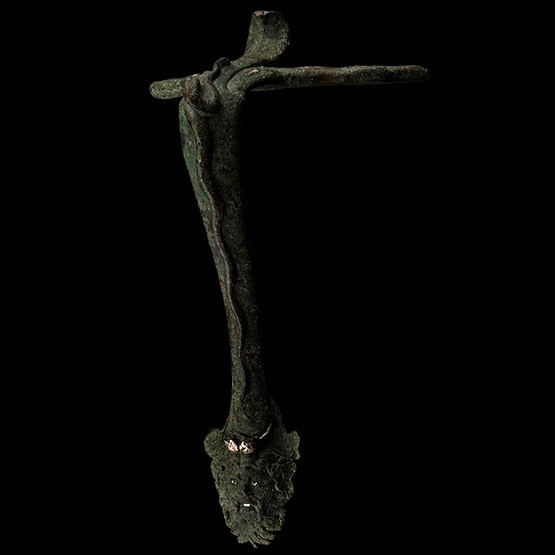
Roman Bronze Vessel Handle with Face
1st century A.D.Estimate: £1,500 - 2,000 (‡+bp*)
Opening Bid: £833
Swept in profile, comprising a horizontal crescentic panel to attach to the rim, with inlaid silver detailing, recurved cobra-shaped thumb pad, raised serpent to the outer face of the tapering handle, finial a mask of Bacchus or Pan, facing with volute scrolls to the brow and thick splayed beard; silver diadem and eyes. 110 grams, 14.2 cm
Private collection. with Christie's, London, 11 June 1997, no.97 (part). with Bonhams, 13 April 2000, no.198. Private collection, Europe. Accompanied by copies of the relevant Christie's and Bonhams catalogue pages. Accompanied by a copy of an Art Loss Register certificate. This lot has been checked against the Interpol Database of stolen works of art and is accompanied by a search certificate number no.12529-232161.
These handles, which formed a leafy plant element and an S- or T-shaped animal at the top, were usually attached to the belly of the bronze vessel by a human head. In our example, the broad head of the mask, with its broad moustache and beard, characterised by abundant hair, seems to hark back to the iconography of the Sileni or Pan.

