-
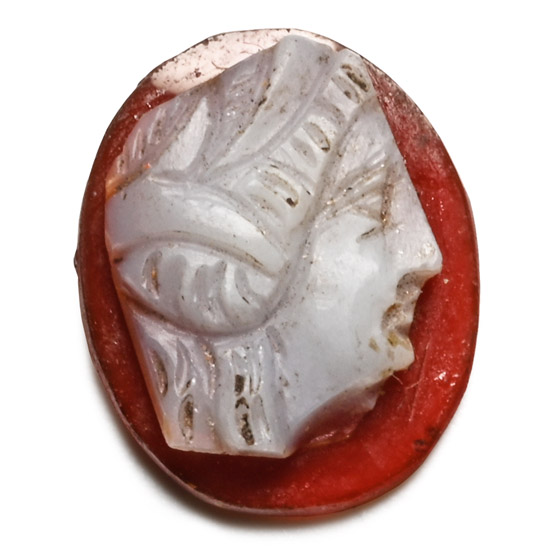
Roman Agate Cameo with Bust of an Empress
Circa 2nd century A.D.Estimate: £300 - 400 (+bp*)
Bids: 3 | Current Bid: £11
An oval gemstone showing a female facing right. 0.26 grams, 9 mm
From the private collection of a European gentleman (1942-2024), formed since the 1970s. -
.jpg)
Roman Carnelian Gemstone with Sol and Greek Inscription
1st century A.D.Estimate: £800 - 1,000 (+bp*)
Bids: 2 | Current Bid: £450
Domed base, featuring a standing god Sol (Greek Helios) wearing a radiate crown and muscled cuirass, his left arm raised and the right hand holding a long whip, Greek inscription 'ΦλλNOY' = gem belonging to a man named Phaanos = 'the radiant one, the shining one ', creating a play-of-words between the owner's name and the solar deity. 1.24 grams, 16 mm
Private collection, UK. UK private collection, acquired on the English art market in the 2000s. -
.jpg)
Roman Carnelian Intaglio with Head of Bacchante
Late 1st century B.C.-early 1st century A.D.Estimate: £500 - 700 (+bp*)
Opening Bid: £250
Translucent oval intaglio with a profile bust wearing an ivy-leaf wreath. 0.91 grams, 15 mm
Ex private French collection of Mr M., 1980s. UK private collection, acquired in London art market in the 2000s. -
.jpg)
Roman Glass Cameo with a Julio-Claudian Prince, Possibly Drusus
1st century A.D.Estimate: £600 - 800 (+bp*)
Bids: 2 | Current Bid: £450
Featuring a vibrant green-blue base with a white frontal bust of a young male with his head turned slightly to the right, big eyes and a small mouth. 1.6 grams, 18 mm
UK private collection, acquired on the French art market in the 2000s.
Although the portrait is partially damaged, its style and composition are Augustan. Based on its resemblance to the portrait of Agrippa—though appearing more youthful—it could represent one of his sons, Gaius or Lucius Caesar. -
.jpg)
Roman White Chalcedony Cameo of a Theatrical Mask
1st century A.D.Estimate: £1,000 - 1,400 (+bp*)
Opening Bid: £500
Showing a New Comedy, 'Cook' type theatre mask with an open mouth; supplied with a museum-quality impression. 1.07 grams, 13 mm
Private English collection, formed between the late 1970s and early 1990s. Private collection, London, UK.
Miniature models of theatrical masks were mass-produced in the ancient world, and can be linked with the Dionysiac mysteries, in association with funeral rites, illustrating the Dionysiac thiasos, the orgiastic world of satyrs and maenads. However, they can also be miniature models of masks linked with highbrow Sophoclean and Euripidean tragedy, or with so-called Middle Comedy, which now only survives in fragments. -
.jpg)
Roman Agate Cameo with Devouring Hound
Circa 1st-2nd century A.D.Estimate: £300 - 400 (+bp*)
Bids: 6 | Current Bid: £30
Black-and-white cameo featuring a raised image of a hunting dog devouring a hare with its long ears pulled against the neck, detailed ribs and claws on the back paw. 0.81 grams, 15 mm
From the private collection of a European gentleman (1942-2024), formed since the 1970s. -
.jpg)
Roman Sapphire Cameo with Bust of Serapis Later Converted to Saint John the Evangelist
Circa 2nd-3rd century A.D., reworked 6th-7th century A.D.Estimate: £3,000 - 4,000 (+bp*)
Bids: 3 | Current Bid: £700
Carved in the half-round on a sapphire crystal showing striations on the reverse, depicting the upper body of Serapis/St John with modius and pleated tunic, eagle with spread wings placed on the chest. 5.06 grams, 23 mm
Acquired circa 1980. Property of a Middlesex gentleman. This lot has been checked against the Interpol Database of stolen works of art and is accompanied by search certificate number no.13351-255640.
This is a prime example of late antique or early medieval spolia, where a pagan motif was converted into a Christian one with minimal mental or manual adaptation into a visual fusion of Serapis and Saint John. During the Roman Empire, especially in the 2nd and 3rd centuries AD, depictions of the 'bust of the God Serapis standing on an eagle' were extremely popular. The eagle symbolised Jupiter-Serapis, as well as Roman power. When the Empire became Christian, this combination was immediately recognised as the Evangelist John, accompanied by his symbol, the eagle. The modius (kalathos) symbolised fertility and dominion over the underworld when placed on Serapis's head. However, it was often incorrectly (or deliberately) interpreted by Christian observers as an early form of a crown, halo, or priestly headdress. As sapphire is extremely difficult to work with, the modius was often left standing, emphasising the figure's imperial or divine dignity. There are documented cases of this kind. Most famous example: 'Gem of Serapis' (Cab. Méd., Paris), or the reinterpretation of depictions of Jupiter as God the Father. During the Christianisation process, pagan gods with beards and eagles (Jupiter/Serapis) were reclassified as John the Evangelist or Christ himself en masse. -
.jpg)
Roman Red Jasper Magical Stomach Amulet with Hercules Fighting a Lion
2nd-3rd century A.D.Estimate: £600 - 800 (+bp*)
Bids: 7 | Current Bid: £55
Bifacial type with incuse design on one side of a Hercules fighting the Nemean lion, club adjacent, and on the other face two columns of angular characters including 'KKK'; supplied with a museum-quality impression. 1.06 grams, 16 mm
From the private collection of a European gentleman (1942-2024), formed since the 1970s. -
.jpg)
Agate Cameo with a Portrait of a Hellenistic Ruler
1st century B.C.Estimate: £2,000 - 3,000 (+bp*)
Opening Bid: £1,000
Detailed bust of a man with his curly hair secured by tainia with the ends hanging behind his neck, aquiline nose and prominent chin, tryphe still visible. 0.75 grams, 17 mm
Formerly in a private collection of an European lady, 1970s-1980s. Private collection, UK. This lot has been checked against the Interpol Database of stolen works of art and is accompanied by search certificate number no.13306-257801 -
.jpg)
Roman Agate Cameo with a Julio-Claudian Portrait of an Emperor
1st century B.C.-1st century A.D.Estimate: £1,000 - 1,400 (+bp*)
Opening Bid: £500
Oval cameo with a profile bust facing left, a laurel crown resting on his close-cropped hair; in the background, a second portrait visible 'capita iugata'. 2.5 grams, 20 mm
UK private collection, acquired on the English art market in the 2000s. -
.jpg)
Roman Sapphire Gemstone with Crescent Moon and Star
Third quarter of 1st century B.C.Estimate: £2,500 - 3,500 (+bp*)
Opening Bid: £1,250
Cushion-shaped greenish-blue intaglio engraved with a large crescent moon and star. 1.05 grams, 10 mm
Formerly in a private collection of an European lady, 1970s-1980s. Private collection, UK. This lot has been checked against the Interpol Database of stolen works of art and is accompanied by search certificate number no.13305-257800.
Basaltic sapphires used by the Romans came from surface deposits in northern Ethiopia, which were already known and productive in ancient times. This hypothesis is supported by comments by Pliny the Elder (23–79 A.D.) and Solinus (early 3rd century A.D.), both of whom referred to gems from Ethiopia named ‘hyacintos’, which is generally accepted in archaeology to be the ancient name of sapphire. The moon and stars have been, since the 4th century BC, symbols of the city of Byzantium and were also linked with Spartan military culture. -
.jpg)
Roman Garnet Gemstone with Portrait
Late 5th century A.D.Estimate: £500 - 700 (+bp*)
Bids: 1 | Current Bid: £5
Ellipsoid type with dished underside, incuse-facing portrait bust, from a Constantinople garnet workshop. 1.22 grams, 14 mm
From the private collection of a European gentleman (1942-2024), formed since the 1970s.

