-
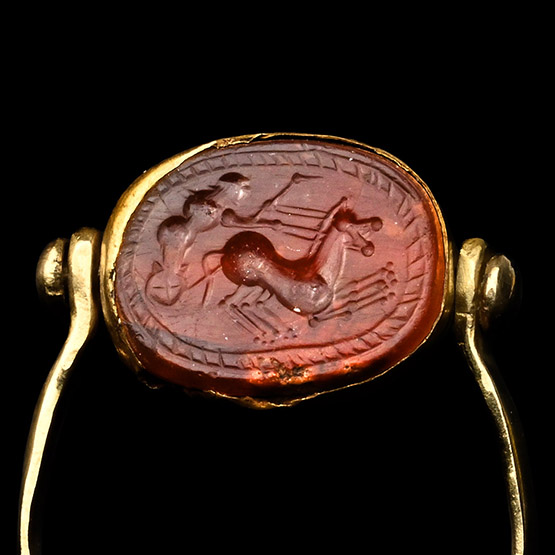
Etruscan Carnelian Scarab of a Charioteer in Gold Ring
Late 4th century B.C.Estimate: £2,500 - 3,500 (+bp*)
Opening Bid: £1,250
Opaque scaraboid engraved in globolo style with a dynamic scene of a charioteer driving a biga with his whip raised; set in a later sheet-gold mount and swivel ring, possibly 19th century; supplied with a museum-quality impression. 4.26 grams, 25.07 mm overall, 17.77 x 16.22 mm internal diameter (approximate size British O, USA 7, Europe 14.98, Japan 14)
Private English collection, formed between the late 1970s and early 1990s. Private collection, UK. This lot has been checked against the Interpol Database of stolen works of art and is accompanied by search certificate number no.12948-245985.
In line with trends introduced from the Eastern Mediterranean increasing use was made by the Etruscans of war chariots, even more luxurious in appearance and faced with embossed sheets of bronze. In addition to transporting warriors, they proved an effective means of controlling outlying areas, and in case were status symbols of great prestige. The Orientalizing period also saw the importation of swift and nimble breeds that were particularly suited for use as cavalry mounts. -
.jpg)
Etruscan Carnelian Scarab of a Fletcher in Gold Ring
Late 4th-3rd century B.C.Estimate: £1,000 - 1,400 (+bp*)
Opening Bid: £500
With carapace detailing and intaglio of a crouching male carving an arrow, set within a dotted border; set into a later gold swivel ring. 4.24 grams, 27.12 mm overall, 18.38 x 18.49 mm internal diameter (approximate size British P 1/2, USA 7 3/4, Europe 16.86, Japan 16)
Private collection, Europe. Acquired on the English art market. -
.jpg)
Etruscan Carnelian Scarab with Bust of a Warrior in Later Victorian Gold Brooch
5th-4th century B.C. and laterEstimate: £2,000 - 3,000 (+bp*)
Bids: 1 | Current Bid: £1,000
The scarab with anatomical detailing on the carapace, underside with a profile bust of a helmetted warrior; set in a later brooch frame with swivel mount for the scarab. 10.35 grams, 55 mm
Acquired on the European art market. This lot has been checked against the Interpol Database of stolen works of art and is accompanied by search certificate number no.13358- 257891.
Egyptian-style scarabs and scaraboids were characteristic of Etruscan art from the 8th century B.C. Originally made in Phoenicia, Cyprus or Rhodes, these objects were made of faience, blue paste, glass paste, bone, or semi-precious stones of varying hardness, from steatite to quartz, onyx and jasper. Mounted in settings on revolving pendants of precious metal, later imitated by Etruscan goldsmiths, these Egyptianising items performed prophylactic-religious functions. -
.jpg)
'The Mildenberg' Greek Gold Bull's Head Pendant
Circa 4th century B.C.Estimate: £3,000 - 4,000 (+bp*)
Bids: 1 | Current Bid: £2,000
Hollow-formed in sheet gold with finely modelled details and applied granulated wreath between its horns; attachment hole to the rear of the head. 3.05 grams, 21 mm
Christie's, London, 'A Peaceable Kingdom: The Leo Mildenberg Collection', 27 October 2004, no.102. This lot has been checked against the Interpol Database of stolen works of art and is accompanied by search certificate number no.13359- 259201.
In many Greek sanctuaries, large numbers of bull figures of different sizes have been found, which must be regarded as representatives of actual sacrificial offerings. Many of them come from the venerable Sanctuary of Zeus at Dodona, with whom the bull has a special relationship. -
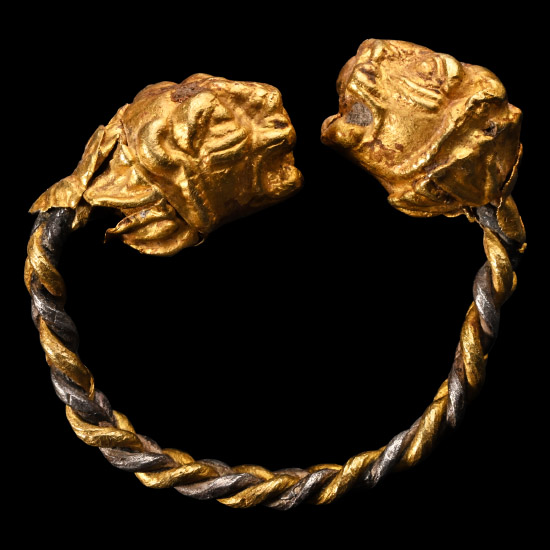
Greek Gold Lion Head Ring with Plaited Band
3rd century B.C. and laterEstimate: £800 - 1,000 (+bp*)
Opening Bid: £400
Formed as a plaited band of gold and silver rods, the finials formed as large lion heads with gaping jaws, a rosette with a rivet behind the neck; possibly a marriage. 8.43 grams, 32 mm
Acquired in London, 1979. -
.jpg)
Greek Carnelian Bead with Gold End Caps
Hellenistic, 1st century B.C.-1st century A.D.Estimate: £600 - 800 (‡+bp*)
Opening Bid: £333
Columnar bead with sheet-gold cap to each end, each with beaded circlets and applied granule clusters, domed end with loop; possibly assembled. 17.44 grams, 60 mm
Acquired in the mid 1980s-1990s. Private collection, Switzerland, thence by descent. Private collection, since the late 1990s.
The very elaborate versions of earrings with large domes and pendants composed of clusters of hollow spheres and granulation are most typically Romano-Syrian, but they begin to be produced in the Late Hellenistic Age. They were diffused in the Levant, Egypt and on the frontier area between the Roman and the Arsacid Empire. -
.jpg)
Greek Gold Bead Collection
4th-3rd century B.C.Estimate: £1,200 - 1,700 (‡+bp*)
Opening Bid: £600
A collection of necklace pendants and dress appliques comprising: a hollow bead with a truncated conical shape, featuring appliques for precious stone inserts; three studs with a hemispherical dome; a pair of appliques decorated with rosette and mask-shaped elements; a pendant in the form of a myrtle berry, and another fragment. 11.19 grams total, 10-31 mm
Acquired by a Swiss family in the mid-1980s to late 1990s, thence by descent. Private collection, Switzerland, since the late 1990s. This lot has been checked against the Interpol Database of stolen works of art and is accompanied by a search certificate number no.13023-246772.
The iconography of Hellenistic jewellery often incorporates vegetal motifs, reflecting the Greek value of fertility. With its heavy incorporation of plant motifs, including tendrils, blossoms, and a bursting pomegranate, the diadem design symbolises a woman’s reproductive potential and alludes to the female wearer’s social responsibility to produce offspring. -
.jpg)
Etruscan Amber Head Pendant
Etruria, 5th century B.C.Estimate: £1,800 - 2,400 (+bp*)
Bids: 4 | Current Bid: £1,600
Carved from translucent red-brown amber as a profile head with stylised Archaic features, large almond eye beneath a defined brow ridge, a softly smiling mouth, and carefully delineated hair arranged in striated bands sweeping back from the face; a drilled perforation at the crown indicates its original function as a suspended ornament; accompanied by a display stand. 23 grams, 50 mm (242 grams total, 81 mm including stand)
Sotheby's, London, 14-15 December 1981, no.206. American private collection; acquired at the above sale. This lot has been checked against the Interpol Database of stolen works of art and is accompanied by search certificate number no.13329-257968.
Amber was a prestigious imported material in Etruria, highly prized for its rarity, colour, and perceived apotropaic power. From the late 6th century B.C. onwards, figured amber pendants appear in elite tombs, particularly those of women, reflecting both personal identity and a protective role within funerary belief systems. The prominent, wide-open eye here may have served as a talismanic motif, thought to ward off malign forces and ensure the wearer’s vigilance and well-being in life and beyond the grave. This piece reflects the distinctive aesthetic of Etruscan amber carving, in which Mediterranean influences are reinterpreted with a locally expressive sculptural style. -
.jpg)
Eastern Greek Carnelian Scaraboid Gemstone with Nude Hero Holding Lions
6th-5th century B.C. or laterEstimate: £800 - 1,000 (+bp*)
Bids: 4 | Current Bid: £25
Scaraboid type with incuse design to the underside of a nude hero facing, holding one lion by the neck and another by the hind leg; supplied with a museum-quality impression. 4.25 grams, 19 mm
From the private collection of a European gentleman (1942-2024), formed since the 1970s.
The gem could be considered a representation of Heracles, even if the iconography is unusual, and is influenced by the Mesopotamian environment, from where it borrows the frontal image of the hero (Gilgamesh or Enkidu) fighting with two beasts. The hero is beardless and holding an inverted lion. He is acting like a master of the animals, showing eastern traits reminiscent of Graeco-Phoenician art. In the Phoenician tradition, a similar image of the god Bes, holding two lions, as posis theron (‘Master of the Animals’), is common. The type is more frequent in the Eastern Mediterranean than in the West and is found on scarabs in carnelian and chalcedony. -
.jpg)
Greek Carnelian Onyx Gemstone with Horseman
1st century B.C.Estimate: £800 - 1,000 (+bp*)
Bids: 3 | Current Bid: £15
Plano-convex 'eye' type with incuse design to the upper face of a huntsman on a rearing horse attacking a lion; supplied with a museum-quality impression. 4.14 grams, 17 mm
From the private collection of a European gentleman (1942-2024), formed since the 1970s. -
.jpg)
Etruscan Variegated Agate Scaraboid Gemstone with Dancing Satyrs
4th century B.C.Estimate: £500 - 700 (+bp*)
Bids: 4 | Current Bid: £13
Scaraboid type with incuse design to the underside of two opposed dancing satyrs, heads and arms missing, possibly unfinished or cut down from a depiction of a lion and hero; supplied with a museum-quality impression. 2.75 grams, 17 mm
From the private collection of a European gentleman (1942-2024), formed since the 1970s. -
.jpg)
Etruscan Agate Talismanic Scarab
Late 4th-early 3rd century B.C.Estimate: £500 - 700 (+bp*)
Opening Bid: £250
Carved from banded orange agate and formed as a flattened scarab with a striated carapace, pierced for suspension. 3.53 grams, 18 mm
UK private collection, acquired on the English market in the 2000s.
The shape of an Etruscan scarab includes: (1) the scarab gem, where the engraving of the curved back of the stone more or less faithfully imitates the anatomical parts of the scarab beetle; (2) the scaraboid, which retains the overall shape of the scarab gem but with little or no engraving on the curved backside; and (3) the pseudo-scarab, which has an image carved in relief on its curved backside instead of a beetle. All three types have a flat, oval underside which carries an engraved miniature image (device) within a decorated border which is usually hatched.

