-
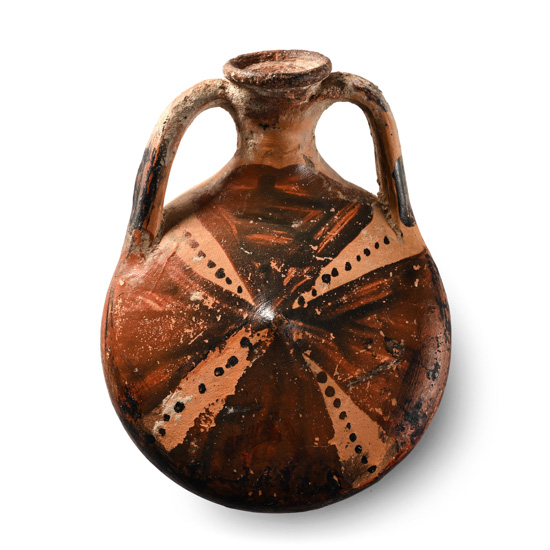
Mycenaean Painted Pottery Flask
14th-13th century B.C.Estimate: £1,200 - 1,700 (‡+bp*)
Bids: 1 | Current Bid: £1,080
Comprising a circular body with a rounded base and two strap handles, a short neck with an everted rim; the body with a painted expanding cross motif with the arms separated by a band of pellets. 132 grams, 11.1 cm
Private collection, Switzerland, acquired in the 1994. Private family collection since the late 1990s. Accompanied by an academic report by Dr Raffaele D'Amato. This lot has been checked against the Interpol Database of stolen works of art and is accompanied by search certificate number no.13018-246795.
Mycenaean ceramics were influenced by Minoan shapes and decorative styles from the late Middle Helladic period. This close relationship – likely accompanied by the development of shared cultural practices and etiquette – creates the hypothesis that pilgrim flasks were introduced to Greece via Crete. Pilgrim flasks were produced in Mycenaean contexts from the Late Helladic IIA:1 period (1420-1390 B.C.). -
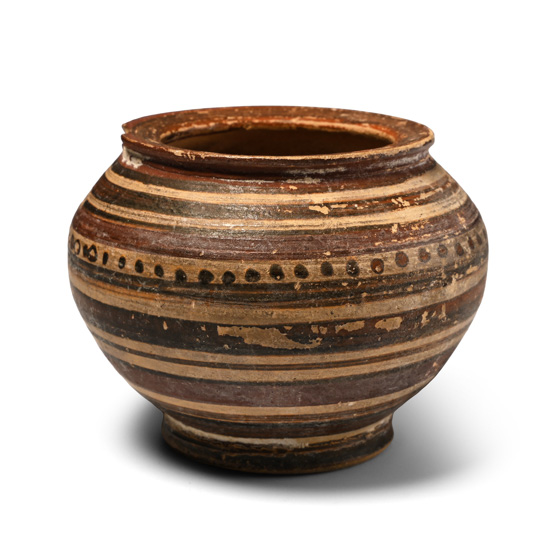
Phoenician Bowl with Crimson and Black Decorations
4th century B.C.Estimate: £800 - 1,000 (‡+bp*)
Opening Bid: £444
With a narrow basal ring, a flared rim, and painted circumferential bands. 49.2 grams, 63 mm
Private collection, Los Angeles, USA. Acquired on the American art market. European private collection.
Similar pottery has been found in the Phoenician necropolis of Villaricos near Madrid (tomb 1082), although undecorated. The pottery seems to be of Iberian-Phoenician style, being bowls of similar type and decorated found also in the necropolis of Tutugi, Galera, Granada, Andalusia. -
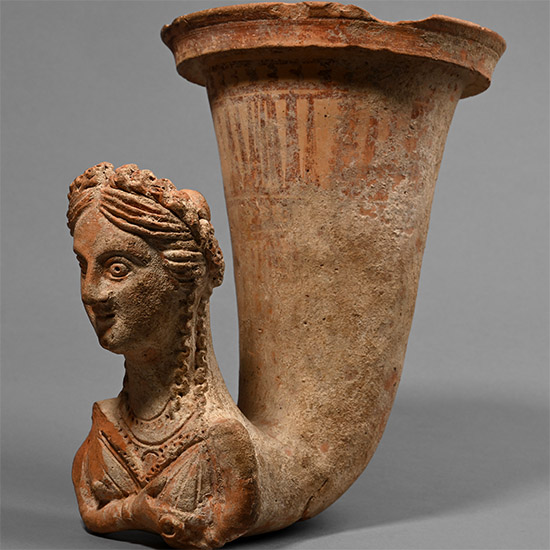
Greek Terracotta Rhyton of a Goddess
3rd-2nd century B.C.Estimate: £5,000 - 7,000 (+bp*)
Bids: 3 | Current Bid: £4,000
With flanged and stepped rim, tapering curved body, figural finial of the goddess with diadem; bands of red and cream geometric detail to the rim and upper body, red wave patterns to the inner face; the goddess modelled with carefully dressed hair and floral diadem, ringlets cascading to her collar bone, alert facial expression with almond-shaped eyes and prominent nose, with C-shaped billetted collar and chiton, cupping her left breast in her right hand; mounted on a custom-made stand. 1.25 kg, 24 cm
Private collection, London, UK; formed 1970s-1980s. Accompanied by an academic report by Dr Raffaele D’Amato. This lot has been checked against the Interpol Database of stolen works of art and is accompanied by search certificate number no.13312-258233.
It is challenging to identify the divinity represented on our vessel: it can be associated with Ariadne, wife of the god Dionysus, but also with a Parthian goddess such as Anahita. She was a Zoroastrian goddess associated with water, fertility, and wisdom, widely venerated across the Parthian Empire and often invoked alongside Ahura Mazda in royal and religious inscriptions. Rhyta in her likeness, typically terminating in a zoomorphic or divine protome, were used as ceremonial drinking vessels, reflecting Anahita's close association with libation and purification rites. -
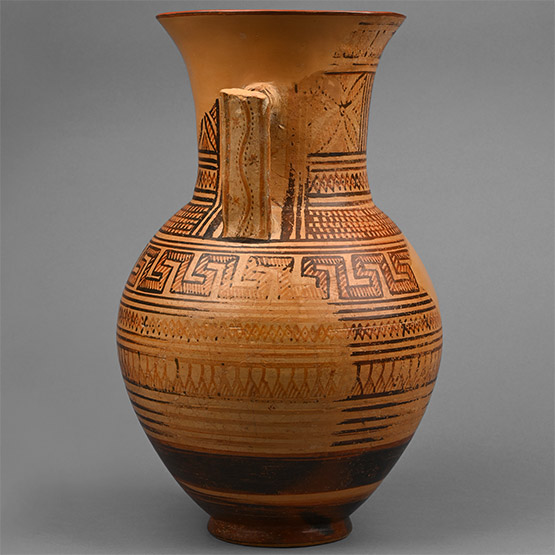
Large Greek Terracotta Oinochoe with Swastikas
Geometric, 8th century B.C.Estimate: £3,000 - 4,000 (‡+bp*)
Bids: 2 | Current Bid: £1,500
With flared mouth, wide neck, bulbous body and ring foot, painted in brown and red matte glaze; geometric pattern spread over several registers separated by bundles of encircling stripes, triangles with hatching inside them, neck with metopes containing swastikas, rosettes and rhombuses with a band of rhombuses beneath; the shoulder with five line friezes arranged one above the other; the body decorated with meander and a band of rhombuses and triangles with hatching below, a broad black stripe (in places reddish as a result of misfiring) to the lower part; transition to the ring foot and ring foot painted black; wide strap handle attached to the shoulder and painted on the outside with a wavy line framed by dots, edge stripes and three small stars, the connecting bar patterned with stripes; museum-quality restoration. 2.04 kg, 35.5 cm
Ex Madame P., Paris. Accompanied by an academic report by Dr Raffaele D'Amato. This lot has been checked against the Interpol Database of stolen works of art and is accompanied by search certificate number no.12460-228686.
Vessels of the Geometric period (900-700 BCE) are easily recognisable by their abstract decorative designs, which had their origin in woven textiles and baskets. While early period pottery typically has sparse geometric motifs on a black background, the amount of decoration increased progressively to the point that objects from the late Geometric period are often entirely covered - in this example, even the strap handle. -
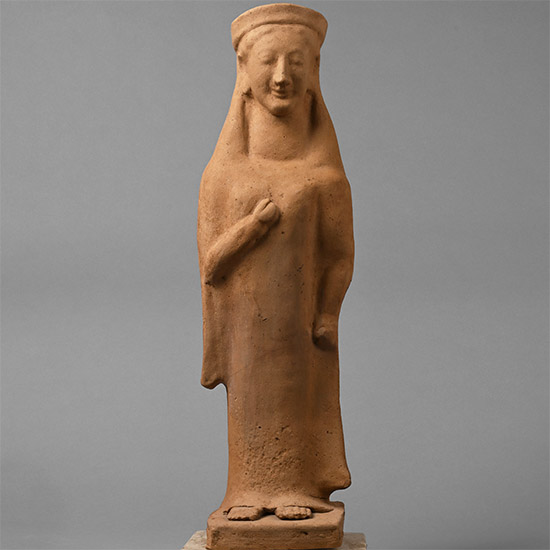
Large Greek Terracotta Figure of a Kore
6th century B.C.Estimate: £4,000 - 6,000 (‡+bp*)
Opening Bid: £2,222
Hollow-formed with scaphoid headdress, long hair hanging behind the shoulders, heavy peplos dress extending to the floor with splayed hem and feet visible beneath; left hand held straight at the thigh, right hand in a fist between the breasts; mounted on a custom-made stand. 6.7 kg total, 57 cm including stand
Swiss private collection, assembled in the 1970s-1980s. with Galerie Serodine, Ascona, Switzerland, 1993. Collection of Dr E.N., Zug, acquired in 1995. This lot has been checked against the Interpol Database of stolen works of art and is accompanied by a search certificate number no.12858-241755.
One of the most typical 6th-century B.C. terracotta female figurines was that of a standing or seated woman wearing a chiton tunic and a himation over it. It was a votive figure offered to the shrines or temples, usually representing the goddess Demeter. The headgear, polos, was an element usually identifying the goddess Demeter or her daughter Persephone. Attica was one of the principal centres of figurine production, but Corinth continued to produce solid standing or seated females with moulded fronts and flat backs. -
.jpg)
Etruscan Bronze Handle Pair with Heads of Medusa
6th-5th century B.C.Estimate: £10,000 - 14,000 (+bp*)
Opening Bid: £5,000
Each formed as a D-shaped fluted bar with the finials formed as grotesque Medusa heads (gorgoneia) in Archaic Greek style with protruding tongue and a pair of bearded snakes framing her forehead; mounted on custom-made display stands. 683 grams total including stand, handle: 10.9-11 cm wide
Ex private collection of Athos Moretti, Bellinzona, Switzerland, in the 1960s. with Christie's, London, 14 June 1978, lot 344. with Sotheby's, New York, 29 May 1987, lot 154. Accompanied by an academic report by Dr Raffaele D’Amato. This lot has been checked against the Interpol Database of stolen works of art and is accompanied by search certificate number no.11773-204596. -
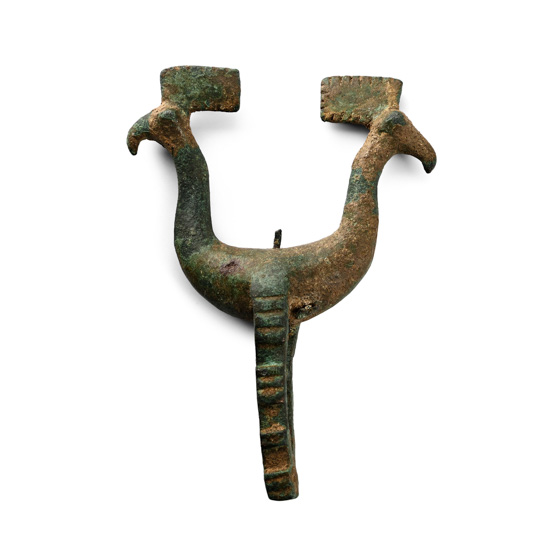
Large Greek Bronze Double-Headed Animal Terminal
Geometric, 8th-6th century B.C.Estimate: £1,200 - 1,700 (‡+bp*)
Opening Bid: £600
Comprising a crescentic body with a slender neck at each end, topped by a bird-head with a rectangular crest, vertical legs with raised block detailing conjoined at the lower end into a mounting peg. 55.6 grams, 86 mm
Ex collection Mr K.H., Germany. Private collection, acquired in 2012. This lot has been checked against the Interpol Database of stolen works of art and is accompanied by search certificate no.13077-246757.
Bird figures, standing on plates or discs, are found as votives mainly in Northern Greek sanctuaries of the Geometric Age. They should be regarded as symbolic and sometimes modest gifts to the gods. Some birds were also designed as pendants. The present fitting resembles a rooster, but it could also represent a peacock, and hence is connected with the goddess Hera. -
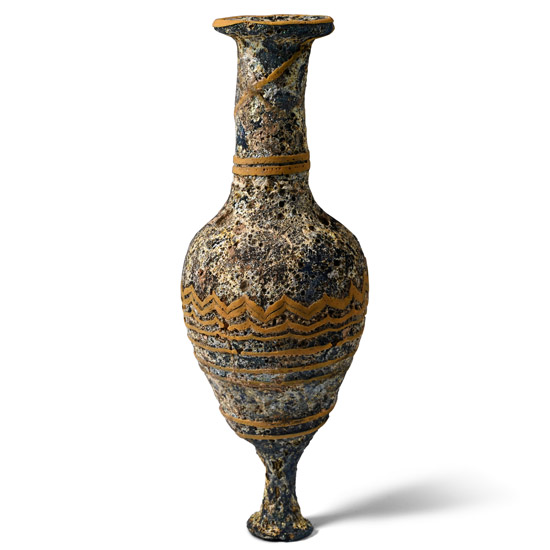
Greek Core-Formed Glass Amphoriskos
5th-3rd century B.C.Estimate: £1,200 - 1,700 (+bp*)
Opening Bid: £600
With applied yellow festooning and trails, knop foot and everted rim to the mouth. 35 grams, 12 cm high
Acquired on the UK art market, 1990s. Private collection, New York, USA. -
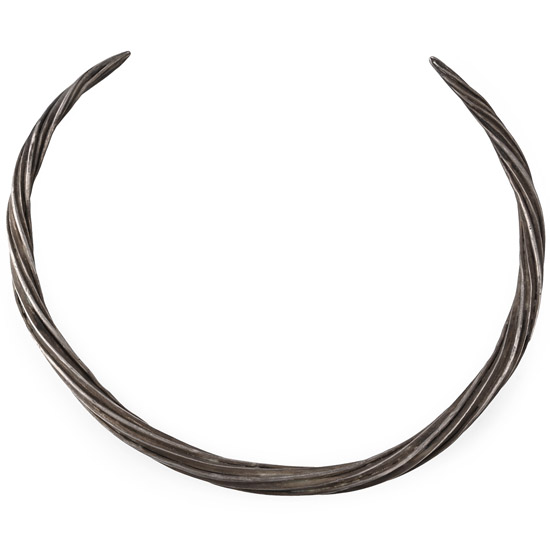
Thracian Silver Twisted Torc
5th century B.C.Estimate: £600 - 800 (+bp*)
Opening Bid: £300
Penannular torc twisted around its axis with tapering finials. 221 grams, 19.7 cm
Acquired in the early 1970s. Private collection, Suffolk. -
.jpg)
Greek Terracotta Figure of Eros, the God of Love
Hellenistic, 3rd-1st century B.C.Estimate: £8,000 - 10,000 (‡+bp*)
Opening Bid: £4,000
Modelled nude in a dynamic pose with his wings spread open, the left leg slightly advanced, and the right arm extended with open palm, a diadem or a fillet on his head; circular socket between the wings; accompanied by a display stand. 808 grams total, 31 cm including stand
Louis-Gabriel Bellon (1819-1899) collection, France. European private collection, 2009. Accompanied by an academic report by Dr Raffaele D’Amato. This lot has been checked against the Interpol Database of stolen works of art and is accompanied by search certificate number no. 13014-246790.
In classical times, Eros was usually depicted as a handsome adolescent, with only his wings distinguishing him from other kaloi and young athletes. Sometimes he was depicted younger and with less masculine features: Lysippos, in the famous statue of Eros of Thespiae, depicted him as a youth. -
.jpg)
Parthian Carnelian Gemstone of a Goat-Headed Rhyton in Gold Ring
4th century B.C.-220 A.D.Estimate: £2,000 - 3,000 (+bp*)
Opening Bid: £1,000
Achaemenid or Parthian oval intaglio engraved with a style standing at the threshold between natural and stiff rigid linear style, depicting a goat-headed rhyton, the vessel terminating in the forepart of a wild goat with the front leg tucked under the body, the head rendered in profile with elegantly arched horns, pronounced muzzle, and carefully incised eye; the neck of the conical rhyton decorated with diagonal and cross-hatched incisions suggesting ribbing or chased metalwork; set in a modern gold ring with a small triangular area at the top left of the stone filled in with gold; supplied with a museum-quality impression. 8.51 grams, 24.02 mm overall, 21.18 mm internal diameter (approximate size British P, USA 7 1/2, Europe 16.23, Japan 15)
Acquired on the European art market. This lot has been checked against the Interpol Database of stolen works of art and is accompanied by search certificate number no.13356-257945.
The subject, a rhyton terminating in an animal protome, belongs to a well-established tradition in Eastern Greek and Achaemenid art of the late Archaic and Classical periods, in which zoomorphic libation vessels were used in ritual and ceremonial contexts. Goat-headed rhyta, though less commonly preserved in glyptic media, are attested in silver and ceramic examples, notably from Asia Minor and Thrace. The stylised horned animal, here likely a wild goat or ibex, is associated with vitality and mountain symbolism, while the rhyton itself signals elite drinking culture and votive use. The use of carnelian is typical of high-quality glyptic production in the 6th to 4th century BC, valued for its durability and ability to take a fine polish. The style and iconography suggest an Eastern Mediterranean origin, most probably Ionian or Anatolian. -
.jpg)
Greek Gold Ring and Carnelian Gemstone with Asclepius and Hygeia
Hellenistic, 1st century B.C.-1st century A.D.Estimate: £2,000 - 3,000 (+bp*)
Bids: 1 | Current Bid: £1,000
Comprising a gold wire hoop with panels of baluster detailing, scrolled and securing a gold cell with an inset cabochon gemstone; to the domed face, the god Asclepius with caduceus symbol; to the flat face, goddess Hygeia standing holding a serpent; some usage wear. 2.12 grams, 22.48 mm overall, 14.21 x 16.13 mm internal diameter (approximate size British F 1/2, USA 3, Europe 4.3, Japan 4)
Private collection, UK. This lot has been checked against the Interpol Database of stolen works of art and is accompanied by search certificate number no.13357- 259200.
Asclepius, son of Apollo and Coronis, was the Graeco-Roman god of medicine, healing and prophecy. He had two daughters with Epione, the goddess of soothing - Hygeia (goddess of health) and Panacea (goddess of healing).

