-
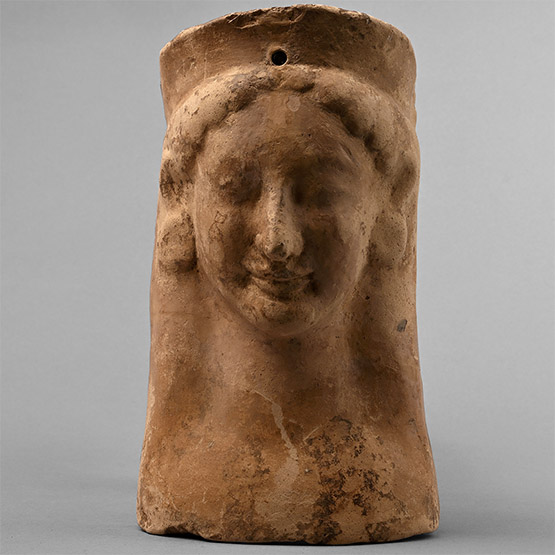
Greek Terracotta Female Protome
Early 5th century B.C.Estimate: £1,200 - 1,700 (‡+bp*)
Opening Bid: £650
Mould-made female protome with oval face, graceful nose and typical "archaic" smile; forehead framed by snail-shell curls descending to shoulder-height; with a low polos with a central perforation and large disc earrings. 606 grams, 19.5 cm
Ex Herbert A. Cahn, Kunst der Antike, Basel, 1997. with Paul and Vreny Vosseler-Studer, Riehen. Accompanied by a copy of an Art Loss Register certificate no.S00057826. This lot has been checked against the Interpol Database of stolen works of art and is accompanied by search certificate number no.12474-228714.
The presence of cults in Magna Graecia, although they fell within a well-established pantheon, in which the deity representing the Great Mother or Mother Earth, protector of fertility, natural and human fecundity, as well as health, was the most ancient, traces back to the figure of Demeter. In terracotta statuary, especially in Lucania, the goddess became the prevalent subject of votive or propitiatory offerings, reproduced in numerous variations of pose. The most common is the seated position, a distant tradition and widespread in the ancient world, the so-called 'goddess enthroned' with its multiple meanings, which allowed it to be adapted to various forms of worship. Demeter is a female deity connected to the earthly world and fertility, and therefore also present in Lucanian religiosity. The theme of the archaic protome—a head severed just below the neck—was transformed and expanded between the 5th and 4th centuries B.C., into that of the bust, finished just above the waist. -
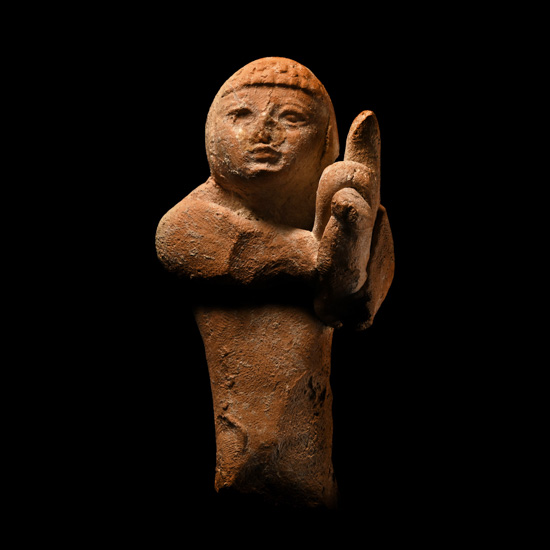
Greek Terracotta Citharode
6th-4th century B.C.Estimate: £1,200 - 1,700 (‡+bp*)
Opening Bid: £600
D-shaped in section with close-cut hairstyle, standing, holding a cithara supported on the left arm, strumming with the right hand. 62 grams, 86 mm
Ex Shlomo Moussaieff (1925-2015), Israel. European private collection. This lot has been checked against the Interpol Database of stolen works of art and is accompanied by search certificate number no.13107-246791.
The cithara was the instrument of the ‘virtuosi’, the principal concert instrument of the ancient Greeks. Its sound box was made of wood and was much bigger than that of the lyra. Strips of copper or horn were commonly incorporated into it, which resonated in sympathy with the strings, giving a great breath of sound. -
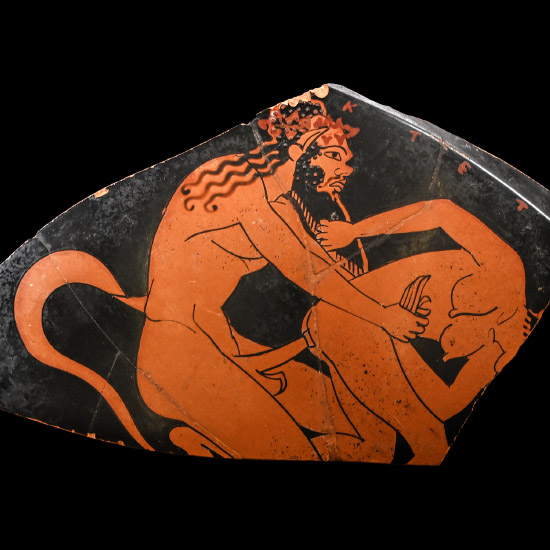
Fragment of a Greek Red-Figure Cup Depicting a Satyr Copulating with a Maenad, Attributed to Epiktetos
Attic, circa 520–490 B.C.Estimate: £4,000 - 6,000 (+bp*)
Bids: 2 | Current Bid: £2,200
Dynamic scene featuring a nude, muscular satyr engaged in coitus with a young maenad; the satyr depicted with long curly hair and long dressed beard, a crown of ivy leaves resting on his head, holding the hand of the maenad with his right hand and her waist with the other; the maenad depicted in a half-kneeling position with her right hand grasping the beard of the satyr; partial Greek inscription above 'KTETO' referring to the artist Epiktetos. 31.2 grams, 11.7 cm
Oswald Burchard collection, Zurich, until 1983. M. Hess collection, Hotel Jura, Basel. Private collection, Germany. Private collection, London. One fragment, Antikenmuseum [ACR] Auctions, 17, 30 June 2015, no.14. Two fragments, Bertolami Fine Art, Auction 43, 19 April 2018, no.55. Comprising three fragments, subsequently joined. This lot has been checked against the Interpol Database of stolen works of art and is accompanied by search certificate number no.13326-258216.
Epiktetos is considered a master of the circular image and painted mainly the interiors of cups—specifically "eye-cups," so named because of the two painted eyes on the exterior, which likely served an apotropaic function. His so-called "bilingual" vases feature black-figure painting on the interior, while the exterior of the bowl is decorated in the red-figure style. He painted few mythological scenes: Theseus confronting the Minotaur; a red-figure cup fragment attributed to him depicts Hermes, Apollo, and Artemis or large-scale compositions; instead, he mostly depicted scenes from daily life (an archer, a mounted warrior, figures at a banquet, a sculptor at work), as well as erotic scenes featuring men or satyrs. -
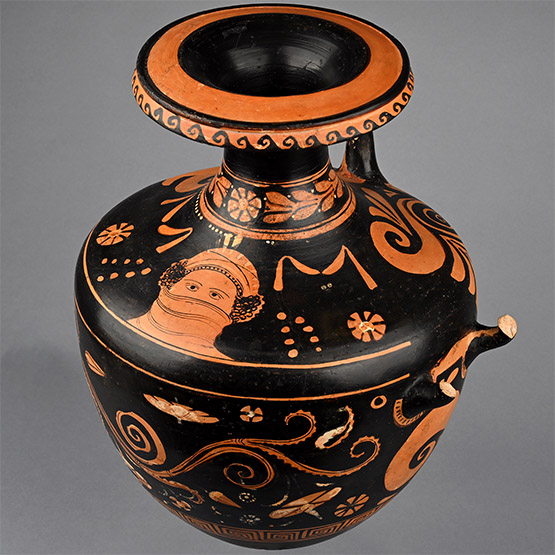
Greek Fragmentary Terracotta Red-Figure Hydria
Paestan or Apulian, 4th century B.C.Estimate: £4,000 - 6,000 (‡+bp*)
Opening Bid: £2,200
Comprising the upper two thirds of the vessel; on the shoulder a facing woman's head with diadem and half-veiled face; rosettes to left and right, with suspended ribbons and dots; vine motif around the body with floral ornaments; to the reverse, palmettes and vines; band of laurel with rosettes around the neck and wavy band at the mouth; reassembled from various fragments with three large areas of restoration, only the beginnings of the handles preserved; mounted on a custom-made stand. 1.95 kg, 31 cm (2.6 kg total, 47.5 cm high including stand)
Ex Herbert A. Cahn, Basel, 1990s. This lot has been checked against the Interpol Database of stolen works of art and is accompanied by search certificate number no.12475-228738.
The face-veiling gesture is a known marriage rite; the diadem may suggest that she is intended to represent Persephone. Alternatively, the veiled woman might be a dancer as many terracotta figurines of dancing women are shown with face-coverings. However, the floral ornaments could indicate a funeral or sepulchral context. -
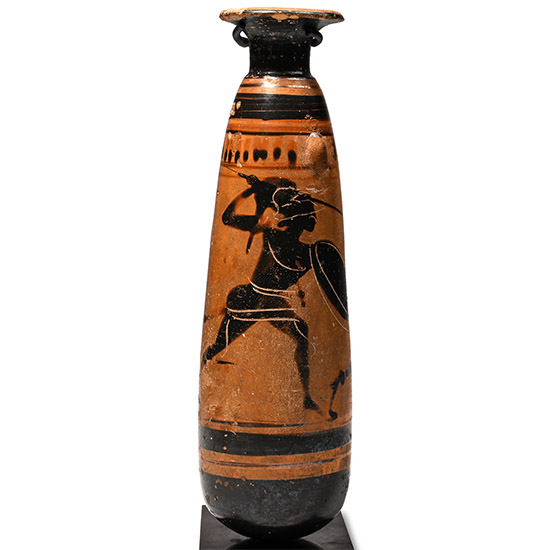
Greek Black-Figure Alabastron with Fighting Warriors
Attic, 500-480 B.C.Estimate: £20,000 - 30,000 (‡+bp*)
Opening Bid: £11,111
Of ovoid shape, short neck and expanded flat rim; painted in horizontal bands with black vertical strokes the shoulder, ovules in the upper part, the central scene representing a Greek Ekdromos fighting a Scythian archer; the Greek warrior, wearing a light sleeveless chiton, and a crested Corinthian helmet, carrying a wide hoplon shield, and a long spear with which he is slashing his opponent; the Scythian archer is wearing a typical tall cap flowing backwards and his long coat-suit, carrying a gorytos, (quiver) and composite bow with arrow; horizontal black stripes below; accompanied by a custom-made display stand. 262 grams total, 16 cm high including stand
Louis-Gabriel Bellon (1819-1899) collection, France. European private collection, 2009. Accompanied by an academic report by Dr Raffaele D’Amato. This lot has been checked against the Interpol Database of stolen works of art and is accompanied by a search certificate number no.13019-246753.
The importance of this alabastron is linked to its iconography, which represents episodes of the Persian Wars, fought 490-480 B.C. Such alabastra are part of a series realised during the period of the conflict and after, and they are an important source of information on the Persian and Greek armies. Here, the two opponents evoke the Greek victories, with a light-armed Greek ekdromos (hoplite fighting in light equipment) killing a Scythian archer, who formed part of the Persian army. The representation of Scythian costume in vase-painting reached its height of popularity between c. 530 and 490 B.C., and went out of fashion after the Graeco-Persian wars, when these clothes began to be associated with the Persian ethnic identity rather than the original Scythian. -
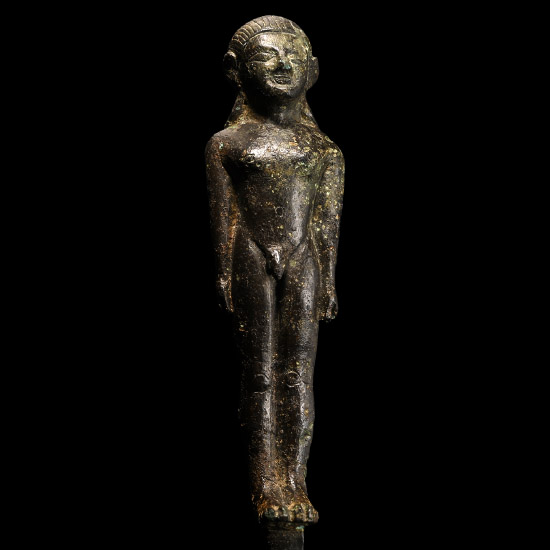
Etruscan Bronze Figure of a Kouros
Late 6th century B.C.Estimate: £2,000 - 3,000 (+bp*)
Bids: 2 | Current Bid: £1,200
Depicting a youthful nude kouros standing frontally, with a long, slender body, broad shoulders, a narrow waist, and arms hanging close to the sides; the head, slightly oversized, characterised by an oval face, large almond-shaped eyes, an Archaic smile, and finely modelled ears, the hair arranged in beaded locks framing the forehead and falling onto the shoulders, reflecting the influence of contemporary Greek Archaic sculpture; standing on an integral rectangular base provided with a long tang for attachment. 118 grams, 11.2 cm
Acquired on the European art market between 1960s and 1980s. English private collection, property of a gentleman. Bertolami Fine Art, London, Auction 54, 9 November 2018, no.88. This lot has been checked against the Interpol Database of stolen works of art and is accompanied by search certificate number no.13320-258214.
The elegant proportions and linear modelling place the statuette within the widespread production of Etruscan votive bronzes of the Late Archaic period, probably intended as a sanctuary dedication. -
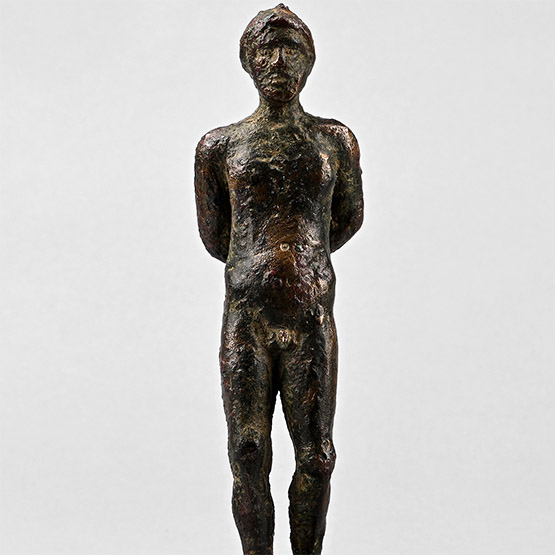
Greek Bronze Figure of a Bound Captive
Hellenistic, 2nd century B.C.Estimate: £2,500 - 3,500 (‡+bp*)
Opening Bid: £1,250
Modelled in the round nude male standing with hands bound behind his back; with short cropped hair and slender figure; left foot absent; mounted on a custom-made stand. 491 grams, 17 cm including stand
Ex S.K. collection. Acquired on the German art market, July 1995. Accompanied by an academic report by Dr Raffaele D'Amato. This lot has been checked against the Interpol Database of stolen works of art and is accompanied by a search certificate number no.12518-232076.
The character's hairstyle of the statuette is simple, and his hair is short, not treated with chalk like that of the famous ‘dying Galatian’ from Pergamon. The gaze is fixed on the distance, while the bony, beardless, long-limbed figure conveys the prisoner's energy. The nose here takes on a strong characteristic together with the broad jaw, which is also recognisable in later statuettes of Roman age. These characteristics, combined with those of nudity, allow us to recognise the figure of the prisoner as a Celtic warrior. -
.jpg)
Etruscan Bronze Statue of a Satyr
Circa 6th century B.C.Estimate: £3,500 - 4,500 (‡+bp*)
Opening Bid: £1,800
Modelled in the round in energetic pose with left hand resting on the hip and right arm raised, head tilted slightly upwards, tail curled gracefully over the rump; on a square base with papyrus stalk detailing; on a later gilt-metal stand mounted on a polished stone cube. 679 grams total, 20.4 cm including stand
Iris Cornelia Love (1933–2020), New York, collection primarily formed in the 1950s-1970s. This lot has been checked against the Interpol Database of stolen works of art and is accompanied by search certificate number no.13335-258241.
Many of the scenes show satyrs in Etruscan art transgressing the limits of accepted behaviour. As symbol of inversion of order, the satyr reflects the rules of the life and culture of the Etruscans and their values. Satyrs in comic, surprising situations indicate the Etruscans' sense of humour. They got their inspiration from Greek art when illustrating myths and narratives, often with a light-hearted approach of their own. The Etruscans were known to be devoted to religious rites and satyrs appear in such scenes too. Satyrs, connected with the Dionysian cortege, appear also on vases in sacrifice scenes and it is suggested here that satyrs dancing and gambolling around a wine vessel are performing a cultic dance in honour of Dionysos. -
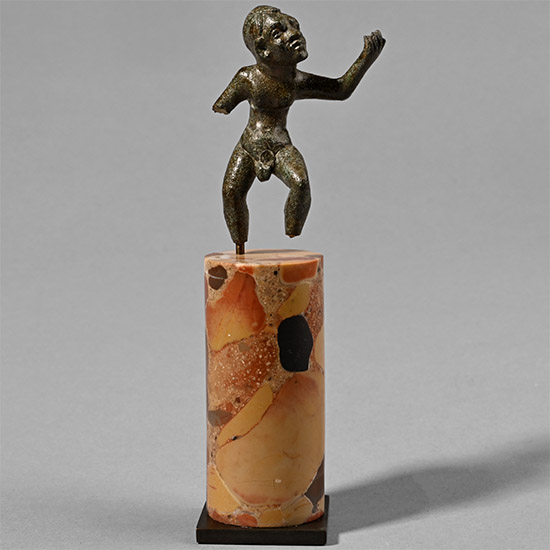
Greek Bronze Statuette of an Alexandrian Dancing Dwarf
Hellenistic, 1st century B.C.-1st century A.D.Estimate: £3,000 - 4,000 (+bp*)
Opening Bid: £1,500
In an active pose with both legs bent and left arm raised dramatically, head tilted to the left; exaggerated facial features, short trimmed hair, slim body with developed pectoral muscles and pronounced kyphosis; mounted on a columnar stand. 295 grams total, 15 cm high imcluding stand
Belgian private art collection of M.A., Brussels, Belgium, 1995. with Gorny and Mosch, 14 December 2011, no.82. This lot has been checked against the Interpol Database of stolen works of art and is accompanied by search certificate number no.13330-258951.
Such figures are often described as ‘grotesques’, yet typically constituted overstated representations of people with dwarfism. Such individuals are invariably shown with exaggerated features such as pot bellies, hunched backs, bald heads, large phalli and angry facial expressions. -
.jpg)
Large Etruscan Statue of a Priest with Patera
2nd century B.C.Estimate: £18,000 - 24,000 (+bp*)
Opening Bid: £9,000
Modelled in the round standing figure with palla draped over the left shoulder and from the hips, extending to calf-length; the head with aquiline nose and dimpled chin modelled with a wreath of large leaves around the brow forming a corona; exaggerated eyes left blank to accept silver inserts; left arm bent, hand holding an incense-holder with cruciform design; right arm extended at shoulder-height with phiale mesomphalos offering dish; socket beneath left foot and screw-threaded post beneath right, repairs to both lower legs. 1.23 kg, 28.4 cm high
Sotheby's, New York, 17 December 1996, no.79. Private collection, New York, USA. Accompanied by copies of the relevant Sotheby's catalogue pages. This lot has been checked against the Interpol Database of stolen works of art and is accompanied by search certificate number no.13355-255463.
The figure is probably a devotee or priest of Diana preparing to make ritual observances with the offering plate and incense burner. A group of similar figures was recovered from the shallows of Lake Nemi south of Rome, close to the site of the Temple of Diana. -
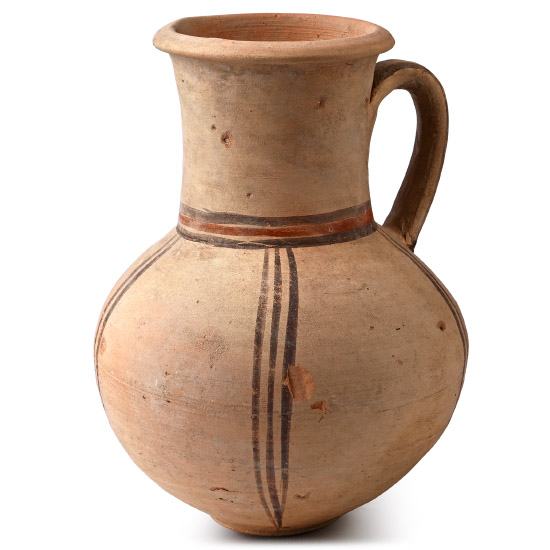
Large Eastern Mediterranean Painted Terracotta Pitcher
1st millennium B.C.Estimate: £400 - 600 (+bp*)
Bids: 7 | Current Bid: £96
With a wide mouth, everted rim, and elongated, cylindrical neck, bulbous body with painted polychrome bands, a strap handle with painted linear decoration. 1.03 kg, 22.5 cm
From a 1980s UK collection. Acquired on the UK art market in the early 2000s. Property of a London, UK, antiquarian. -
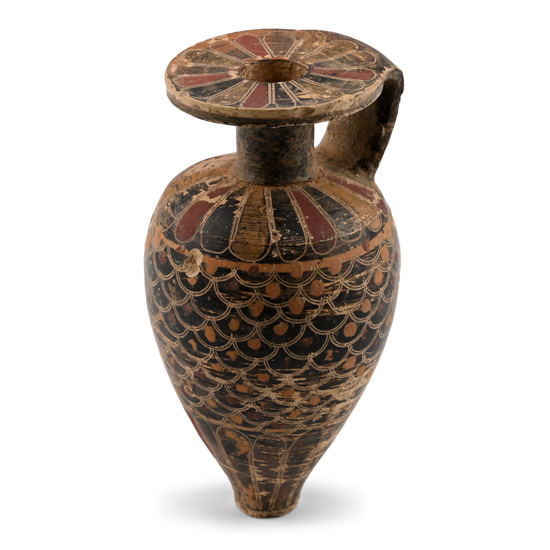
Proto-Corinthian Painted Terracotta Aryballos
7th century B.C.Estimate: £1,800 - 2,400 (‡+bp*)
Bids: 1 | Current Bid: £1,000
Comprising a piriform body and a tubular neck with a wide rim, a strap handle to the rear, the rim with painted polychrome petals, the pattern repeating beneath the neck and on the base of the vessel; the body decorated with fishscale decoration. 79 grams, 10.5 cm
Swiss private collection, assembled in the 1960s and 1970s. Acquired by the present owner in 2004. Accompanied by an academic report by Dr Raffaele D’Amato. This lot has been checked against the Interpol Database of stolen works of art and is accompanied by search certificate number no.30017-246794.
The aryballoi were used to hold perfumed oil, an essential item for the wealthy middle classes of the time. Similar piriform vases are fairly common in Corinthian contexts. There is utmost precision in both the potting and the execution of the incised scale pattern of the present example. The fish-scale decoration was realised with the incision technique, by executing the scales neatly with their ends meeting.

