-
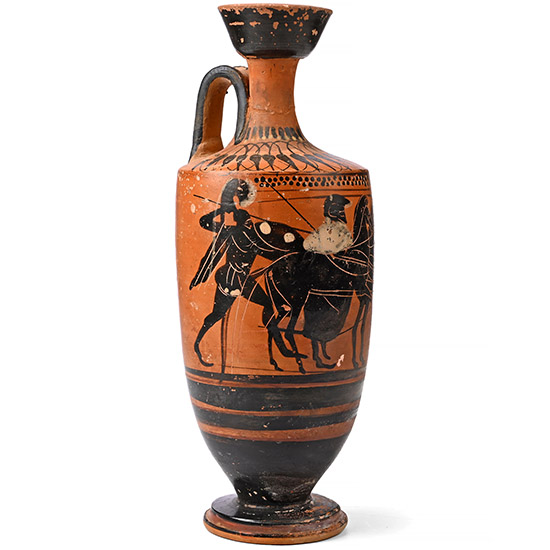
Greek Black-Figure Lekythos with Horses and Fighting Warriors
Attic, 4th century B.C.Estimate: £1,200 - 1,700 (+bp*)
Bids: 3 | Current Bid: £1,100
Cylindrical with echinus mouth and stepped torus foot, on the body a dynamic scene consisting of four rearing horses, side-by-side and wearing harnesses, nestled between the horses a standing warrior wearing a crested helmet, behind the horses an advancing warrior wearing a plumed helmet, holding a long spear in his raised hand a round shield in the other; before the horses a fleeing opponent in a running pose, facing back and holding a spear in one hand while protecting himself with a shield held in the other; long tongue motifs on the shoulder; restored. 472 grams, 23.5 cm
Ex Bonhams, Knightsbridge, London, 1990s. Private collection, Suffolk.
The scene depicts a battle between hoplites, possibly an episode from the Iliad. Originally, one or two of the combatants were positioned on a chariot; four horses from it remain visible. The scene may represent the wounding of Ares, the god of war, as he is pursued by Diomedes and accompanied by the goddess Pallas, whose helmet is emerging from behind the horses. -
.jpg)
Greek Black-Figure Ware Kylix
Attic, circa 5th century B.C.Estimate: £1,800 - 2,400 (+bp*)
Bids: 2 | Current Bid: £1,500
Broad and shallow with two strap handles, an advancing figure holding a shield at the tondo, outside with a figural frieze of two robed figures in discussion, seated on churule chairs, an attendant behind the left figure, a rider on horseback on each side of the scene; restored. 373 grams, 26 cm
From a German collection, pre 1970. This lot has been checked against the Interpol Database of stolen works of art and is accompanied by search certificate number no.13316-258818.
The present piece is a wide-bowled drinking cup known as a kylix - one of the most popular forms of pottery from the Achaean times (1600-1100 B.C.) through to the classical period (c.510-323 B.C.). It dates to an important moment in the development of Greek ceramics, just as the black-figure technique was being perfected by Athenian painters. Painted in black slip with details incised on top, kylikes usually had a frieze around the outside of the bowl as well as another scene on the tondo of the inside. -
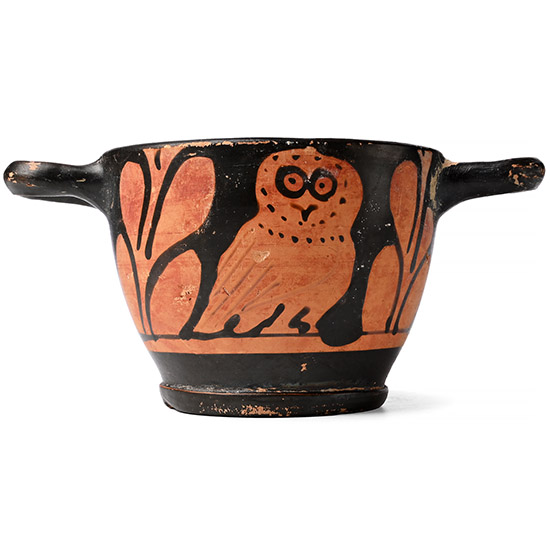
Greek Red-Figure Skyphos with Owl
Attic, 5th-4th century B.C.Estimate: £500 - 700 (+bp*)
Bids: 4 | Current Bid: £550
Mammiform body with flared pedestal base and two loop handles to the rim; each side with a facing image of an owl between laurel fronds; concentric circles to the base, Attic workmanship. 115 grams, 14.1 cm wide
Bonhams, Knightsbridge, London, 5 July 1994, no.39. Private collection, Suffolk. -
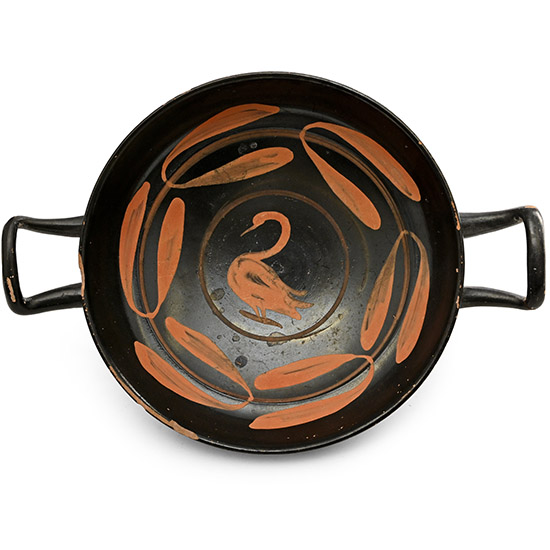
Greek Black-Glazed Twin-Handled Stemless Kylix with Swan
Apulia, 4th century B.C.Estimate: £600 - 800 (+bp*)
Opening Bid: £300
Shallow with arched loop handles below the rim, low stepped foot; tondo with painted wreath of laurel leaves surrounding a standing swan in profile; to the outer face, two horizontal sprigs of laurel leaves; possibly by the Swan painter. 206 grams, 20.6 cm
Bonhams, Knightsbridge, London, 5 July 1994, no.43. Private collection, Suffolk. Accompanied by copies of the relevant Bonhams cataloguing pages. -
.jpg)
Greek Red-Figure Bell Krater with Eros
Apulia, 4th century B.C.Estimate: £3,000 - 4,000 (+bp*)
Bids: 2 | Current Bid: £2,400
With flared and carinated foot, broad stem, ovoid body, carinated shoulder, everted rim with lip, D-shaped antefixes and lateral pendant loop handles; band of ivy to the neck and meander to the lower edge, frieze with figural scenes: Side A - seated female with thyrsos pointing towards Eros with head turned regarding her, wings spread; Side B - seated female in tiered robe pointing towards standing Eros with wreath, objects in the field; by the Ascoli Satriano Painter; restored. 1.81 kg, 33.5 cm
Ex private collection, previously with Bonhams, Bond Street, London, UK. This lot has been checked against the Interpol Database of stolen works of art and is accompanied by search certificate number no.13353-259030.
Female heads and Eros figures are common features on the vases attributed to the Ascoli Satriano Painter. His real name is unknown, and he has been named after a northern Apulian town, where many of his vases have been found. -
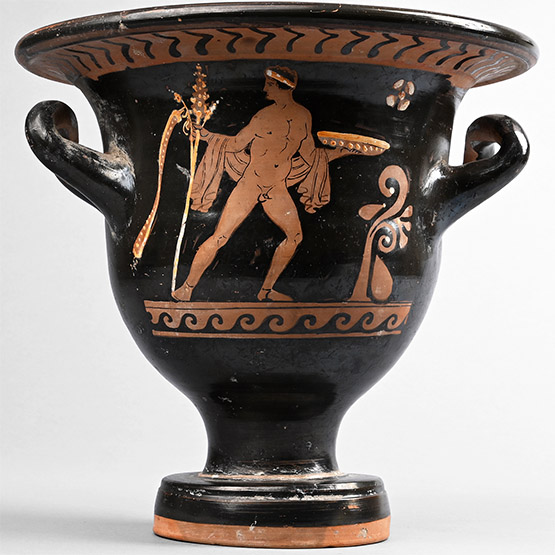
Greek Red-Figure Bell Krater Belonging to the Chevron Group
Apulia, 4th century B.C.Estimate: £1,500 - 2,000 (+bp*)
Bids: 2 | Current Bid: £1,000
With reserved herringbone band beneath the rim, wave pattern to be the baseline; Side A: young man with thyrsus and pendant streamer holding a phiale, a loose mantle draped from the elbows; Side B: head of a lady of fashion with white accents to her stephane and hair drawn up in a chignon, a volute and window before her. 1.11 kg, 23.2 cm wide
Acquired on the art market between the late 1990s and mid-2000s. Estate of the late Barry Paul Buxton (1944-2024), Oakham, Rutland. Acquired on the UK art market, 2025. Accompanied by an academic report by Dr Raffaele D'Amato. This lot has been checked against the Interpol Database of stolen works of art and is accompanied by search certificate no.13071-249285.
Bell kraters were commonly used in regions of ancient Italy for mixing and serving wine during communal gatherings, thanks to their wide shape and flared mouth. These vessels also served as artistic expressions, reflecting the cultural tastes of the time. The Chevron Group is the conventional name for a group of ancient Apulian red-figure vase painters who were active in Southern Italy between approximately 335-310 B.C. They are named for their distinctive use of a band of chevron patterns to encircle the rims of the small kraters (mixing vessels) they decorated. -
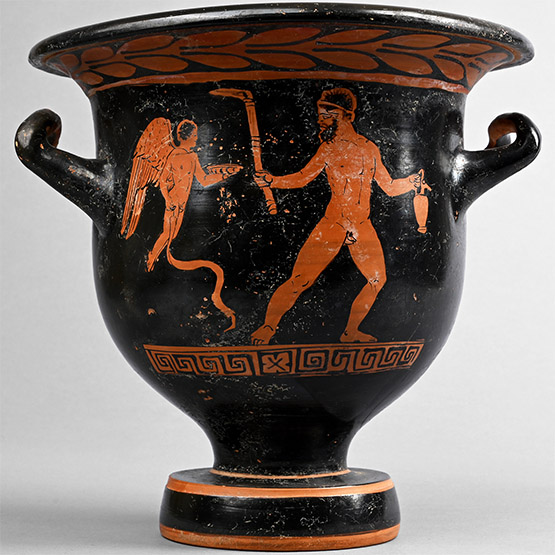
Greek Red-Figure Bell Krater with Satyr and Eros
Apulia, circa 450-400 B.C.Estimate: £1,500 - 2,000 (+bp*)
Bids: 2 | Current Bid: £1,100
With laurel-leaf wreath beneath the flared rim, band of meander ornament as a baseline; Side A: striding satyr with torch and oinochoe followed by Eros holding a scroll behind; Side B: woman wearing a himation in active pose with sphere advancing towards a tendril. 814 grams, 20 cm
Acquired on the art market between the late 1990s and mid-2000s. Estate of the late Barry Paul Buxton (1944-2024), Oakham, Rutland. Acquired on the UK art market, 2025. Accompanied by an academic report by Dr Raffaele D'Amato. This lot has been checked against the Interpol Database of stolen works of art and is accompanied by search certificate no.13070-249284.
Often, the iconography of an 'elevated' mythological subject was applied to members of Dionysos' retinue. Here we have three typical examples of them: a satyr, an Eros, and a woman, all three behaving according to Bacchic ecstasies. -
.jpg)
Large Greek Black-Glazed Trefoil-Lipped Oinochoe
Apulia, 5th century B.C.Estimate: £4,000 - 6,000 (+bp*)
Bids: 1 | Current Bid: £2,000
With a trefoil mouth, an applied D-section handle and a tiered foot. 405 grams, 22.1 cm
Property from a private collection. with Sotheby's, New York, 9 December 2003, no.9. Accompanied by copies of the relevant Sotheby's catalogue pages. -
.jpg)
Exceptionally Large Greek Gnathian Skyphos
Apulia, 5th-3rd century B.C.Estimate: £1,500 - 2,000 (+bp*)
Bids: 3 | Current Bid: £1,200
Mammiform body with pedestal base and two loop handles to the rim; Side A - band of white ovolo detailing to the neck, median red band with vine leaves and tendrils; Side B - bilinear band below neck with lateral pellets. 2.21 kg, 34.4 cm
Ex Orivate collection, formerly with Art Ancient, previously Derek Glover collection. -
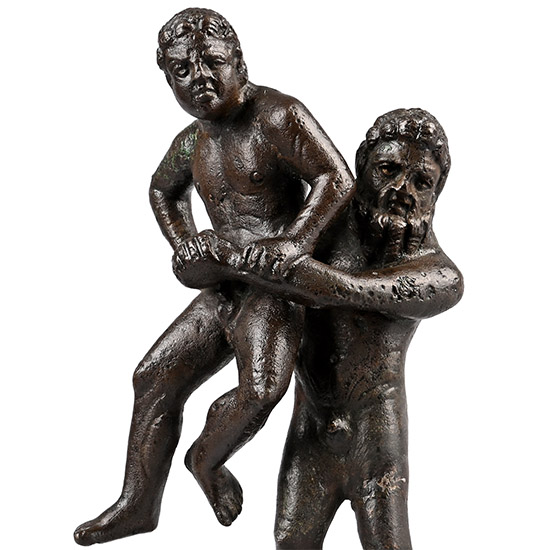
Greek Bronze Hercules and Antaeus Statue Group
Hellenistic, 3rd-1st century B.C.Estimate: £10,000 - 14,000 (‡+bp*)
Opening Bid: £4,900
Dynamic scene of two nude wrestlers, the giant Antaeus and Hercules, Hercules lifting Antaeus off the ground with his arms, while Antaeus is trying to pry his arms open to regain contact with Mother Earth, which would restore his strength; set on a custom-made display stand. 1.01 kg total, 20.3 cm high including stand
Mallams Oxford. From a UK private collection since the 1970s. This lot has been checked against the Interpol Database of stolen works of art and is accompanied by search certificate number no.13333-258242.
Here, the giant Antaeus is depicted with the more common dimensions of the hero, Hercules. Antaeus was a giant, the son of Neptune and Gaia. Antaeus would challenge all passers-by to wrestling matches and remained invincible as long as he remained in contact with his mother, the Earth. As in Greek wrestling, like its modern equivalent, he typically attempted to force opponents to the ground, and he always won, killing them. He built a temple to his father using the skulls of his defeated opponents. Antaeus fought Hercules as he was on his way to the Garden of Hesperides as his Eleventh Labour. Hercules realised that he could not beat Antaeus by throwing or pinning him. Instead, he held him aloft and then crushed him to death in a bear hug. The scene is famously depicted on a Greek krater dating to the sixth century BC and now in the Louvre, and was a popular subject for Renaissance artists. The episode in which Hercules defeats Antaeus is mentioned in Ovid's Metamorphoses. -
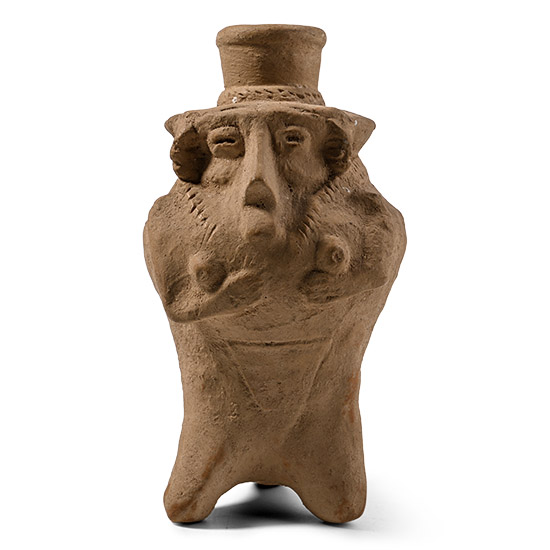
Phoenician Terracotta Anthropomorphic Vessel
3rd century B.C.Estimate: £1,200 - 1,700 (+bp*)
Opening Bid: £667
With three splayed stub feet, tubular body with flared shoulder and neck; applied facial detailing, pointillé circlet and collar, arms bent beneath the breasts, incised loincloth detail. 514 grams, 15.2 cm
with J.F. collection, Madrid. Ex Ars Historica Arqueologia, 7 October 2019. -
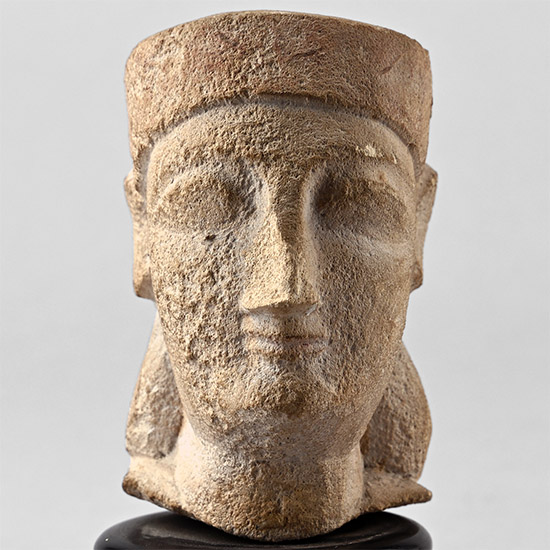
'The Metropolitan Museum of Art' Cypriot Limestone Votive Head of a Man
Circa 5th century B.C.Estimate: £700 - 900 (+bp*)
Bids: 7 | Current Bid: £1,300
Finely carved votive head with almond-shaped eyes and strong nose, lips set to a gentle smile, typical of the Greek kouroi of this period, wearing a conical headdress leaving the ears exposed; set on its original base from the Metropolitan Museum of Art, New York, with item number '163' and three sale labels on the base. 367 grams total, 13.1 cm high including stand
Likely discovered by Luigi Palma di Cesnola in Cyprus, 1860s-70s. Collection of The Metropolitan Museum of Art, New York, likely acquired from the above in 1872. Collection of Ira Martin, New York, acquired from the above on 12 March 1926. with Christie’s, New York, Antiquities, 5 June 1998, no.133. Private collection, thence by descent.

