-
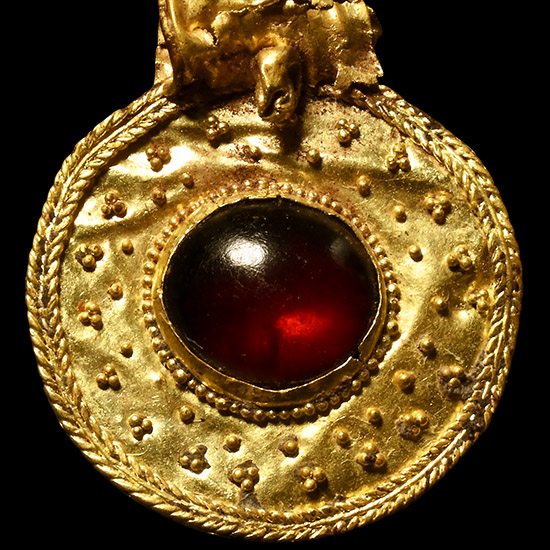
Merovingian Gold Pendant with Cabochon Garnet
Circa 5th-6th century A.D.Estimate: £1,000 - 1,400 (+bp*)
Bids: 1 | Current Bid: £40
Foil disc with central cell surrounded by a beaded filigree collar, ropework filigree rim and granule clusters to the tondo; cell with inset garnet cabochon; broad ribbed loop with hollow-formed granule stud at the junction. 0.94 grams, 20 mm
From a European collection, 1980s. Property of an Essex, UK, gentleman -
.jpg)
Migration Period Gold Double Axehead Pendant
Circa 6th-8th century A.D.Estimate: £300 - 400 (+bp*)
Bids: 1 | Current Bid: £20
Formed as a miniature twibil with loop handle and granule to each corner. 0.64 grams, 13 mm
Ex German art market, 2000s. Acquired from an EU collector living in London. From the collection of a Surrey, UK, gentleman. -
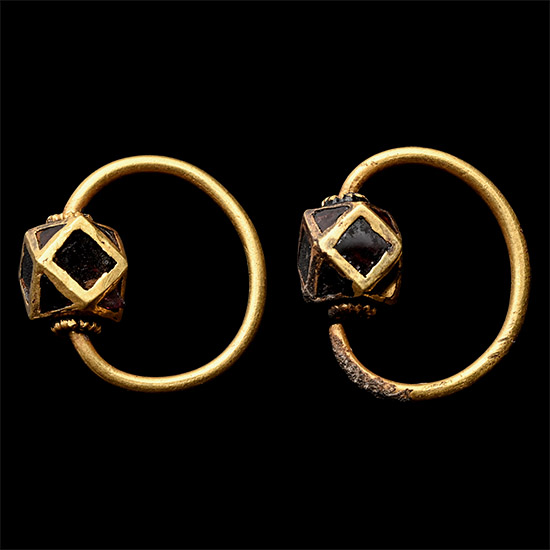
Merovingian Gold Earrings with Garnets
6th century A.D.Estimate: £2,500 - 3,500 (+bp*)
Bids: 2 | Current Bid: £2,000
Of circular form, each composed of a plain gold hoop terminating in a cube-shaped setting displayed upon panels of almandine garnet, carefully cut and backed with gold foil to enhance their translucency and depth of colour; the polygonal settings formed of intersecting gold struts. 21.44 grams total, 30-32mm
New York art market. Christie's, New York, 18 December 1998, no.316. with Ariadne Galleries, New York, acquired at the above sale. Private American collection, acquired from the above, 27 April 2016.
Collectively, these objects demonstrate the wide diffusion of this Ostrogothic type across the Mediterranean, highlighting both the technical mastery of cloisonné work and its symbolic value within elite Gothic adornment. Their integrity is exceptional for jewels of this period, and they would be suitable, if desired, for sympathetic adaptation with discreet loops for modern wear. The use of garnet inlaid into gold cells reflects the continuation of Late Roman cloisonné techniques, adapted and developed within the Ostrogothic world. Such earrings, with their bold cubic settings and luminous stones, would have projected wealth and status, while also embodying the cultural synthesis of Roman and Gothic traditions in Italy and the wider Mediterranean during the 6th century. Displayed upon a modern bespoke bronze stand, included with the earrings. -
.jpg)
Germanic Silver Radiate-Headed Bow Brooch
6th-8th century A.D.Estimate: £700 - 900 (+bp*)
Opening Bid: £250
Comprising a D-shaped headplate with scrolled tendril fill and seven radiating knops; flattened bow above triangular foot plate with similar tendril motifs, profile bird-heads to each edge, lobe finial with facing mask; ferrous pin to reverse. 67 grams, 10 cm
From the private collection of a London gentleman, from his grandfather's collection formed before the early 1970s. -
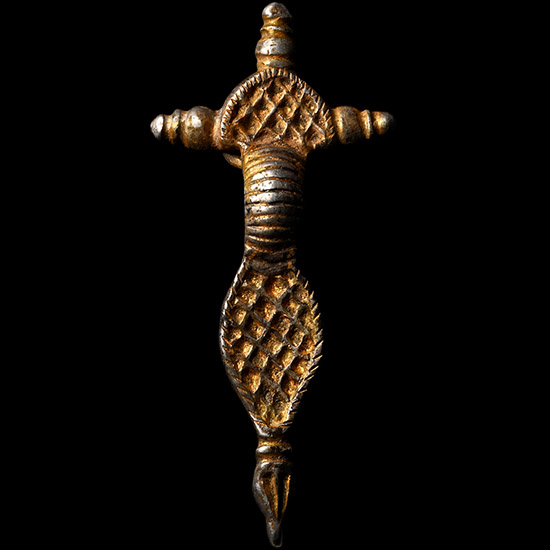
Frankish Silver-Gilt Radiate-Headed Bow Brooch
Circa 6th century A.D.Estimate: £400 - 600 (+bp*)
Bids: 1 | Current Bid: £200
Comprising a D-shaped headplate with notched border and reserved lattice ornament; three collared knops to the outer edge; shallow segmented bow; lozengiform footplate with notched border, reserved lattice ornament and collared knop finial; spring, pin and catchplate to the reverse. 23.8 grams, 76 mm
Ex German art market, 2000s. Acquired from an EU collector living in London. From the collection of a Surrey, UK, gentleman. -
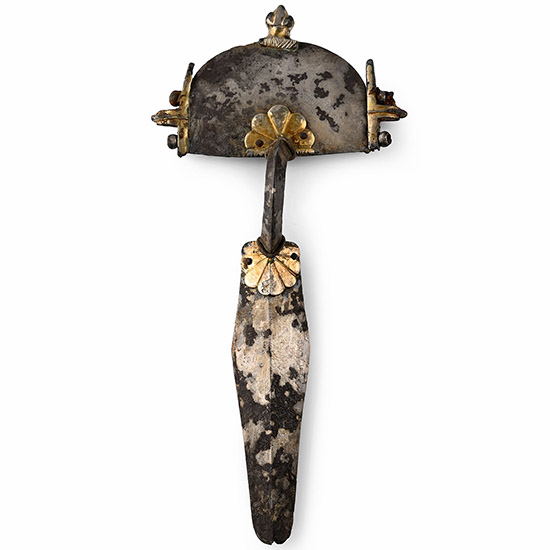
Large Gothic Silver-Gilt Fibula
Bosphorean Culture, 5th century A.D.Estimate: £3,000 - 4,000 (‡+bp*)
Opening Bid: £1,500
Comprising: a semi-circular headplate with a ram-head knop at the apex and applied gilt projections at the sides forming part of the spring mechanism; deep keeled bow with a petalled finials; keeled subrectangular footplate with a rounded finial and a tapering catchplate below. 67 grams, 20.7 cm
L. De Clercq collection, Belgium, 1980s. Ex private European collection. Accompanied by an academic report by Dr Raffaele D’Amato. This lot has been checked against the Interpol Database of stolen works of art and is accompanied by search certificate number no. 13013-246783.
Fibulae of this type were mainly found in female burials and were placed on the right side of the chest and on the left shoulder. It was from this period that the custom of wearing wide belts with buckles and a pair of brooches on the shoulders spread along the south-western Black Sea coast, having originated among the Germanic tribes of the western Roman provinces. -
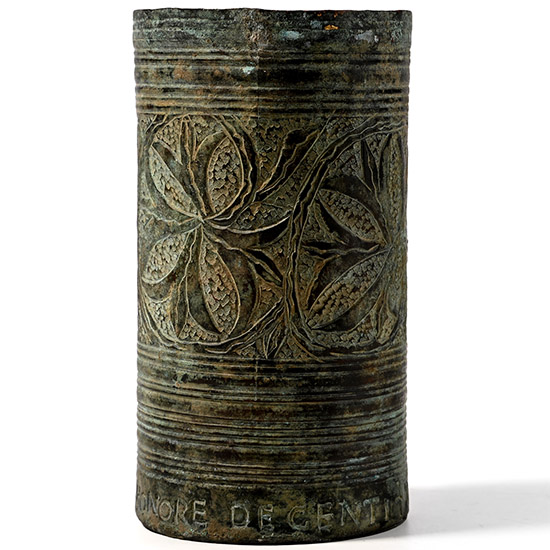
Dark Age Bronze Decorated Pyxis
Circa 5th-6th century A.D. or laterEstimate: £500 - 700 (+bp*)
Opening Bid: £250
Tubular in section with planar base; circumferential ribbing to the sidewall and pounced field with reserved tendrils and leaves; with later Lombardic script legend above base '+ XTVS EVANGELII REDIMITVS HONORE DECENTI' (Christ ... of the Gospel submitted with noble honour). 56.9 grams, 77 mm
Ex German art market, 2000s. Acquired from an EU collector living in London. From the collection of a Surrey, UK, gentleman.
A similar dedicatory inscription appears on the Farfa Casket. -
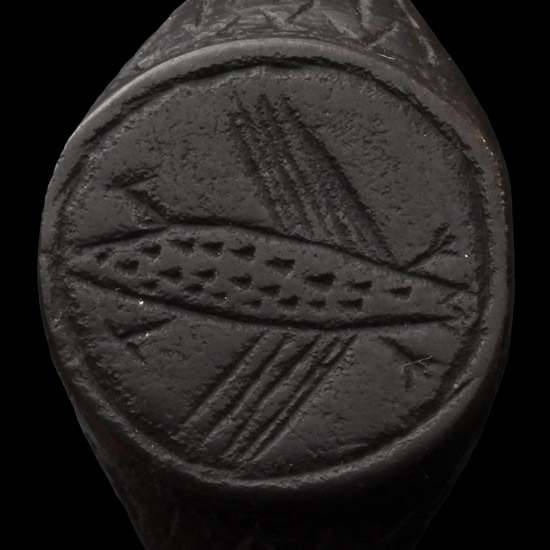
Migration Period Bronze Ring with Insect
Circa 6th-8th century A.D.Estimate: £60 - 80 (+bp*)
Bids: 1 | Current Bid: £5
With arcading to the shoulders, discoid bezel with incised winged insect motif. 5.13 grams, 19.55 mm overall, 17.90 mm internal diameter (approximate size British L 1/2, USA 6, Europe 11.87, Japan 11)
Ex German art market, 2000s. Acquired from an EU collector living in London. From the collection of a Surrey, UK, gentleman.
Possibly intended to represent a bee, a popular motif due to its association with two valuable materials: wax and honey. -
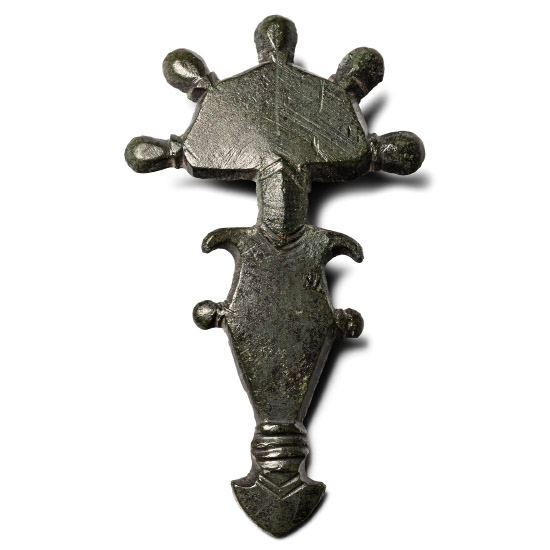
Visigothic Bronze Radiate-Headed Brooch
Circa 6th-7th century A.D.Estimate: £60 - 80 (+bp*)
Bids: 2 | Current Bid: £15
Comprising a hemispherical head with five projecting globules, a gently arching keeled bow and the footplate with two lateral knops and a triangular terminal; pin-lugs and part of the catchplate on the reverse. 9.34 grams, 56 mm
From a European collection, 1990s. Accompanied by a previous dealer's sales ticket. -
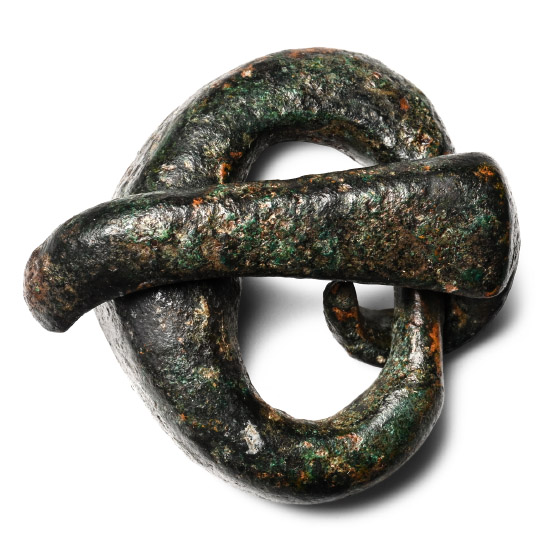
Germanic Bronze Buckle
6th-9th century A.D.Estimate: £30 - 40 (+bp*)
Opening Bid: £5
Comprising a thick D-shaped loop and a D-section curving tongue. 36 grams, 52 mm
From the private collection of Graham Slater (1927-2024), Cambridge, UK; formed 1980s-1990s. Accompanied by a previous dealer's sales ticket. -
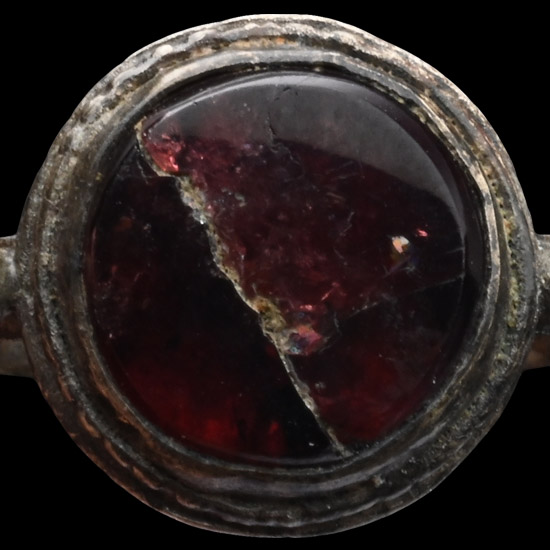
Dark Age Silver Ring with Garnet
Circa 6th-8th century A.D.Estimate: £60 - 80 (+bp*)
Bids: 9 | Current Bid: £102
Comprising a slender hoop with an applied granule on each shoulder flanking the circular bezel set with a table-cut garnet. 1.97 grams, 19.01 mm overall, 16.10 x 14.65 mm internal diameter (approximate size British J, USA 4 3/4, Europe 8.69, Japan 8)
Ex German art market, 2000s. Acquired from an EU collector living in London. From the collection of a Surrey, UK, gentleman. -
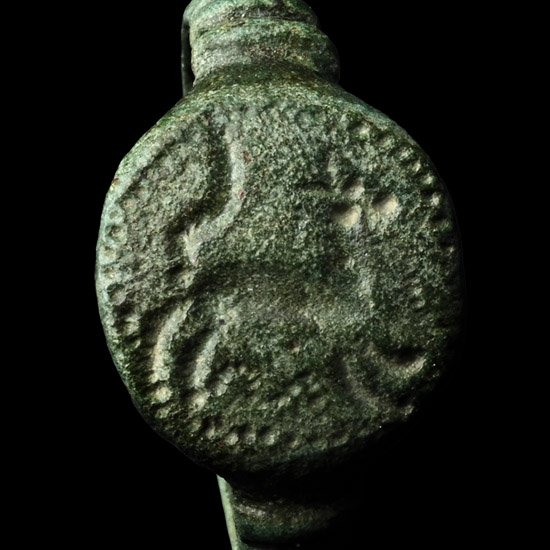
Migration Period Bronze Ring with Animal
6th-8th century A.D.Estimate: £60 - 80 (+bp*)
Bids: 1 | Current Bid: £5
D-section hoop with ribbed shoulders, an oval bezel with a feline in a dynamic pose. 5.86 grams, 24.60 mm overall, 20.29 x 17.00 mm internal diameter (approximate size British O 1/2, USA 7 1/4, Europe 15.61, Japan 15)
Ex German art market, 2000s. Acquired from an EU collector living in London. From the collection of a Surrey, UK, gentleman.

