-
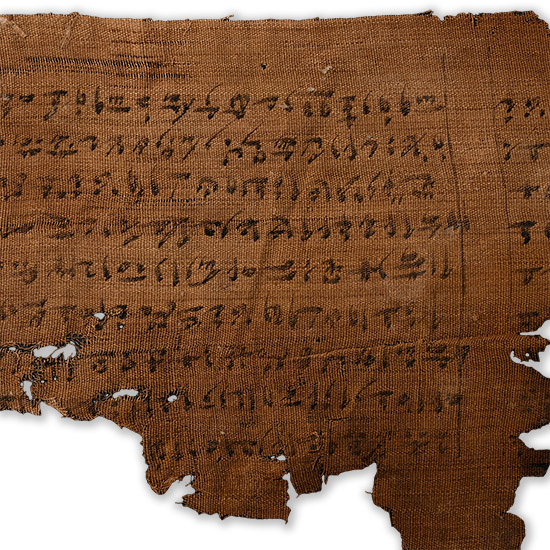
Egyptian Funerary Linen Fragment with Hieratic Text from the Book of the Dead for Ta-sherit-n-ta-ihet
Graeco-Roman Period, circa 3rd century B.C.-2nd century A.D.Estimate: £500 - 700 (+bp*)
Bids: 20 | Current Bid: £1,100
Bearing a portion of Chapter 17, a spell written in late hieratic script executed in black ink on woven linen, consistent with funerary bandages of the Graeco-Roman period; the inscription identifies the owner as a woman named Ta-sherit-n-ta-ihet, with her mother named Iset-(m-)khebit; as is typical for funerary manuscripts of this period, the father’s name is not recorded. 5.08 grams, 22 cm wide
Found inside an 18th-century Bible and believed to be a souvenir acquired in the 19th century. From the private collection of a North American lady. An academically identified and unpublished fragment, offering potential for further scholarly study and publication. Accompanied by a report in progress dated 28 April 2026 by Holly Lund.
Spell 17 is among the most important and widely transmitted compositions in the Book of the Dead, concerned with cosmology, divine knowledge, and the transformation of the deceased in the afterlife. Even in fragmentary form, such texts provide valuable insight into funerary belief and scribal practice during the later phases of ancient Egyptian religion. This description was prepared using information provided by Dr Ann-Katrin Gill, Academic Assistant at the Egyptological Institute, University of Leipzig, and a separate assessment by Steve Vinson, Professor and Director of Graduate Studies in the Department of Middle Eastern Languages and Cultures at Indiana University, Bloomington. The linen fragment may derive from a nineteenth-century mummy unwrapping, a practise widely attested in this period. -
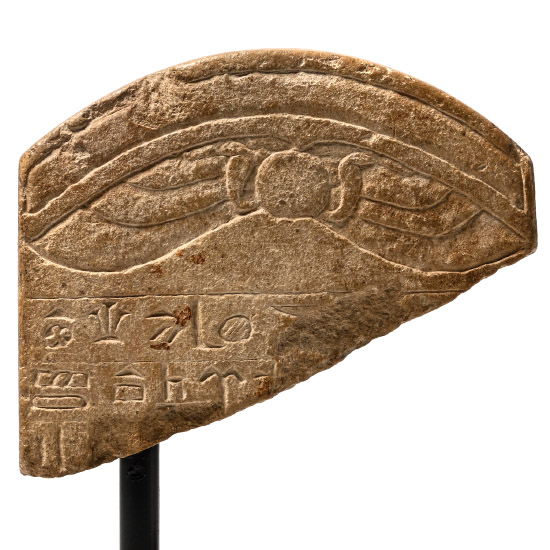
Egyptian Bifacial Magical Stela with Bes
Ptolemaic Period, circa 280-180 B.CEstimate: £500 - 700 (+bp*)
Bids: 7 | Current Bid: £600
Upper portion of an arch-top limestone stele fragment with two dressed faces; the obverse lunette features a winged sun disc flanked by uraei and two partial rows of incised pseudo-hieroglyphs below; the reverse displays the head of the god Bes in high relief, with traces of the head of the young Horus immediately below, who would have been depicted grasping the two partially preserved snakes and a scorpion carved in raised relief to the right; mounted on a custom-made display stand. 450 grams total, 11.6 cm high including stand
Frossart Collection, France, by the 19th century. Private collection, London, UK.
Although fragmentary, this stela is easily recognisable as a Horus cippus or magical stela. They were used to heal ailments caused by snake or scorpion venom. Ancient Egyptians believed that water poured over these cippi would turn into a healing liquid that the afflicted could drink or apply to their bodies. -
.jpg)
Egyptian Bronze Statuette of Young Horus
Late Period, 664-332 B.C.Estimate: £700 - 900 (+bp*)
Bids: 9 | Current Bid: £850
Modelled in the round in striding pose with one arm resting along the body and the right hand raised to his mouth, wearing an elaborate side-lock of youth and Pschent crown fronted by uraeus; mounted on a display stand. 202 grams total, 12.8 cm including stand
with R.H. Blanchard's Egyptian Museum, Cairo, early 20th century. Private collection, London, UK. Accompanied by its original base, retaining the Blanchard label.
Harpocrates is the Greek equivalent of the Egyptian name Hor-pa-khered, which means 'Horus the Child'. This name refers to Horus as the divine infant of Isis and Osiris. Wearing an amulet of Harpocrates was believed to provide the same protection that Isis granted to her beloved son. Larger bronze statuettes, such as this, were probably votive offerings to Harpocrates, intended to secure his favour and protection. -
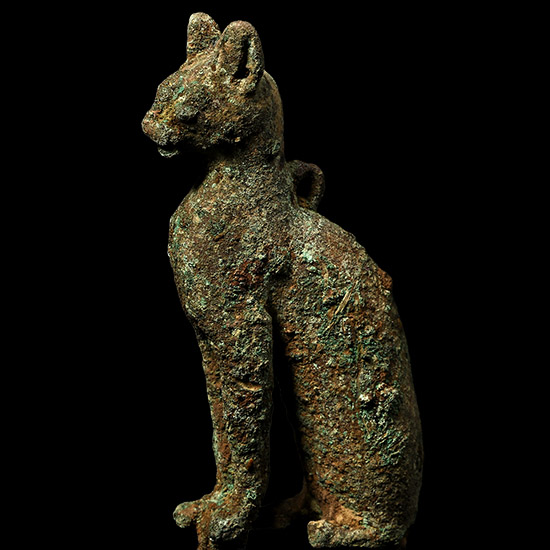
Egyptian Bronze Seated Cat Statuette
Late Period, 664-332 B.C.Estimate: £800 - 1,000 (+bp*)
Opening Bid: £444
Bastet in squatting pose, ears pricked and alert with her tail wrapped close to right side of her body, two short lugs beneath for attachment to a separate base, and a suspension loop behind the shoulders. 74 grams, 87 mm
Acquired on the UK art market, 1990s. Private collection, New York, USA. -
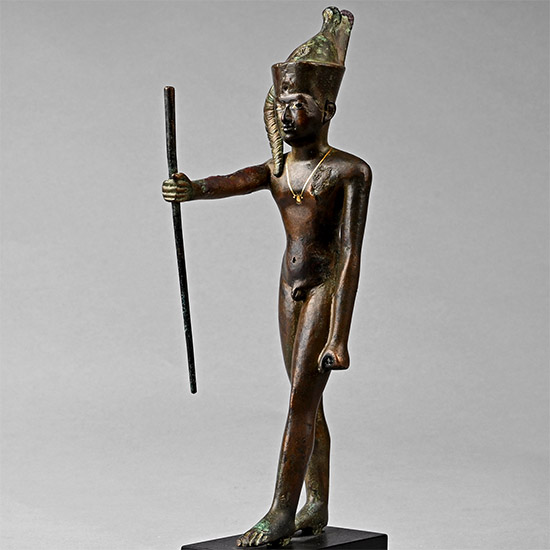
Large Egyptian Bronze Statue of the God Ihy with Gold Necklace and Silver Inlaid Eyes
Late Period, 664-332 B.C.Estimate: £20,000 - 30,000 (+bp*)
Opening Bid: £10,000
Depicted nude in an advancing pose; silver inlaid eyes, braided sidelock of youth; left hand by his side, drilled to accept a separate element, the other outstretched at a right angle to his body, holding a tapering cylindrical staff, not belonging; he may originally have held a sistrum, an ancient Egyptian percussion instrument, or a menat, both closely associated with the goddess Hathor; here, Ihy wears the Pschent crown with remains of uraeus, and an inlaid gold necklace suspended with an ib pendant around his neck; finely detailed facial features, with engraved Nekhbet vulture with outspread wings at the back of the crown; integral lugs on soles of feet; mounted on a custom-made stand. 899 grams total, 25 cm including stand
From the Singer family collection, Germany, acquired circa 1962. with A.A.L., Geneva, 1980. with Christie's, London, 25 April 2015, no.163 [£50,000-£70,000]. Private collection, London, UK. Accompanied by copies of the relevant Christie's catalogue pages. This lot has been checked against the Interpol Database of stolen works of art and is accompanied by search certificate number no.13309-258229.
Ihy was an Egyptian god associated with music, joy, and ritual celebrations, particularly as the divine child of Hathor and of Horus or Ra. He is typically depicted as a youthful figure, often naked or lightly clothed, wearing a sidelock of youth and carrying a sistrum or menat, both percussion instruments closely connected with ritual performances in Hathor's cult, especially at the temples of Dendera and Edfu. His name is generally understood to mean 'the musician' or 'the one who plays music,' although it may also mean 'calf', a reference to his relationship with the cow-goddess Hathor. Bronze statuettes of Ihy, such as this example, were probably produced as votive offerings dedicated in temples, especially those devoted to Hathor. Worshippers may have commissioned such figures in the hope of obtaining divine favour, protection, fertility, healing, or participation in the blessings linked with music and festivity. Some examples may also have served as cult images used in temple ceremonies or as protective objects placed in domestic or funerary settings. -
.jpg)
Egyptian Alabaster and Glass Eye Pair
Late-Ptolemaic Period, 664-30 B.C.Estimate: £800 - 1,000 (+bp*)
Bids: 8 | Current Bid: £1,600
The sclera white alabaster stone and the iris black glass. 15.33 grams, 31mm
From a North American gentleman's collection, 1990s.
Egyptian coffin eye inlays were both decorative and symbolic, intended to make the coffin appear lifelike and assist the deceased in the afterlife. Typically, they featured a white sclera (glass, travertine, alabaster or quartz), a dark iris (glass or often obsidian), and sometimes red paint at the inner corner. The eyes were often set in bronze or copper frames, occasionally with faience or bronze eyebrows. -
.jpg)
Egyptian Diorite Heart Scarab
Late Period, 664-332 B.C.Estimate: £1,000 - 1,400 (+bp*)
Bids: 1 | Current Bid: £5
Finely carved, with naturalistic detailing to the upper body, legs shown folded beneath the body with suspension loop at centre. 7.5 grams, 25 mm
From a 20th century UK collection.
The Egyptians saw the scarab as a symbol of renewal and rebirth. The beetle was associated with the sun god because scarabs roll large balls of dung in which to lay their eggs, a behaviour that the Egyptians thought resembled the progression of the sun through the sky from east to west. Scarab amulets were used for their magical rejuvenating properties by both the living and the dead. The regenerative powers of scarabs, such as the one offered here, could be used by either the living or the dead for healing and protection. -
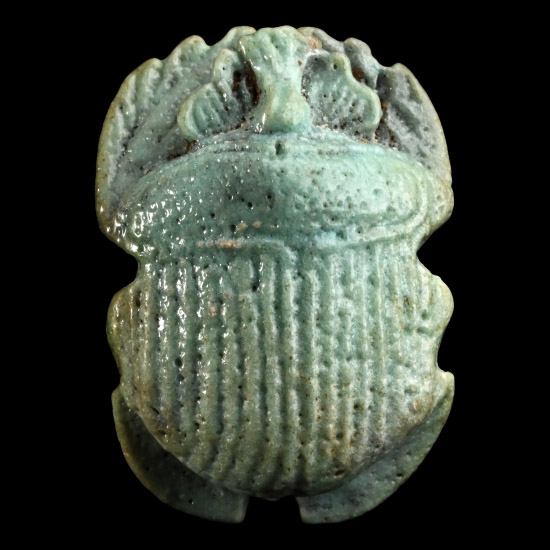
Egyptian Faience Heart Scarab
Late Period, 664-332 B.C.Estimate: £400 - 600 (+bp*)
Bids: 1 | Current Bid: £300
With fine anatomical detailing on the body and striated wingcase, legs folded beneath the body and flanked by a ribbed suspension loop. 1.89 grams, 20 mm
Ex Swedish nobleman's collection, early 20th century, reputedly from Petrie’s excavations. -
.jpg)
Egyptian Black Steatite Eye of Horus Amulet
Late Period, 664-332 B.C.Estimate: £700 - 900 (+bp*)
Bids: 6 | Current Bid: £40
Carved unifacial amulet with hatched eyebrow and ribbed suspension loop. 1.45 grams, 19 mm
From a 20th century UK collection.
The wedjat-eye amulet is a representation of the healed eye of the god Horus, featuring both human and falcon elements. The name Wedjat in ancient Egyptian means ‘the one that is sound.’ According to Egyptian mythology, Horus' eye was wounded or taken by the god Seth and restored by Thoth. The wedjat-eye amulet was thought to protect its wearer and bestow the power of recovery and regeneration onto them. It was very popular and used by both the living and the dead. -
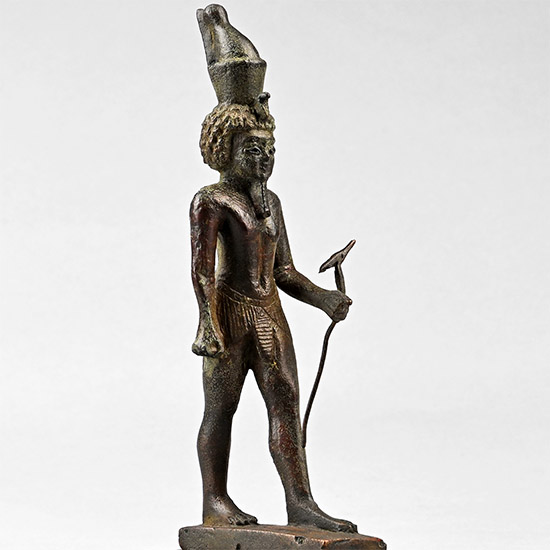
Egyptian Bronze Statuette of the God Neferhotep
Ptolemaic Period, 332-30 B.C.Estimate: £8,000 - 10,000 (+bp*)
Opening Bid: £4,000
Neferhotep depicted advancing on a rectangular base, holding in the left hand the was sceptre, topped with the stylised head of an animal linked to the god Seth, with the right arm held rigid by the side with a clenched fist; wearing a Pschent crown with uraeus above the brow, a short, pleated shendyt kilt, and a broad multi-strand collar; the head features a tightly curled wig, false beard, and lentoid wire rims around the eyes; mounted on a custom-made stand. 345 grams total, 17.3 cm high including stand
Private collection of Mrs Bogaert, formed in 1949, Ghent, near Brussels, Belgium. Ex private collection, London, UK. This lot has been checked against the Interpol Database of stolen works of art and is accompanied by search certificate number no.13310-258230.
Neferhotep was explicitly recognised as a deity with a cult only from the Late Period, although it may have been understood earlier and later as the incarnation of the youthful divine king, since pharaohs from the 18th Dynasty to the Ptolemaic Period are sometimes depicted wearing the same wig. Neferhotep, whose name translates as 'the perfect one is at peace,' was considered to be the son of Hathor and was venerated at Hu (Diospolis Parva), as well as at Karnak, Dendera, and Behbeit el-Hagar. Provenanced statues of the god originate from the Memphite region. -
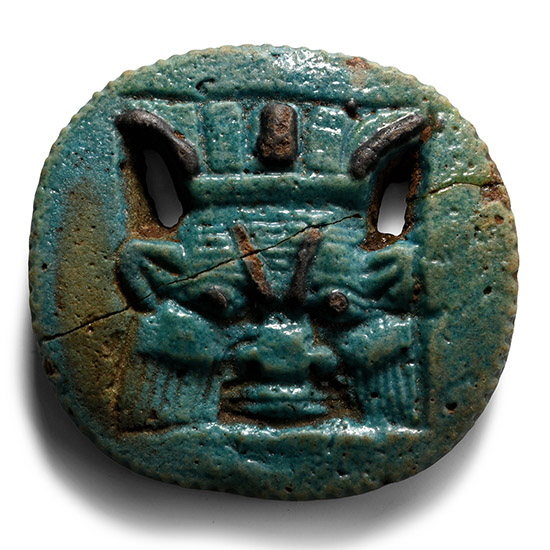
Egyptian Faience Amuletic Bes Plaque
Late Period, 664-332 B.C.Estimate: £1,500 - 2,000 (+bp*)
Bids: 1 | Current Bid: £750
Oval plaque with ribbed outer edge, central depiction of the typically grimacing face of Bes wearing a feathered headdress. 23.8 grams, 52 mm
From an early 20th century collection.
From the New Kingdom onward, Bes became one of ancient Egypt's most popular apotropaic deities. Despite his somewhat fearsome appearance, Bes served as the patron and protector of pregnant women and children and was also believed to shield them from snakes. -
.jpg)
Egyptian Steatite Bust in a Gold Pendant
Ptolemaic-Roman Period, 2nd century B.C.-2nd century A.D.Estimate: £700 - 900 (+bp*)
Opening Bid: £350
Fragment of a carved panel or vessel depicting a female bust, possibly a queen or Isis, modelled in half-round relief, wearing a loosely draped tunic, a tiered wesekh collar, and a heavy curled, tripartite wig; reverse with lotus flower ropework and other ornamentation; mounted in a later gold suspension frame. 8.75 grams, 38 mm
Private collection, Southern France, 1970s. Acquired on the English art market.
This fragment likely originates from an elaborately decorated bowl belonging to a specific group thought to have been made in Alexandria (cf. Page-Gasser, M., Wiese, A.B., Ägypten: Augenblicke der Ewigkeit, Mainz, 1997, for a complete example). The purpose of these bowls is unclear, but they may have been used as votive offerings in sanctuaries.

