-
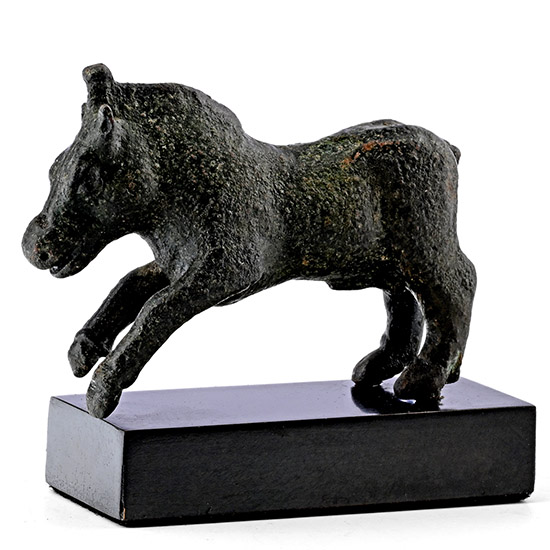
'The Miller' Romano-Celtic Bronze Leaping Boar Statuette
1st century B.C.-1st century A.D.Estimate: £3,000 - 4,000 (+bp*)
Bids: 1 | Current Bid: £2,250
Depicted in a dynamic pose with its front legs raised and the weight of the body borne on its hind legs, flared nostrils and large, round eyes; mounted on a custom-made display stand. 165 grams total, 73 mm wide including stand
Found Hampshire, UK, in the 1980s. From the collection of the late David Miller of Hemel Hempstead, UK, and a Cambridge collection of the 2000s. Accompanied by a previously illustrated catalogue card with provenance. This lot has been checked against the Interpol Database of stolen works of art and is accompanied by search certificate number no.13378-258774.
The small statuettes of boars found in Roman Britain and Gaul were likely used as votive figurines for cult places. They were widespread in the Roman provinces of Celtic origin. However, one cannot exclude the fact that many boars found in Britain belong to the pre-conquest era. One of the few types of bronze figurines that are known to precede the arrival of the Romans is, in fact, that of the boars. -
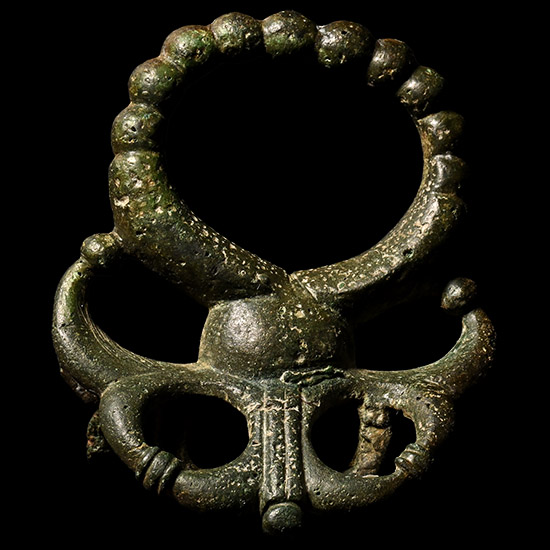
Celtic Bronze Openwork Chariot Teret Ring
Iron Age, 1st century B.C.-1st century A.D.Estimate: £200 - 300 (+bp*)
Bids: 1 | Current Bid: £110
Comprising: a substantial ring, the upper section formed as a series of conjoined bulbs, the lower portion lentoid in section springing from a bulb; the bulb mounted on a base, C-shaped in section, carinated and recurved at each end to terminate in a knop attached to the underside of the ring; the base developing to a vertical strap with flanking crescent horns meeting at a ribbed collar; beneath the bulb, a rectangular loop to accept a bridle strap; one side of base absent. 64.6 grams, 63 mm
Acquired on the UK art market. Property of a Lancashire, UK, collector.
The design features of the terret are consistent with Insular La Tène art of the last centuries B.C., such as the returned horns with knop finials and the crescent motifs. -
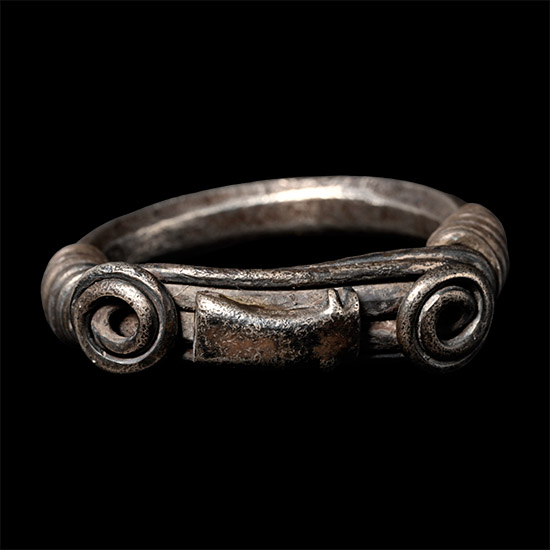
Central Balkans Silver Ring with Spiralled Terminals and Axe Motif Ornament
Iron Age, 1st-2nd century A.D.Estimate: £700 - 900 (+bp*)
Bids: 2 | Current Bid: £650
Robust ring of octagonal section, fashioned from drawn and hammered wire, the hoop terminating in tightly coiled spirals, which flank a rectangular ornament soldered across the bezel, recalling a miniature axe-head; the coils further reinforced with wrapped silver wire, securing the decorative composition. 8.30 grams, 28.40 mm overall, 21.70 x 19.32 mm internal diameter (approximate size British T 1/2, USA 9 3/4, Europe 21.89, Japan 21)
Bonhams, Fine Antiquities, 4 July 1998, no.19. Private collection, UK, 1990s. with Rupert Wace Ancient Art Ltd, London. with Ariadne Galleries, New York and London, acquired from the above at TEFAF 2014, New York. Private American collection, acquired from the above, 23 January 2017.
This ring belongs to the repertoire of autochthonous Balkan silverwork that flourished from the Roman conquest through the mid-3rd century. The type is closely related to ornaments documented in the Tekija and Bare hoards, where bracelets and rings with spiral-wrapped ends and miniature axes appear as apotropaic symbols. While the axe motif was deeply embedded in Dacian and Balkan visual culture, its execution here in silver, combined with wire wrapping and spiralled terminals, reflects the enduring influence of Hellenistic toreutics upon local craftsmanship. Rather than a Viking jewel, the ring finds its most convincing parallels among the Balkan-Danubian silver hoards of the early Roman Empire. -
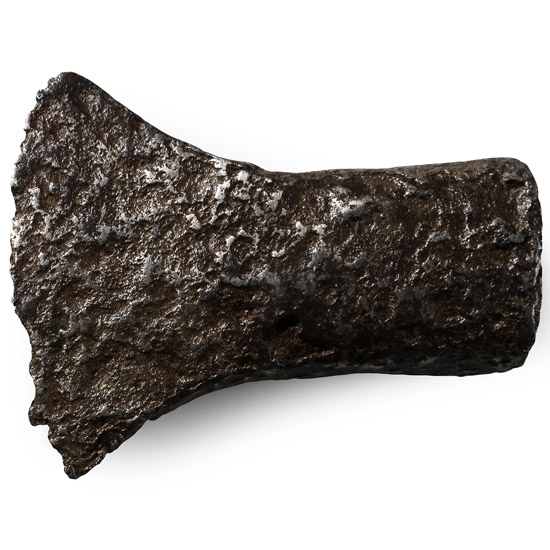
Celtic Iron Closed Socketted Splayed Axehead
Late Hallstatt-Early La Tene Period, circa 450 B.C.Estimate: £40 - 60 (+bp*)
Bids: 4 | Current Bid: £26
Splayed blade and a rectangular-section socket. 124 grams, 73 mm
Ex M. Spiegelberg collection, since 1989-1992; thence by descent. Accompanied by a copy of a previous yellow cataloguing slip. -
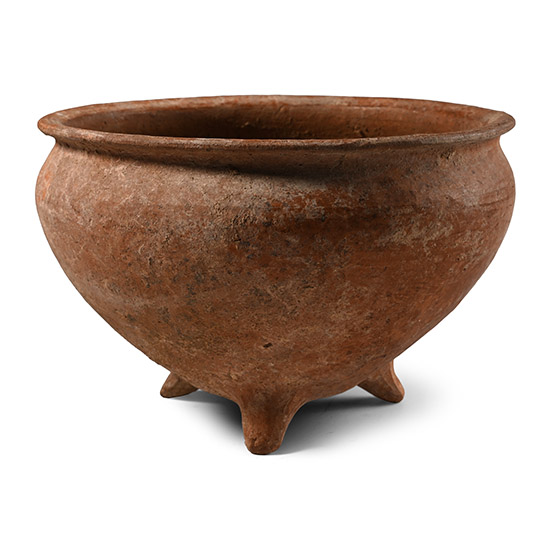
Iron Age Belgic Terracotta Tripod Bowl
2nd century B.C.-1st century A.D. or laterEstimate: £150 - 200 (+bp*)
Bids: 3 | Current Bid: £20
Comprising a wide body with an everted rim, three flaring stub legs beneath the bowl; an old inked collector's number '2' on the side. 500 grams, 16.5 cm
Previously from the Eileen Lewenstein collection, gifted in the 1970s. From the Ffestiniog pottery collection, Wales, UK. -
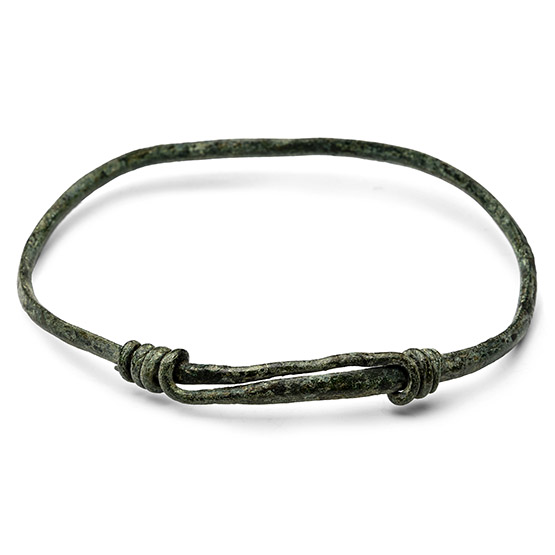
Celtic Bronze Armlet with Coiled Bezel
Iron Age, circa 2nd century B.C.-1st century A.D.Estimate: £80 - 100 (+bp*)
Opening Bid: £40
Formed from a single lentoid-section rod with the ends wound around the shank in a sliding knot. 22.2 grams, 88 mm
From the collection of a late Gloucestershire, UK, collector. -
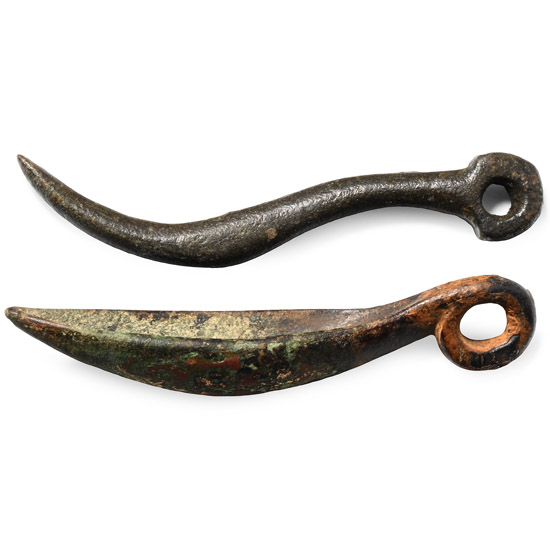
Celtic Bronze Cosmetic Woad Grinder Set
Iron Age, 1st century B.C.-1st century A.D.Estimate: £60 - 80 (+bp*)
Bids: 4 | Current Bid: £25
Comprising a scaphoid mortar with thick loop finial; separate grinder with hooked point and ring finial. 20.3 grams total, 60-61 mm
From the private collection of Mr Brian Edwards, New Malden, Surrey, UK, formed from the late 1970s-early 1980s; thence by descent. -
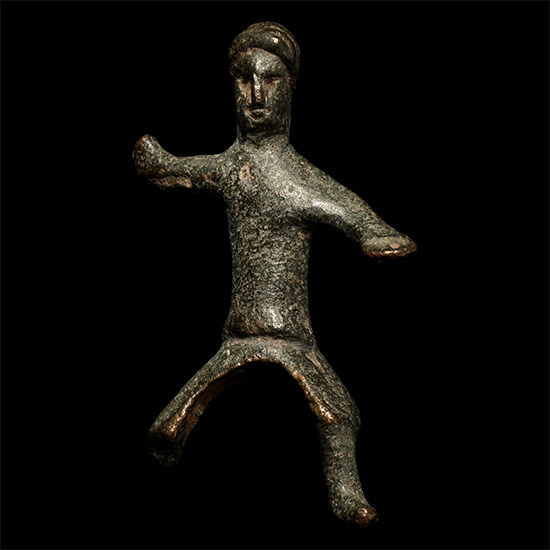
Celtic Bronze Rider Figure
Iron Age, 1st century B.C.-1st century A.D.Estimate: £60 - 80 (+bp*)
Bids: 5 | Current Bid: £50
Modelled in the round, male with legs in a straddling pose, wearing a tight-fitting coat, left hand thrust forward and right arm raised; tunic spread out to the rear. 20.3 grams, 50 mm
From the private collection of the late collection of Mr M., Waterlooville, Hampshire, UK, formed from the late 1980s to early 1990s. -
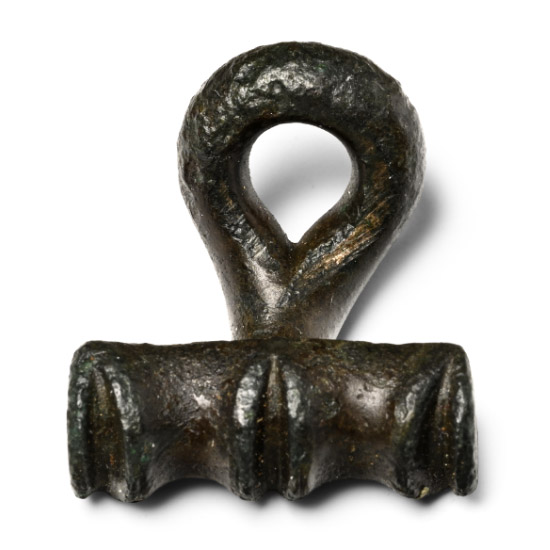
British Celtic Bronze Toggle and Loop Fastener
Iron Age, 1st century B.C.-1st century A.D.Estimate: £30 - 40 (+bp*)
Bids: 1 | Current Bid: £5
Button-and-loop fastener with D-section segmented face, flared arm with round-section attachment loop. 17.5 grams, 28 mm
Found Wilden, Bedfordshire, UK. Recorded with UKDFD no.53478. -
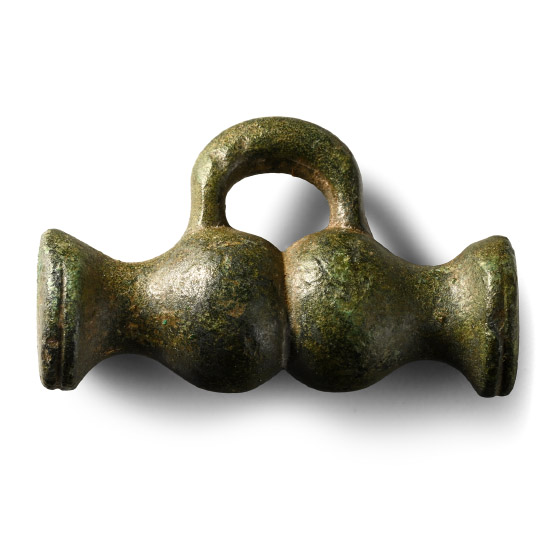
British Celtic Bronze Toggle and Loop Fastener
Iron Age, 1st century B.C.-1st century A.D.Estimate: £30 - 40 (+bp*)
Bids: 3 | Current Bid: £20
With median loop and gusseted disc finials, baluster-shaped in profile. 14.29 grams, 29 mm
Found Wilden, Bedfordshire, UK. Recorded with UKDFD no.53125. -
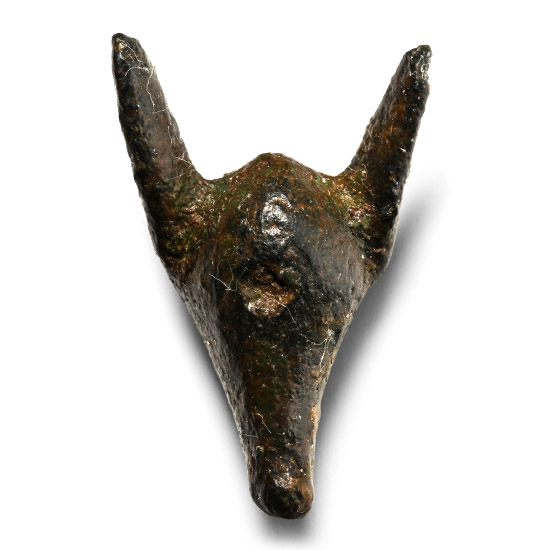
British Celtic Bronze Dog's Head
Iron Age, 1st century B.C.-1st century A.D.Estimate: £40 - 60 (+bp*)
Bids: 3 | Current Bid: £37
A stylised zoomorphic head, roughly pear-shaped and flattened on the underside, with slender ears angling upwards at the back; vertical perforation to the centre; area of iron corrosion at the base indicating the now-missing rivet. 4.18 grams, 23 mm
Found Titchmarsh, East Northamptonshire, UK. Accompanied by a copy of the British Museum's Portable Antiquities Scheme (PAS) report no.BH-F944D6 -
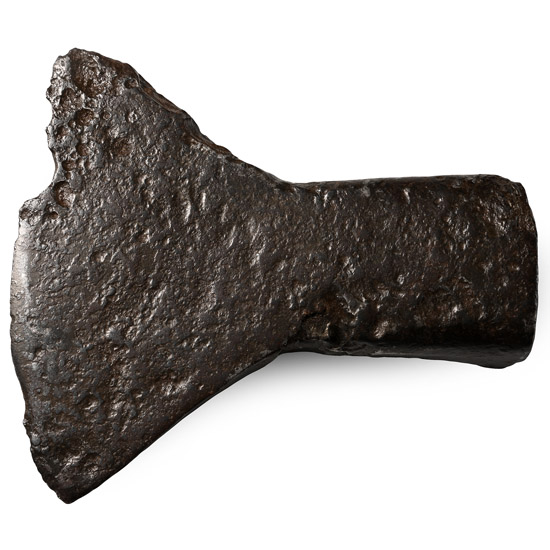
Large Celtic Iron Open Socketted Splayed Axehead
Late Hallstatt-Early La Tene Period, circa 450 B.C.Estimate: £50 - 70 (+bp*)
Bids: 3 | Current Bid: £20
With a flaring blade and a rectangular socket open on one side. 424 grams, 12.5 cm
Ex M. Spiegelberg collection, since 1989-1992; thence by descent. Accompanied by a previous yellow cataloguing slip.

