-
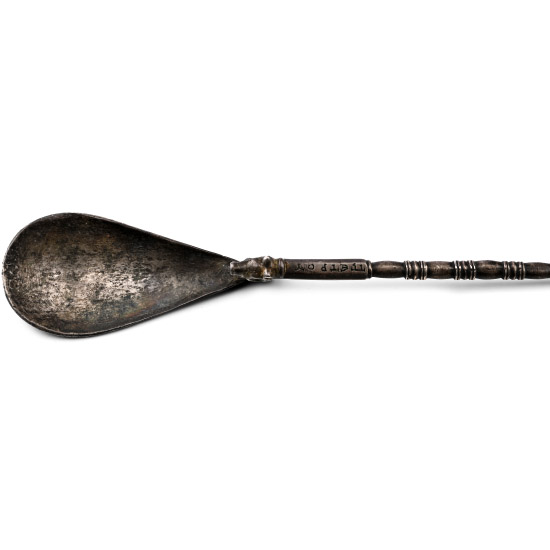
Late Byzantine Silver Spoon with 'St Peter' Inscription on the Handle
Late 6th-8th century A.D.Estimate: £800 - 1,000 (+bp*)
Bids: 1 | Current Bid: £400
Featuring a large, shallow piriform bowl, stepped junction with a boar's head above, a hexagonal-section stem extending from behind the boar's neck bearing a Greek inscription 'TTETPOY' (of Peter); a balustered handle with a cuboid, striated finial. 60.77 grams, 21.5 cm
Acquired on the UK art market. Private collection, Surrey, UK.
The inscription suggests that the spoon may have had a liturgical purpose, associated with the Holy Communion. Still today in the Orthodox Church, the Body and Blood of Christ are dispensed with similar liturgical objects. The name Peter can be associated with the church, or simply with the owner of the liturgical artefact. -
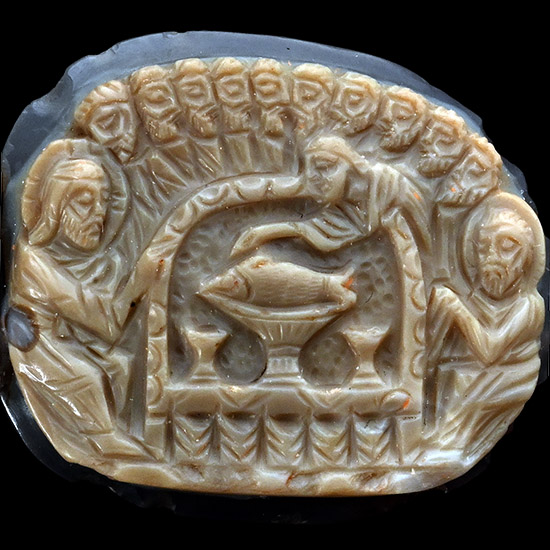
Byzantine Carved Agate Cameo of The Holy Banquet
6th-8th century A.D.Estimate: £4,000 - 6,000 (+bp*)
Bids: 1 | Current Bid: £3,200
Plano-convex in section with low-relief carving: scene with a meal at a so-called sigma table surrounded by Christ, Peter, John and the other disciples; Christ and Peter attending and beardless Saint John the Evangelist preparing the fish. 9.95 grams, 32 mm
From a North American gentleman's collection, 1990s. This lot has been checked against the Interpol Database of stolen works of art and is accompanied by search certificate number no.13368-259040.
In early Byzantine art, Saint Peter is often depicted as the only figure apart from Christ to be shown with a nimbus, to emphasise his pre-eminent position as a church father and the 'rock' of the church. -
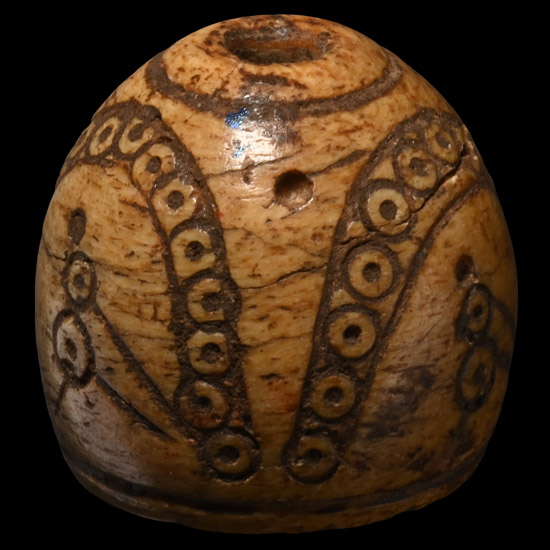
Byzantine Engraved Bone Spindle Whorl with Birds Below Canopy
Circa 8th-12th century A.D.Estimate: £80 - 100 (+bp*)
Opening Bid: £44
Barrel-shaped with incised ring-and-dot ornament forming an arcade. 7.78 grams, 17.78 mm
Ex Abelita family collection, 1980s-2000s. -
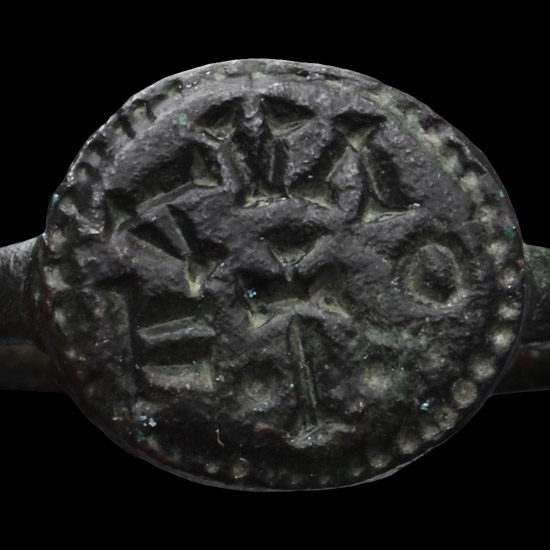
Byzantine Bronze Ring with Cross and Inscription
Circa 7th-9th century A.D.Estimate: £80 - 100 (+bp*)
Bids: 1 | Current Bid: £5
Slender round-section hoop and a discoid bezel with a central cross flanked by two pellets and inscription 'πAVΛO' (= to Paul). 5.20 grams, 25.77 mm overall, 19.26 mm internal diameter (approximate size British S 1/2, USA 9 1/4, Europe 20.63, Japan 19)
Ex German art market, 2000s. Acquired from an EU collector living in London. From the collection of a Surrey, UK, gentleman. -
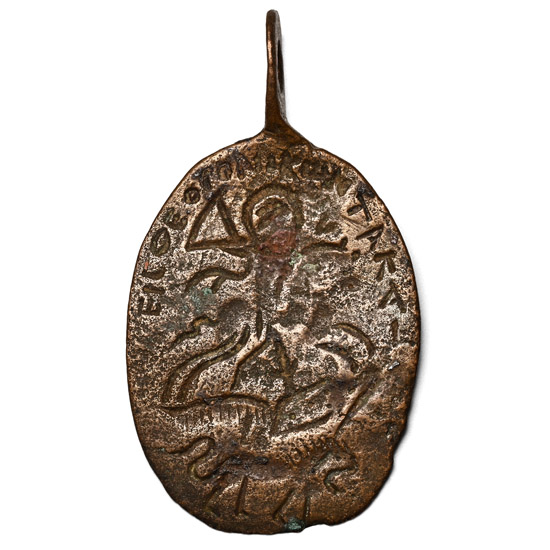
Eastern Roman Bronze Amulet with Saint Spearing the Dragon
Circa 14th century A.D.Estimate: £100 - 140 (+bp*)
Bids: 5 | Current Bid: £31
Oval pendant with integral suspension loop, one side with armoured Saint Theodore or Saint George on horseback slaying the dragon with a barbed spear, a lion beneath and a Greek inscription on the upper edge 'EICΘEOCONIKѠNTAKAK = εἷς θεός ὁ νικῶν τά κακ(ά)' = the one god who defeats evil; the reverse with four animals (two lions, a snake, an ibis and a scorpion) reaching towards an altar or a boat, a Greek inscription above 'ПІΝѠCAΒAѠΘΜIΧAΗΛ' = I drink, The God of the hosts, Michael. 8.77 grams, 56 mm
From the private collection of a European gentleman (1942-2024), formed since the 1970s. -
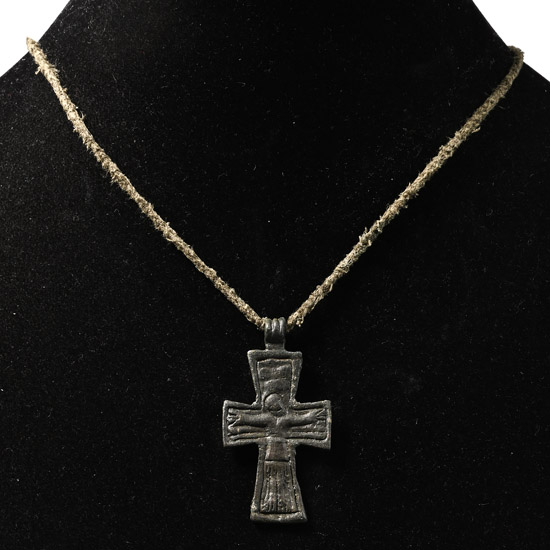
Byzantine Bronze Cross Pendant
Circa 10th-12th century A.D.Estimate: £60 - 80 (+bp*)
Bids: 13 | Current Bid: £170
Expanding cross pendant with integral ribbed loop and a low-relief Corpus Christi on the obverse, suspended from a later fabric cord. 11.3 grams total, pendant: 53 mm
Acquired at the York Fair. Property of a Lancashire, UK, collector. -
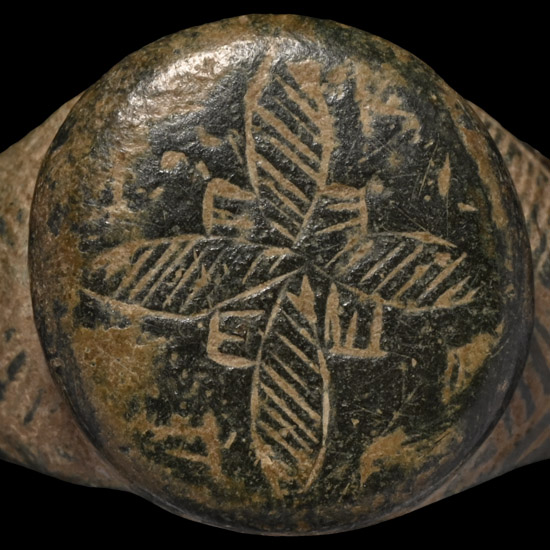
Byzantine Bronze Ring with Floral Cross
Circa 6th-8th century A.D.Estimate: £40 - 60 (+bp*)
Bids: 2 | Current Bid: £10
With broad hoop and stud to the underside, drum-shaped bezel with hatching to the shoulders, incuse hatched cross. 15.11 grams, 26.76 mm overall, 19.02 mm internal diameter (approximate size British Q 1/2, USA 8 1/4, Europe 18.12, Japan 17)
From the private collection of Mr Brian Edwards, New Malden, Surrey, UK, formed from the late 1970s-early 1980s; thence by descent. Accompanied by the original collector's data sheet(s) with reference no.A89. -
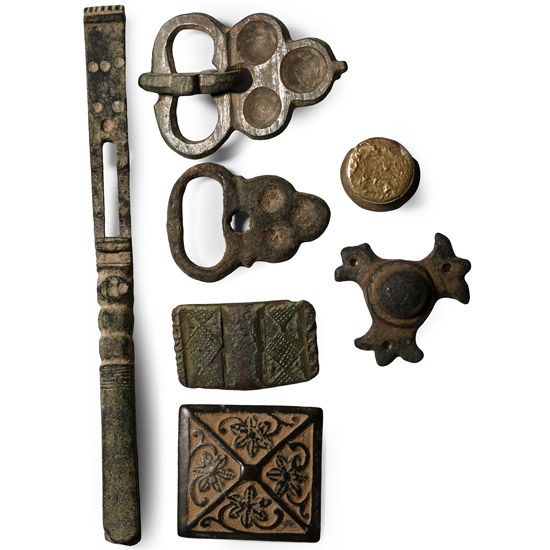
Byzantine Bronze Artefact Collection
6th-12th century A.D.Estimate: £40 - 60 (+bp*)
Bids: 2 | Current Bid: £10
Including a book-clamp with sliding catch, belt buckle with trefoil plate and other items. 51.8 grams total, 14-96 mm
From the private collection of Mr Brian Edwards, New Malden, Surrey, UK, formed from the late 1970s-early 1980s; thence by descent. -
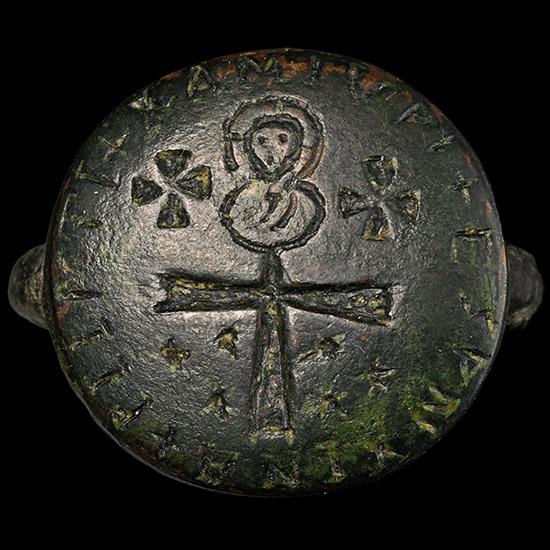
Large Byzantine Bronze Ring with Cross and Saint
Circa 6th-7th century A.D.Estimate: £300 - 400 (+bp*)
Bids: 1 | Current Bid: £55
Comprising a thick round-section hoop and integral disc bezel; incuse cross with nimbate bust above flanked by two equal-arm crosses, enigmatic legend to the rim. 18.62 grams, 30.50 mm overall, 23.22 mm internal diameter (approximate size British U 1/2, USA 10 1/4, Europe 23.15, Japan 22)
Acquired circa 1980. Property of a Middlesex gentleman. -
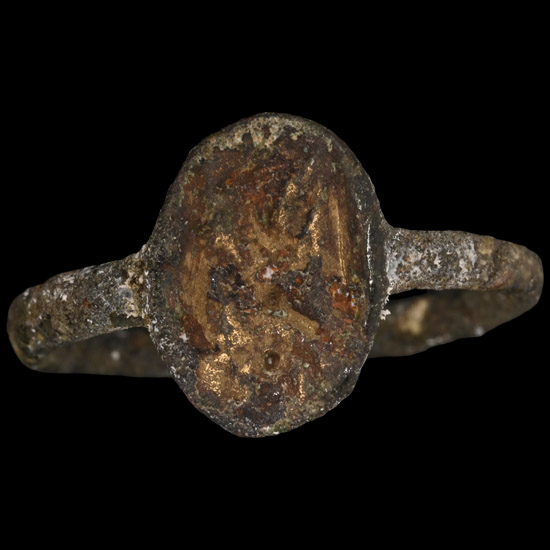
Byzantine Bronze Ring with Saint
6th-7th century A.D.Estimate: £30 - 40 (+bp*)
Bids: 1 | Current Bid: £5
Featuring a D-section hoop and a perpendicular oval hoop with a standing saint holding a staff. 2.17 grams, 23.65 mm overall, 20.39 mm internal diameter (approximate size British U, USA 10, Europe 22.52, Japan 21)
From the private collection of a European gentleman (1942-2024), formed since the 1970s. -
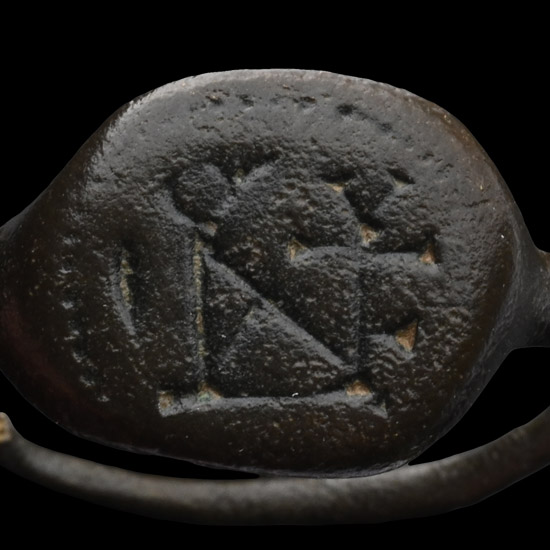
Byzantine Bronze Ring with Monogram
Circa 6th-8th century A.D.Estimate: £60 - 80 (+bp*)
Bids: 1 | Current Bid: £5
Slender round-section hoop with an oval bezel bearing a monogram, the hoop split. 4.58 grams, 24.60 mm overall, 21.30 mm internal diameter (approximate size British U 1/2, USA 10 1/4, Europe 23.15, Japan 22)
Ex German art market, 2000s. Acquired from an EU collector living in London. From the collection of a Surrey, UK, gentleman. -
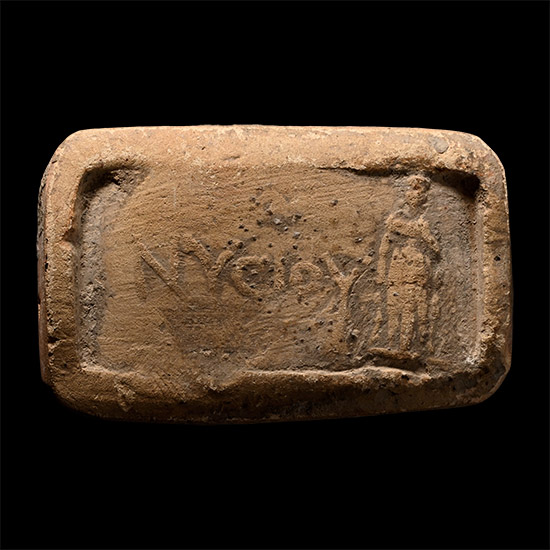
Byzantine Terracotta Tile with NYCIOY
6th-8th century A.D.Estimate: £40 - 60 (+bp*)
Bids: 1 | Current Bid: £5
Rectangular in plan with raised lip enclosing scene with standing female figure in ankle-length robe, legend 'ΝΥCΙΟΥ' (for νησιού 'belonging to Nisios'). 28.3 grams, 45 mm
From the private collection of Mr Brian Edwards, New Malden, Surrey, UK, formed from the late 1970s-early 1980s; thence by descent.

