-
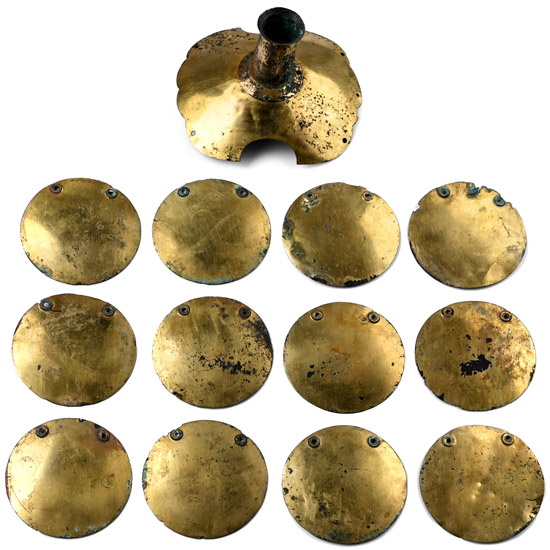
Byzantine Age Gilt Bronze Horse Bridle Decoration Group
9th-10th century A.D.Estimate: £1,500 - 2,000 (+bp*)
Bids: 6 | Current Bid: £30
Comprising: a domed cap with lateral scoops and attachment holes to the edges, a central applied tapering tube with flared rim; twelve gently domed disc-scales with two attachment points. 357 grams total, 8.2-13.3 cm
From the private collection of a London gentleman, from his grandfather's collection formed before the early 1970s.
The cap is provided with a plume-holder and two lateral slots for the ears; the scales decorate the rest of the bridle or harness. -
.jpg)
Byzantine Gilt Bronze Horse Harness Decoration Set
8th-10th century A.D.Estimate: £1,200 - 1,700 (+bp*)
Bids: 3 | Current Bid: £1,080
Comprising: a large octofoil harness frontal plate with beaded rim and granulation; studs with quatrefoil plates; bell-shaped dangles. 556 grams total, 11-92 mm
From the private collection of a London gentleman, from his grandfather's collection formed before the early 1970s. This lot has been checked against the Interpol Database of stolen works of art and is accompanied by a search certificate number no.12687-234699.
The military technology of Byzantium and Khazar Kingdom were interconnected in the 8th-10th centuries A.D. Many military items, like horse harnesses, were produced in both countries and object of interchange between the two military cultures. -
.jpg)
Byzantine Gold Marriage Ring
Circa 6th-7th century A.D.Estimate: £5,000 - 7,000 (+bp*)
Bids: 3 | Current Bid: £4,700
D-section hoop with expanding shoulders, trumpet-shaped bezel with two facing busts and a cross between and a nimbate bearded bust above, legend 'OMONOIA' (harmony) below. 9.62 grams, 23.93 mm overall, 18.92 mm internal diameter (approximate size British R 1/2, USA 8 3/4, Europe 19.38, Japan 18)
From an important Byzantine collection, formed in the 1970s, Surrey, UK. This lot has been checked against the Interpol Database of stolen works of art and is accompanied by search certificate number no.13347-258734.
The marriage ring is one of the typologies in which figural decorations are frequently found. Generally speaking, marriage rings are engraved with a representation of a husband and wife, sometimes accompanied by Christ, and usually engraved with wishes for 'harmony, health and the grace of God'. Rings of this type had been used since the late 4th century A.D. and remained extremely popular in Byzantium in the 6th and 7th centuries. -
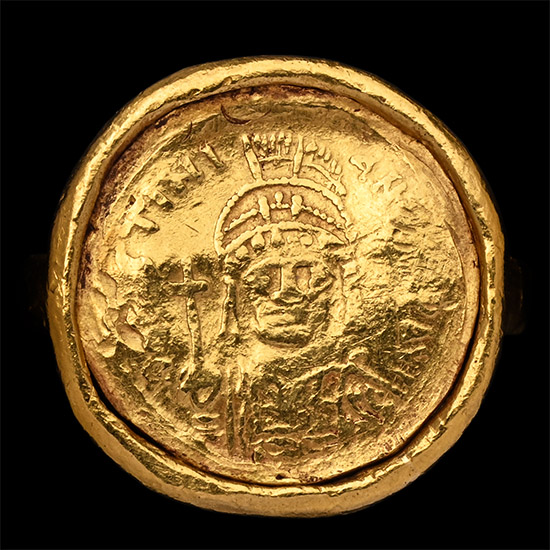
Byzantine Gold Solidus in Gold Ring
6th century A.D.Estimate: £2,500 - 3,500 (+bp*)
Opening Bid: £1,300
The coin showing a facing bust of a pearl-diademed emperor, cuirassed and holding a cross; set in a thick frame with a double rectangular-section hoop below; the solidus a cast or barbarised version. 21.14 grams, 24.51 mm overall, 17.47 x 16.14 mm internal diameter (approximate size British J 1/2, USA 5, Europe 9.32, Japan 9)
Acquired on the European art market. This lot has been checked against the Interpol Database of stolen works of art and is accompanied by search certificate number no.13338-257893.
The coin represents a frontal bust of Justinian I in a helmet (kamelaukion) with a plume, a diadem with trefoil ornament on the front, and a cuirass decorated with four pellets. Globus cruciger in right hand, shield with horseman device on left shoulder. Inscription: DNIVSTINIANVSPPAVC (Dominus Noster Justinianus Semper Augustus). Probably Mint of Rome 537-542. -
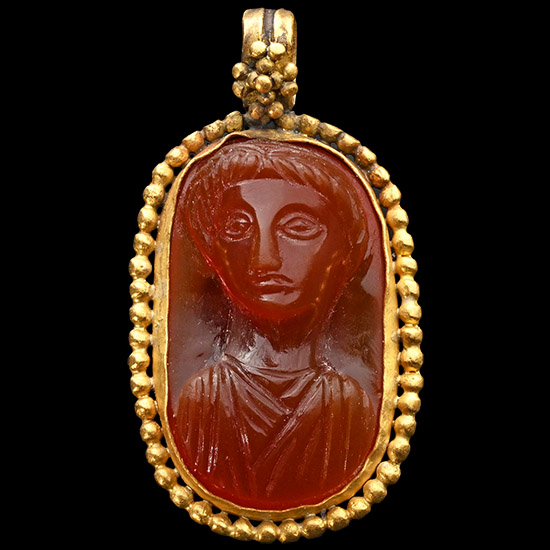
Byzantine Gold Pendant with Carnelian Cameo Bust
Circa 3rd-6th century A.D.Estimate: £3,000 - 4,000 (+bp*)
Opening Bid: £1,500
Carved bust modelled in the half-round with large lentoid eyes and braided hair to the brow, depicting a disciple, an apostle, or a portrait; gold cell with band of granules to the outer edge, ribbed suspension loop with granule detailing. 8.97 grams, 39 mm
From a North American gentleman's collection, 1990s. This lot has been checked against the Interpol Database of stolen works of art and is accompanied by search certificate number no.13367-259037.
Towards the end of the 3rd century, the Roman production of gemstones decreased quickly. At the same time, early Christian motifs appeared on the gemstones. Rare motifs like the one in the current gemstone show portraits of noblewomen or men. -
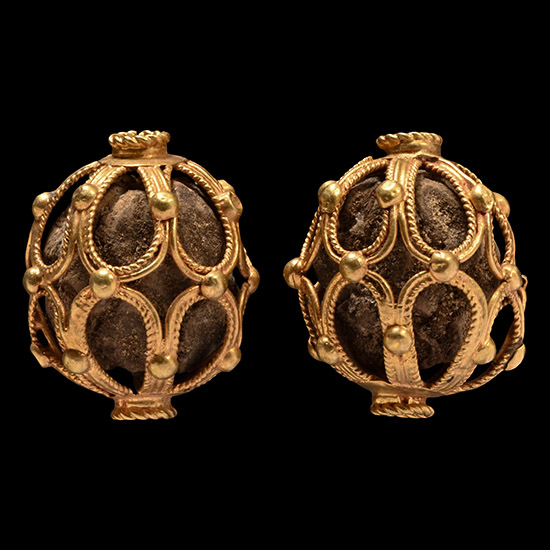
Byzantine Gold Openwork Beads from Earrings
10th-11th century A.D.Estimate: £550 - 750 (‡+bp*)
Opening Bid: £275
Each a spherical cage with ropework texturing, a granule at each node; oval glass bead within. 13.8 grams, 22 mm each
Acquired on the Swiss art market, 1998. Private collection, Europe.
The openwork beads were prepared to be inserted in an earring of ‘Grapevine’ typology, III type of earring in the Niederle classification. Similar specimens, imported from Byzantium, were found in Tokaj (Hungary) and dated to the time of the Emperor Romanus Lekapenos (920-944 A.D.). -
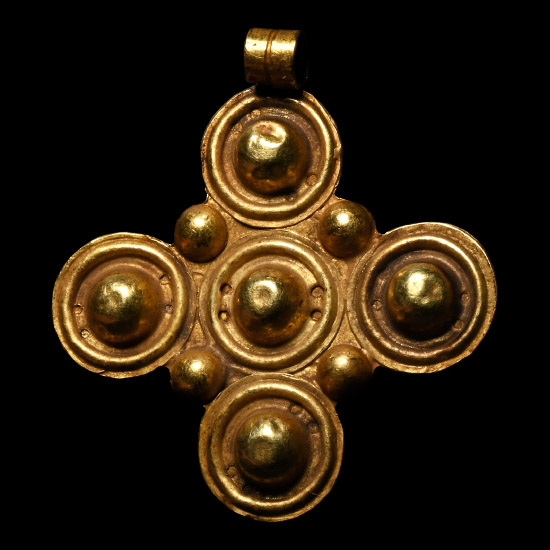
Byzantine Gold Cross Pendant with Bosses
Circa 6th-8th century A.D.Estimate: £800 - 1,000 (+bp*)
Bids: 1 | Current Bid: £500
Formed of five hemispherical bosses, likely representing the five wounds of Christ, with a small raised boss at each junction; applied suspension loop. 3.41 grams, 35 mm
UK private collection before 2000. London collection, acquired on the UK art market. -
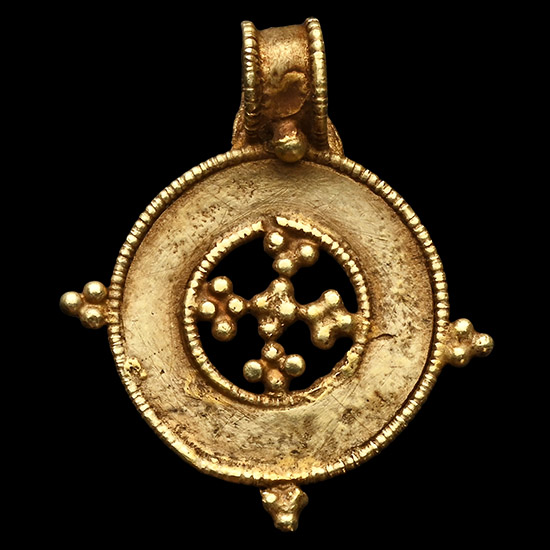
Byzantine Gold Cross Pendant
Circa 6th-8th century A.D.Estimate: £600 - 800 (+bp*)
Bids: 2 | Current Bid: £40
Comprising an annular plaque with beaded wire frame to inner and outer edges, granule clusters to three cardinal points and a cruciform cluster to the centre; a suspension loop with cluster at the junction and beaded wire edges. 1.88 grams, 24 mm
From a North American gentleman's collection, 1990s. -
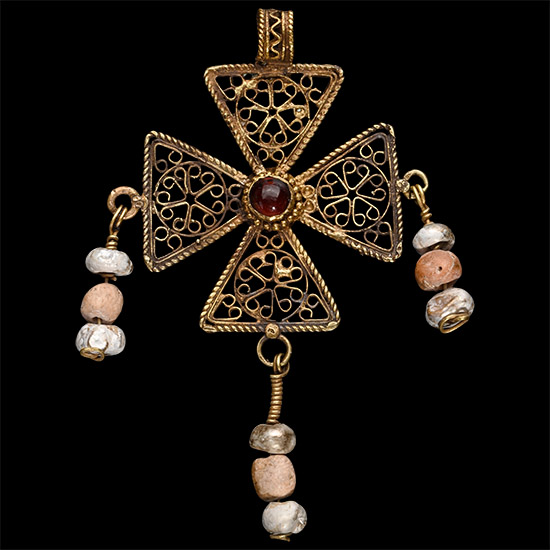
Byzantine Filigree Gold Cross Pendant with Bead Drops
Circa 6th-8th century A.D.Estimate: £1,500 - 2,000 (+bp*)
Bids: 1 | Current Bid: £100
Formed as a Maltese cross, each arm with twisted filigree frame and filigree coils, dangle to the outer end with pearl and other beads (pearls ancient but possibly not original), central stepped cell with beaded collar and inset garnet cabochon, loop with filigree detailing. 3.68 grams, 50 mm
From a North American gentleman's collection, 1990s. -
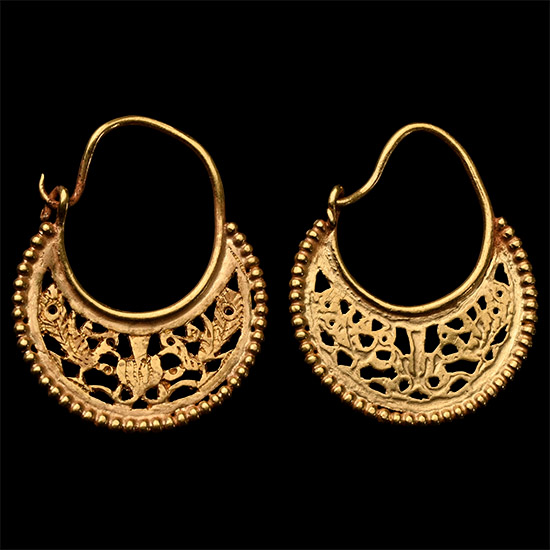
Byzantine Gold Openwork Earring Pair
6th-8th century A.D.Estimate: £1,000 - 1,400 (+bp*)
Bids: 2 | Current Bid: £650
Each a crescent plaque with beaded borders, sprung hook and catch; openwork foliage motif with two opposing birds. 5.75 grams total, 28-29 mm
Private collection, 1990s-early 2000s. -
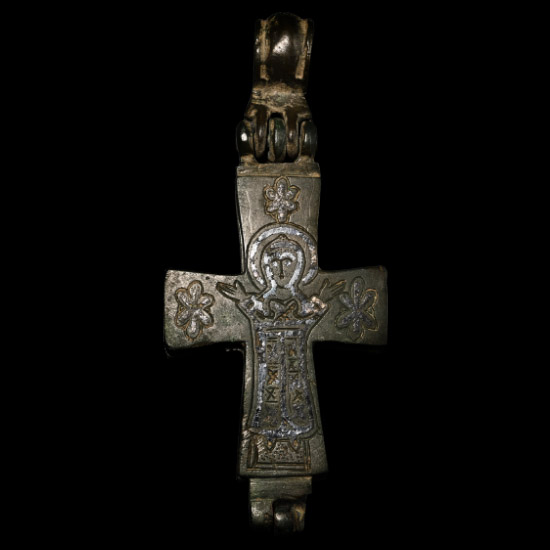
Large Byzantine Bronze Reliquary Cross Pendant with Christ
Circa 10th-12th century A.D.Estimate: £800 - 1,000 (+bp*)
Bids: 12 | Current Bid: £800
Enkolpion with hinged loop; obverse with low-relief nimbate Corpus Christi with arms extended laterally, inlaid silver detailing; reverse with robed figure in orans pose with silver detailing to nimbus and robe. 123 grams, 11.2 cm
From the private coin collection of a West London, UK, gentleman, formed since the mid 1980s. -
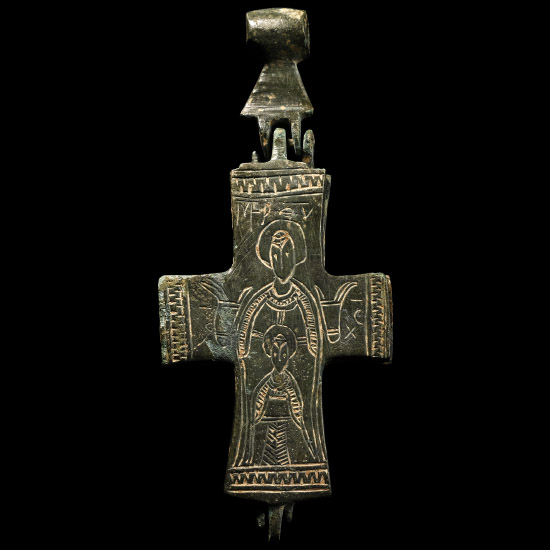
Large Byzantine Bronze Reliquary Cross Pendant with Saint George and Mary
Circa 10th-12th century A.D.Estimate: £400 - 600 (+bp*)
Bids: 11 | Current Bid: £110
With separate hinge and suspension loop; obverse with nimbate robed figure in a tondo with legend 'ΓΕΟΡΓ[Η]' (St George); reverse with robed and nimbate figure in orans pose with 'ICX' beneath each wrist, smaller nimbate figure before, legend 'MHP ΘV' (Mother of God). 82 grams, 10.8 cm
From the private collection of a West London, UK, gentleman, formed since the mid 1980s.

