-
.jpg)
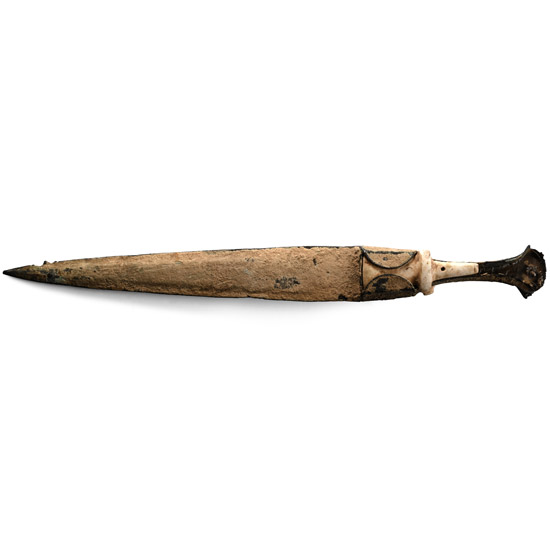
Scythian Iron Wide-Bladed Sword with Engraved Decoration
6th-5th century B.C.Estimate: £2,000 - 3,000 (+bp*)
Opening Bid: £750
Double-edged blade with a triangular point and squared shoulders, vertical ornamental lines on both sides of the blade, strong hilt with an engraved wave-like decoration on one side. 603 grams, 68 cm
From the private collection of a London gentleman, from his grandfather's collection formed before the early 1970s. Accompanied by an academic report by Dr Raffaele D'Amato. This lot has been checked against the Interpol Database of stolen works of art and is accompanied by search certificate number no.13300-257655.
From the 7th century B.C., the Scythian sword appears to be a two-edged, almost parallel-sided blade tapering towards the point, about 50-60 cm long, rarely reaching 70 cm in length. The present sword can be considered to be a particular type of Scythian akinakes, with strong influences from the Urartian Caucasian culture. The sword is very similar to an example from the Haimanova Mohyla barrow, and the hilt is similar to an example visible on the relief from the Yubilejnoe settlement (Lifanti-Shelekhan, 2022 figs.8,11), where swords of the Sindo-Maeotian type are depicted. -
Luristan Bronze Dagger
13th century B.C.Estimate: £1,000 - 1,400 (+bp*)
Bids: 1 | Current Bid: £900
With a lentoid-section blade, tongue-shaped in plan, with an integral tapering hilt with flared finial, lateral flanges to accept the remains of a panel of cream-coloured stone to each face which would have formed the grip. 255 grams, 32.7 cm
Acquired on the UK art market, 1990s. Private collection, New York, USA.
The art of Luristan can be described as the art of nomadic herdsmen and horsemen with an emphasis on the crafting of small, easily portable objects, among these a great number of bronze weapons. The rich and noble aristocrats of Luristan, Elamites, Hurrians, Lullubians, Kutians, and Kassites went to battle splendidly equipped and wore magnificent bronze armour, using maces, spears and daggers as offensive weapons, alongside spears, bows and arrows. -
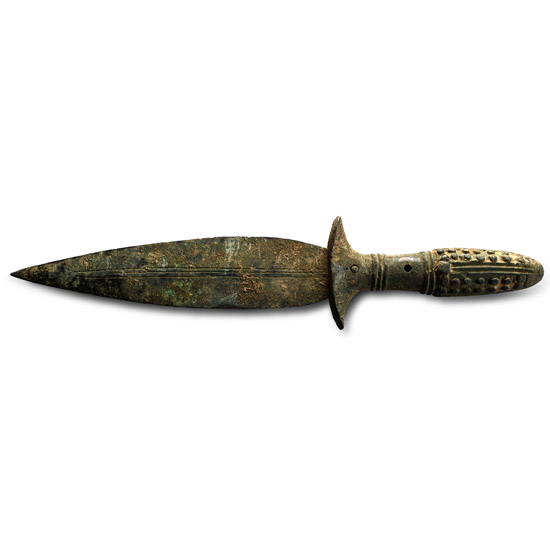
Elamite Bronze Dagger with Decorated Hilt
2nd millennium B.C.Estimate: £1,000 - 1,400 (+bp*)
Bids: 1 | Current Bid: £900
Leaf-shaped blade with a separately cast hilt; blade tapering to a point, incised with three lines of incised linear decoration; hilt with flared guard, pierced with a pin and with a raised geometric pattern. 165 grams, 24.5 cm
Acquired on the UK art market, 1990s. Private collection, New York, USA. -
.jpg)
Luristan Dagger with Animal-Headed Hilt
Circa 1000-700 B.C.Estimate: £600 - 800 (+bp*)
Bids: 1 | Current Bid: £540
With a lentoid-section blade, tongue-shaped in plan; integral tapering hilt with flared lobes to the finial, lateral spurs to the grip with incised detailing; baluster formed as a pair of addorsed horse-heads forming a stylised grotesque mask; mounted on a custom-made stand. 540 grams total, 36 cm including stand
with Art Ancient, London, UK. Private collection, London, UK.
Pre-Mongol remains in Kazakhstan, and the Russian-Ukrainian steppes can be attributed to the Cumans, also called Kiptchaks. In the latter region, the Cuman presence is particularly associated with 12th- to 13th-century kurgan groups. Certain elements of the grave goods are highly characteristic of the Cumans, such as gold sceptres made from a coiled metal rod, which sometimes resemble a straightened torque. -
.jpg)
Cuman Silver Military Sceptre
12th-13th century A.D.Estimate: £15,000 - 20,000 (+bp*)
Opening Bid: £7,500
Comprising a slender tapering body in graduated gilded sheet-silver sleeves with rolled rims; at base, a bronze ferrule with a squared finial; at top, a mushroom-shaped boss with lateral attachment rivet; restored. 353 grams, 56 cm
Private collection, UK. This lot has been checked against the Interpol Database of stolen works of art and is accompanied by search certificate number no.13377-259199. -
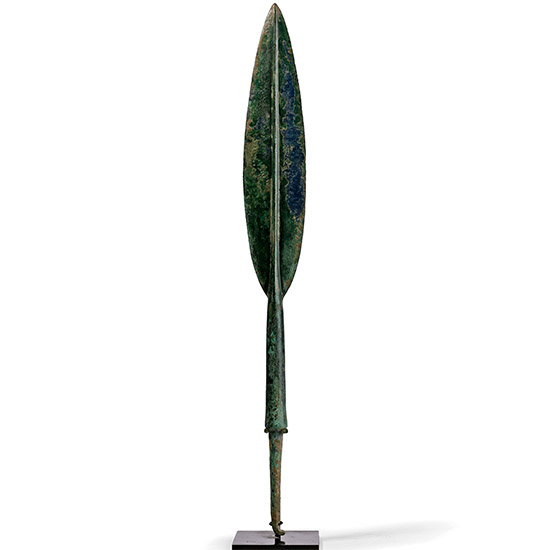
Large Luristan Leaf-Shaped Bronze Spearhead
Circa 1000-700 B.C.Estimate: £600 - 800 (+bp*)
Bids: 1 | Current Bid: £300
Comprising a leaf-shaped blade with a midrib and a long tapering socket; accompanied by a display stand. 771 grams total, 44 cm including stand
with Art Ancient, London, UK. Private collection, London.
The spear, belonging to type 3 of the Khorasani classification, was used by chariot fighters to strike each other or the enemy infantry from above. Similar specimens with longer sockets were excavated by Negahban in the Amlash area. According to Moorey, sockets as long, if not longer than the blade, are a characteristic of Iranian spearheads in the late 2nd and early 1st millennium B.C. A similar spearhead from the Tappeh Sialk has been dated to the 9th-7th century B.C. -
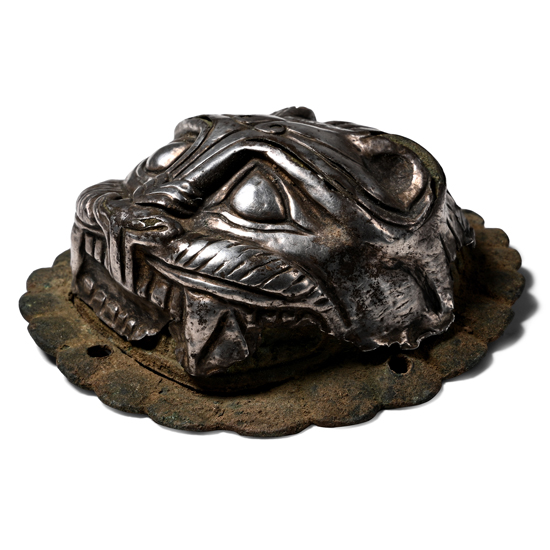
Sasanian Silver-Plated Lion Shield Boss
6th-7th century A.D. or earlierEstimate: £800 - 1,000 (+bp*)
Opening Bid: £400
With stylised repoussé head and face detailing showing two faces, one to the side and the other to the top, the mane represented by a scalloped border; sheet-silver cladding to the head over bronze; pierced for attachment. 80.9 grams, 78 mm
Ex London, UK, gallery, 1971-early 2000s. London, UK, collection. -
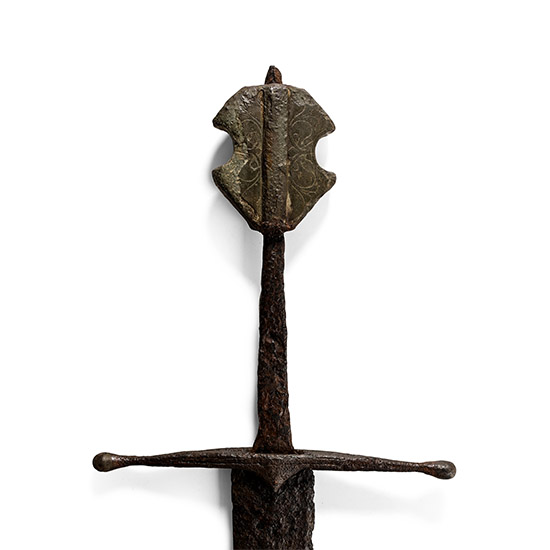
Medieval Iron Single-Handed Sword with Decorated Bronze Pommel
14th-15th century A.D.Estimate: £3,000 - 4,000 (+bp*)
Opening Bid: £1,500
Longsword of Oakeshott's Type XVa, cross style 1, with two-edged lenticular-section piled blade with taper overall to a narrow point; quillons round in section with taper to ends and bronze lobe finials, median locket to lower edge; flat-section tang tapering to the upper end; the pommel a variant of Oakshott's Type V with median vertical band to each face, piriform block with lateral scoops. 1.07 kg, 105 cm
From the private family collection of a lady, UK; acquired in Germany, mid-20th century. Accompanied by an academic report by Dr Raffaele D’Amato. This lot has been checked against the Interpol Database of stolen works of art and is accompanied by search certificate number no.13301-257660.
The Type XVa of Oakeshott has a blade similar to the Type XV, being generally more slender than its parent type, and having a grip which is much longer, ranging from seven to nine inches long or more. This style of sword appears to have been popular in the 14th century, based on surviving examples. Interesting is here the style of the quillons, which are rare: in style 11 the guard may be long or short, curved or straight, but always characterised by knobbed ends and a circular or rhomboidal in section. A sword found in the River Ouse in Surrey shows a similar blade, with a flat oval diamond section, and the outline is such that the sword could be regarded as of type XV, although many swords of type XVII are of the same shape and proportions. -
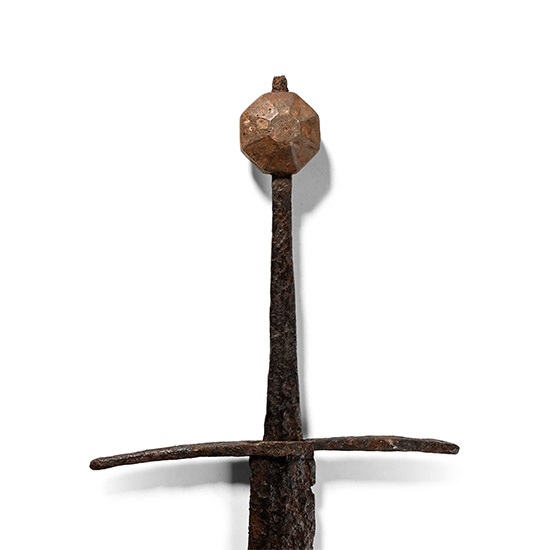
Medieval Iron Hand-and-Half Sword
14th-15th century A.D.Estimate: £2,000 - 3,000 (+bp*)
Bids: 2 | Current Bid: £1,200
Longsword of Oakeshott's Type XVIIIa or b, comprising: two-edged, slender lenticular-section piled blade with taper overall to a narrow point; quillons square in section with taper and slight droop to ends; flat-section tang tapering to the upper end; pommel of Oakshott's Type I1 with scooped border to each face, central panel. 873 grams, 99.5 cm
From the private collection of a London gentleman, from his grandfather's collection formed before the early 1970s. Accompanied by an academic report by Dr Raffaele D'Amato. This lot has been checked against the Interpol Database of stolen works of art and is accompanied by search certificate number no.13302-257654.
Examples of this category of swords show almost every kind of hilt used during the 15th century, from the classic forms of the 13th century to all the new varieties of pommel and cross which developed after 1400. Because the previous types of swords were practically useless against the fully armoured man-at-arms, Western European warfare needed a sword able to pierce the weak points of the protective equipment, a circumstance that led to the creation of types XV, XVI and XVII that found their quintessence in the type XVIII. The subtypes XVIIIa and XVIIIb had longer blades, and especially the type XVIIIb was a very long-gripped bastard sword. -
.jpg)
Medieval Iron Hand-and-Half Sword with Bronze Pommel with Coat of Arms
13th century A.D.Estimate: £5,000 - 7,000 (+bp*)
Bids: 2 | Current Bid: £2,500
Comprising: two-edged lenticular-section piled blade (Oakshott's Type XII) with gentle taper overall to a narrow point; quillons round in section with taper to ends and hooked finial; broad flat-section tang tapering to the upper end; disc pommel of Oakshott's Type K with scooped border to each face, central disc with beaded rim, inner heater-shaped panel with reserved cross potent. 1.32 kg, 101 cm
From the private family collection of a lady, UK; acquired in Germany, mid-20th century. Accompanied by an academic report by Dr Raffaele D'Amato. This lot has been checked against the Interpol Database of stolen works of art and is accompanied by search certificate number no.13303-257659. -
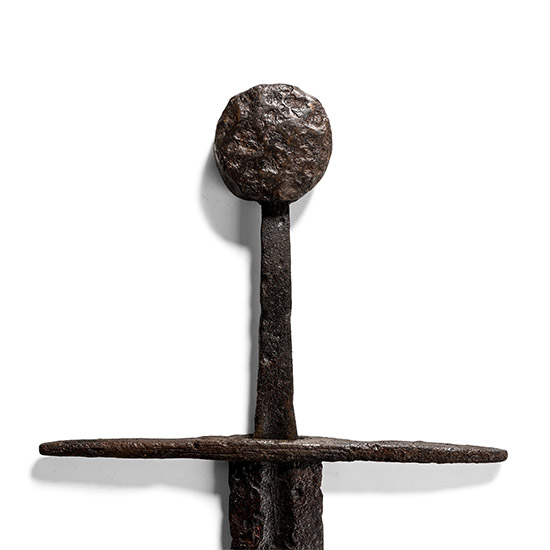
Medieval Iron Single-Handed Sword
12th-13th century A.D.Estimate: £3,000 - 4,000 (+bp*)
Bids: 20 | Current Bid: £6,551
Comprising: two-edged lenticular-section piled blade (Oakshott's Type XI) with gentle taper overall to a rounded point and fuller to both faces; quillons round in section with taper to ends; flat-section tang tapering to the upper end; disc pommel of Oakshott's Type G with slightly domed faces. 1.01 kg, 95 cm
From the private collection of a London gentleman, from his grandfather's collection formed before the early 1970s. Accompanied by an academic report by Dr Raffaele D’Amato. This lot has been checked against the Interpol Database of stolen works of art and is accompanied by search certificate number no.13303-257653. -
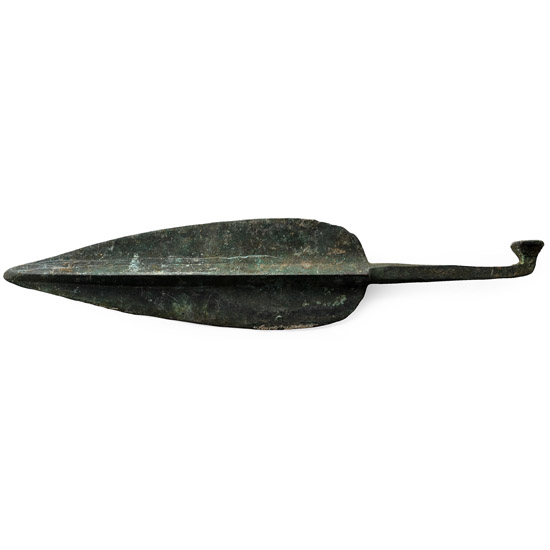
Western Asiatic Bronze Tanged Spearhead
14th-10th century B.C.Estimate: £100 - 140 (+bp*)
Bids: 1 | Current Bid: £51
Leaf-shaped blade with raised midrib extending to the rectangular-section tang with a bent finial. 171 grams, 25.5 cm
Ex Abelita collection, 1990s.

