-
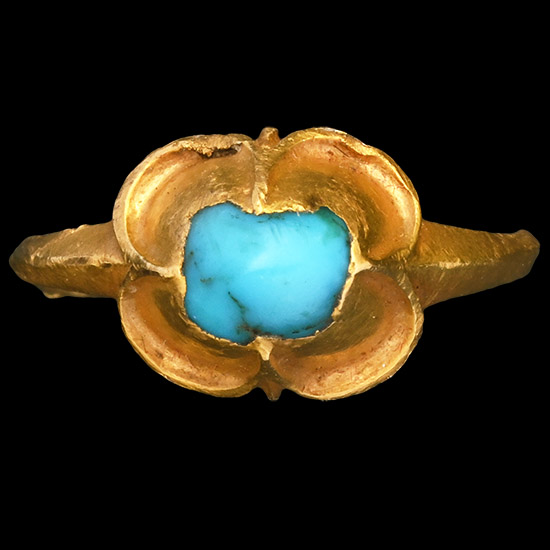
Medieval Gold Ring with Turquoise
1200-1500 A.D.Estimate: £3,000 - 4,000 (+bp*)
Opening Bid: £1,400
Comprising a slender hoop with a high pie-crust bezel with a cabochon turquoise within a rub-over setting. 3.46 grams, 22.77 mm overall, 16.01 mm internal diameter (approximate size British J, USA 4 3/4, Europe 8.69, Japan 8)
Acquired on the European art market. This lot has been checked against the Interpol Database of stolen works of art and is accompanied by search certificate number no.13328-257948.
This form of decorative ring with central stone setting is relatively common in the medieval period, when a focus on gemstones over metalwork became increasingly common. Several rings of this type are known and appear to have been popular in the 15th century. -
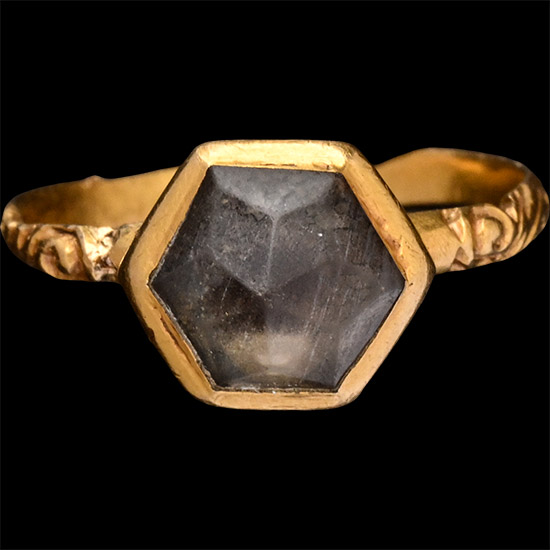
Renaissance Gold Ring with Gem
16th century A.D.Estimate: £1,500 - 2,000 (+bp*)
Opening Bid: £750
Comprising a slender hoop with scroll-decorated shoulders, a high hexagonal colette setting with a point-cut rock crystal with foil backing. 2.75 grams, 22.97 mm overall, 15.54 mm internal diameter (approximate size British I 1/2, USA 4 1/2, Europe 8.07, Japan 7)
Acquired on the European art market. -
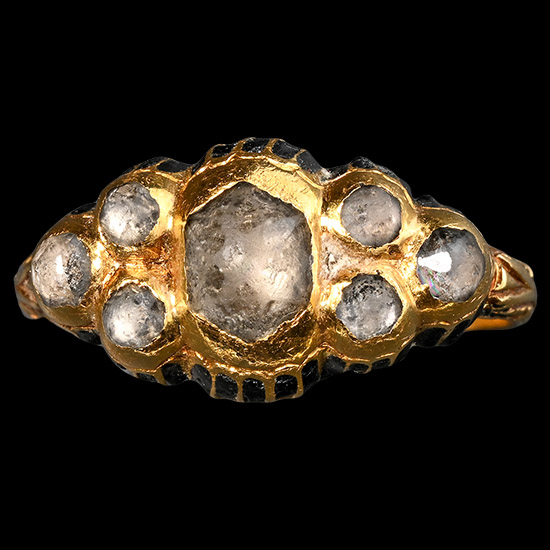
Renaissance Enamelled Gold Ring with Facetted Gems
17th century A.D.Estimate: £1,500 - 2,000 (+bp*)
Opening Bid: £750
With a closed back setting and carved shoulders, the bezel set with seven facetted paste gemstones in cut-down collets with black enamel decoration to the gallery; European workmanship. 5.75 grams, 25.32 mm overall, 19.74 mm internal diameter (approximate size British S, USA 9, Europe 20, Japan 19)
Acquired on the European art market. -
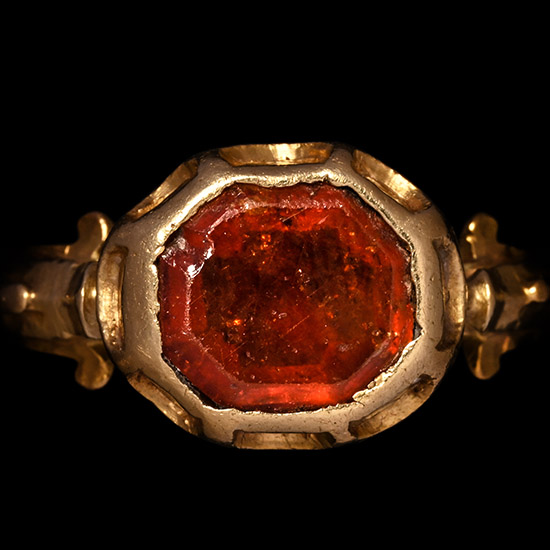
Renaissance Gold Ring with Table-Cut Hessonite Garnet
Western Europe, 16th century A.D.Estimate: £2,500 - 3,500 (+bp*)
Bids: 1 | Current Bid: £1,400
Tiered hoop and shoulders supporting a cup bezel with scallop detailing, inset with an octagonal cloison. 7.07 grams, 27.56 mm overall, 19.87 x 19.76 mm internal diameter (approximate size British U, USA 10, Europe 22.52, Japan 21)
Private collection, Europe. Acquired on the English art market. This lot has been checked against the Interpol Database of stolen works of art and is accompanied by a search certificate number no.13048-248385.
Parallels for the ring type are dated 16th century. A related finger ring is also available in the British Museum collection. The chalice-shaped workmanship of the bezel betrays a strong Italian influence in the workmanship of the ring section. -
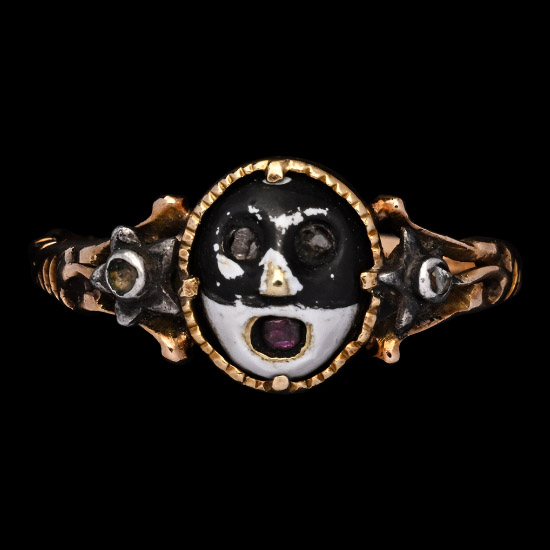
Gem-Set Gold Masquerade Ring with Love Inscription
Italy, circa 1760 A.D.Estimate: £5,000 - 7,000 (+bp*)
Bids: 1 | Current Bid: £2,500
Finely modelled with a black-and-white enamelled mask, the features animated by rose-cut diamond eyes and a small ruby set into the open mouth; the head framed by a serrated gold collet and flanked by silver foliate clusters each set with a further rose-cut diamond; the shank formed as asymmetrical rococo scrolls with pierced and chased detailing throughout, the reverse of the bezel open, revealing white enamel engraved with faint traces of an original posy inscription. 2.28 grams, 21.10 mm overall, 17.45 x 16.35 mm internal diameter (approximate size British N, USA 6 1/2, Europe 13.72, Japan 13)
The enamel remains entirely original and unrestored.
Acquired on the European art market. This lot has been checked against the Interpol Database of stolen works of art and is accompanied by search certificate number no.13321-257909.
Though now largely worn, the underside of the bezel would likely have borne a concealed love sentiment, comparable to the formula Je cache mes amours ('I mask my love'), found on related rings of mid-18th-century manufacture. The theme of the masked lover, drawn from contemporary masquerade culture and its associations with flirtation, secrecy, and clandestine courtship, here transforms the jewel into a witty and intimate token. -
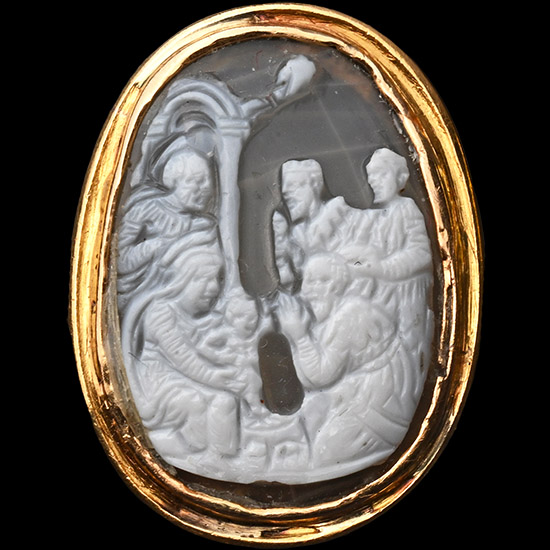
Post Medieval Gold Ring with Sardonyx Cameo with Adoration of the Magi
Italy, 15th century A.D.Estimate: £5,000 - 7,000 (+bp*)
Opening Bid: £2,500
Featuring a finely carved sardonyx cameo illustrating the Nativity, with the Virgin Mary extending the Christ Child toward the three Magi bearing gifts, while Joseph stands beside her; the family shown emerging from an arched doorway, beneath the Star of Bethlehem; set in a 19th-century high-carat gold mount, probably English in origin. 4.62 grams, 21.88 mm overall, 18.25 mm internal diameter (approximate size British Q, USA 8, Europe 17.49, Japan 16)
Acquired on the European art market. This lot has been checked against the Interpol Database of stolen works of art and is accompanied by search certificate number no.13334-258013.
The scene is staged horizontally, with the Holy Family at one end and the Magi and their entourage proceeding towards it, essentially unfolding in the foreground in a sort of procession, one behind the other. This was the standard image, although in the Italian School of Renaissance the same scene was often modified according to the vision of Botticelli, who put at the centre the Holy Family. -
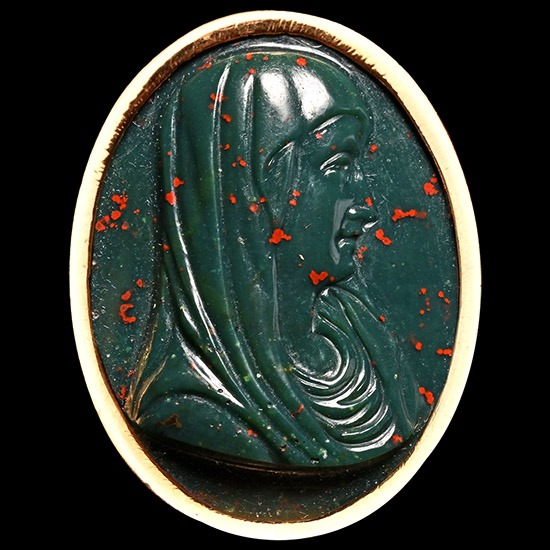
Late Renaissance Double-Sided Heliotrope Cameo of Christ and the Virgin in Gold Ring
Italy, 17th century A.D.Estimate: £3,500 - 4,500 (+bp*)
Opening Bid: £1,750
Comprising a dark green oval cameo with bright red flecks, on the upper side, a veiled head of Mary with a solemn expression, the underside featuring a classical depiction of bearded Jesus with long hair and wearing a draped garment; set in a substantial gold ring with a wide hoop. 15.59 grams, 25.53 mm overall, 16.26 mm internal diameter (approximate size British K, USA 5 1/4, Europe 9.95, Japan 9)
Acquired on the European art market. This lot has been checked against the Interpol Database of stolen works of art and is accompanied by search certificate number no.13390-257998.
It was believed that the scarlet flecks in the stone were the blood of Christ, hence its popular use for the subject of Christ throughout the Middle Ages until the 19th century. -
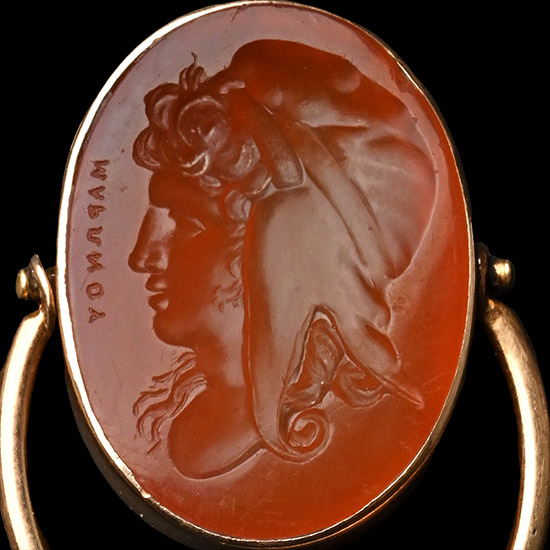
Carnelian Gemstone of the Prince of Troy in Gold Ring
Italy, 19th century A.D.Estimate: £3,500 - 4,500 (+bp*)
Opening Bid: £1,750
An oval orange carnelian intaglio with a profile bust of Paris wearing a Phrygian cap, his long locks cascading from underneath it, a Greek pseudo-signature for Maronos on the field; set in a later swivel-ring; supplied with a museum-quality impression. 5.04 grams, 21.88 mm overall, 18.74 mm internal diameter (approximate size British M, USA 6, Europe 12.46, Japan 12)
Acquired on the European art market. This lot has been checked against the Interpol Database of stolen works of art and is accompanied by search certificate number no.13337-257952.
In Classical as in Neo-Classical art, Paris is often depicted wearing the Phrygian cap, and typically portrayed in Persian-style attire, featuring long sleeves and trousers, and a cloak. -
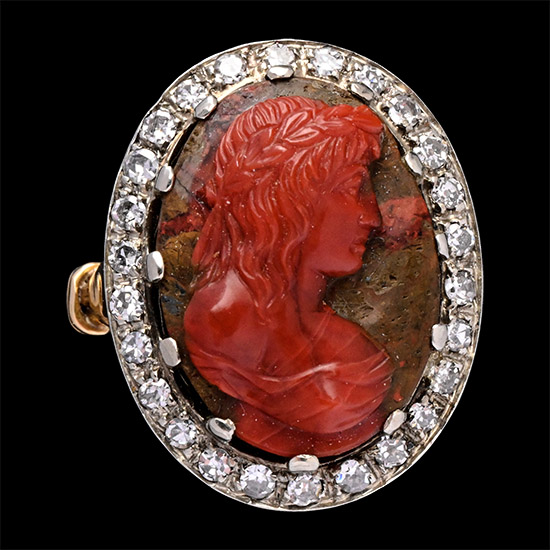
Hardstone Cameo of a Muse in Ring
Italy, 18th century A.D.Estimate: £2,000 - 3,000 (+bp*)
Bids: 3 | Current Bid: £1,400
Carved in two-coloured red and brown agate, depicting a classical muse in right-facing profile with flowing hair, and drapery, the laurel wreath identifying her as an embodiment of poetic or artistic inspiration; the cameo set in a 19th-century mount with a border of single-cut diamonds set in platinum, a pierced, open-backed construction and bifurcated shoulders enriched with classical leaf motifs. 6.47 grams, 25.88 mm overall, 16.12 mm internal diameter (approximate size British J 1/2, USA 5, Europe 9.32, Japan 9)
Acquired on the European art market. This lot has been checked against the Interpol Database of stolen works of art and is accompanied by search certificate number no.13327-257906.
The union of an eighteenth-century Italian gem engraving with a later English mount reflects a broader nineteenth-century practice of integrating earlier engraved gems into newly conceived settings. -
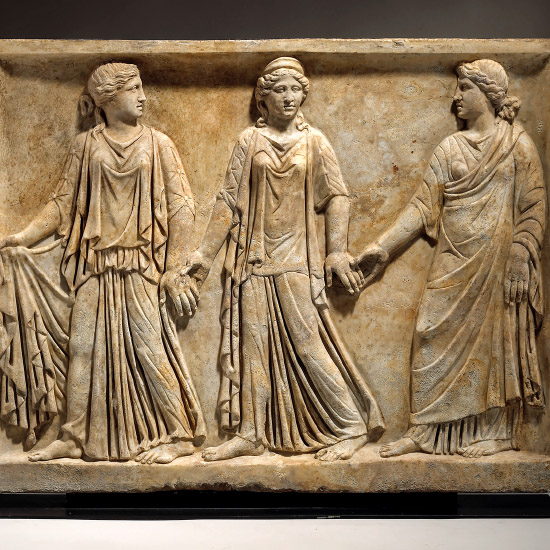
Large Marble Relief with Three Figures
18th-19th century A.D.Estimate: £5,000 - 7,000 (+bp*)
Opening Bid: £2,500
Rectangular slab with raised border and high-relief scene; three standing females wearing floor-length draped and tiered robes, holding hands; the left figure with right hand extended slightly, holding out the folds of her robe, head turned back towards the middle figure whose hand she holds; middle figure facing with diadem in her neatly dressed hair, holding the extended hand of the third figure holding the hem of her robe and angled stiffly away from the others. 145 kg total including stand, 106.5 cm wide
Private collection, UK. This lot has been checked against the Interpol Database of stolen works of art and is accompanied by search certificate number no.13391-259010.
A group of three young females is often interpreted as the Three Graces. However, in classical art, these three figures usually stand close together and are nude or sparsely clothed - unlike the females in this carving. Groups of three goddesses - such as Persephone, Demeter and Hekate - may denote the phases of the moon or, more broadly, the three phases of a female life as maiden / mother/ elder. The scene bears some resemblance to the 1st century AD relief of 'Three dancing nymphs' in Santa Barbara Museum of Art, California; however, that has a more exuberant and lively air contrasted with the rigid formality of the piece. -
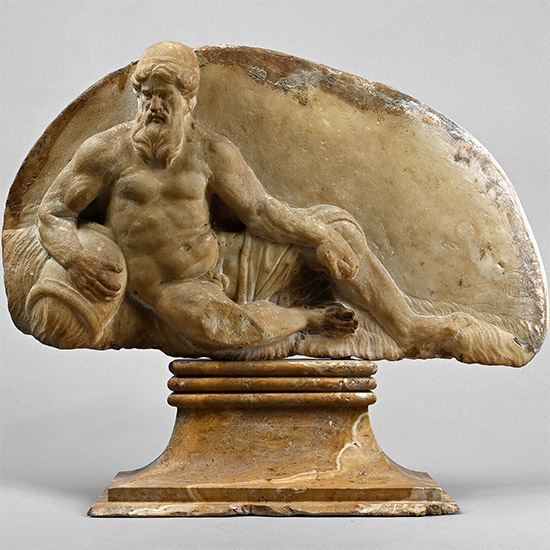
Baroque Period Marble Frieze Depicting a River God
17th-18th century A.D.Estimate: £2,000 - 3,000 (‡+bp*)
Bids: 4 | Current Bid: £1,900
Depicted lying on a riverbed, leaning on his right side, his aged face framed by a rich, flowing beard, his wavy hair held back by a taenia; his body, naked and corpulent, is covered only by a light cloak wrapping his legs; his left hand is stretched forward, his right hand resting on a vase pouring water from the river; the figure stands out against a smooth, semicircular cut wall; mounted on an old collection marble base. 13 kg, 44.5 cm wide
With evidence of break along outer edges suggesting the fragment was once part of a larger composition or fountain. Areas of old glue remnants to the broken edge. The marble is stable, with age staining to the entire surface; minor chips throughout but generally in very good condition.
Previously in an old European collection, probably from the 18th/19th century, based on the old collection marble base and mounting technique. Private collection, France. This lot has been checked against the Interpol Database of stolen works of art and is accompanied by search certificate no. 13239-251810.
The representations of river or sea divinities usually depicted them in the same position, with naked torso wrapped only in a wide cloak, and usually bearded. The sculpture bears similarities with the sculpture of a river divinity, in the Archaeological Museum of Napoli (inv. 5977), from Rome and belonging to the Farnese Collection, from the second half of the 2nd century A.D. -
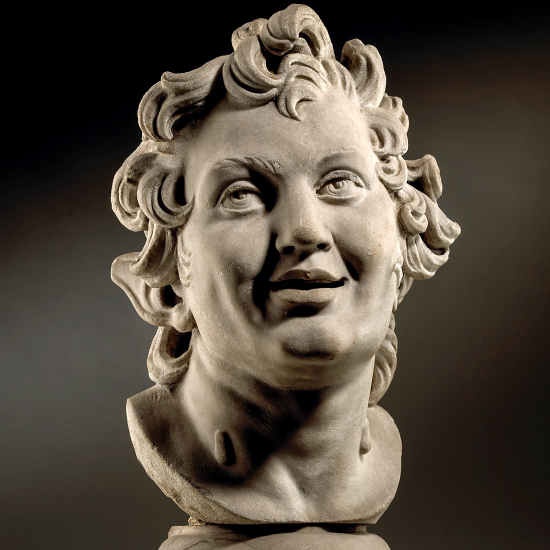
Life-Size Stone Head of a Centaur
18th century A.D.Estimate: £3,000 - 4,000 (+bp*)
Bids: 2 | Current Bid: £2,000
Carved in the round bust depicting a faun or centaur with a youthful face; the hair falling in exuberant curls over the goat-like ears, the mouth parted in laughter, the eyes set beneath a stern brow; on an integral pedestal base with repair to reverse. 21.4 kg, 45 cm high
Private collection, UK. This lot has been checked against the Interpol Database of stolen works of art and is accompanied by search certificate number no.13392-259012.
Monumental marble centaurs were excavated together at Hadrian's Villa in December 1736. Pope Clement XIII secured them for the Capitoline Museum, where they remain to this day. Bronze reproductions of the famous centaurs were very much in vogue amongst the Grand Tour travellers of the 18th century.

