-
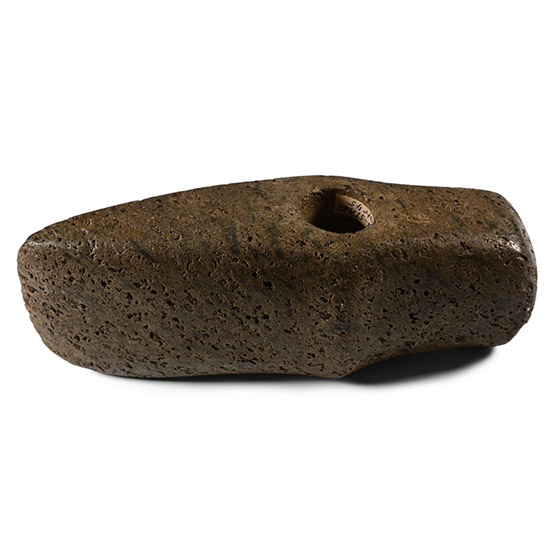
Stone Age Pierced Boat-Shaped Axehead
Neolithic Period, 4th millennium B.P.Estimate: £400 - 600 (‡+bp*)
Opening Bid: £222
Boat-shaped in plan with central drilling; domed hammer-face to butt, carination to each broad face. 656 grams, 14.8 cm
Acquired in the 1996. Private collection, Switzerland, thence by descent. Private collection, since the late 1990s. -
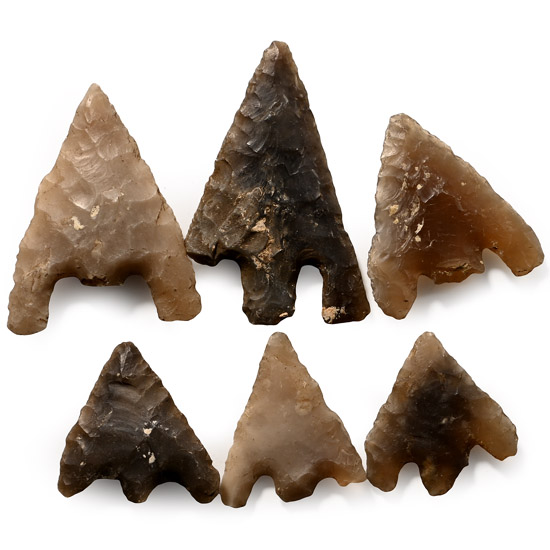
Farnham Stone Age Knapped Flint Arrowhead Collection
Neolithic Period, circa 6,000 B.P.Estimate: £300 - 400 (+bp*)
Bids: 9 | Current Bid: £55
Barbed and tanged types, lentoid in section. 13.2 grams total, 21-34 mm
Found during the original official excavations in the Farnham area, Surrey, UK, which were conducted by Harold Faulker (1875-1963), and William Francis Rankine (c.1877-1962), who were instrumental with the excavation works and pit dwellings at sites including Six Bells, Frensham, Tilford, Thursley and Bagshot, and Waverley, amongst others at and near Farnham in the 1930s and 1940s. Much of the material is now in the prestigious Farnham museum. The present part of the collection having been gifted to their good friend and Haselmere Parish Priest, Charles Borelli (c.1914-2000) of Farnham; who was part of the Borelli family from Italy who emigrated from Lake Como in 1828 to set up the Borelli family watch and jewellery business; thence by family descent to his nephew.
Farnham district is one of the most interesting prehistoric regions in England, and has been visited by a succession of prehistoric peoples from Palaeolithic times onwards. Along the southern slope of the Farnham valley are three gravel terraces, which are famous prehistorically and have yielded large quantities of flint implements and bones of prehistoric animals, notably the mammoth. In prehistoric times, the chalk deposits played an important role in attracting settlers, as they contained rich layers of flint nodules used to make implements. The Farnham Gravels have been an abundant source of Palaeolithic finds, most prominent being hand axes. The axes differ in type, and each type is associated with a cultural phase of the Palaeolithic period. Types similar to these are found in similar deposits in the Somme valley and in many English valley gravels. Flint mining was also carried out by the Neolithic folk. Polished axes and leaf forms, arrowheads and knives, or possibly lance heads, are characteristic of the Neolithic flint work. -
.jpg)
Giant French Stone Age 12 Inch Acheulean Knapped Handaxe
Lower Palaeolithic Period, circa 650,000-350,000 B.P.Estimate: £800 - 1,000 (+bp*)
Bids: 3 | Current Bid: £600
Made from a tabular nodule utilising its cortex as the grip, long cutting edges with a dual patina; attributed to Homo heidelbergensis. 2.1 kg, 30.5 cm
From Car Bouresches, Haut-de-France. Acquired in the 1970s-1990s. From the collections of the famous UK musician and amateur archaeologist, Victor Brox (1941-2023). Acquired on the UK art market. From a private collection. -
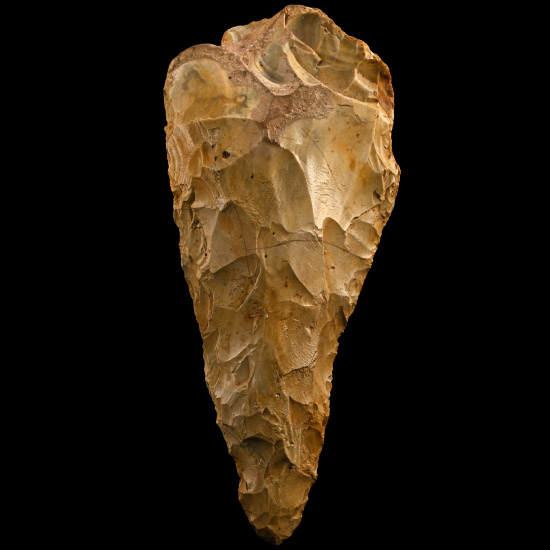
British Stone Age Knapped Flint Axe
Middle Palaeolithic Period, circa 150,000-60,000 B.P.Estimate: £300 - 400 (+bp*)
Bids: 11 | Current Bid: £800
Piriform body in cream-coloured flint, with remains of an old handwritten label on one side. 572 grams,19 cm
Found Test Road, Huzbourough Copse, Hampshire, UK, August 1965. From the collection of Martin Doyle, Leverstock, UK, 1980s-2000s. -
.jpg)
African Stone Age Homo Erectus Knapped Handaxe
Lower Palaeolithic Period, circa 1,000,000-500,000 B.P.Estimate: £250 - 350 (+bp*)
Bids: 2 | Current Bid: £150
Piriform axe with narrow point, the surfaces weathered smooth, inked collector's note 'Seguedine 71'. 515 grams, 20 cm
From Seguedine, Africa. Ex old German collection formed in the 1970s by Dr J Fehkhaber. Acquired on the European art market. -
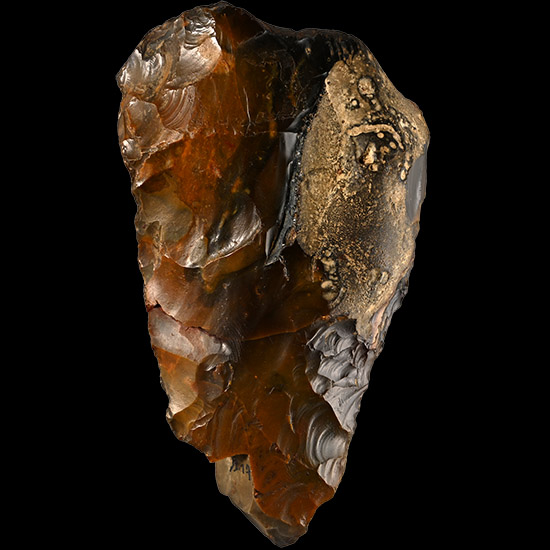
Stone Age Acheulean Handaxe
Lower Palaeolithic, circa 700,000-300,000 B.P.Estimate: £300 - 400 (+bp*)
Bids: 4 | Current Bid: £160
Ovate axe in dark brown stone with some cortex visible, old collector's note ' 2 P. Abbevillier alluvions de la Somme.' 617 grams, 15.3 cm
From Abbeville, France (according to inscription). Collection of Michel C. Vaes (1934-2024), Belgium, formed 1960s-90s. Accompanied by a copy of the EU Licence no.2026 DMF 0436. -
.jpg)
Massive North American Stone Age Knapped Grey Chert Ceremonial Adena Spear Point
Early Woodland Period, circa 2500-1900 B.P.Estimate: £1,000 - 1,400 (+bp*)
Bids: 1 | Current Bid: £400
With yellow patina and some polished areas, a ceremonial blade of exceptional length, fashioned from high-quality chert with controlled percussion flaking and well-balanced symmetry. 193 grams, 26.3 cm
Acquired in 1977 by the archaeologist owner from a private collection in Ohio, USA.
Blades of this size exceed functional hunting requirements and belong to the class of oversized ritual pieces placed in high-status Adena mound burials. This spearpoint is a rare and impressive example of Early Woodland craftsmanship. -
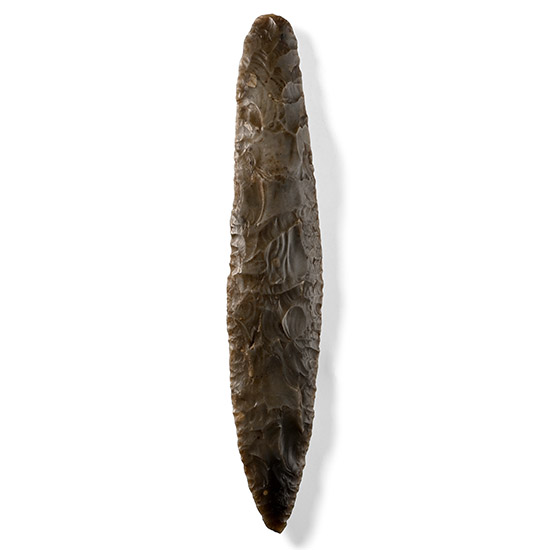
Danish 'Type-1B' Knapped Flint Dagger
Neolithic Early Dagger Period, circa 4400-3800 B.P.Estimate: £500 - 700 (+bp*)
Opening Bid: £200
A finely made and complete early fine Senonian or Danian flint dagger belonging to the Danish Single Grave Culture (Dolktid), a slender lanceolate outline with near-parallel sides, a discreetly indicated hafting zone, and the maximum width placed at or just ahead of the midsection. 66 grams, 18.3 cm
Found Ordrup, Sjaelland Island, Denmark, 1970. From the private collection of amateur archaeologist Jorgen Faxholm, UK. Accompanied by a copy of a previous catalogue sheet with reference.
This dagger shows the characteristic manufacturing traits of the earliest dagger horizon. There is no polishing or parallel-struck flaking of the later, more elaborate types. The maker relied on careful, even marginal retouch to create a sharp and functional cutting edge. The dagger appears to retain its original proportions with no evidence of later reworking or reduction. By the time Lomborg formalised the typology, approximately 540 examples of Type 1B were recorded from graves or intentional depositions, with a further circa 150 from unprovenanced contexts. This example sits squarely within that early corpus and represents the form at its best. -
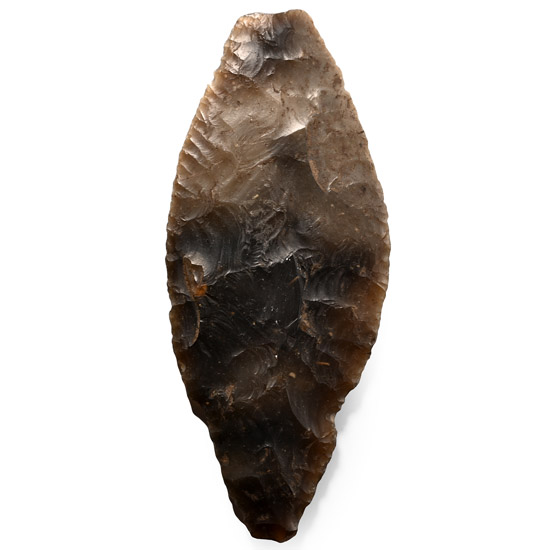
British Stone Age Knapped Flint Beaker Dagger
Beaker Period, 4700-3700 B.P.Estimate: £300 - 400 (+bp*)
Bids: 4 | Current Bid: £160
Lentoid body with finely knapped edges, inked collector's note 'Suffolk. 86' to one side; very rare. 67 grams, 13.7 cm
Found Suffolk, UK, 1986(?). From the collection of Martin Doyle, Leverstock, UK, 1980s-2000s. -
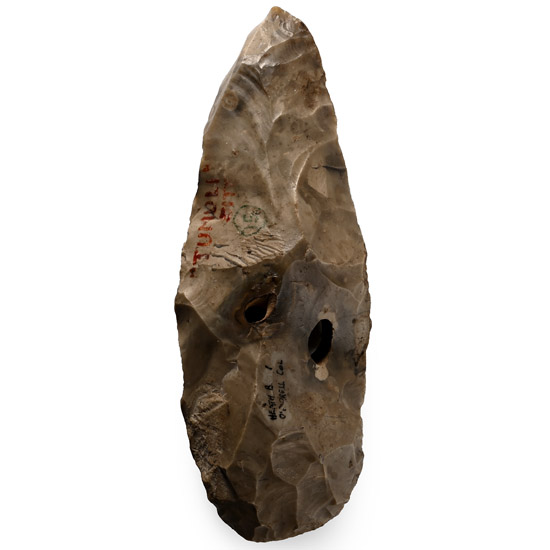
Very Large Farnham Stone Age Knapped Flint Axe
Neolithic Period, circa 6,000 B.P.Estimate: £300 - 400 (+bp*)
Bids: 3 | Current Bid: £110
Piriform in plan and lentoid in section with narrow point; two natural cavities with cortex, one passing through the depth of the stone; old inked legends 'Tumuli Pit', '15', Heath B 1 / O'Morell Col' and to reverse '1807'. 540 grams, 19.6 cm
Found during the original official excavations in the Farnham area, Surrey, UK, which were conducted by Harold Faulker (1875-1963), and William Francis Rankine (c.1877-1962), who were instrumental with the excavation works and pit dwellings at sites including Six Bells, Frensham, Tilford, Thursley and Bagshot, and Waverley, amongst others at and near Farnham in the 1930s and 1940s. Much of the material is now in the prestigious Farnham museum. The present part of the collection having been gifted to their good friend and Haselmere Parish Priest, Charles Borelli (c.1914-2000) of Farnham; who was part of the Borelli family from Italy who emigrated from Lake Como in 1828 to set up the Borelli family watch and jewellery business; thence by family descent to his nephew.
Farnham district is one of the most interesting prehistoric regions in England, and has been visited by a succession of prehistoric peoples from Palaeolithic times onwards. Along the southern slope of the Farnham valley are three gravel terraces, which are famous prehistorically and have yielded large quantities of flint implements and bones of prehistoric animals, notably the mammoth. In prehistoric times, the chalk deposits played an important role in attracting settlers, as they contained rich layers of flint nodules used to make implements. The Farnham Gravels have been an abundant source of Palaeolithic finds, most prominent being hand axes. The axes differ in type, and each type is associated with a cultural phase of the Palaeolithic period. Types similar to these are found in similar deposits in the Somme valley and in many English valley gravels. Flint mining was also carried out by the Neolithic folk. Polished axes and leaf forms, arrowheads and knives, or possibly lance heads, are characteristic of the Neolithic flint work. -
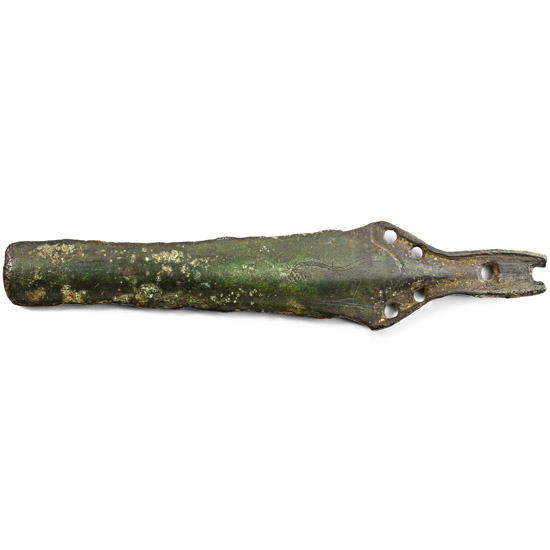
Bronze Age Votive Sword Hilt and Upper Blade Section with 'Shooting Star' Decoration
1150-950 B.C.Estimate: £600 - 800 (+bp*)
Opening Bid: £300
With a broad median rib and flared shoulder, grip with flange to each edge, five perforations for attachment of the organic components, engraved with a motif resembling a shooting star or comet. 358 grams, 23.8 cm
Possibly from the collection of relative Scott Langshaw Burdett (1896-1961), who served in the Great War as a Lieutenant in the Royal Sussex Regiment, was awarded the Military Cross, and later became Consul-General in Hong Kong. From an old Sussex family collection since at least 1946, thence by descent 2011. -

'The Miller' Romano-Celtic Bronze Leaping Boar Statuette
1st century B.C.-1st century A.D.Estimate: £3,000 - 4,000 (+bp*)
Bids: 1 | Current Bid: £2,250
Depicted in a dynamic pose with its front legs raised and the weight of the body borne on its hind legs, flared nostrils and large, round eyes; mounted on a custom-made display stand. 165 grams total, 73 mm wide including stand
Found Hampshire, UK, in the 1980s. From the collection of the late David Miller of Hemel Hempstead, UK, and a Cambridge collection of the 2000s. Accompanied by a previously illustrated catalogue card with provenance. This lot has been checked against the Interpol Database of stolen works of art and is accompanied by search certificate number no.13378-258774.
The small statuettes of boars found in Roman Britain and Gaul were likely used as votive figurines for cult places. They were widespread in the Roman provinces of Celtic origin. However, one cannot exclude the fact that many boars found in Britain belong to the pre-conquest era. One of the few types of bronze figurines that are known to precede the arrival of the Romans is, in fact, that of the boars.

