-
.jpg)
Sabean Yemeni Dedicatory Plaque from the Kingdom of Qataban
1st century A.D.Estimate: £1,200 - 1,700 (+bp*)
Opening Bid: £600
With eight lines of qatabanic Sabaean text regarding an unknown temple of the kingdom of Qatabān, dedicated to the gods Amm dhu-Raymatum and Warafum: '1 Dlwn -b-Gbln ʿbd (s¹q)ny[ ʿm] 2 ḏ-Rymtm w-Wrfm (s¹)qnyt-ḏ= 3 hbm ḥg tkrb-s¹mn gwm/ 4 bʿw mhrt Nbṭ m w-(ytʿs¹) 5 w-ʾbl-s¹ ḥg t(k)rb-s¹mn l-m= 6 tʿn-s¹ b-s¹wt brṯ n rṯd D..= 7 wn ʿm w-Wrfm ʾḏn-s¹ w-(mqm)-s¹ 8 w-qny-s¹ b-ḥg ʿm w-ʾnby' 'Dalwān ... offered [to ʿAmm] (2) dhu-Raymatum and Warafum the offering of (3) bronze according to the promise he made to them ... (4) ... mares of Nabaṭ um ... (5) his camel in accordance with the promise he had made to them to be (6) protected in this expedition. Dalwān has confided (7) to ʿAmm and Warafum his faculties, his abilities (8) and his possessions, with the approval of Amm and Anbī'; mounted on a custom-made stand. 1.01 kg total, 23.7 cm high including stand
Ex London W1 collector; acquired between 1970 and the late 1990s. -
.jpg)
Very Large Bactrian Copper Armband with Animal-Headed Terminals
2nd millennium B.C.Estimate: £2,000 - 3,000 (+bp*)
Opening Bid: £1,111
Penannular armband with shallow D-section hoop and terminals formed as stylised ram-heads, each with exaggerated coiled horns, circular eyes set with cream-coloured beads and shallow semi-circular muzzles; transverse bands of geometric motifs along the neck. 616 grams, 10.4 cm
with a London, UK gallery 1971-early 2000s. Private collection, London, UK.
The bracelet is a product of the Bactria-Margiana Archaeological Complex ('BMAC', also developed from the 'Oxus Civilisation'), which was the dominant culture in the 3rd and 2nd millennium (often dated to c. 2250-1700 B.C.) in that area, corresponding roughly to modern Tajikistan and Afghanistan. The members of the group practised animal husbandry and a limited form of agriculture, with wheeled carts from the 4th millennium B.C. Its craftsmen were proficient at working metals and alloys, including bronze, copper, silver, and gold. Fortified sites with multiple walls are another notable BMAC development. -
.jpg)
Large Amlash Bronze Spouted Libation Vessel
Circa 1200-1000 B.C.Estimate: £3,000 - 4,000 (+bp*)
Opening Bid: £1,667
One of the largest known examples, comprising a thin-walled body and flaring foot, a separately made long spout rivetted to the body; the U-shaped spout resembling the beak of a bird with stylised linear feather detailing to the gracefully curving neck, eleven domed rivets to the edges; the base of the foot with concentric circle decoration. 735 grams, 46 cm
Believed to have been acquired in the 1960s-1970s. From the collection of Mr Jay Gluck (1927–2000) and Mrs Sumi Hiramoto Gluck. Malter Galleries Inc., Auction 80, The Gluck Collection of Ancient Art, 7 April 2002, no.54. Alexander Ancient Art, Netherlands. Private collection, London, UK. This lot has been checked against the Interpol Database of stolen works of art and is accompanied by search certificate number no.13314-257665.
Jay Gluck (1927–2000) was an American author, art historian, and orientalist who spent much of his life in Japan and the wider Asia-Pacific region. A passionate collector and scholar of Asian art and culture, he is perhaps best known for his landmark publication Japan Inside Out (1964), and later A Survey of Persian Handicrafts (1977), co-authored with his wife Sumi Hiramoto Gluck, a Japanese-born artist and cultural collaborator who shared his deep engagement with Eastern art traditions. Together, the Glucks assembled a distinguished collection reflecting their combined expertise and decades of firsthand engagement with the arts of Asia and the ancient world. Items from their collection are held with great regard for the couple's scholarly rigour and the depth of provenance they represent. -
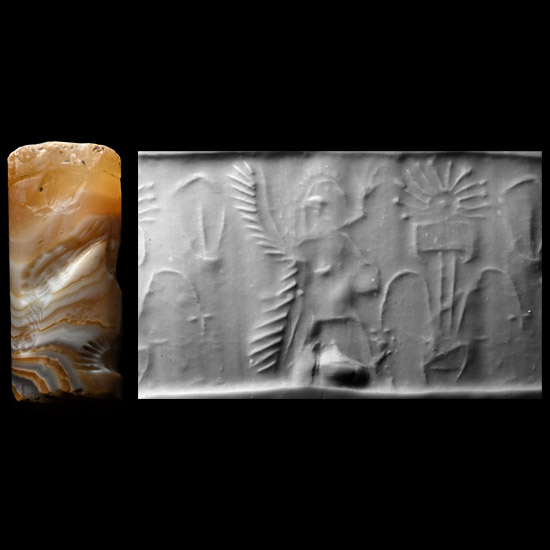
Western Asiatic Banded Agate Cylinder Seal with Winged Figure
2nd-1st millennium B.C.Estimate: £400 - 600 (+bp*)
Bids: 5 | Current Bid: £30
Frieze depicting a standing winged figure in profile facing a column with disc above and radiating beams; supplied with a museum-quality impression. 8.37 grams, 30 mm
From the private collection of a European gentleman (1942-2024), formed since the 1970s. -
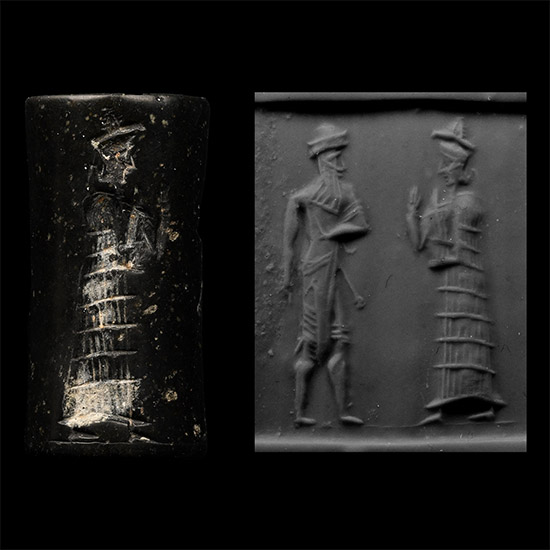
Old Babylonian Cylinder Seal with Two Standing Figures
2nd millennium B.C.Estimate: £1,200 - 1,700 (‡+bp*)
Opening Bid: £600
Representing a god in short mantle and round cap with upturned brim, holding a mace in his left hand, before him a goddess standing in a horned crown and kaunakes, her hands raised in supplication; accompanied by a museum-quality impression. 8.96 grams, 27 mm
Ex Mr J.K. collection, USA. Acquired from the above, 1997. This lot has been checked against the Interpol Database of stolen works of art and is accompanied by a search certificate number no.12581-232131.
The seals of the First Isin Dynasty were much more varied than those just preceding the Third Dynasty of Ur. Often the chief god - probably Shamash - is standing, and the 'introducing' goddess is facing him, while the worshipper is not pictured. The seals are a mine for the understanding of the old Babylonian costume. The tunic of the female goddess here is made of tufted material that the Greeks called kaunakes, the weave of which imitated the effect of the earlier sheepskin costumes. -
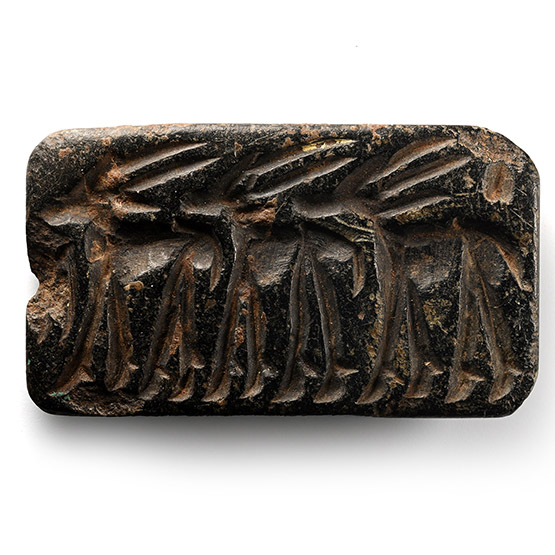
Western Asiatic Steatite Seal with Animals
3300-2900 B.C.Estimate: £600 - 800 (‡+bp*)
Bids: 1 | Current Bid: £375
Rectangular in plan and triangular in section with a median hole, flat face with incuse frieze of ibexes. 38.9 grams, 61 mm
Acquired in the mid 1980s-1990s. Private collection, Switzerland, thence by descent. Private collection, since the late 1990s.
Some stamp seals from the period of transition between Jemdat Nasr and the Early Dynastic Period of Ur represent animals, and some scholars suggest that they were probably used as pendants or amulets. The animals are somewhat simplified and often reduced to mere lines: a file of animals usually forms the basis of such a pattern. -
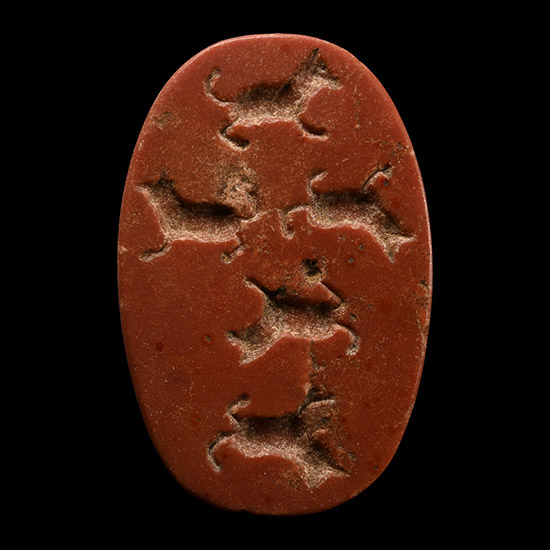
Large Akkadian Red Jasper Seal
Circa 2200 B.C.Estimate: £600 - 800 (‡+bp*)
Opening Bid: £333
Plano-convex in section with incuse animal forms to the underside. 82.8 grams, 66 mm
Private collection. Acquired from a Swiss collection, 2002.
The seal shows stylistic affinity with Akkadian seals representing animals. A few scenes of daily life occur on Akkadian seals, chiefly on the small number illustrating the history of Etana and the eagle. If Akkadian, our seal can be considered very rare. -
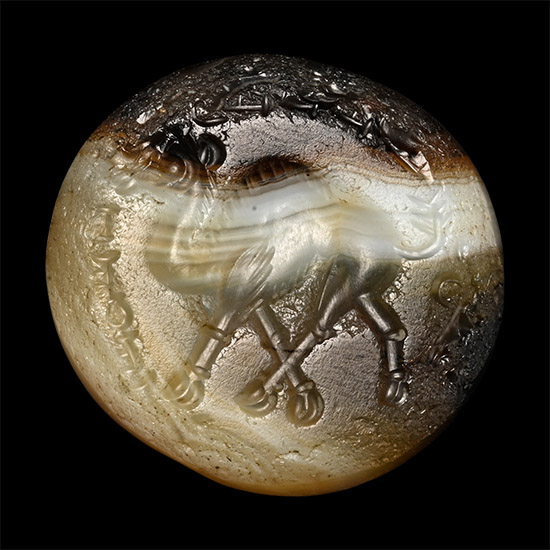
Sasanian Banded Agate Stamp Seal with a Dromedary Camel and Inscription
5th-7th century A.D.Estimate: £1,000 - 1,400 (+bp*)
Opening Bid: £500
Plano-convex in section with transverse piercing; incuse image on the underside of a charging dromedary camel inside a circular Sasanian inscription; supplied with a museum-quality impression; very rare type. 8.9 grams, 20 mm
From a privately held London, UK, collection from the 1990s. -
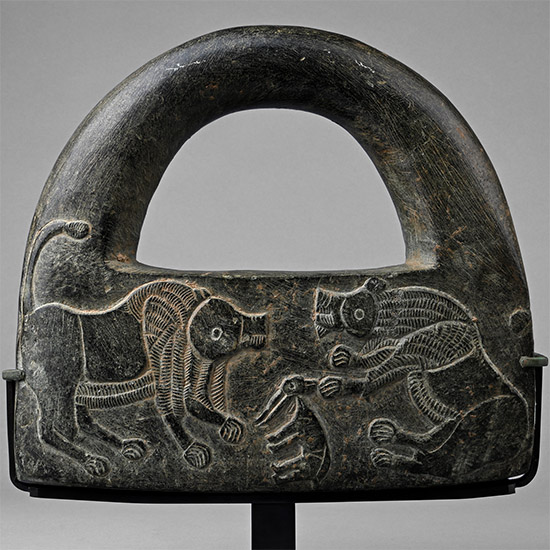
Large Bactrian Black Chlorite 'Hand Bag' Ceremonial Weight
3rd millennium B.C.Estimate: £12,000 - 17,000 (+bp*)
Bids: 1 | Current Bid: £8,000
D-shaped in profile with a round-section loop; obverse with a reserved scene of two lions with hatched detailing to the fur advancing towards a small quadruped placed perpendicular to them; reverse with a median eagle with wings extended and feather detailing, flanked by rearing serpents and a scorpion; mounted on a custom-made stand. 6.25 kg total, 28.3 cm high including stand
with Gallery Rosen Ancient Art, Tel Aviv, 10 November 1969. Ex London, UK, gallery, 1971-early 2000s. London, UK, collection. Accompanied by a copy of an original invoice from Gallery Rosen Ancient Art, 10 November 1969. Accompanied by an academic report by Dr Raffaele D’Amato. This lot has been checked against the Interpol Database of stolen works of art and is accompanied by search certificate number no.13246-252973.
Among the most iconic intercultural style objects are the so-called 'lock' or 'handbag' weights. They have been found in a variety of different colourful stones, such as breccia, chlorite, fossiliferous limestone, calcite and onyx. At the beginning, these objects were probably not weights at all, but were likely badges of high office, carried to indicate authority. Similar objects have been found throughout Mesopotamia, the islands of the Persian Gulf, on the Iranian steppe, and in the Indus Valley. -
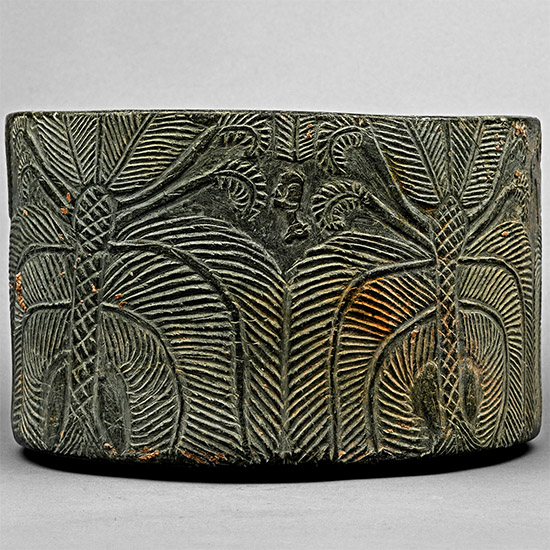
Mesopotamian Steatite Bowl with Animals and Palm Trees
3rd millennium B.C.Estimate: £10,000 - 14,000 (‡+bp*)
Opening Bid: £5,000
Drum-shaped steatite vessel with broad flat rim; low-relief frieze to the outer face: dense vegetation panels with hatched treetrunks and fronds, resting quadrupeds, each with the legs folded beneath the body. 5.3 kg, 24.5 cm wide
Acquired by a Swiss family in the mid-1980s to late 1990s, thence by descent. Private collection, Switzerland, since the late 1990s. Accompanied by an academic report by Dr Raffaele D’Amato. This lot has been checked against the Interpol Database of stolen works of art and is accompanied by search certificate number no.13026-246787.
In Mesopotamia ancient stone-carvers produced a variety of vessels from soft soapstone (steatite) and pale yellow alabaster, along with jewellery. They include cylindrical boxes, cups, high open-rim vases and a few globular jars. Among it the most prominent products were the cups with tall, slender stalks, apparently intended for religious purposes. The repertoire of motifs of the ‘Intercultural Style’ includes vegetal, architectural, and abstract or naturalistic representations of people and animals, depicted in a carved and inlaid technique. -
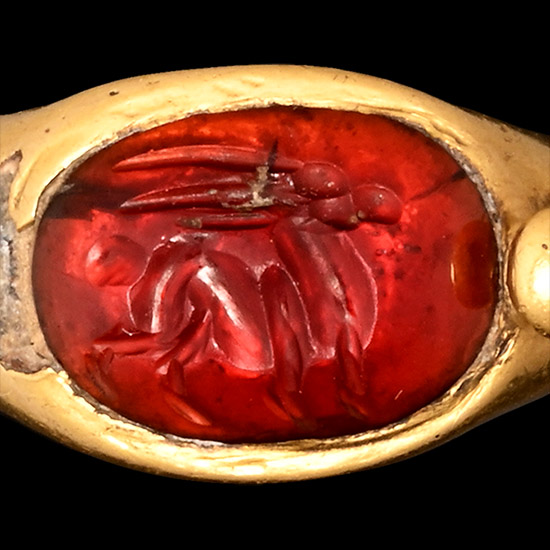
Sasanian Gold Ring with Garnet Gemstone of an Ibex
3rd-4th century A.D.Estimate: £1,000 - 1,400 (+bp*)
Opening Bid: £500
With a characteristic knop to one shoulder, an ellipsoid plaque with cell and inset intaglio, advancing ibex; hollow-formed; supplied with a museum-quality impression. 6.00 grams, 22.16 mm overall, 17.21 x 16.14 mm internal diameter (approximate size British L 1/2, USA 6, Europe 11.87, Japan 11)
From a privately held London, UK, collection from the 1990s. -
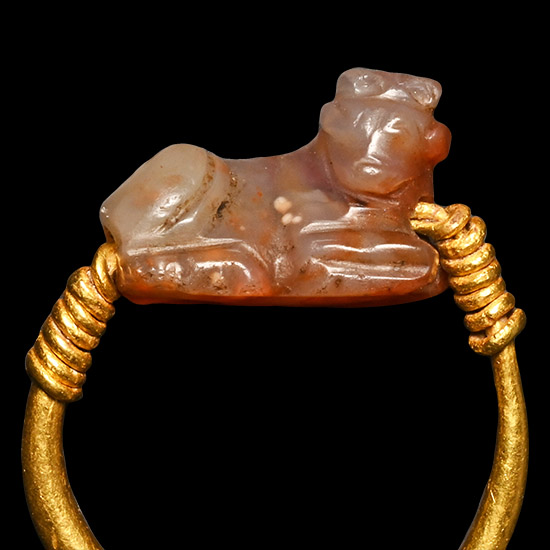
Achaemenid Gold Ring with Agate Bull Figure
Circa 500 B.C.Estimate: £4,000 - 6,000 (+bp*)
Opening Bid: £2,000
Comprising a round-section swivel ring set with a carved bull depicted recumbent with its head turned to the right. 4.71 grams, 27.98 mm overall, 19.07 mm internal diameter (approximate size British N, USA 6 1/2, Europe 13.72, Japan 13)
Private collection, UK. This lot has been checked against the Interpol Database of stolen works of art and is accompanied by search certificate number no.12939-245988.

