-
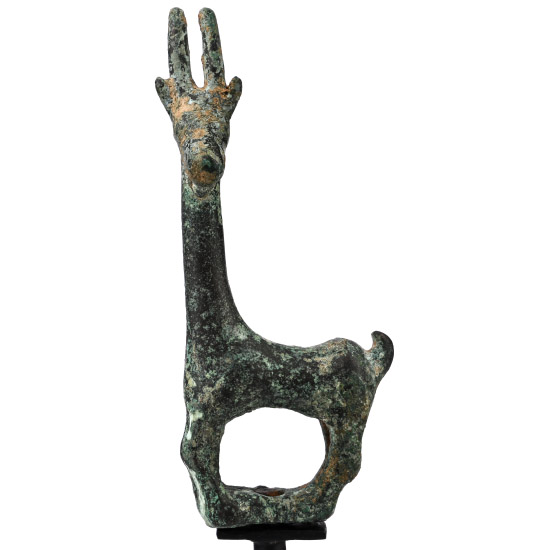
Luristan Bronze Antelope Statuette
13th-7th cenury B.C.Estimate: £400 - 600 (+bp*)
Bids: 1 | Current Bid: £200
Depicted standing with head erect and prominent curving horns; mounted on a custom-made display stand. 98 grams, 96 mm (279 grams, 22.6 cm including stand)
From a private collection, since 1989. Ex West London, UK collection. -
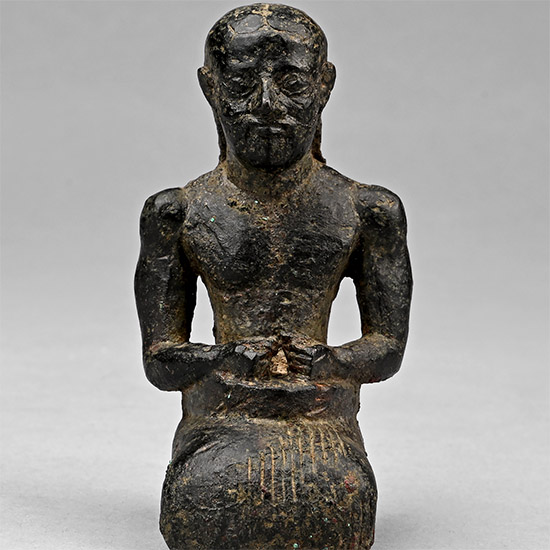
Western Asiatic Bronze Statuette of a Kneeling Priest
Late 3rd millennium B.C.Estimate: £4,000 - 6,000 (+bp*)
Bids: 3 | Current Bid: £3,600
Modelled as a kneeling priest wearing a knee-length kilt, the long hair combed back from the face and extending down the back, arms bent, and fists clenched, resting on the belt, recessed to the underside. 359 grams, 83 mm
Ex London family collection, since the 1970s. Accompanied by a report of metallurgical analytical results, written by Metallurgist Dr Brian Gilmour of the Research Laboratory for Archaeology and the History of Art, University of Oxford. This lot has been checked against the Interpol Database of stolen works of art and is accompanied by search certificate number no.13313-258236.
This powerful figure was probably lost-wax cast in arsenical copper, as were many Near Eastern bronzes of the 3rd millennium. He is muscular with broad shoulders, a strong chest and a well-toned, rippling abdomen. The pleated long garment is typical of the Mesopotamian men. Very interesting is his praying gesture, which is typical of the statuette of Ur culture. -
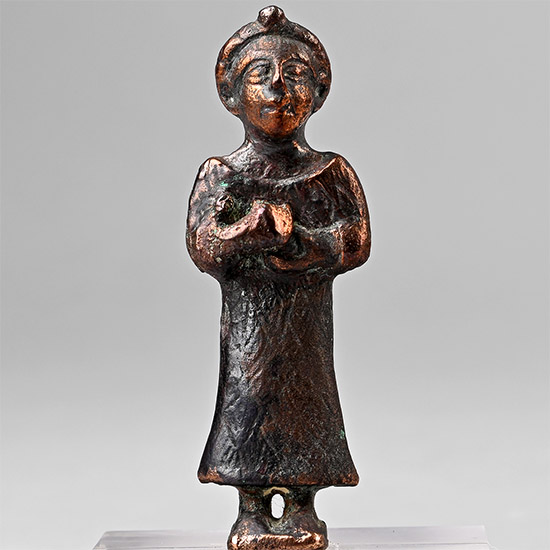
Middle Elamite Copper Figure of a Worshipper
Circa 1500–1100 B.C.Estimate: £4,000 - 6,000 (+bp*)
Opening Bid: £2,000
Figure of a worshipper with the hands raised at the waist and standing barefoot on a rectangular plinth, wearing a dress without any visible seams, the embroidery and pattern of the fabric represented by a concentric chevron design; stylised facial features and large almond-shaped eyes, thick twisted roll of fabric holding the hair with a small knot at the top; set on a custom-made stand. 106 grams total, 87 mm including stand
with Mr Modjallal Iradj, France. Acquired by a London, UK gallery, 18 March 1977. Private collection, UK. This lot has been checked against the Interpol Database of stolen works of art and is accompanied by search certificate number no.13370-257696.
The Elamite culture was an important civilisation in the ancient Near East that lasted for many centuries, from the 3rd millennium to the 6th century BC. They developed their own style of art, metalwork, and seal designs, as well as their own form of cuneiform writing. Although the Elamites were eventually absorbed into later empires, many aspects of their culture continued to influence the ancient world around them. Objects of this type are understood to be ritual or votive gifts. -
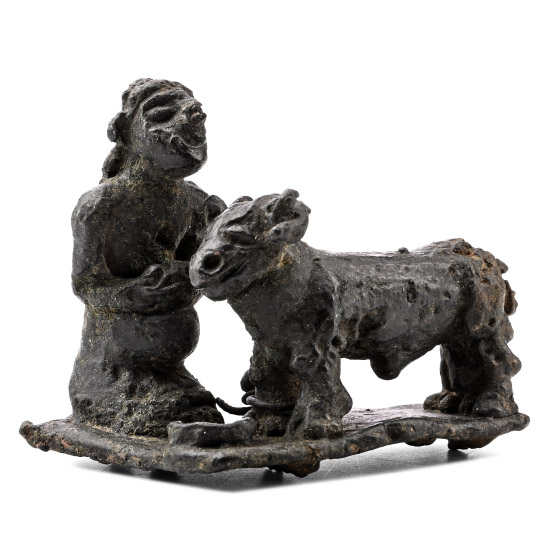
Western Asiatic Bronze Kneeling Priest with Sacred Ram Statuette
3rd-2nd millennium B.C.Estimate: £1,800 - 2,400 (+bp*)
Opening Bid: £900
Diorama on a L-shaped base depicting a ram standing with a shackle to one foreleg attached to a stub pillar, bowl by the forelegs, kneeling kilted male to the side with a pot on his lap, hands clasped, mouth open; attachment lugs to the underside. 155 grams, 58 mm wide
Property of a London gentleman; in the family collection since the 1970s. This lot has been checked against the Interpol Database of stolen works of art and is accompanied by search certificate number no.13311-258232.
According to some scholars, the ram should be considered a symbol of farreh, an important Iranian concept sometimes translated as ‘glory’ or ‘charisma’ that mythical kings needed to rule and heroes to defeat their enemies. -
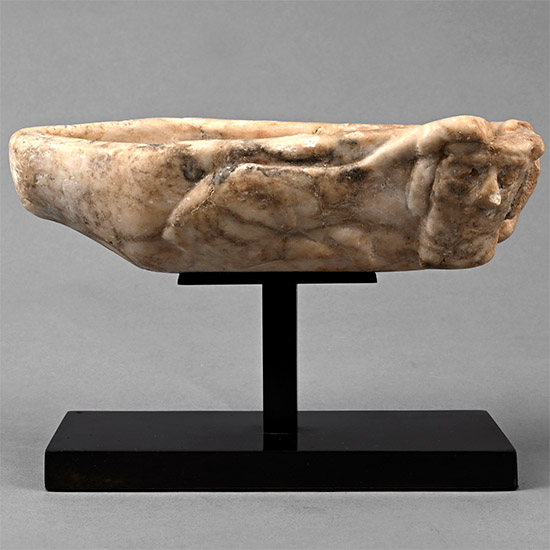
Old Babylonian Alabaster Vessel with Recumbent Lamassu
Early 2nd millennium B.C.Estimate: £3,000 - 4,000 (+bp*)
Bids: 1 | Current Bid: £2,250
Deep elongated vessel, carved with an image of a reclining Lamassu on one side, the hind legs and the right front leg tucked beneath the body, the left front leg raised on the side of the head, the head modelled in the half-round with a characteristic long beard and hair framing the face; accompanied by a display stand. 781 grams, 19.5 cm (1.12 kg total including stand)
From an important London-Geneva collection, formed before 1988, by family descent. This lot has been checked against the Interpol Database of stolen works of art and is accompanied by search certificate number no.13371-258817.
The Lamassu was a protective deity related to several Mesopotamian civilisations (Assyrian in particular, where it was represented as a winged bull-man). They were considered beneficial and protective spirits, guardians of the doors with an apotropaic function, destined to ward off dark or hostile forces. -
.jpg)
Sumerian Head with Inlaid Eyes
Circa 3000 B.C.Estimate: £1,200 - 1,700 (+bp*)
Bids: 1 | Current Bid: £1,000
D-section carved mask with lateral spurs to the brow, exaggerated aquiline nose and broad mouth with raised lips; applied shell and glass inlay to each eye; pierced at the cheeks for attachment; mounted on a custom-made stand. 28.7 grams total, head: 28 mm wide, 83 mm including stand
From the private collection of the late Mr S.M., London, UK, 1970s-1990s; and a North American collection. -
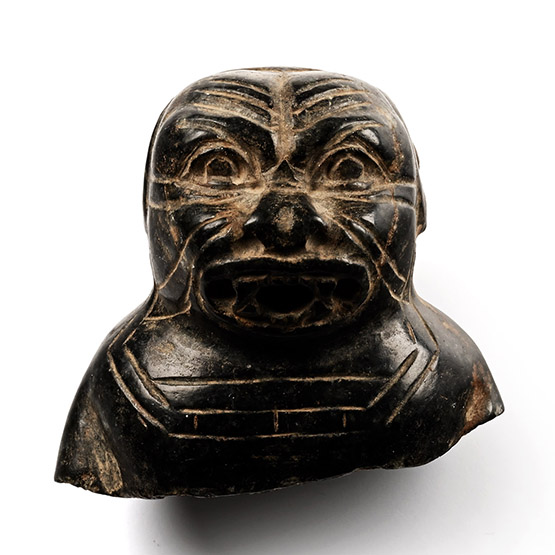
Assyrian Stone Bust of the Demon Humbaba
8th-7th century B.C.Estimate: £1,200 - 1,700 (‡+bp*)
Opening Bid: £600
Carved in the round bust with heavily hatched brow and cheeks, D-shaped eyes, snubbed feline nose, ellipsoid mouth gaping with teeth exposed, segmented panel to chest. 47 grams, 37 mm
European art market, 1997. Acquired by the present owner from the above. This lot has been checked against the Interpol Database of stolen works of art and is accompanied by a search certificate no.12596-232196. -
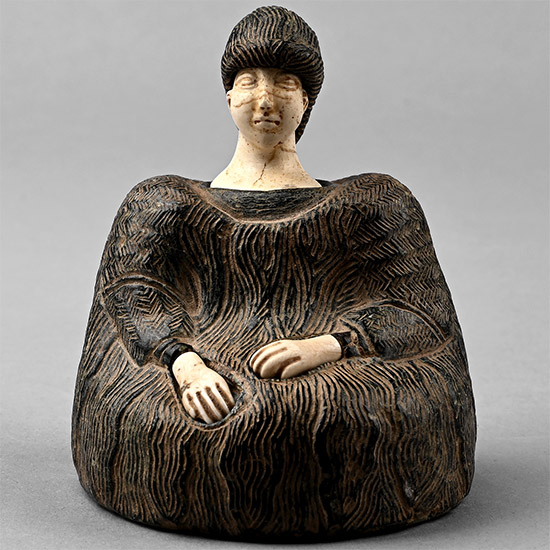
Bactrian Stone Female 'Princess' Idol
Bactria-Margiana, late 3rd-2nd millennium B.C.Estimate: £10,000 - 14,000 (+bp*)
Bids: 1 | Current Bid: £5,000
Carved as a seated human figure, body with rows of overlapping tufts of fur, set with a bald head carved from cream stone with semi-naturalistic detailing to the face; a separate wig with wavy hair, and separately modelled hands. 540 grams total, 95 mm high
Palace Galleries, New York, early 2000s. Acquired by the current owner from the above. Private collection of a North American lady. This lot has been checked against the Interpol Database of stolen works of art and is accompanied by search certificate number no.13372-256950.
This wonderful composite stone sculpture of a seated female figure with finely carved features is typical of the area of Bactria-Margiana, from the late 3rd to early 2nd millennium B.C. Among the few three-dimensional images assigned to this period in Central Asia are a group of stone female figures seated or squatting on a platform and wearing a pattern-decorated robe, perhaps imitating sheep's fleece. -
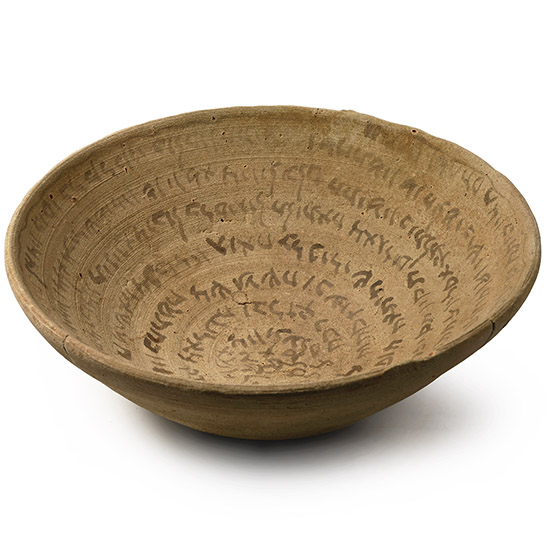
Aramaic Terracotta Magical Incantation Bowl
Circa 4th-8th century A.D.Estimate: £500 - 700 (+bp*)
Bids: 7 | Current Bid: £450
Flat-based bowl, inscribed in spiral from the bottom inner wall to the rim with Aramaic text. 360 grams, 17.6 cm
Private collection, 1980s. UK private collection before 2000. Acquired on the UK art market. Private collection, London, UK
Aramaic incantation bowls are particular to the Sasanian period and have been found in the regions of modern Iraq. These simple ceramic bowls, also known as magic bowls, each contain an Aramaic inscription, written in ink, which spirals from the centre. The bowls seem to have played an important part in domestic life. For example, during excavation in Nippur in 1889, one or more incantation bowls were found in each house together with domestic artefacts, most often in doorways or under floorboards in the corner of rooms. The bowls are predominantly apotropaic, and the inscriptions tend to protect their owners from misfortunes such as childbirth, illness and evil spirits. -
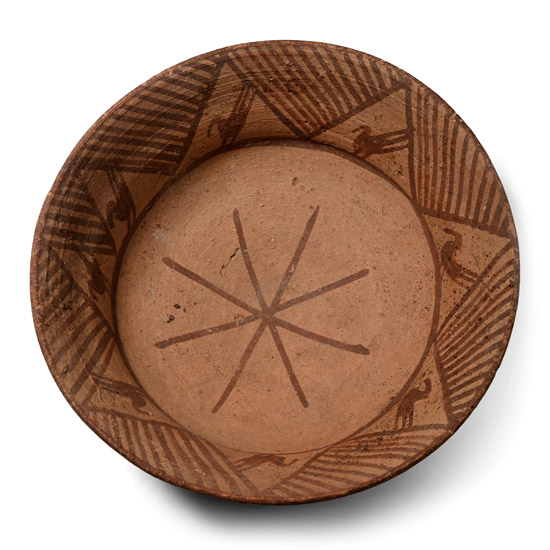
Western Asiatic Terracotta Bowl with Painted Birds
4th-3rd millennium B.C.Estimate: £600 - 800 (+bp*)
Opening Bid: £333
With a rounded underside and flared rim; painted asterisk to centre, hatched chevrons to mouth with profile birds in the voids; early Iranian workmanship. 298 grams, 16 cm wide
Ex London, UK, gallery, 1971-early 2000s. London, UK, collection. -
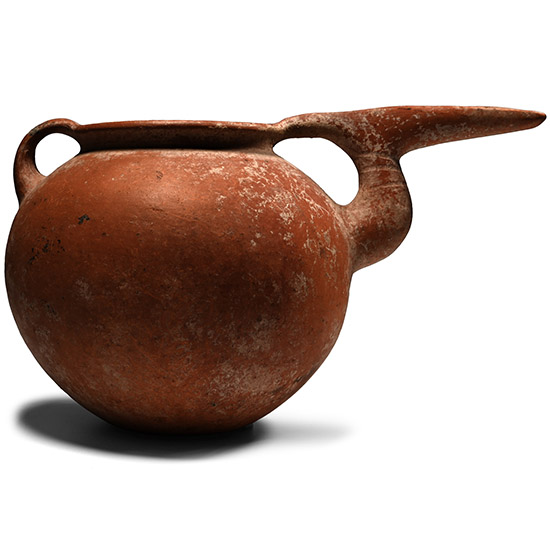
Large Amlash Terracotta Vessel
Early 1st millennium B.C.Estimate: £1,200 - 1,700 (+bp*)
Opening Bid: £690
Of zoomorphic form, with a globular body, u-section spout and loop handle to the rear. 846 grams, 30 cm wide
Acquired before 1978. Private collection, UK. Accompanied by a thermoluminescence analysis report no.N125e39 from Oxford Authentication. This lot has been checked against the Interpol Database of stolen works of art and is accompanied by a search certificate number no.12703-235149. -
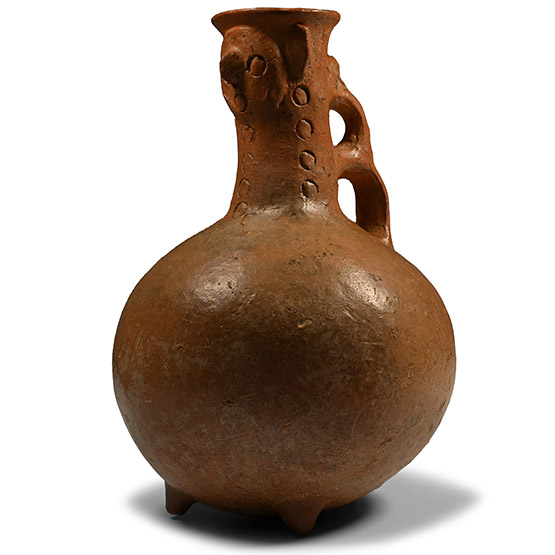
Amlash Terracotta Single-Handled Jug with Head Attachment
Circa 1000-800 B.C.Estimate: £600 - 800 (‡+bp*)
Opening Bid: £325
Comprising a rounded body resting on three stub legs; funicular mouth and short neck; beneath the rim a mask with pinched nose and two pointed ears, impressed circular eyes and mouth; three vertical decorative strips impressed with the same tool as formed the eyes and mouth; tiered strap handle with two finger-grips to the outer face and impressed detailing running from the neck to the shoulder; rim and one foot partly restored. 723 grams, 20.6 cm
Ex Zackary, Los Angeles, 1960s. Thereafter London art market, 1992. Accompanied by a copy of an Art Loss Register certificate no.S00079639.
Several tripod vessels were found at Marlik and Amlash. Examples of tripod vessels from other sites include a comparable example with a tripod stand from Agha Evlar. Jars with tripod knob stands and long necks, particularly similar to the Marlik specimen from Zeinab Bejar, were found in the upper level of Tombs C L and B III of Ghalekuti in the Dailaman region of Gilan. Vessels with tripod legs from Kalardasht are dated by Vanden Berghe to 1000-800 B.C.

