-
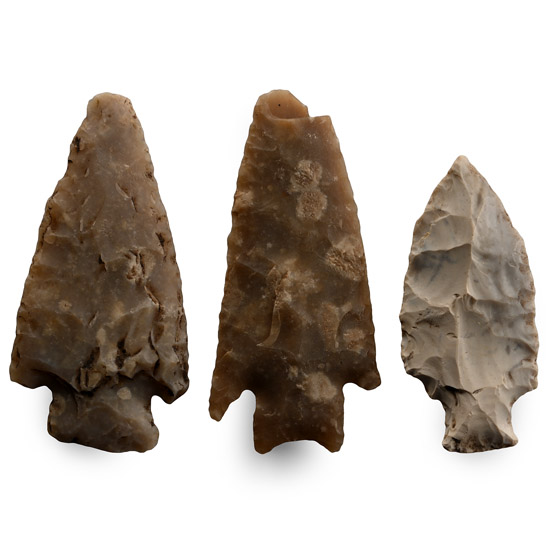
Large North American Stone Age Knapped Spear Point Group
Archaic Woodland Period, circa 2500-1900 B.P. or laterEstimate: £30 - 40 (+bp*)
Bids: 1 | Current Bid: £5
Comprising three tanged points in grey-brown stone, two barbed. 57.9 grams total, 64-78 mm
From a previous old English collection. From the private collection of a West Midlands lady collector; acquired from a UK auction house. -
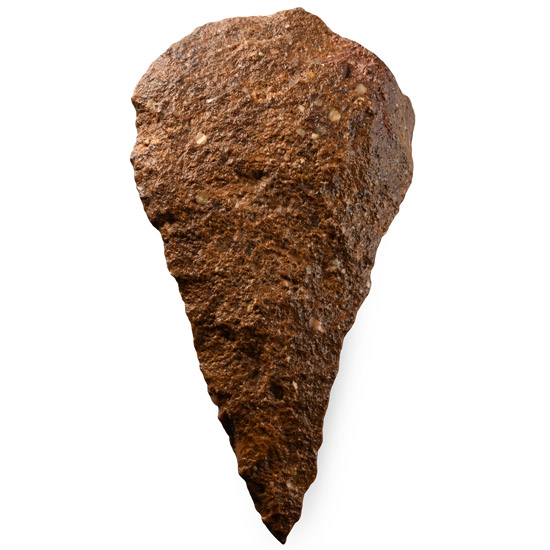
African Stone Age Homo Erectus Knapped Acheulean Classic Pointed Handaxe
Lower Palaeolithic Period, circa 1,000,000-500,000 B.P.Estimate: £150 - 200 (+bp*)
Bids: 2 | Current Bid: £10
Classic piriform type with broad butt. 206 grams, 17.6 cm
From the Northern Sahara, North Africa. From a collection formed during the 1970s and 1980s, having been acquired on the British art market; thence by descent to the current owner in 1998. -
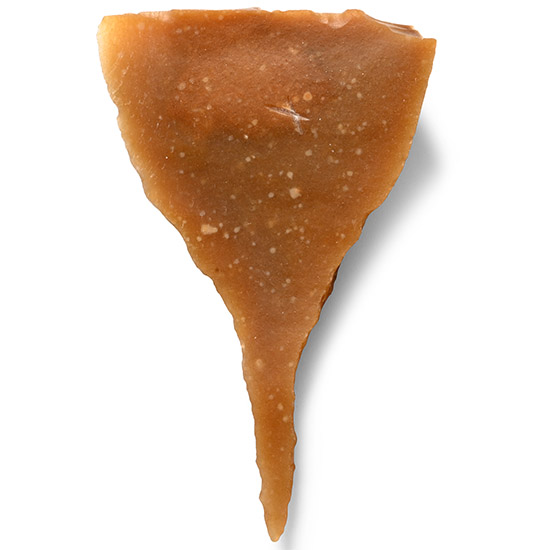
Stone Age Flint Drill
Neolithic Period, circa 6th millennium B.P.Estimate: £40 - 60 (+bp*)
Bids: 1 | Current Bid: £5
With a flat underside and a slender, elongated drill bit. 9.64 grams, 52 mm
From the private collection of the late Mr M., a collector from Waterlooville, Hampshire, UK; late 1980s-early 1990s. -
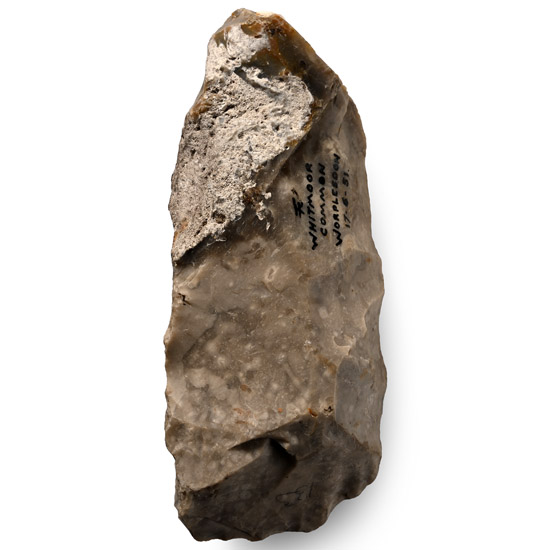
Worplesdon Stone Age Knapped Flint Axe
Neolithic Period, circa 6,000 B.P.Estimate: £100 - 140 (+bp*)
Bids: 1 | Current Bid: £5
Biconvex in section with narrow butt, curved cutting edge, cortex to butt; old inked legend 'F[.] / Whitmoor Common Worplesdon / 17-6-51'. 310 grams, 13 cm
Found Worplesdon, Surrey, UK, on 17th June 1951. From the collection of Haselmere Parish Priest, Charles Borelli (c.1914-2000) of Farnham; who was part of the Borelli family from Italy who emigrated from Lake Como in 1828 to set up the Borelli family watch and jewellery business; thence by family descent to his nephew.
Farnham district is one of the most interesting prehistoric regions in England, and has been visited by a succession of prehistoric peoples from Palaeolithic times onwards. Along the southern slope of the Farnham valley are three gravel terraces, which are famous prehistorically and have yielded large quantities of flint implements and bones of prehistoric animals, notably the mammoth. In prehistoric times, the chalk deposits played an important role in attracting settlers, as they contained rich layers of flint nodules used to make implements. The Farnham Gravels have been an abundant source of Palaeolithic finds, most prominent being hand axes. The axes differ in type, and each type is associated with a cultural phase of the Palaeolithic period. Types similar to these are found in similar deposits in the Somme valley and in many English valley gravels. Flint mining was also carried out by the Neolithic folk. Polished axes and leaf forms, arrowheads and knives, or possibly lance heads, are characteristic of the Neolithic flint work. -
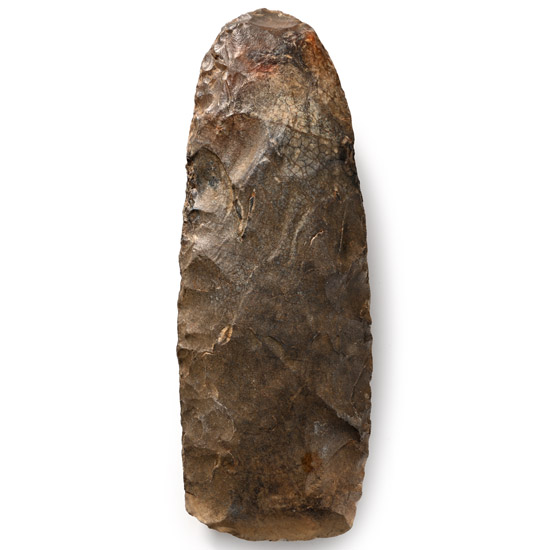
Stone Age Knapped Flint Axehead
Neolithic Period, circa 6th century B.P.Estimate: £80 - 100 (+bp*)
Opening Bid: £40
Biconvex in section and tongue-shaped with narrow rounded butt, polished surface. 94 grams, 10.6 cm
By repute, found Lincolnshire, UK. -
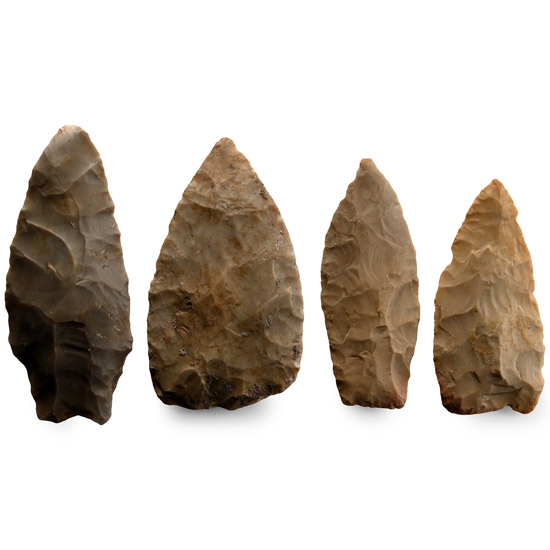
Large North American Stone Age Knapped Spear Point Group
Archaic Woodland Period, circa 2500-1900 B.P. or laterEstimate: £40 - 60 (+bp*)
Opening Bid: £5
Comprising four ovate points in grey and cream stone. 83.9 grams total, 67-82 mm
From a previous old English collection. From the private collection of a West Midlands lady collector; acquired from a UK auction house. -
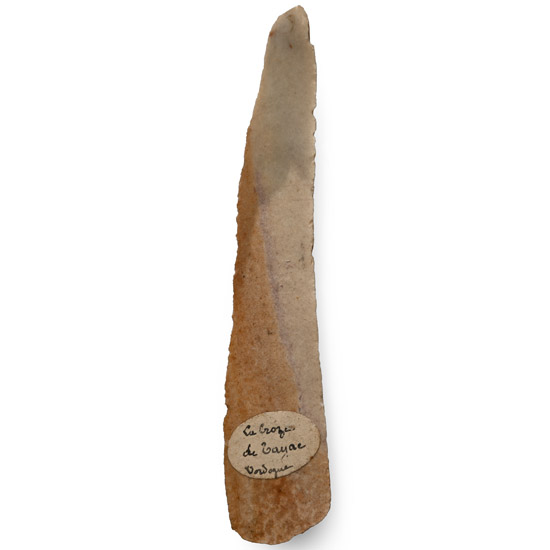
French Stone Age Knapped Flint Long Blade Scraper
Gravettian Period, circa 33,000-21,000 B.P.Estimate: £30 - 40 (+bp*)
Bids: 1 | Current Bid: £5
Slender triangular-section scraper with usage wear to long edges and rounded ends; old inked label 'La Croze du Tayac, Dordogne'. 20.1 grams, 11.1 cm
From La Croze du Tayac, France. Acquired in the 1970s-1990s. From the collections of the famous UK musician and amateur archaeologist, Victor Brox (1941-2023). From the private collection of an East Anglian, UK, specialist collector. -
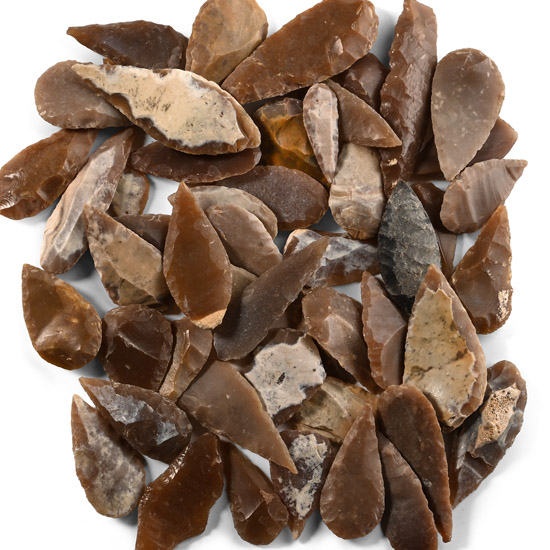
Stone Age Mixed Type Arrowhead Collection
Neolithic Period, circa 8th-6th millennium B.C.Estimate: £50 - 70 (+bp*)
Bids: 4 | Current Bid: £15
Comprising mostly bifacial and uniface leaf-shaped and piriform flint and chert arrowheads; probably from the Sahara region of North Africa. 100 grams total, 15-46 mm
Ex UK gallery, early 2000s. -
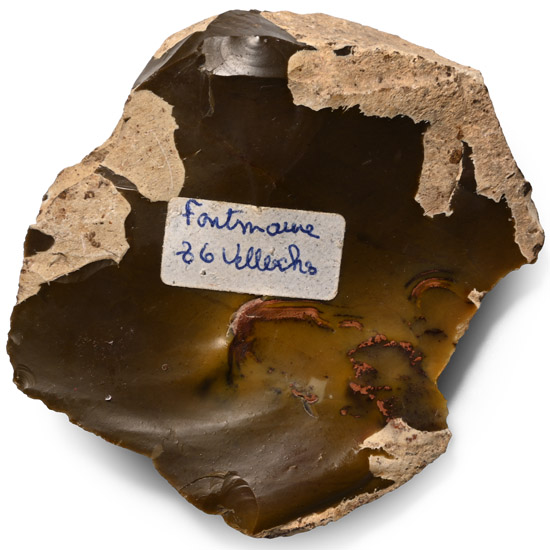
French Stone Age Fontmaure Jasper Neanderthal Knapped Flint Scraper
Middle Palaeolithic Period, circa 150,000-60,000 B.P.Estimate: £40 - 60 (+bp*)
Opening Bid: £5
Cordate in plan with cortex to the butt, notched cutting edge; old label 'Fontmaure, 86 Vellechs'. 110 grams, 76 mm
From the well-regarded site of Fontmaure, Vaucluse department, France. Acquired in the 1970s-1990s. From the collections of the famous UK musician and amateur archaeologist, Victor Brox (1941-2023). From a private collection. -
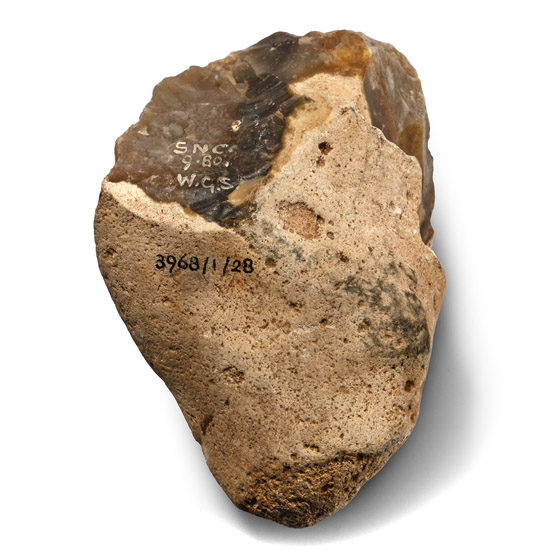
Stone Age Clactonian Flint Chopper
Lower Palaeolithic Period, circa 700,000-300,000 B.P.Estimate: £40 - 60 (+bp*)
Opening Bid: £5
Rounded blade and cortex-covered butt, old inked collection numbers 'SNC 9.60 W.G.S' and 3968/1/28', and a pencilled note '150.9' to the other side. 152 grams, 79 mm
Previously in several old Stone Age tool collections, having been annotated with three different accession numbers. Acquired from an Oxfordshire, UK, auction house. From the private collection of a West Midlands lady collector. -
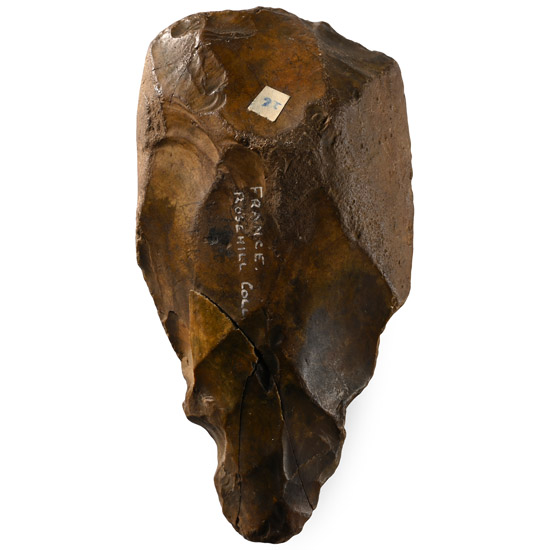
Stone Age Acheulean Handaxe
Lower Palaeolithic, circa 700,000-300,000 B.P.Estimate: £180 - 240 (+bp*)
Bids: 1 | Current Bid: £5
Ovate axe with an old collection sticker on one side and an inked collector's note 'France. Rosehill Coll.'; repaired. 445 grams, 13.4 cm
From France (according to inscription). The Rosehill Collection of the Rt Hon David Carnegie (1865-1921), 10th Earl of Northesk (according to inscription), and likely sold at the sale of his collection at Christie's, London, 14-17 July 1924. Collection of Michel C. Vaes (1934-2024), Belgium, formed 1960s-90s. Accompanied by a copy of EU Licence no.2026 DMF 0436. -
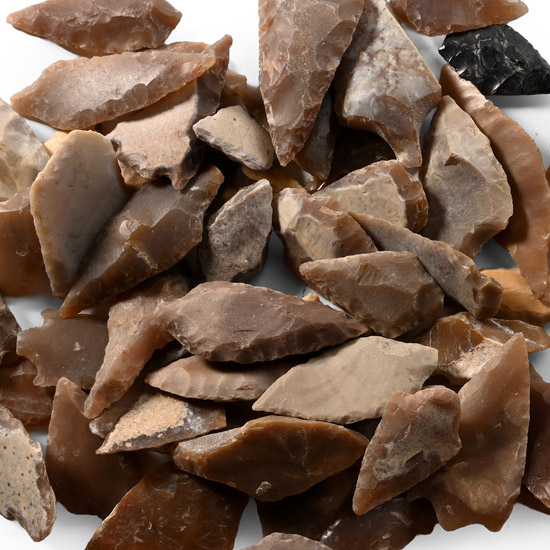
Stone Age Barbed and Tanged Arrowhead Collection
Neolithic Period, 8th-6th millennium B.P.Estimate: £50 - 70 (+bp*)
Bids: 2 | Current Bid: £10
Comprising mostly bifacial and unifacial barbed and tanged flint and chert arrowheads; probably from the Sahara region of North Africa. 118 grams total, 19-46 mm
UK gallery, early 2000s.
Similar specimens of arrowheads have been found in the Eastern Sahara Region of Abu Tartur Plateau. Most of the arrowheads came from the El Jarar Neolithic, c. 7700-7300 B.P. (c.6500-6100 B.C.). Other parallels occur in the region of Kharga Oasis.

