-
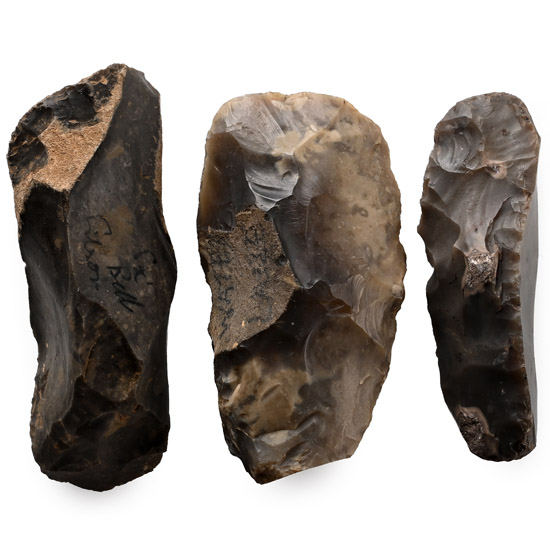
Farnham Stone Age Flint Axehead Collection
Neolithic Period, circa 6,000 B.P.Estimate: £80 - 100 (+bp*)
Opening Bid: £5
Comprising three small axes, each with some cortex remaining, two with extensive inked and pencilled notations. 235 grams total, 75-86 mm
Found during the original official excavations in the Farnham area, Surrey, UK, which were conducted by Harold Faulker (1875-1963), and William Francis Rankine (c.1877-1962), who were instrumental with the excavation works and pit dwellings at sites including Six Bells, Frensham, Tilford, Thursley and Bagshot, and Waverley, amongst others at and near Farnham in the 1930s and 1940s. Much of the material is now in the prestigious Farnham museum. The present part of the collection having been gifted to their good friend and Haselmere Parish Priest, Charles Borelli (c.1914-2000) of Farnham; who was part of the Borelli family from Italy who emigrated from Lake Como in 1828 to set up the Borelli family watch and jewellery business; thence by family descent to his nephew.
Farnham district is one of the most interesting prehistoric regions in England, and has been visited by a succession of prehistoric peoples from Palaeolithic times onwards. Along the southern slope of the Farnham valley are three gravel terraces, which are famous prehistorically and have yielded large quantities of flint implements and bones of prehistoric animals, notably the mammoth. In prehistoric times, the chalk deposits played an important role in attracting settlers, as they contained rich layers of flint nodules used to make implements. The Farnham Gravels have been an abundant source of Palaeolithic finds, most prominent being hand axes. The axes differ in type, and each type is associated with a cultural phase of the Palaeolithic period. Types similar to these are found in similar deposits in the Somme valley and in many English valley gravels. Flint mining was also carried out by the Neolithic folk. Polished axes and leaf forms, arrowheads and knives, or possibly lance heads, are characteristic of the Neolithic flint work. -
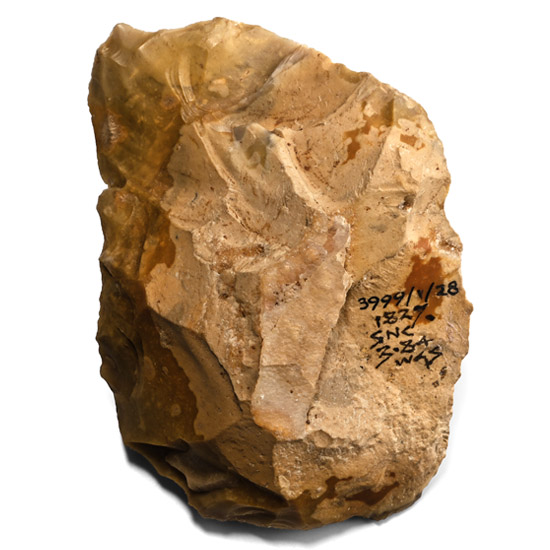
Stone Age Clactonian Flint Scraper
Lower Palaeolithic Period, circa 700,000-300,000 B.P.Estimate: £30 - 40 (+bp*)
Opening Bid: £5
Ovate in plan with a rounded blade, inked collection notes '3999/1/28' '1827. SNC 3.84 WGS', and a pencilled note '1237' on the other side. 124 grams, 87 mm
Previously in several old Stone Age tool collections, having been annotated with three different accession numbers. Acquired from an Oxfordshire, UK, auction house. From the private collection of a West Midlands lady collector. -
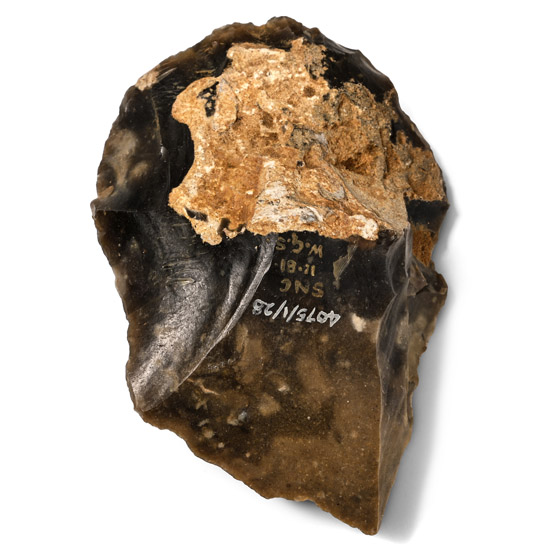
Stone Age Flint Core
Lower Palaeolithic Period, circa 700,000-300,000 B.P.Estimate: £50 - 70 (+bp*)
Opening Bid: £5
Ovate in plan with inked collection numbers '4075/1/28' and 'SNC 11.81 W.G.S.', some cortex remaining. 102 grams, 85 mm
Previously in several old Stone Age tool collections, having been annotated with two different accession numbers. Acquired from an Oxfordshire, UK, auction house. From the private collection of a West Midlands lady collector. -
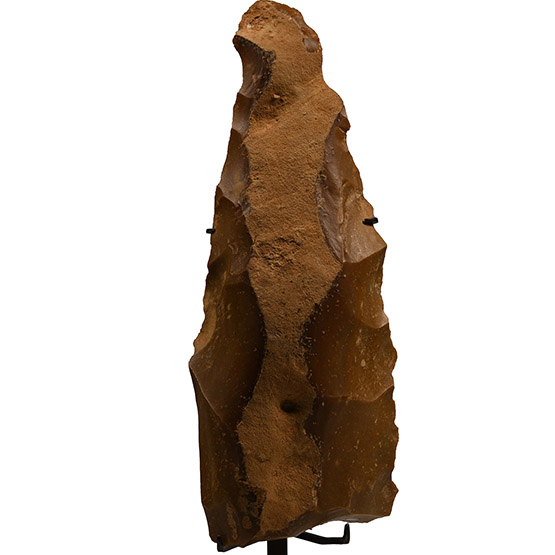
Very Large Stone Age 'Livre de Beurre' from Le Grand Pressigny
Neolithic Period, 5500-2400 B.P.Estimate: £600 - 800 (‡+bp*)
Opening Bid: £325
A substantial flint core or so-called 'Livre de Beurre' with vertical traces of blows on the work side, including one pronounced blade negative extending half way along the stone’s length; cortex remains and core preparation traces on other side; proximal end with impact surface, distal end with rounded point; two bifacial wave to chevron-shaped core edges; flat-prismatic cross-section; raw material for blade production, beige stone (silex) with yellow undertone, cream-coloured patches and spots, slightly shiny surface (origin: Le Grand Pressigny, Dép. Indre-et-Loire, France); old collector's label 'N13310'; supplied with a custom-made stand. 2.62 kg, 30.5 cm (3.79 kg total, 37.5 cm including stand)
Private collection, B.G., Southwest France. Accompanied by a copy of an Art Loss Register certificate no.S00127506. -
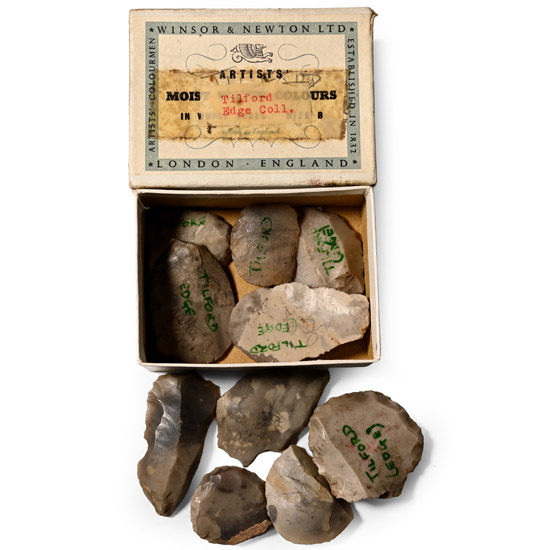
Farnham Stone Age Flint Scraper Collection
Neolithic Period, circa 6,000 B.P.Estimate: £50 - 70 (+bp*)
Bids: 1 | Current Bid: £5
Comprising ten scrapers, each with an inked or pencilled find location; supplied in an old box. 140 grams total including box, 30-53 mm
Found Tilford, near Farnham, Hampshire. Found during the original official excavations in the Farnham area, Surrey, UK, which were conducted by Harold Faulker (1875-1963), and William Francis Rankine (c.1877-1962), who were instrumental with the excavation works and pit dwellings at sites including Six Bells, Frensham, Tilford, Thursley and Bagshot, and Waverley, amongst others at and near Farnham in the 1930s and 1940s. Much of the material is now in the prestigious Farnham museum. The present part of the collection having been gifted to their good friend and Haselmere Parish Priest, Charles Borelli (c.1914-2000) of Farnham; who was part of the Borelli family from Italy who emigrated from Lake Como in 1828 to set up the Borelli family watch and jewellery business; thence by family descent to his nephew.
Farnham district is one of the most interesting prehistoric regions in England, and has been visited by a succession of prehistoric peoples from Palaeolithic times onwards. Along the southern slope of the Farnham valley are three gravel terraces, which are famous prehistorically and have yielded large quantities of flint implements and bones of prehistoric animals, notably the mammoth. In prehistoric times, the chalk deposits played an important role in attracting settlers, as they contained rich layers of flint nodules used to make implements. The Farnham Gravels have been an abundant source of Palaeolithic finds, most prominent being hand axes. The axes differ in type, and each type is associated with a cultural phase of the Palaeolithic period. Types similar to these are found in similar deposits in the Somme valley and in many English valley gravels. Flint mining was also carried out by the Neolithic folk. Polished axes and leaf forms, arrowheads and knives, or possibly lance heads, are characteristic of the Neolithic flint work. -
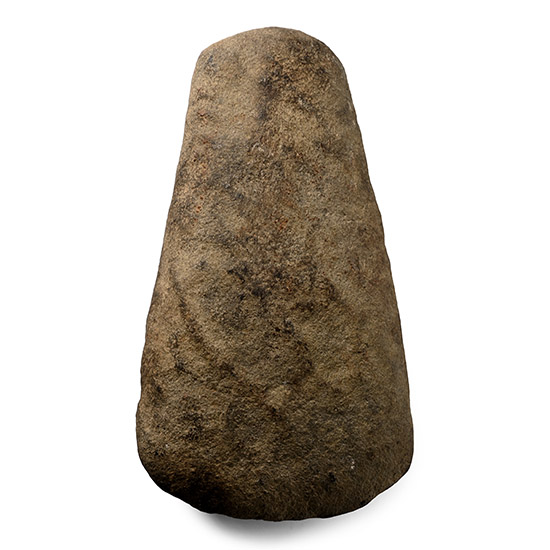
Stone Age Pecked Axehead
Neolithic Period, circa 6th millennium B.P.Estimate: £60 - 80 (+bp*)
Opening Bid: £5
With a curved blade and a narrow, rounded butt. 540 grams, 13.9 cm
From the late collection of gentleman from Portsmouth, Hampshire, UK, whose collection was formed from the late 1980s-early 1990s. -
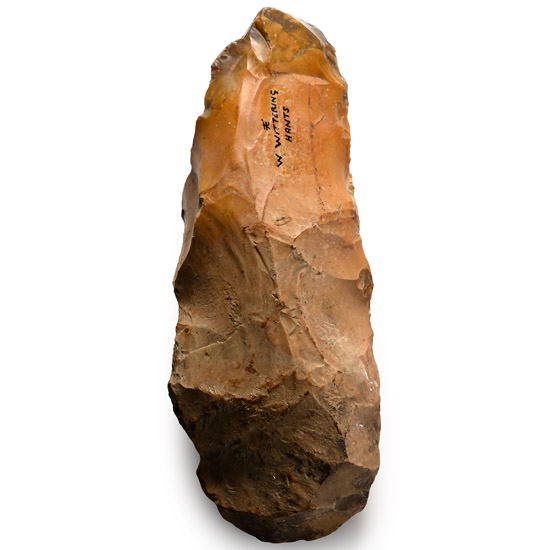
Farnham Stone Age Knapped Flint Axe
Neolithic Period, circa 6,000 B.P.Estimate: £100 - 140 (+bp*)
Bids: 1 | Current Bid: £5
Tongue-shaped in profile and biconvex in section with irregular narrow butt; old inked legend 'F[.] / W. Wittering Hants'. 263 grams, 13.5 cm
Found during the original official excavations in the Farnham area, Surrey, UK, which were conducted by Harold Faulker (1875-1963), and William Francis Rankine (c.1877-1962), who were instrumental with the excavation works and pit dwellings at sites including Six Bells, Frensham, Tilford, Thursley and Bagshot, and Waverley, amongst others at and near Farnham in the 1930s and 1940s. Much of the material is now in the prestigious Farnham museum. The present part of the collection having been gifted to their good friend and Haselmere Parish Priest, Charles Borelli (c.1914-2000) of Farnham; who was part of the Borelli family from Italy who emigrated from Lake Como in 1828 to set up the Borelli family watch and jewellery business; thence by family descent to his nephew.
Farnham district is one of the most interesting prehistoric regions in England, and has been visited by a succession of prehistoric peoples from Palaeolithic times onwards. Along the southern slope of the Farnham valley are three gravel terraces, which are famous prehistorically and have yielded large quantities of flint implements and bones of prehistoric animals, notably the mammoth. In prehistoric times, the chalk deposits played an important role in attracting settlers, as they contained rich layers of flint nodules used to make implements. The Farnham Gravels have been an abundant source of Palaeolithic finds, most prominent being hand axes. The axes differ in type, and each type is associated with a cultural phase of the Palaeolithic period. Types similar to these are found in similar deposits in the Somme valley and in many English valley gravels. Flint mining was also carried out by the Neolithic folk. Polished axes and leaf forms, arrowheads and knives, or possibly lance heads, are characteristic of the Neolithic flint work. -
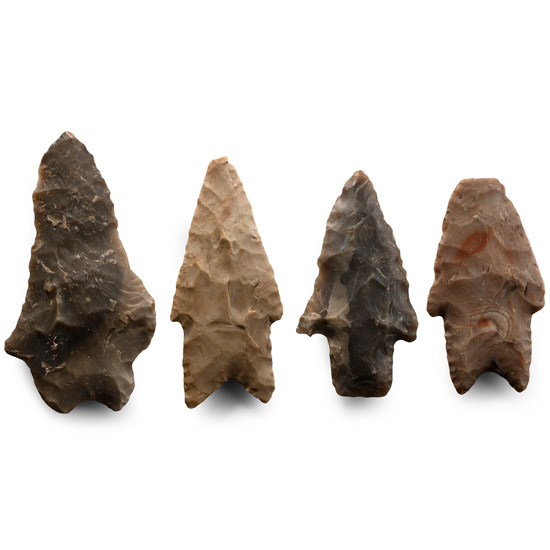
Large North American Stone Age Knapped Spear Point Group
Archaic Woodland Period, circa 2500-1900 B.P. or laterEstimate: £40 - 60 (+bp*)
Opening Bid: £5
Comprising three points with a 'swallow-tail' type tang and one with a rectangular tang in cream and grey stone. 72.7 grams total, 63-80 mm
From a previous old English collection. From the private collection of a West Midlands lady collector; acquired from a UK auction house. -
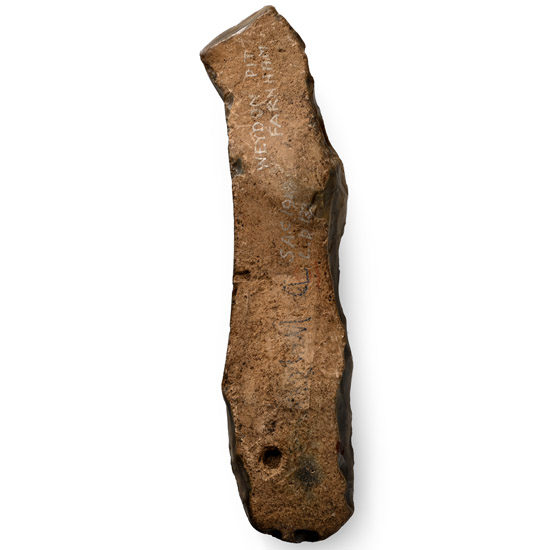
Farnham Stone Age Knapped Flint Wedge
Neolithic Period, circa 6,000 B.P.Estimate: £80 - 100 (+bp*)
Opening Bid: £5
Narrow and rectangular in section with cortex to both faces; old inked legends 'Wheydon Pit Farnham', 'S.A.C.19 L.D. 132' and others mostly effaced. 178 grams, 16.5 cm
Found during the original official excavations in the Farnham area, Surrey, UK, which were conducted by Harold Faulker (1875-1963), and William Francis Rankine (c.1877-1962), who were instrumental with the excavation works and pit dwellings at sites including Six Bells, Frensham, Tilford, Thursley and Bagshot, and Waverley, amongst others at and near Farnham in the 1930s and 1940s. Much of the material is now in the prestigious Farnham museum. The present part of the collection having been gifted to their good friend and Haselmere Parish Priest, Charles Borelli (c.1914-2000) of Farnham; who was part of the Borelli family from Italy who emigrated from Lake Como in 1828 to set up the Borelli family watch and jewellery business; thence by family descent to his nephew.
Farnham district is one of the most interesting prehistoric regions in England, and has been visited by a succession of prehistoric peoples from Palaeolithic times onwards. Along the southern slope of the Farnham valley are three gravel terraces, which are famous prehistorically and have yielded large quantities of flint implements and bones of prehistoric animals, notably the mammoth. In prehistoric times, the chalk deposits played an important role in attracting settlers, as they contained rich layers of flint nodules used to make implements. The Farnham Gravels have been an abundant source of Palaeolithic finds, most prominent being hand axes. The axes differ in type, and each type is associated with a cultural phase of the Palaeolithic period. Types similar to these are found in similar deposits in the Somme valley and in many English valley gravels. Flint mining was also carried out by the Neolithic folk. Polished axes and leaf forms, arrowheads and knives, or possibly lance heads, are characteristic of the Neolithic flint work. -
.jpg)
French Stone Age Mousterian Knapped Flint Knife Scraper
Middle Palaeolithic Period, circa 150,000-60,000 B.P.Estimate: £40 - 60 (+bp*)
Opening Bid: £5
Piriform in plam with cortex to the reverse; rounded butt and broad point; old inked legend '16 St Front'. 66.9 grams, 76 mm
From St Front, Périgueux, Dordogne, France. Acquired in the 1970s-1990s. From the collections of the famous UK musician and amateur archaeologist, Victor Brox (1941-2023). From the private collection of an East Anglian, UK, specialist collector. -
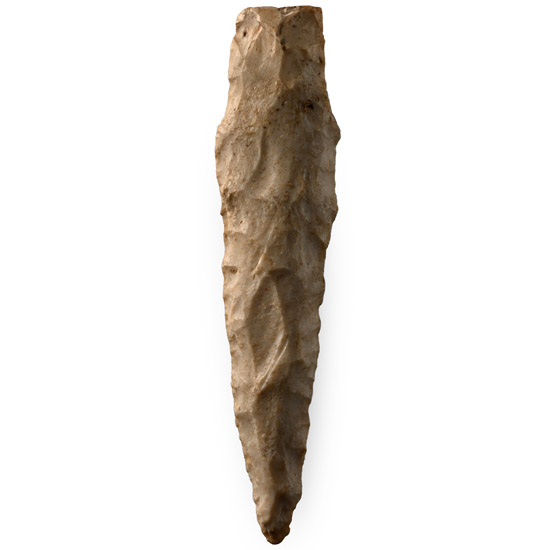
North American Stone Age Knapped Bifacial Dagger
Circa 6000-4000 B.P.Estimate: £120 - 170 (+bp*)
Opening Bid: £5
Narrow blade made from cream stone, inked Hugh Fawcett collection monogram and notes 'North America, 60-47'. 33.5 grams, 10.8 cm
Ex Dr Hugh Alderson Fawcett (1891-1982), a general practitioner and antiquarian who built up an important collection of ancient implements, weapons and ornaments. From the collection of a West Sussex collector. Acquired from the UK art market in the 2020s.
Dr Hugh Alderson Fawcett (1891-1982) was a general practitioner and antiquarian who built up an important collection of ancient implements, weapons and ornaments. The bulk of his collection is now in the Bristol Museum and Art Gallery, but Fawcett previously sold or traded some examples. His distinctive monogram and careful recording of provenance make his pieces readily identifiable. -
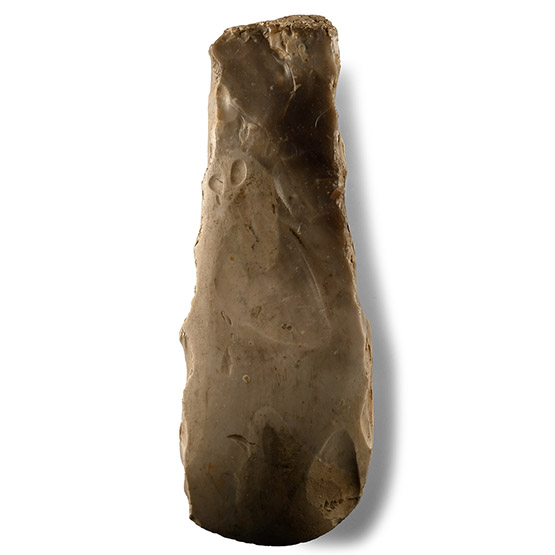
Stone Age Thick-Butted Polished Axe Head
Neolithic Period, circa 5500-2200 B.P.Estimate: £300 - 400 (‡+bp*)
Opening Bid: £160
Worked on all sides to a slightly asymmetrical profile with rectangular cross-section; irregular butt and rounded cutting edge, sides knapped but not polished; butt roughly retouched on surface and edges for attachment of the haft; edge chipped; light grey flint with darker and lighter hues and white spots and patches. 411 grams, 15.2 cm
Hervé Bouraly, Paris, between 1965-1974. Accompanied by a copy of an Art Loss Register certificate no.S00134589.

