-
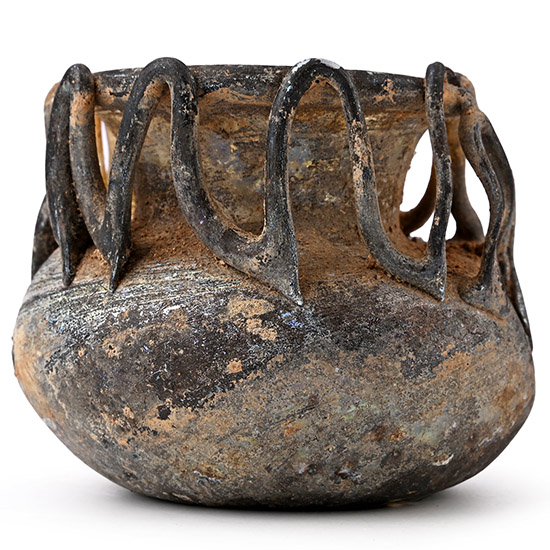
Roman Glass Vessel with Iridescence
4th-5th century A.D.Estimate: £400 - 600 (+bp*)
Bids: 1 | Current Bid: £30
Squat body with a short trumpet-shaped neck with rolled rim, applied openwork gallery encircling the neck. 59.8 grams, 73 mm wide
From an important London, UK, collection 1980-2020.
Such jars, with applied trails, are commonly found in the Near East and Egypt. One trail was wound once horizontally around the undercurve of the mouth; another was applied in a large pad to shoulder and then formed into wavy zigzag patterns. -
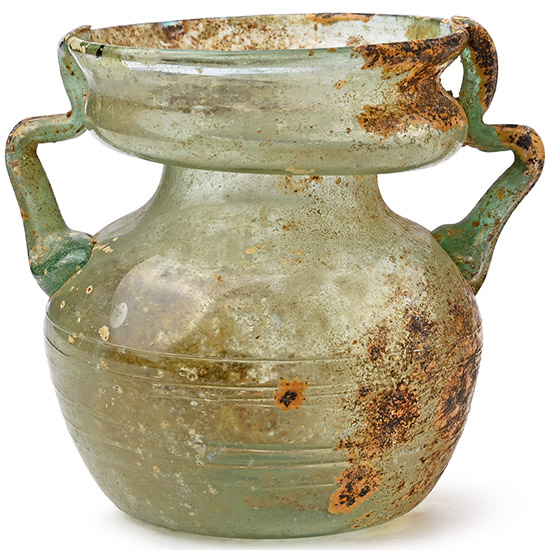
Roman Green Glass Handled Jar
2nd-3rd century A.D.Estimate: £400 - 600 (+bp*)
Opening Bid: £200
With a dimpled base, bulbous body with a carinated flange to the neck and a broad mouth, applied lateral handles. 74.4 grams, 95 mm wide
From an important London, UK, collection 1980-2020. -
.jpg)
Very Large Eastern Roman Blue Glass Bottle with Iridescence
2nd-3rd century A.D.Estimate: £2,000 - 3,000 (+bp*)
Opening Bid: £1,000
Piriform in profile with a narrow neck and flared mouth with a chamfered rim, dimple base. 949 grams, 29.1 cm
From the Xavier Guerrand-Hermès private collection. with Artcurial, Paris, 25 March 2014, no.39. Private collection, London, UK. This lot has been checked against the Interpol Database of stolen works of art and is accompanied by search certificate number no.12959-245241.
On ancient glass, iridescence is the soft play of colour that develops as the surface ages and becomes silica-rich. Minute layers form over time and break light into shifting blues, greens and golds. It is not a modern finish but something time has drawn out of the material itself, so the pattern and palette are unique to each piece. Collectors prize good, stable iridescence because it lifts the form: ribs read more crisply, profiles glow, and simple vessels take on depth and movement. Museums now tend to preserve these surfaces rather than polish them away, recognising both their beauty and what they tell us about an object’s long life (though it is not, by itself, a dating test). For display, iridescent glass performs brilliantly under gentle, directional light, where the colours “turn” as the vessel is moved. Well-preserved, even iridescence of this quality is not common and adds materially to the presence and desirability of the piece. -
.jpg)
Large Roman Green Mosaic Glass Fragment
Late 1st century B.C.-early 1st century A.D.Estimate: £2,000 - 3,000 (+bp*)
Opening Bid: £1,000
Large fragment of green glass with white swirls and petals, accompanied by a custom-made display stand. 193 grams, 15.5 cm (454 grams total including stand)
Bearing an old collection number '240' on the reverse. Dr Jutaro Kawabe, Nagoya, Japan, assembled during the 1960s-1980s. with Hoshigaoka Gallery until the late 1990s. This lot has been checked against the Interpol Database of stolen works of art and is accompanied by search certificate number no.13410-258950.
The decoration is well documented in the Eastern Roman Empire, especially the Syro-Palestinian coast. The most frequently occurring colours in these glass mosaics are opaque red, but green and blue tints are not uncommon. -
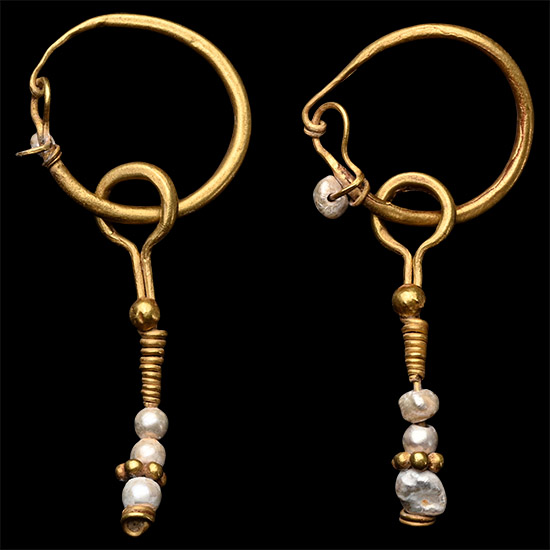
Roman Gold Earrings with Pearls
2nd-3rd century A.D.Estimate: £600 - 800 (+bp*)
Bids: 1 | Current Bid: £500
Matched pair, each comprising a tubular shank with hook-and-eye closure, free-running dangle with pearl bead and granule cluster below. 3.94 grams total, 50 mm each
Private collection, 1990s-early 2000s. with Gorny and Mosch, Munich, 14 December 2010, no.160. Accompanied by copies of the Gorny and Mosch catalogue pages. -
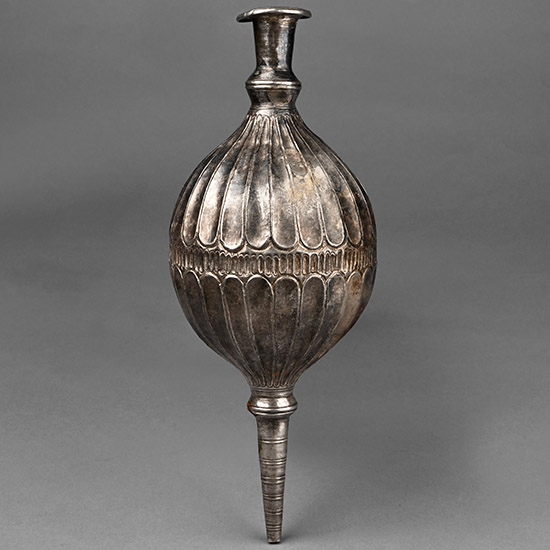
Large Graeco-Roman Silver Wine Infundibulum
5th century B.C.-1st century A.D.Estimate: £30,000 - 40,000 (+bp*)
Bids: 7 | Current Bid: £30,000
With a hollow spherical body decorated with slightly concave petals radiating from each end, separated by a central grooved band; one end with a tapering funnel marked by horizontal grooves, the other with a short tapering neck and a wide rim. 356 grams, 29.5 cm
Old Austrian private collection, 1980s. Accompanied by a copy of a nine-page examination report number 154/2026 by Dr habil Mikhail Treister. Accompanied by an academic report by Dr Raffaele D’Amato. This lot has been checked against the Interpol Database of stolen works of art and is accompanied by search certificate number no.12905-242699.
Comparable instruments, usually called clepsydra in Greek and infundibulum in Latin, were in use in the 5th – first half of the 4th centuries B.C. A total of 13 such objects, or clepsydra, are known, including two of the unknown origin), represented by the finds both from Central (Lazio) and South (Campania, Calabria and Basilicata) Italy, Illyria (Apollonia) and Central Greece (Boeotia, Phocis) (all made of bronze), from the Taman peninsula in the North Pontic area, a fragmented one – from the Ulyap kurgan necropolis in the Trans-Kuban region and a silver piece from an aristocratic Thracian burial in the Plovdiv region. A distinctive feature of all these metal objects is the combination of a narrow vertical tube, at the lower end turning into a container with holes in the bottom. -
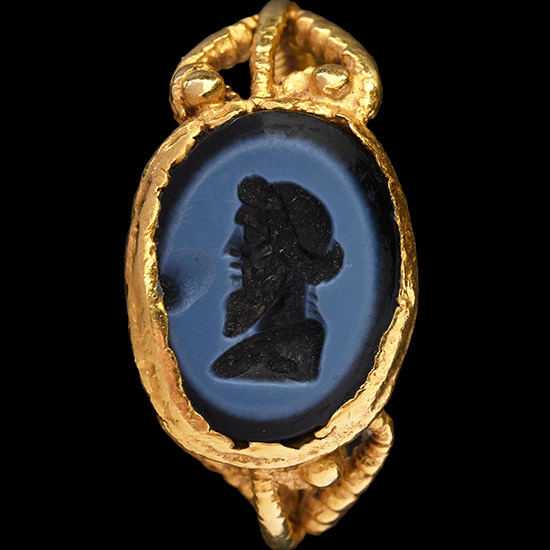
Roman Gold Ring with Nicolo Gemstone of a Bearded Bacchus as a Herm
1st century A.D. ring: 3rd-4th century A.D.Estimate: £3,500 - 4,500 (+bp*)
Bids: 1 | Current Bid: £10
The intaglio deeply carved to depict a profile of Bacchus, set within a closed-back bezel; the band formed as a triple-twisted rope with granules and beadwork upon the shoulders. 5.90 grams, 22.20 mm overall, 16.36 x 13.99 mm internal diameter (approximate size British I, USA 4 1/4, Europe 7.44, Japan 7)
Acquired on the European art market. This lot has been checked against the Interpol Database of stolen works of art and is accompanied by search certificate number no.13342-257959.
The band formed as a triple-twisted rope with granules, and beadwork upon the shoulders is typical of the 3rd to 4th centuries AD. However, the image of the bearded Bacchus remains attached to the original Greek iconography, as seen on the Ermae of the classical period. -
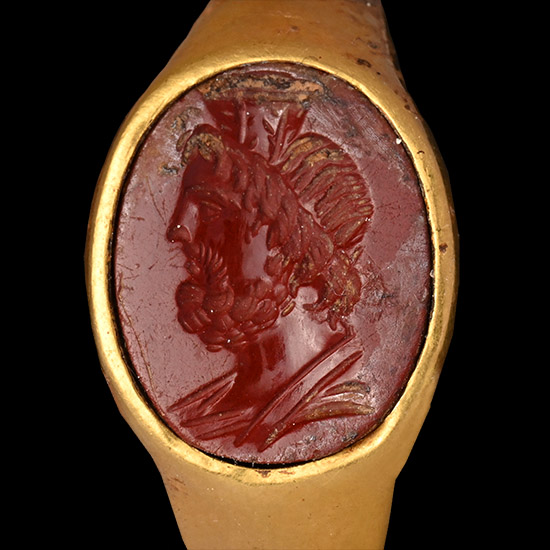
Roman Gold Ring with Bust of the God Serapis
1st-2nd century A.D.Estimate: £2,500 - 3,500 (‡+bp*)
Bids: 1 | Current Bid: £2,000
Hollow-formed hoop with broad ellipsoid cell, inset red jasper intaglio profile bust of Serapis with modius; possibly a marriage, supplied with a museum-quality impression. 5.65 grams, 27.68 mm overall, 18.70 x 15.32 mm internal diameter (approximate size British L 1/2, USA 6, Europe 11.87, Japan 11)
Private European collection. Acquired in 2002. This lot has been checked against the Interpol Database of stolen works of art and is accompanied by search certificate number no.13122-246778.
Serapis was a Graeco-Egyptian god combining the Egyptian gods Osiris and Apis, but with a decidedly Greek appearance. He was promoted by Ptolemy I in the 3rd century BC to help unite the Greek and Egyptian people. Later, Ptolemaic rulers spread his worship, and Serapis became popular across the Roman Empire. Outside Egypt, he was often identified as Isis's partner, replacing Osiris. Over time, he also adopted traits associated with the Greek gods, Hades and Dionysus. -
.jpg)
Roman Gold Ring with Jasper Gemstone with Dolphin
2nd-3rd century A.D.Estimate: £1,000 - 1,400 (+bp*)
Opening Bid: £500
Facetted rectangular-section hoop with square bezel set with a tall oval intaglio engraved with a dolphin. 6.94 grams, 18.78 mm overall, 15.99 x 11.46 mm internal diameter (approximate size British E, USA 2 1/4, Europe 2.41, Japan 2)
UK private collection before 2000. London collection, acquired on the UK art market. -
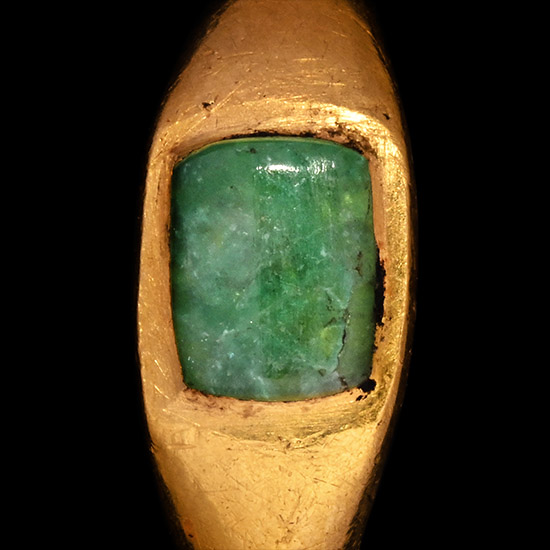
Roman Child's Ring with Emerald
1st-2nd century A.D.Estimate: £500 - 700 (+bp*)
Bids: 1 | Current Bid: £250
Integral flat bezel with inset green emerald. 1.22 grams, 13.23 mm overall, 10.74 mm internal diameter
Private English collection, formed between the late 1970s and early 1990s. Private collection, UK. -
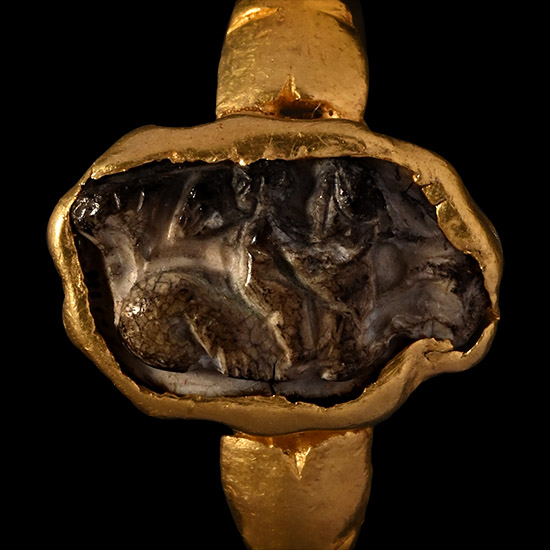
Roman Gold Ring with Burnt Agate Cameo of Eros, the Greek God of Love Riding a Hippocampus
1st century A.D.Estimate: £1,200 - 1,700 (+bp*)
Opening Bid: £600
D-section hoop with ellipsoid cell, inset cameo with Eros on a hippocamp. 3.59 grams, 20.92 mm overall, 16.98 mm internal diameter (approximate size British M, USA 6, Europe 12.46, Japan 12)
Private collection, Europe. Acquired on the English art market. -
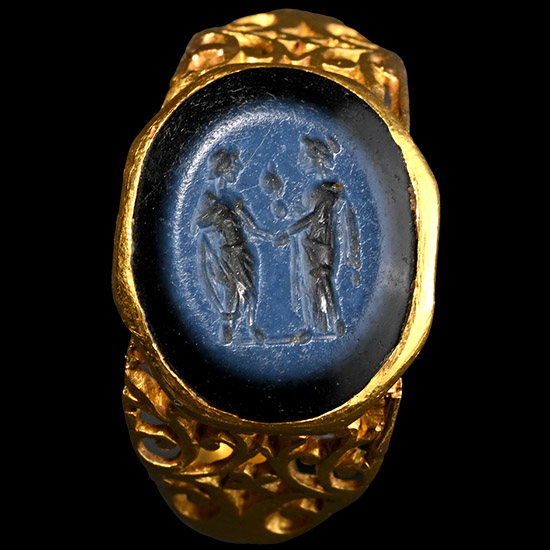
Roman Gold Matrimonial Ring with Nicolo Gemstone
2nd-3rd century A.D.Estimate: £8,000 - 10,000 (+bp*)
Bids: 2 | Current Bid: £4,200
A 3rd-century A.D. opus interrasile ring featuring an expanding hoop with openwork volute scroll shoulders, set with a 2nd-century A.D. dextrarum iunctio nicolo intaglio showing an opposing man and a woman holding hands, the woman holding an ear of wheat, the male figure wearing a long military mantle hanging down his back; supplied with a museum-quality impression. 8.40 grams, 23.52 mm overall, 18.89 x 17.87 mm internal diameter (approximate size British Q, USA 8, Europe 17.49, Japan 16)
Acquired on the European art market. This lot has been checked against the Interpol Database of stolen works of art and is accompanied by search certificate number no.13346-257954.
The wheat symbolises abundance, fertility and prosperity in marriage.

