-
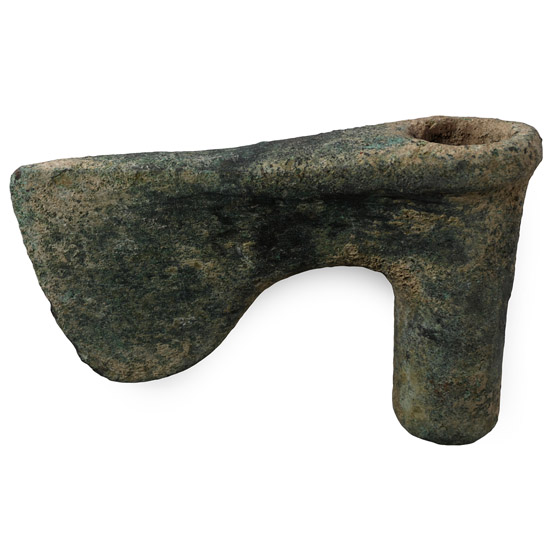
Luristan Bronze Axehead
2nd-1st millennium B.C.Estimate: £100 - 140 (+bp*)
Opening Bid: £50
With a short socketted shaft and flange to the mouth, broadening blade towards the cutting edge. 291 grams, 10.1 cm
Ex Abelita collection, 1990s. -
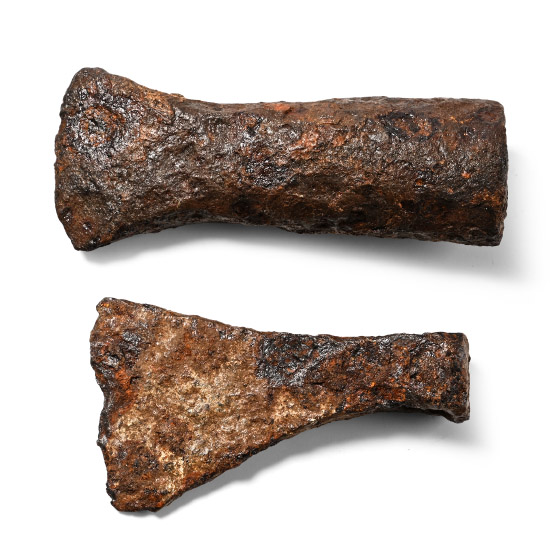
Medieval and Later Iron Axehead and Adze Group
15th-19th century A.D.Estimate: £30 - 40 (+bp*)
Bids: 2 | Current Bid: £25
Comprising: small blade with offset triangular socket, flared edge; adze with split socket and small flared blade. 157 grams total, 69-82 mm
From the private collection of Mr Brian Edwards, New Malden, Surrey, UK, formed from the late 1970s-early 1980s; thence by descent. Accompanied by the original collector's data sheet(s) with reference nos.A72 & A73. -
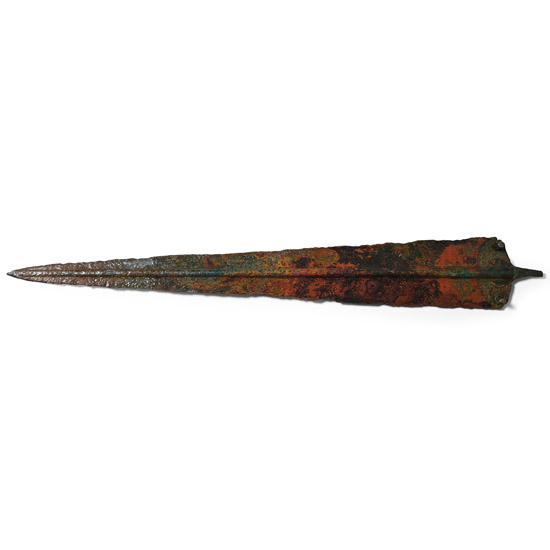
Luristan Bronze Tanged and Rivetted Spearhead
1st millennium B.C.Estimate: £180 - 240 (+bp*)
Bids: 1 | Current Bid: £90
Comprising a triangular blade with a narrow midrib, a short tang with two attachment studs in situ. 184 grams, 32 cm
Ex Abelita family collection, 1980s-2000s. -
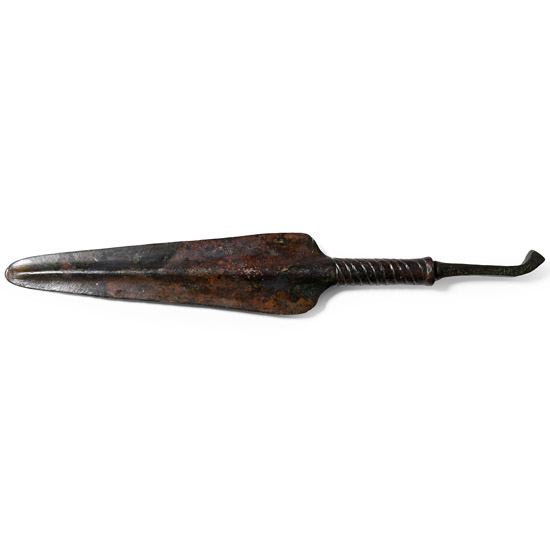
Western Asiatic Bronze Spear Blade
2nd-1st millennium B.C.Estimate: £180 - 240 (+bp*)
Bids: 1 | Current Bid: £90
Comprising a triangular blade with a rounded tip, a flaring neck with incised barleytwist detailing, and a square-section tang with bent tip. 355 grams, 32.2 cm
Ex Abelita family collection, 1980s-2000s. -
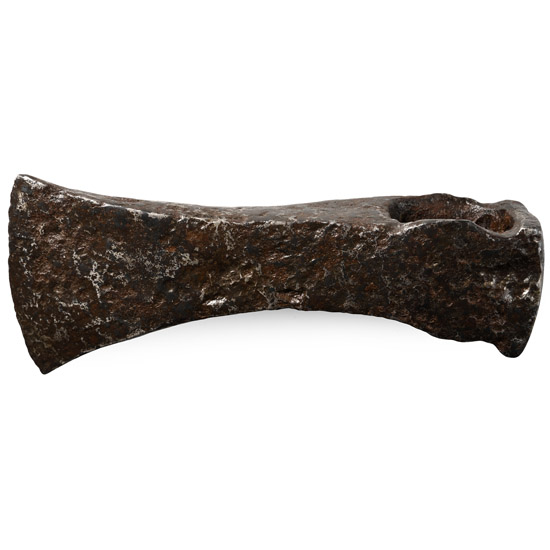
Late Roman Period Iron Narrow Axehead
Germany, 3rd-5th century A.D.Estimate: £40 - 60 (+bp*)
Bids: 3 | Current Bid: £20
Narrow axe with curved blade and oval socket with a flat extension to the rear. 616 grams, 15.5 cm
Ex M. Spiegelberg collection, since 1991; thence by descent. Accompanied by a previous yellow cataloguing slip. -
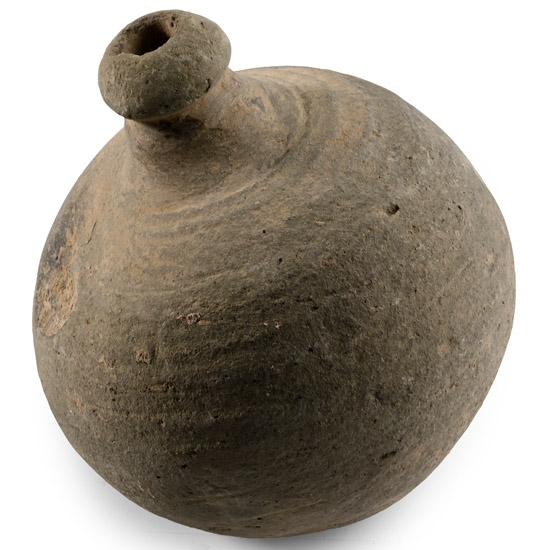
Byzantine 'Greek Fire' Ceramic Fire Bomb or Hand Grenade
9th-11th century A.D.Estimate: £80 - 100 (+bp*)
Bids: 3 | Current Bid: £20
Bulbous body with rounded base and domed filler-hole; intended to be filled with explosive liquid and a wick, and used as a hand grenade. 682 grams, 11.3 cm
From an important specialist collection, London, UK, 1990s. Accompanied by an academic paper by military specialist Dr Raffaele D'Amato, dated 15 July 2019 and titled 'Eastern Roman Empire - Greek Fire Bomb or Hand Grenade (μεσαίον kακάβιον) 9th-11th century AD'.
Apart from the use of siphons or manual flame-throwers called cheirosiphona, special corps of Roman soldiers employed terracotta grenades, in the form of small jars, abundantly evidenced in archaeological excavations. They were called μεσαία kακαβιά or κυτροκακάβια, where the former had a bulbous shape and the latter a more cylindrical form. -
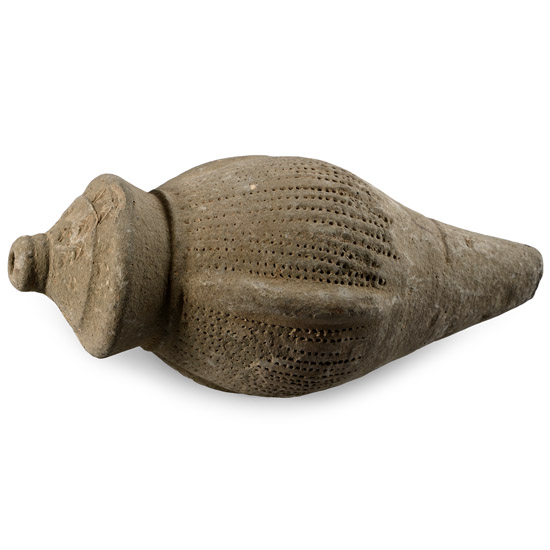
Turco-Mongol 'Greek Fire' Ceramic Fire Bomb or Hand Grenade
13th-15th century A.D.Estimate: £80 - 100 (+bp*)
Bids: 3 | Current Bid: £20
Piriform in profile with a stepped neck, incised decoration and three raised lugs; intended to be filled with explosive liquid and a wick, and used as a hand grenade. 424 grams, 17 cm
From an important specialist collection, London, UK, 1990s. Accompanied by an academic paper by military specialist Dr Raffaele D'Amato, dated 15 July 2019 and titled 'Eastern Roman Empire - Greek Fire Bomb or Hand Grenade (μεσαίον kακάβιον) 9th-11th century AD'.
Apart from the use of siphons or manual flame-throwers called cheirosiphona, special corps of Roman soldiers employed terracotta grenades, in the form of small jars, abundantly evidenced in archaeological excavations. They were called μεσαία kακαβιά or κυτροκακάβια, where the former had a bulbous shape and the latter a more cylindrical form. -
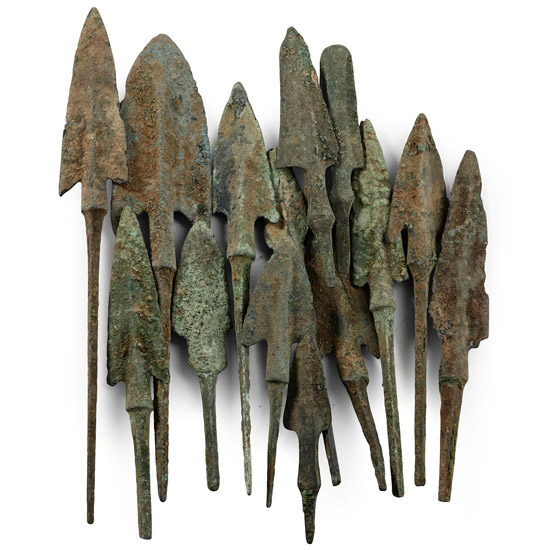
Western Asiatic Bronze Arrowhead Collection
2nd-1st millennium B.C.Estimate: £100 - 140 (+bp*)
Bids: 3 | Current Bid: £90
Comprising fourteen tanged arraoheads, mostly barbed types. 232 grams total, 6.1-16 cm
Ex London, UK, collection, 1990s. -
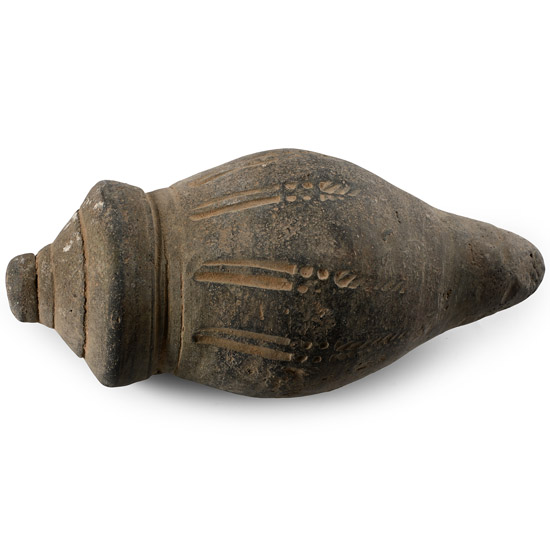
Turco-Mongol 'Greek Fire' Ceramic Fire Bomb or Hand Grenade
14th-15th century A.D.Estimate: £80 - 100 (+bp*)
Bids: 2 | Current Bid: £25
Piriform in profile with a stepped neck, incised decoration; intended to be filled with explosive liquid and a wick, and used as a hand grenade. 385 grams, 16 cm
From an important specialist collection, London, UK, 1990s. Accompanied by an academic paper by military specialist Dr Raffaele D'Amato, dated 15 July 2019 and titled 'Eastern Roman Empire - Greek Fire Bomb or Hand Grenade (μεσαίον kακάβιον) 9th-11th century AD'.
Apart from the use of siphons or manual flame-throwers called cheirosiphona, special corps of Roman soldiers employed terracotta grenades, in the form of small jars, abundantly evidenced in archaeological excavations. They were called μεσαία kακαβιά or κυτροκακάβια, where the former had a bulbous shape and the latter a more cylindrical form. -
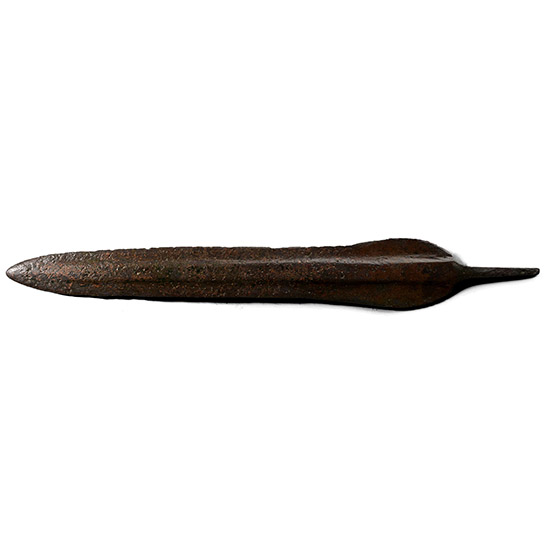
Large Western Asiatic Bronze Dagger
1st millennium B.C.Estimate: £200 - 300 (+bp*)
Bids: 1 | Current Bid: £100
Slender blade with a wide midrib and a short rectangular-section tang. 267 grams, 34.7 cm
Ex Abelita family collection, 1990s. -
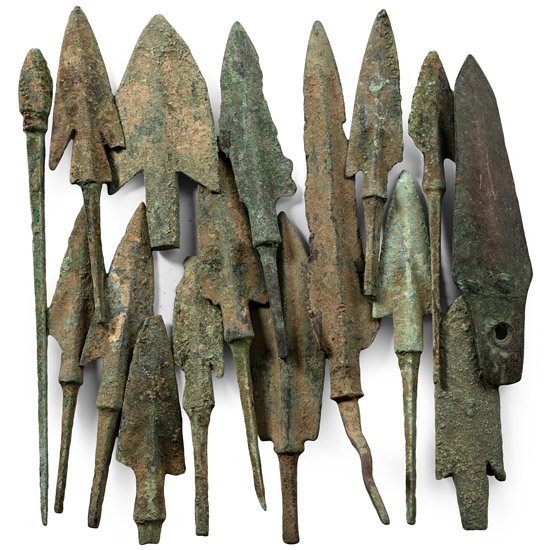
Western Asiatic Bronze Arrowhead Collection
2nd-1st millennium B.C.Estimate: £100 - 140 (+bp*)
Bids: 1 | Current Bid: £55
Comprising sixteen tanged arrowheads, mostly barbed types. 313 grams total, 6.5-14.7 cm
Ex London, UK, collection, 1990s. -
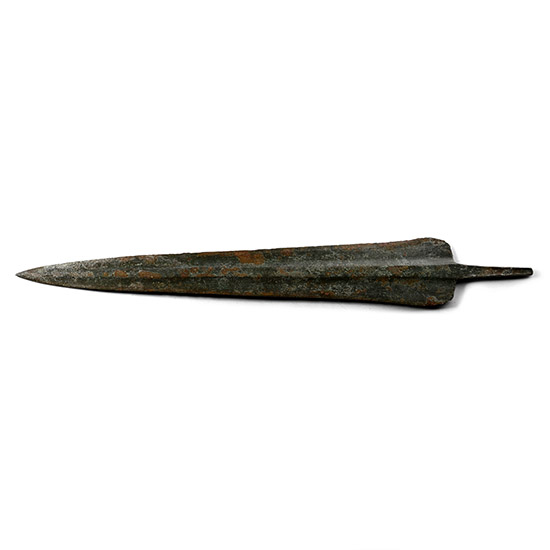
Western Asiatic Bronze Dagger
14th-10th century B.C.Estimate: £200 - 300 (+bp*)
Bids: 1 | Current Bid: £100
Triangular blade with raised midrib and a rectangular-section tang. 130 grams, 31 cm
Ex Abelita family collection, 1990s.

