
Auction Highlights
-
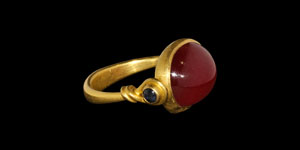
Greek Gold Swivel Ring with Ruby and Sapphires
Sold for (Inc. bp): £17,360
A substantial D-section penannular hoop with tapering ends forming looped hinge elements; the bezel a gold cell with lug to each end engaged with the loop and set with a sapphire cabochon; the cell open to the underside, set with a large cabochon ruby, the coiled ends recently soldered to allow it to be worn. -
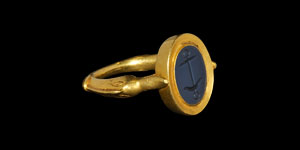
Roman Gold Ring with Anchor and Dolphins
Sold for (Inc. bp): £5,704
A carinated gold hoop with shoulders formed as opposed dolphins supporting a discoid plaque in their mouths; incised eye detail to each side, notched crests, zigags to the mouths, punched point borders; the bezel dished to the upper face with inset blue jasper plaque, intaglio anchor motif with ring above the stock and another below the tines. -
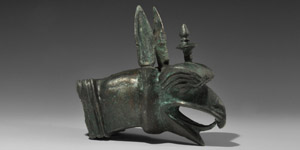
Greek Gryphon-Head Cauldron Mount
Sold for (Inc. bp): £2,976
A large bronze hollow-formed cauldron decoration in a form of a griffin-head with open beak and curved pointed tongue, olive-shaped eyes decorated with heavy quadruple 'eyebrows'; the head encircled by a U-shaped ring; the square-section neck decorated with three raised ribs to the rear, a central knob and conical finial projecting from the crown of the head between two leaf-shaped separately-formed ears. -
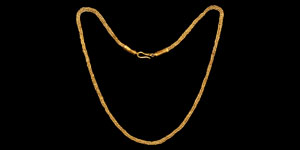
Roman Heavy Gold Braided Chain with Clasp
Sold for (Inc. bp): £2,852
A choker-length gold trichinopoly braid with ribbed collar finials, hook-and-eye closure. -
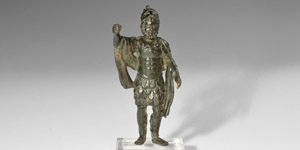
Roman Mars Statuette
Sold for (Inc. bp): £2,232
A bronze statue of Mars with beard and wearing cuirass with gorgonieon at breast, kilt with scaled lapets, greaves on legs and Corinthian helmet on head with small figure of winged sphinx to the top; right arm held up, left extending forward, cloak around shoulders; mounted on a custom made stand. -
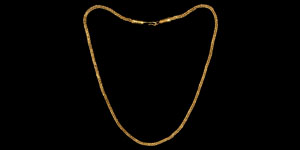
Byzantine Gold Heavy Braided Chain with Clasp
Sold for (Inc. bp): £3,224
A choker-length gold trichinopoly braid with ribbed collar finials, hook-and-eye closure. -
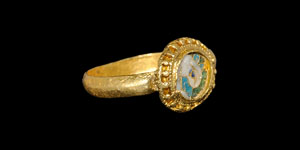
Anglo-Saxon Gold Ring with Cloisonne Hound's Head
Sold for (Inc. bp): £12,400
A gold ring with plain shank with round bezel with open cells around the edge; in the centre gold wire cells filled with white and green cloisonné enamel forming the head of a hound. -
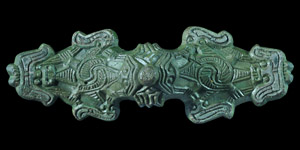
Scandinavian Viking Equal-Arm Brooch
Sold for (Inc. bp): £5,208
A bronze bow brooch with hollow conical bow and symmetrical arms; the bow with central stud and facing masks above hatched bodies extending to the arms, each with lateral S-shaped animal elements, hands gripping the ribbon bodies and opposed facing mask at the outer edge; masks and lateral animals with silvered surfaces; hollow to the underside, pin-lugs and catchplate intact. -
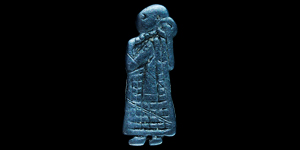
Viking 'Valkyrie' Pendant
Sold for (Inc. bp): £4,464
A flat-section silver plaque depicting a standing female in profile dressed in a long hatched robe, one hand raised touching a necklace of circular beads, long hair stylised in a 'knot' hairstyle, a semicircular loop to the reverse. -
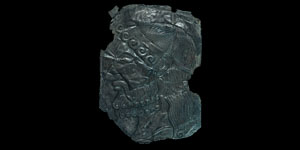
Western Asiatic Sumerian Bearded Face Plaque
Sold for (Inc. bp): £4,464
A sheet silver plaque with repoussé image of a profile bearded male bust with band to the brow; the hair shown in vertical waves with curled ends, the beard similar; lentoid eye and raised eyebrow; beaded lateral borders. -
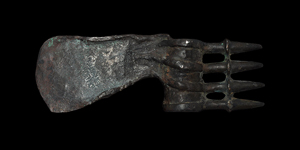
Western Asiatic Axehead with Nebuchadnezzar and Marduk Inscription
Sold for (Inc. bp): £3,858
A bronze axehead formed as a tubular socket with four moulded ribs projecting to the rear to form four conical spikes, a tongue-shaped flat blade slightly pressed in the upper and lower border with incised cuneiform inscription; accompanied by an old scholarly note, typed and signed by W.G. Lambert, late Professor of Assyriology, University of Birmingham, 1970-1993, which states: "Ancient Inscribed Bronze Axehead naming a King of Babylon. Maximum height: 5 cm, Maximum length: 14.8 cm. the centre of this axehead is round, with hole for the shaft. On the opposite side from the blade are four spikes, joined for greater strength about half-way between the points and the shaft-hole. Each spike continues as a ridge of metal around the shaft-hole, the lower forming a circle, the upper three continuing on the opposite side from the spikes onto the blade. This has an upper edge continuing the angle of the spikes, but the lower edge goes downwards to the cutting edge, which is thus deeper than the opposite end of the blade. Originally the blade was deeper that it is now: the upper and lower edges have been hammered to give the blade more strength by thickening the edges. This happened since manufacture because the inscription has been in part obliterated by this hammering. The inscription is in Babylonian cuneiform and reads: te-le-'-ᵈama[r-utu] [m]ut-nen-na-a e-te₄-[ra] [m]uš-te-'-ú aš-ra-ti-[ka] [..........] x du-un-nin i-di-ia-m[a] [lu]-šam-qí-ta ge-ri-ia [ša] ᵈnabû-ku-dúr-ri-usur lugal šár: You are able, Marduk, to save the pious who seeks after your shrines, [........].Strengthen my arms that I may fell my foes. [Property of] Nebuchadnezzar, king of the world. This is a prayer to the Babylonian god Marduk, with ownership ascription. The Nebuchadnezzar named is Nebuchadnezzar I, king of Babylon 1125-1103 B.C., not the Nebuchadnezzar II known from the Bible. The inscription begins on one side of the blade and is completed on the other side. Another axehead of the same type formerly in the Foroughi Collection has the same inscription, though complete, see G.Dossin, in Iranica Antiquea II (1962) pl. xxiv. Both these axeheads were apparently found in Iran, but the inscription is purely Babylonian. How such Babylonian inscriptions came to be found in Iran is a debated issue. It may be that such texts were copied onto bronze objects made in Iran, but in any case their date is close to that of kings named. This is then an important axehead naming a major king of Babylon." A later note of prof. Lamber completes the translation: " te-le-'-ᵈama[r-utu] [m]ut-nen-na-a e-te₄-[ra] [m]uš-te-'-ú aš-ra-ti-[ka] [eli n] a-ki-ri šu-zu-uz-zu [i-zi-q]a ša-ra-ka a-si-' n[a-ak]-ri-ia du-un-nin kak-ki-ia-ma lu-ú-di-ša ge-ri-[ia] ša ᵐná-[ku]-dúr-ri-ÚRU lugal šár: You are able, O Marduk,to make prevail over enemies the devout noble who ever seeks your sanctuaries. Your spirit has [blown], destroy (?) my enemies, strengthen my arms that I may tresh [my] foes. Property of Nebuchadnezzar, king of the world. This is Nebuchadnezzar I, king of Babylon 1125-1103 B.C. Another copy of this inscription on the same type of axehead exists in the former Foroughi Collection and was published by G.Dossin in Iranica Antiqua II (1962) p.158 and pl. xxiv. The inscription there is a little better preserved, and one can note one difference: this axehead under study writes du-un-nin, while the Foroughi example writes du-un-ni-in, proving that the one was not copied mechanically from the other. Some one involved understood the writing. This axehead comes from Luristan and probably dates from a little later than the reign of Nebuchadnezzar I, the inscription having been copied in Iran from an object with this inscription made in Babylon, but circulating in Iran. Generally this object is in good state of preservation, though there is some corrosion of the inscription, and the blade has been sharpened recently." -
.jpg)
Medieval The Congham Limoges Cross
Sold for (Inc. bp): £2,480
The majority of a gilt-bronze Limoges cross plaque with cloison enamel ornament; a reserved Corpus Christi with arms extended and head bowed, framed by a nimbus with enamel fill, two large polychrome enamel rosettes and two smaller roundels; above, a panel with incised 'IHS' (for Iesus Hominem Salvator 'Jesus saviour of men') and 'XRS' (for Christos) and Manus Dei (hand of God) descending from a cloud; to the reverse, scrolled tendrils and flowers. -
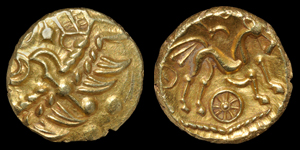
Celtic Iron Age Coins - Atrebates and Regni - Selsey Two Faced Gold Stater
Sold for (Inc. bp): £3,100
Obv: wreath pattern with two large pellets behind and a hidden face. Rev: triple-tailed horse with charioteer's arms above, eye symbol behind and eight-spoked wheel below with corded wide V-shaped ground line. -
.jpg)
Celtic Iron Age Coins - Iceni - Antedios - Triple Moon Gold Stater
Sold for (Inc. bp): £3,472
Obv: three opposed crescents, pellet at centre and at cusps, enclosed by six arcs with trefoil or quatrefoil of pellets in angles. Rev: horse right with mane of dashes, W-shaped forelegs, pellet under tail and 'lyre' symbol above, with double-ringed solar motif above and with large pellet and ANTED monogram below. -
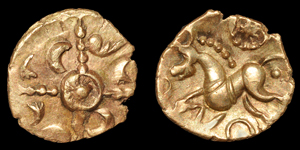
Celtic Iron Age Coins - Corieltauvi - Torksey Gold Quarter Stater
Sold for (Inc. bp): £1,984
Obv: centre pellet-in-annulet with four radiating beaded lines with crescents and bear's paws in angles. Rev: horse left, with harness straps and beaded mane, pellet under tail with star in pelletted circle above and large annulet below. -
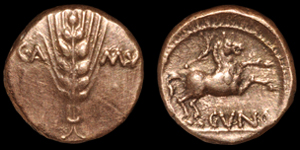
Celtic Iron Age Coins - Catuvellauni - Cunobelin - Classic Gold Stater
Sold for (Inc. bp): £2,108
Obv: ear of corn with central stalk with C.A to left and MV right. Rev: 'classic' style horse rearing right with branch above and CVNO on ground line below. -
.jpg)
Celtic Iron Age Coins - Iceni - Snettisham Multiple Pellets Gold Stater
Sold for (Inc. bp): £2,232
Obv: plain, traces of crossed wreaths. Rev: horse right with double tail without pellets and beaded mane, 'simplified wing' motif above and pellet-in-annulet-in-beaded-ring below, two double pellet-in-beaded-rings behind, above and below tail. -
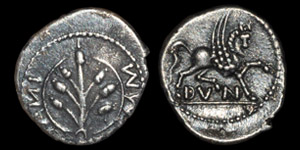
Celtic Iron Age Coins - Cantiaci - Amminus - Plant Silver Unit
Sold for (Inc. bp): £1,488
Obv: plant within circle with [A]M - INVS legend. Rev: Pegasus stepping right with DVN above ground line below. -
.jpg)
Ancient Roman Imperial Coins - Agrippina II under Claudius - Mother and Son - Denarius
Sold for (Inc. bp): £3,348
Rome mint. Obv: AGRIPPINAE AVGVSTAE legend with draped bust of Agrippina II right, wearing crown of corn-ears, her hair in long plait behind. Rev: NERO CLAVD CAES DRVSVS GERM PRINC IVVENT legend with bare-headed, draped bust of Nero left. -
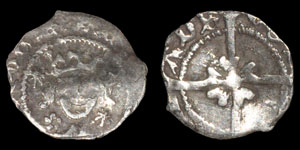
World Coins - Ireland - Edward IV - Drogheda - Suns and Roses Penny
Sold for (Inc. bp): £3,720
Obv: facing bust with sun to left of crown adn rose to right and rose to left of neck and sun to right with +ED[......]HYBE legend. Rev: large rose over long cross with [VILL] ADR OG[H] [EDA] legend for Drogheda mint.
No results were found for this search. Please change your search criteria and try again.
