
Auction Highlights
-
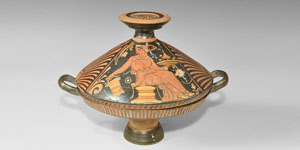
Greek Red Figure Ware Lekanis
Sold for (Inc. bp): £2,662
A blackware lekanis with pedestal base and strap handles to the sides, discoid handle to the lid with central rosette; the dish with band of vertical strokes to the outer rim, eccentric brown disc to the centre; the lid with two figural panels separated by red palmettes: Side A: a naked youth sitting on his cloak with legs crossed, upper body turned; cream detail to the shoes, headband and tie for the petasos on his back; in the right hand, the handles to a situla with cream lines and points; in the left hand a second situla with cream detailing and a casket, opened to reveal an alabastron and a round object; bands of cream pellets in the field; Side B: a lady seated on a stand with upper body turned to the rear; cream detail to the shoes and closures of the belted peplos, stephane and bangles to the left wrist; in the right hand the handle of a situla with line and point detailing; in the left hand a phiale with ivy-leaf above, suspended ball below; rosettes and bands of pellets in the field. -
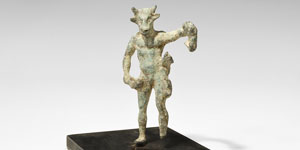
Greek Bronze Minotaur Figurine
Sold for (Inc. bp): £5,566
A cast figurine of the Minotaur standing with club in the right hand, left arm raised; mounted on a custom-made wooden stand with old collector' label 'Coll. General Cesnola / Am. Consul Gen. / Crete / Sotheby's 1892'. The Minotaur, monstrous offspring of the Cretan queen Pasiphae and a white bull, was first represented during the Minoan period (27th - 15th century BC). According to myth, the creature, imprisoned in a labyrinth beneath the royal palace, demanded yearly human sacrifices until it was eventually slain by the hero Theseus. The tale may have had its origins in the prehistoric Greek worship of a 'horned god' and the likely practise of human sacrifice at the palace-city of Knossos. By the Archaic period of Greek art (c. 800 - 480 BC), the Minotaur was an established and popular subject -matter for vase paintings, sculpture and metalwork (cf. the depiction of Theseus slaying the MInotaur on a black-figure kylix held in the Toledo Museum of Art, Ohio, USA, accession no. 1958.70 / Beazley 350734). Later, during the Hellenistic and Roman periods, bulls were also associated with the worship of Mithras, meaning that this figure may have held dual significance for its original owner. -
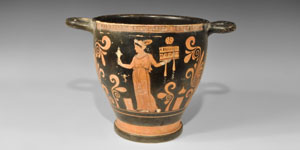
Greek Apulian Skyphos with Odysseus and Penelope
Sold for (Inc. bp): £2,481
A red-figure ceramic skyphos with pedestal base, bell-shaped body and slightly everted rim; to the rim a band of red ovolo on one face and wave patterns on the other; two round-section handles; the body with two red figure scenes separated by palmettes below the handles; Side A: Penelope standing wearing a draped peplos robe, hair dressed with a ribboned sakkos with stephane, holding a casket in the left hand and mirror (?) in the right hand; restricted cream detailing to the headdress, mirror, coiled bracelets and shoes; Side B: a standing nude Odysseus with mantle to the left arm, hand resting on the caduceus, petasos to the back, holding a dish of fruit in the right hand; cream detailing to the headband, petasos, caduceus and dish. -
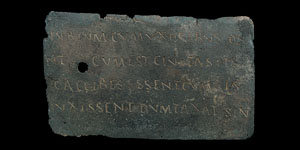
Roman Bronze Military Diploma For Cilix the Cilician
Sold for (Inc. bp): £1,694
A section of a military diploma, being the lower right half of the tabella I, reading: "[N]VBIVM CVM VXORIBVS QV[..] / [..]NT CVM EST CIVITAS IIS / CAELIBES ESSENT CVM IIS / [.]VXISSENT DVM TAXAI SIN' in four lines; to the other face, thirteen lines of similar script within incised borders 'ET CONVBIVM CVM / IABVISSENT CVM EST / VI.K. ††BR / RVFINO / TE.PONTIANO / [.] CILICE . [...]OIOPOLI[.] / [.]RI EIVS CILICI / [..] EIVS / VM EX TABVLA AENEA / M VROPO . ITEM / ΛVAM', part of a constitution issued on the 27th of January (ante diem VI kalendas Februarias) 131 AD, while M. Antonius Rufinus and Sergius Octavius Laenas Pontianus were consuls, the diploma was given to a Cilix, a Cilician; he had a wife and a son and was born in a town with name ending in "-polis", since there is no place for the name of the unit and the commander, it is highly possible it is a copy after a constitution issued for one of the praetorian fleets from Ravenna or Misenum; the tabella was thereafter cut for reuse, and new lines on the left margin were added. -
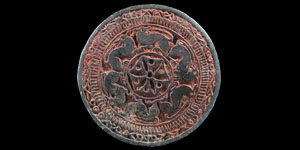
Anglo-Saxon Enamelled Bronze 'Quoit Brooch Style' Roundel Appliqué
Sold for (Inc. bp): £5,082
A cast flat-section circular plaque with bands of reserved ornament on a red enamel background; the central motif a hexagon with hexafoil to the centre, a band of Quoit Brooch Style profile animals in three confronted pairs, a band of radiating darts and perimeter band of alternating series of annulets and saltires; stud remains to the reverse and layout markings, including small, enamel filled piercings from where the design was set out onto the disc. -
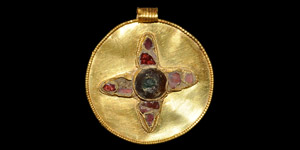
Anglo-Saxon Gold and Garnet Disc Pendant
Sold for (Inc. bp): £4,356
A flat disc pendant with beaded wire border, applied ribbed loop extending to the rear face; gold cellwork cross with inset cloison garnets and beaded wire border, central domed glass boss with green glass knop. -
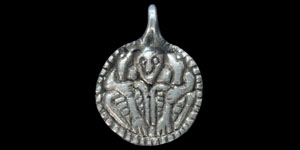
Scandinavian Viking Silver Pendant with Odin Gripping Two Ravens
Sold for (Inc. bp): £11,495
A cast discoid Scandinavian Viking pendant with integral loop, pelletted border enclosing a low-relief image of a male face between two birds, grasped by arms at the necks, small loop to the top, possibly replaced in antiquity. -
.jpg)
Anglo-Saxon Florid Animal-Masks with Birds Cruciform Brooch
Sold for (Inc. bp): £8,591
A gilt-bronze bow brooch of florid cruciform type comprising: a square headplate with lateral bars, three D-shaped plaques to the sides each a Style I face formed from opposed profile bird-heads, scroll eyes and peltoid lower portion, billetted collar to the rear; a broad bow with facetted ends, central discoid panel; footplate with lateral bird-head lappets; terminal with Style I mask above addorsed bird-heads and a peltoid plaque; to the reverse, pin-lugs with ferrous accretion, hooked catchplate. -
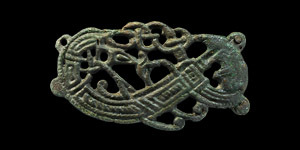
Viking Scandinavian Jellinge Style Bronze Dragon Belt Plaque
Sold for (Inc. bp): £2,178
A cast openwork mount in the form of an s-shaped beast decorated with panels of hatching interlaced with openwork tendrils, scrolled ends turning to form the frames for the attachment rivets (three present); the design including elements of the earlier Jellinge Style (e.g. hatched body panels) with the later Ringerike Style (e.g. the mesh of tendrils, lentoid eye). -
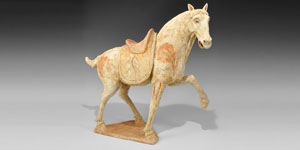
Chinese Ceramic Prancing Horse Figurine
Sold for (Inc. bp): £6,655
A cast horse figurine on an irregular base in lively advancing pose, foreleg raised; the saddle a separate casting. -
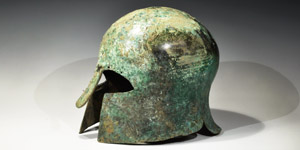
Greek Bronze Corinthian Helmet
Sold for (Inc. bp): £19,360
A greek bronze helmet hammered from a single heavy sheet, of domed form, with a flaring neck-guard, elongated almond-shaped eye holes, and a protruding nose-guard rounded at the tip, perforated along the perimeter with eight pins preserved; ancient repair to the guard after battle damage. -
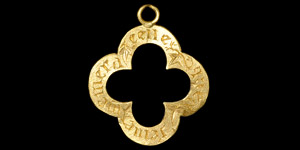
Medieval Gold Quatrefoil 'Remember that you love me' Posy Pendant
Sold for (Inc. bp): £4,477
A flat-section openwork quatrefoil pendant with loop, inscribed to one face 'celle que teme memera' with foliage and to the other 'noez mon'; medieval French corresponding to ''notez mon celle que té me memera' (Remember that you love me). -
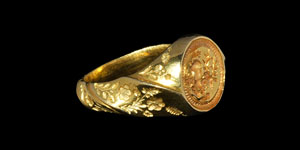
Medieval Gold 'Hart' Signet Ring
Sold for (Inc. bp): £7,502
A substantial finger ring with D-section hoop shoulders decorated with diagonal scrolling bands, the concave portions ornamented with five-petalled pansies and foliage, expanding shoulders; the circular bezel bearing the cut signet seal design of a hart (stag) couchant with large antlers, collared and chained with a three-petalled lily with leaves in the field each side, with black letter 'ht' monogram below being a punning abbreviation of the name Hart. -
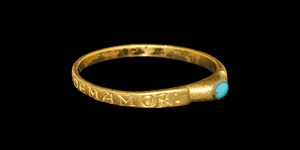
Medieval Gold 'God gives me the joy of love' Stirrup Ring
Sold for (Inc. bp): £3,025
A flat-section hoop with pyramidal bezel and inset supplant turquoise stone; to the outer face a legend in Lombardic script '+DEV:DOINST:IOIE:DEMAMOR: (God gives me the joy of love). -
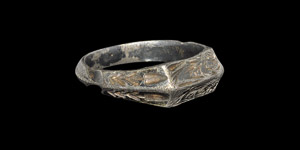
Medieval Silver-Gilt St Catherine and St Barbara Iconographic Ring
Sold for (Inc. bp): £1,029
A cast finger ring with carinated pelletted hoop, inset chevron to each shoulder and integral facetted bezel with incised images of plants below St. Barbara with a branch and St. Catherine with a wheel above her shoulder. -
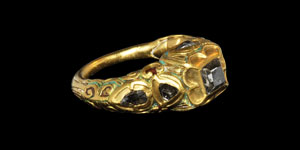
Post Medieval Gold and Diamond Finger Ring
Sold for (Inc. bp): £6,534
An ornate hoop with segmented inner face, scrolls and inset facetted diamonds to the shoulders, box bezel with inset facetted diamonds to four vertical faces and a large table-cut diamond to the upper face. -
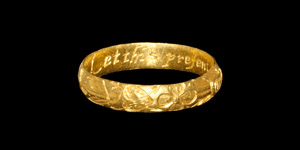
Post Medieval Gold 'Let This Present My Good Intent' Love Hearts and Forget-Me-Nots Posy Ring
Sold for (Inc. bp): £2,178
A D-section hoop ornamented with a full running design of engraved hearts pierced by crossed arrows alternating with stemmed forget-me-nots and other flowers to the outer face; inscribed to the inner face in an italic hand 'Let this present my good intent' (with long 's' to 'present'). -
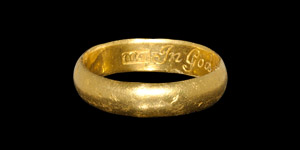
Post Medieval Gold 'In God above we join our love' Posy Ring
Sold for (Inc. bp): £1,198
A plain D-section hoop with engraved text to the inner face in an italic hand 'In God above we join our love' and maker's mark 'WG'. -
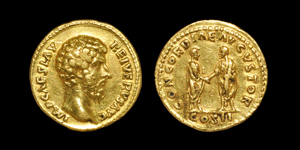
Ancient Roman Imperial Coins - Lucius Verus - Concordia Gold Aureus
Sold for (Inc. bp): £3,388
161 AD, Rome mint. Obv: IMP CAES L AVREL VERVS AVG legend (L of AVREL engraved as I) with bare head right. Rev: CONCORDIAE AVGVSTOR legend with Marcus Aurelius and Lucius Verus, both togate, and each holding a scroll, clasping hands. -
.jpg)
Celtic Iron Age Coins - Gallo Belgic - Ambiani - Gold 'Defaced Die' Quarter Stater
Sold for (Inc. bp): £2,057
150-50 BC, Sills class 1b, Scheers class IIa-b. Obv: random straight lines intersecting across the flan. Rev: horse left with 'lyre' below and crossed lines above. -
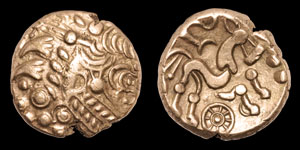
Celtic Iron Age Coins - Belgae - 'Cheriton Wheel' Gold Stater
Sold for (Inc. bp): £1,573
50-10 BC. Obv: wreath, cloak and crescents with pellet-in-annulets below. Rev: triple-tailed horse right with charioteer's arms above and pellet-centred wheel below. -
.jpg)
Celtic Iron Age Coins - Early Uninscribed Coinage - 'Maldon Wheel' Gold Quarter Stater
Sold for (Inc. bp): £1,331
60-30 BC, Qc general type. Obv: wreath, crescents and wheel with spike. Rev: horse right with floral sun above and pellet below. -
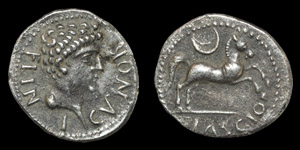
Celtic Iron Age Coins - Catuvellauni - Cunobelin - Portrait Silver Unit
Sold for (Inc. bp): £1,573
1-40 AD. Obv: profile bust right with CVNOB - ELIN - I legend. Rev: rearing horse right with hollow crescent above and TASCIO legend below. -
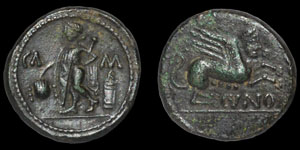
Celtic Iron Age Coins - Catuvellauni - Cunobelin - 'Severed Head' Bronze Unit
Sold for (Inc. bp): £1,452
8-41 AD. Obv: sphinx springing right with CVNO below and plain ground line. Rev: standing cloaked figure walking left holding severed head and staff with CA to left and M to right and altar behind with plain ground line below. -
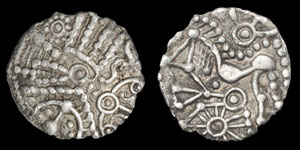
Celtic Iron Age Coins - Belgae - 'Hampshire Thin Flan' Silver Unit
Sold for (Inc. bp): £1,150
50 BC-50 AD. Obv: complex wreath design with pellet-in-annulets, whorls, hatching and other symbols. Rev: horse left with pellet-and-line mane, hatching below head, pellet-in-annulet with three spokes above and large spoked 'wheel' below. -
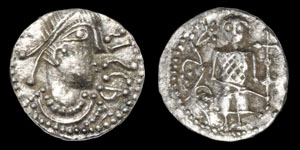
Anglo-Saxon Coins - Secondary Phase - C ARIP Eclectic Group - Sceatta
Sold for (Inc. bp): £1,150
710-750 AD. Obv: profile diademed bust right with blundered and retrograde legend in front reading as SISCP with P inverted and retrograde. Rev: standing male figure in cross-hatched tunic holding pellet-ended cross staff to right with 'bird' shaped vine to left. -
.jpg)
Anglo-Saxon Coins - Baldred - Rochester / Dunn - Portrait Penny
Sold for (Inc. bp): £1,331
823-825 AD. Obv: profile bust right with +BALDRED REX legend. Rev: eight-spoked wheel with pellet-in-annulet centre and pellets between spokes and +DVNN MONETA legend for the moneyer Dunn at Rochester mint. -
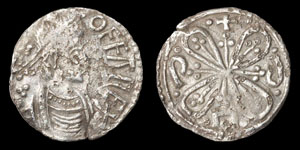
Anglo-Saxon Coins - Offa - London / Dud(da) - Light Coinage Portrait Penny
Sold for (Inc. bp): £1,573
765-792 AD, Blunt 28. Obv: diademed profile bust right with OFFA REX in front. Rev: large lobed cross with cross botoneé to each lobe and + d U d in angles for the moneyer Dud(da) at London. -
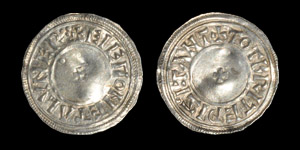
Anglo-Saxon Coins - Aethelstan - Scandinavian or Norse? - Irregular Circumscription Cross Penny
Sold for (Inc. bp): £1,210
924-939(?) AD, imitative, BMC type v (variant). Obv: small cross with EÐIS.I.TANT+TOT BRIT irregular legend. Rev: small cross with pellet above one angle and +EIEMONETALVNER:. irregular legend for a moneyer 'Eie' (perhaps copying from Ellaf? at London?) at an uncertain, perhaps Scandinavian mint. -
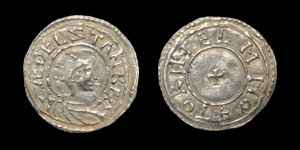
Anglo-Saxon Coins - Aethelstan - Torthelm - Portrait Penny
Sold for (Inc. bp): £3,146
924-939 AD, BMC type viii. Obv: profile bust with +ÆÐELSTAN REX legend. Rev: small cross with +TORHTELMMO legend for the moneyer Torthelm, struck at a southern or East Anglian mint. -
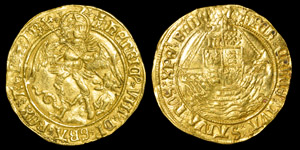
English Tudor Coins - Henry VIII - Gold Angel
Sold for (Inc. bp): £1,331
1509-1526 AD, first coinage. Obv: St Michael slaying dragon with HENRIC VIII DI GRA REX AGL Z FR legend with 'castle' mintmark and saltire to left only. Rev: ship with arms over, 'h' to left and rose to right of mast and PER CRVCE TVA SALVA NOS XPE REDE legend. -
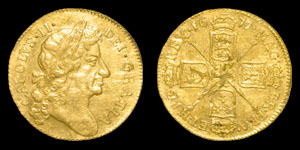
English Milled Coins - Charles II - 1677 - Gold Guinea
Sold for (Inc. bp): £3,872
Dated 1677, fourth bust. Obv: profile bust with CAROLVS II DEI GRATIA legend. Rev: cruciform shields and sceptres with MAG BR FRA ET HIB REX legend and date. -
.jpg)
World Coins - Islamic - Umayyad Caliphs - Post Reform Gold Dinar
Sold for (Inc. bp): £35,090
697-750 AD (77-132 AH), eastern type. Obv: Arabic inscriptions. Rev: Arabic inscriptions.
No results were found for this search. Please change your search criteria and try again.
