
Ancient Art, Antiquities, Books, Natural History, Stamps & Coins

-
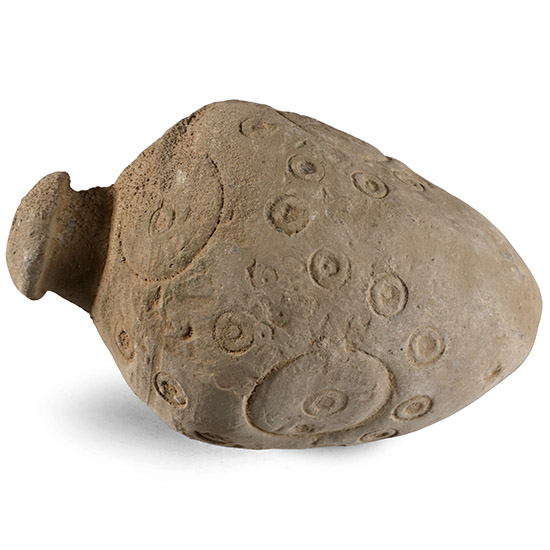
Byzantine 'Greek Fire' Ceramic Fire Bomb or Hand Grenade
9th-11th century A.D.Estimate: £70 - 90 (+bp*)
Bids: 1 | Current Bid: £5
Bulbous body with rounded base and domed filler hole, the body decorated with impressed ring-and-dot motifs; intended to be filled with explosive liquid and a wick, and used as a hand grenade. 376 grams, 11.6 cm
Ex important collection of weaponry, London, UK, 1980-1990s. Accompanied by an academic paper by military specialist Dr Raffaele D'Amato, dated 15 July 2019 and titled 'Eastern Roman Empire - Greek Fire Bomb or Hand Grenade (μεσαίον kακάβιον) 9th-11th century AD'.
Apart from the use of siphons or manual flame-throwers called cheirosiphona, special corps of Roman soldiers employed terracotta grenades, in the form of small jars, abundantly evidenced in archaeological excavations. They were called μεσαία kακαβιά or κυτροκακάβια, where the former had a bulbous shape and the latter a more cylindrical form. -
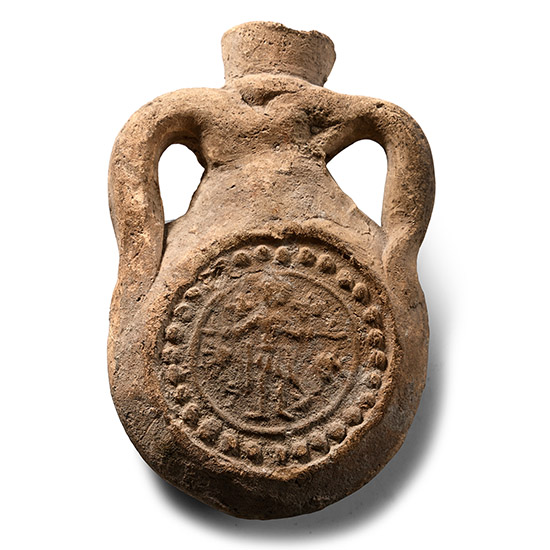
Byzantine Ceramic Pilgrim Flask with Saint Menas
6th-7th century A.D.Estimate: £200 - 300 (+bp*)
Bids: 1 | Current Bid: £5
A bifacial flask with flared rim flanked by strap handles; impressed roundel to each face with beaded border and nimbate figure flanked by two crosses. 105 grams, 10.1 cm
From the private collection of Peter Clayton, FCILIP, Dip, Arch, FSA, FRNS, Hemel Hempstead, Hertfordshire, UK; formed since the late 1950s. -
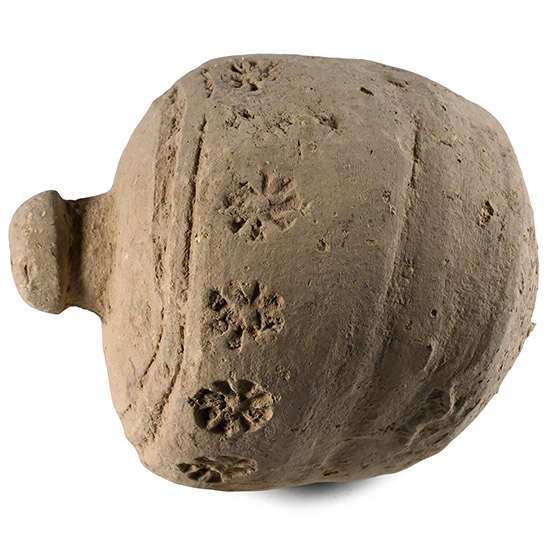
Byzantine 'Greek Fire' Ceramic Fire Bomb or Hand Grenade
9th-11th century A.D.Estimate: £70 - 90 (+bp*)
Bids: 1 | Current Bid: £5
Bulbous body with rounded base and domed filler hole, the shoulder with an impressed band of rosettes and two circumferential bands above; intended to be filled with explosive liquid and a wick, and used as a hand grenade. 681 grams, 12 cm
Ex important collection of weaponry, London, UK, 1980-1990s. Accompanied by an academic paper by military specialist Dr Raffaele D'Amato, dated 15 July 2019 and titled 'Eastern Roman Empire - Greek Fire Bomb or Hand Grenade (μεσαίον kακάβιον) 9th-11th century AD'.
Apart from the use of siphons or manual flame-throwers called cheirosiphona, special corps of Roman soldiers employed terracotta grenades, in the form of small jars, abundantly evidenced in archaeological excavations. They were called μεσαία kακαβιά or κυτροκακάβια, where the former had a bulbous shape and the latter a more cylindrical form. -
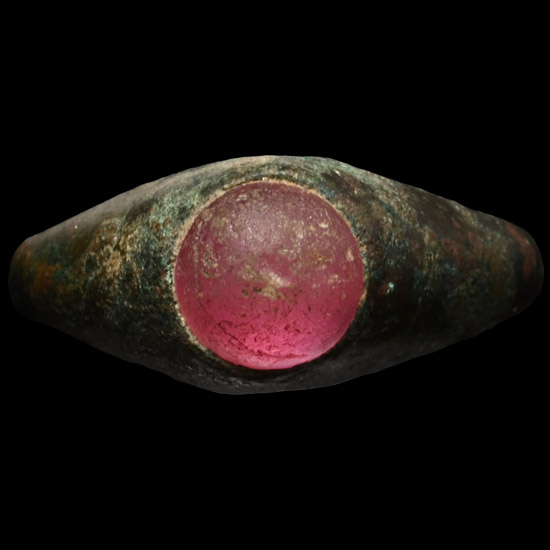
Byzantine Bronze Ring with Pink Cabochon
15th century A.D.Estimate: £40 - 60 (+bp*)
Opening Bid: £5
With bezel of flattened conical form pierced at the base, inset glass cabochon. 5.55 grams, 26.50 mm overall, 16.85 mm internal diameter (approximate size British L 1/2, USA 6, Europe 11.87, Japan 11)
From the private collection of a European gentleman (1942-2024), formed since the 1970s. -
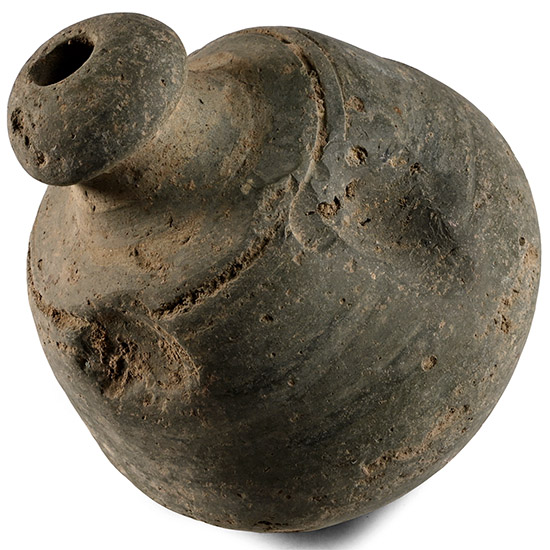
Byzantine 'Greek Fire' Ceramic Fire Bomb or Hand Grenade
9th-11th century A.D.Estimate: £70 - 90 (+bp*)
Bids: 1 | Current Bid: £5
Bulbous body with rounded base and domed filler hole, an impressed circumferential band above the shoulder; intended to be filled with explosive liquid and a wick, and used as a hand grenade. 401 grams, 95 mm
Ex important collection of weaponry, London, UK, 1980-1990s. Accompanied by an academic paper by military specialist Dr Raffaele D'Amato, dated 15 July 2019 and titled 'Eastern Roman Empire - Greek Fire Bomb or Hand Grenade (μεσαίον kακάβιον) 9th-11th century AD'.
Apart from the use of siphons or manual flame-throwers called cheirosiphona, special corps of Roman soldiers employed terracotta grenades, in the form of small jars, abundantly evidenced in archaeological excavations. They were called μεσαία kακαβιά or κυτροκακάβια, where the former had a bulbous shape and the latter a more cylindrical form. -
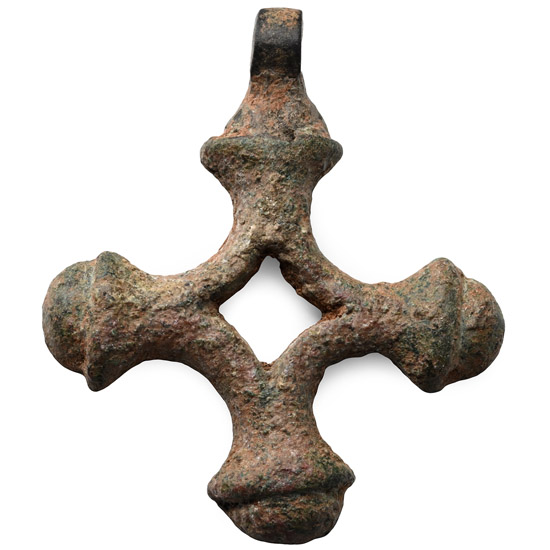
Byzantine Bronze Cross Pendant
Circa 10th-12th century A.D.Estimate: £40 - 60 (+bp*)
Bids: 1 | Current Bid: £5
With central lozenge void, short arms terminating in buds, pierced lug above. 15.7 grams, 45.7 mm
Private collection, 1980s. Acquired on the UK art market. Private collection, London, UK. -
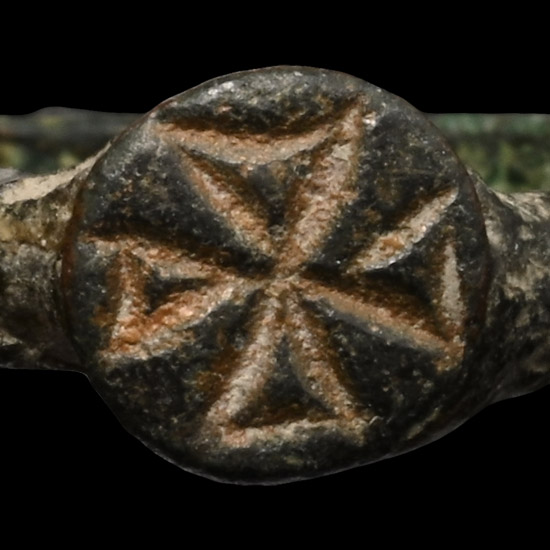
Byzantine Bronze Ring with Cross
Circa 6th-7th century A.D.Estimate: £50 - 70 (+bp*)
Opening Bid: £5
D-setion hoop with integral disc bezel, incuse Maltese cross motif. 4.61 grams, 25.21 mm overall, 19.19 mm internal diameter (approximate size British Q, USA 8, Europe 17.49, Japan 16)
From the private collection of a European gentleman (1942-2024), formed since the 1970s. -
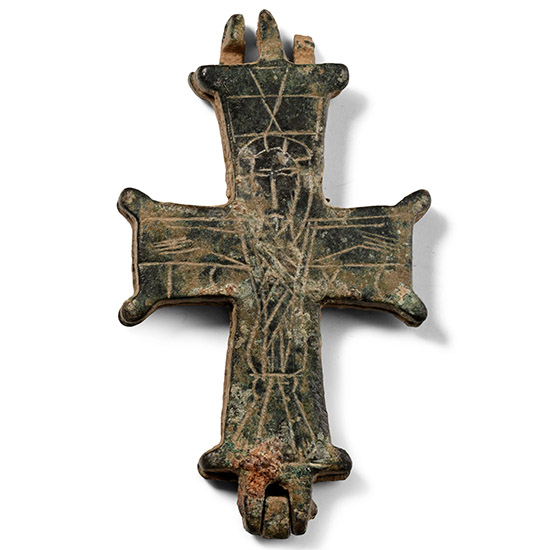
Byzantine Bronze Reliquary Cross Pendant
Circa 10th-12th century A.D.Estimate: £100 - 140 (+bp*)
Opening Bid: £50
Enkolpion with hinged loop, nimbate figure of Virgin Mary in orans pose to obverse, Corpus Christi to reverse. 20.83 grams, 58 mm
Ex German art market, 2000s. Acquired from an EU collector living in London. From the collection of a Surrey, UK, gentleman. -
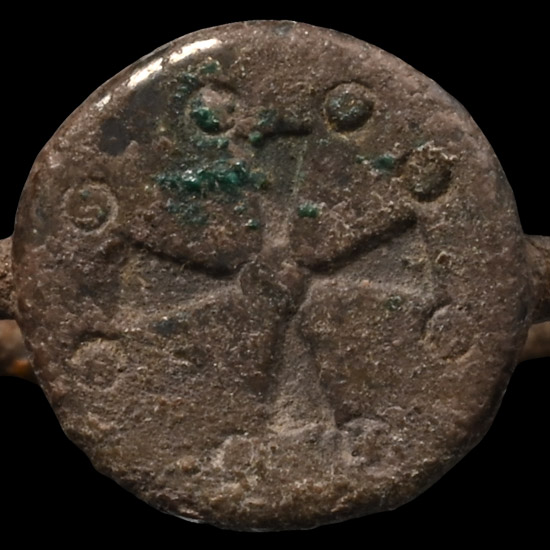
Byzantine Bronze Ring with Cross
Circa 7th century A.D.Estimate: £40 - 60 (+bp*)
Opening Bid: £5
Disc bezel with central Maltese cross and border of annulets. 2.67 grams, 22.07 mm overall, 18.90 mm internal diameter (approximate size British Q, USA 8, Europe 17.49, Japan 16)
From the private collection of a European gentleman (1942-2024), formed since the 1970s. -
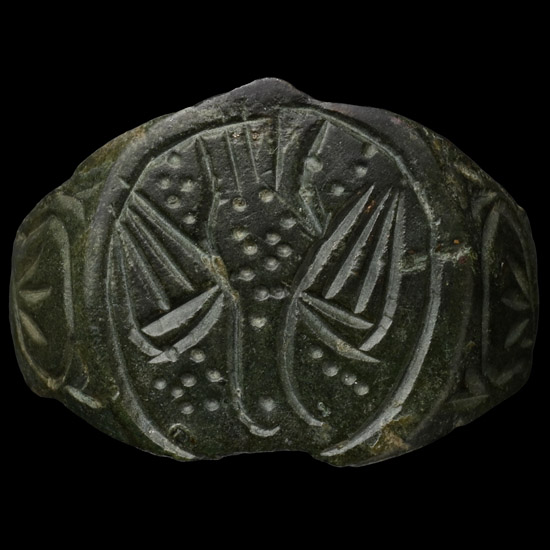
Byzantine Bronze Ring with Spread Eagle
Circa 12th-15th century A.D.Estimate: £60 - 80 (+bp*)
Opening Bid: £5
Flat-section hoop with expanding shoulders, a discoid plaque with incised bird in flight motif. 4.24 grams, 22.24 mm overall, 20.22 x 18.72 mm internal diameter (approximate size British R, USA 8 1/2, Europe 18 3/4, Japan 18)
Ex German art market, 2000s. Acquired from an EU collector living in London. From the collection of a Surrey, UK, gentleman. -
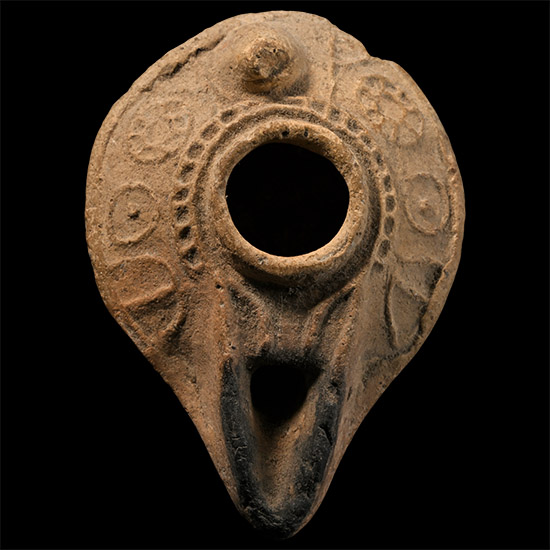
Byzantine Terracotta Oil Lamp with Roundel Decoration
Holy Land, circa 7th century A.D.Estimate: £50 - 70 (+bp*)
Bids: 1 | Current Bid: £5
The body with roundel decoration in relief, small stub handle to the rear and a triangular spout. 83 grams, 96 mm
Ex J. Zadok & Sons, 18, King David Road, Jerusalem, Israel. From the property of a late Lincolnshire, UK, gentleman; thence by descent. Accompanied by a certificate of antiquity issued by J. Zadok & Sons. -
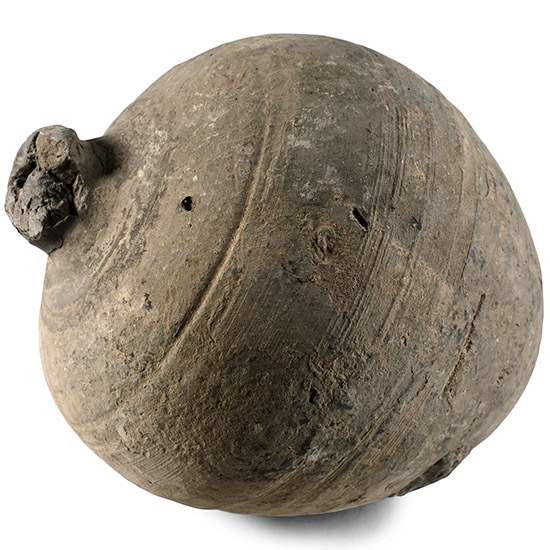
Byzantine 'Greek Fire' Ceramic Fire Bomb or Hand Grenade
9th-11th century A.D.Estimate: £70 - 90 (+bp*)
Bids: 1 | Current Bid: £5
Bulbous body with rounded base and domed filler hole, impressed circumferential bands on the body; intended to be filled with explosive liquid and a wick, and used as a hand grenade. 790 grams, 11.9 cm
Ex important collection of weaponry, London, UK, 1980-1990s. Accompanied by an academic paper by military specialist Dr Raffaele D'Amato, dated 15 July 2019 and titled 'Eastern Roman Empire - Greek Fire Bomb or Hand Grenade (μεσαίον kακάβιον) 9th-11th century AD'.
Apart from the use of siphons or manual flame-throwers called cheirosiphona, special corps of Roman soldiers employed terracotta grenades, in the form of small jars, abundantly evidenced in archaeological excavations. They were called μεσαία kακαβιά or κυτροκακάβια, where the former had a bulbous shape and the latter a more cylindrical form.
