
Ancient Art, Antiquities, Books, Natural History, Stamps & Coins

-
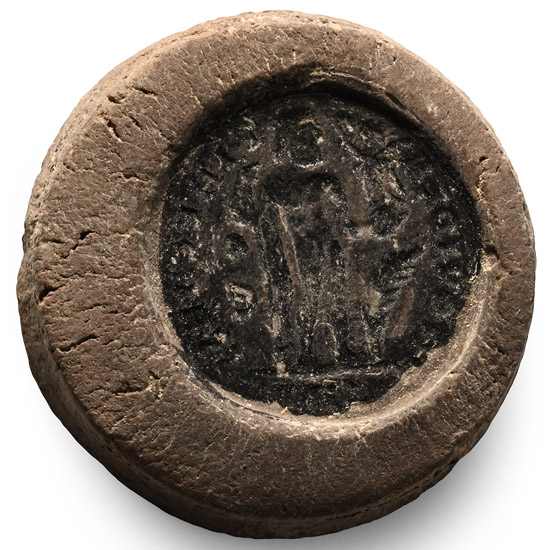
Roman Terracotta Coin Forger's Mould
Circa 3rd-4th century A.D.Estimate: £50 - 70 (+bp*)
Opening Bid: £5
Discoid clay mould with an impressed design of a coin on each face. 6.05 grams, 27 mm
London gentleman's collection, 1970-1990s, by descent. -
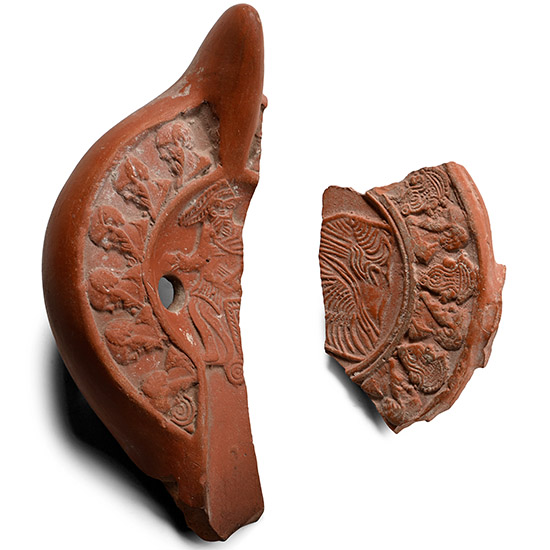
Late Roman Terracotta Oil Lamp Fragment Group
4th-5th century A.D.Estimate: £50 - 70 (+bp*)
Opening Bid: £5
Comprising: an oil lamp fragment with a stub handle at the rear, the rim with a frieze of bearded profile busts, the discus with a seated figure facing; the other fragment with a raised ledge below, the rim with a frieze of bearded profile busts alternating with amphorae, discus showing the lower part of a folded garment(?). 123 grams total, 59-12.2 cm
Found at Caerleon Bathhouse, Newport, Wales, UK. From the private collection of Peter Clayton, FCILIP, Dip, Arch, FSA, FRNS, Hemel Hempstead, Hertfordshire, UK; formed since the late 1950s. -
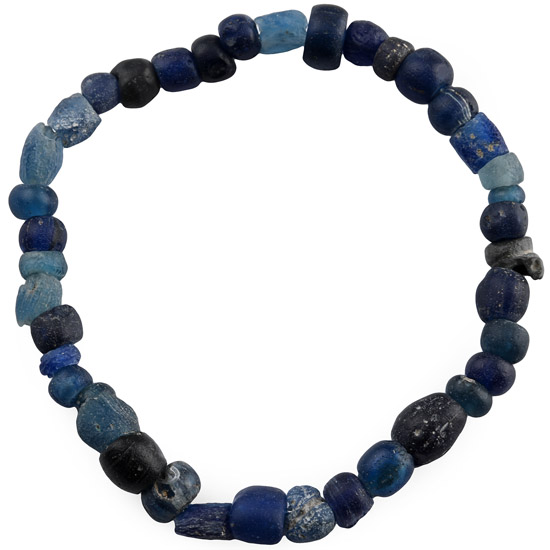
Roman Dark Blue Glass Bead Bracelet
Circa 1st-4th century A.D.Estimate: £50 - 70 (+bp*)
Bids: 1 | Current Bid: £5
Comprising mainly oblate beads, restrung with an elasticated string. 8.09 grams, 16.6 cm
Ex Ancient Art Shop, Windsor, UK, 1990s. Ex private collection. -
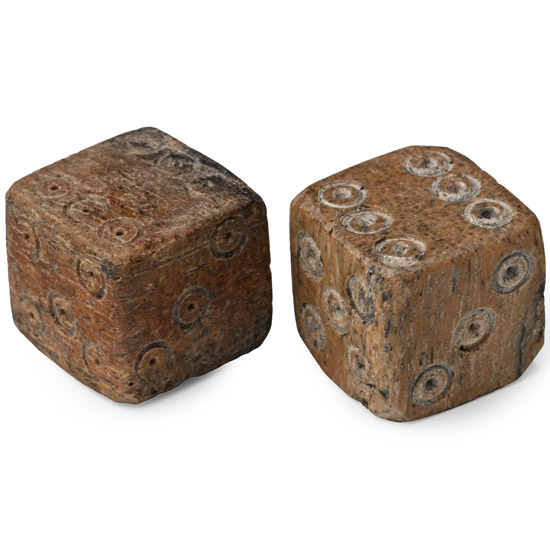
Roman Bone Gaming Dice Pair
Circa 1st-4th century A.D.Estimate: £100 - 140 (+bp*)
Bids: 1 | Current Bid: £75
Comprising two cuboid dice with ring-and-dot markings disposed 1:6, 2:5, 3:4. 5.82 grams total, 11 mm each
Ex Essex gentleman, previously in a Cambridgeshire, UK, gentleman's collection. -
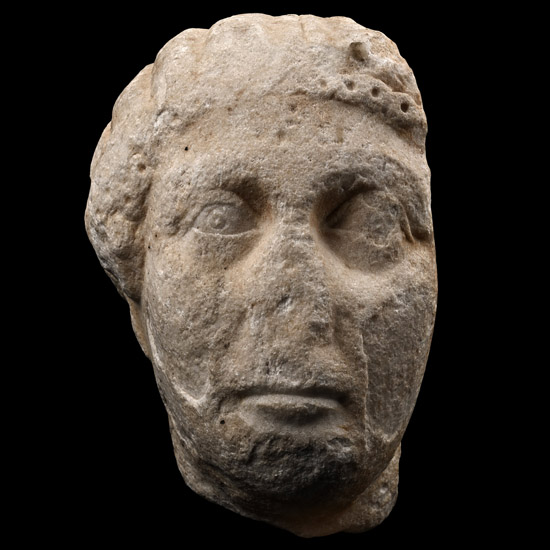
Roman Marble Head of a Woman
3rd-4th century A.D.Estimate: £4,000 - 6,000 (+bp*)
Opening Bid: £2,222
Carved in three-quarter view, with hair dressed in a chignon with frontal band and wavy segments; soft facial features with much detailing remaining to the proper right eye and mouth; likely a frieze fragment; mounted on an old collector's display stand with typed label 'Marble, woman's head / Egypt / C.25-100 A.D. / Cat.No. 6169'. 8.45 kg, 39 cm high
Acquired in trade from the San Franciscanum Museum, Israel, prior to 1980. with Archaeologia, pre 1983, Switzerland and Canada. Accompanied by an academic report by Dr Raffaele D’Amato. This lot has been checked against the Interpol Database of stolen works of art and is accompanied by search certificate number no.12964-242755.
The arrangement of the hair is characteristic of female portraits dating between the late Severan and Tetrarchic periods. The head, due to the treatment of the hair, finds comparisons with a female portrait in the Museo Nazionale Romano, depicting an elderly woman of the Antonine era, and with another female portrait in the same museum, dated to the third decade of the 3rd century A.D., reworked in the Tetrarchic period, and which showed a Severan so-called Nest Frisur hairstyle. The sculpture in question can therefore be dated between the 3rd century A.D. and the first decades of the 4th century A.D. based on the hairstyle, the shape of the eyes and the eyebrows. -
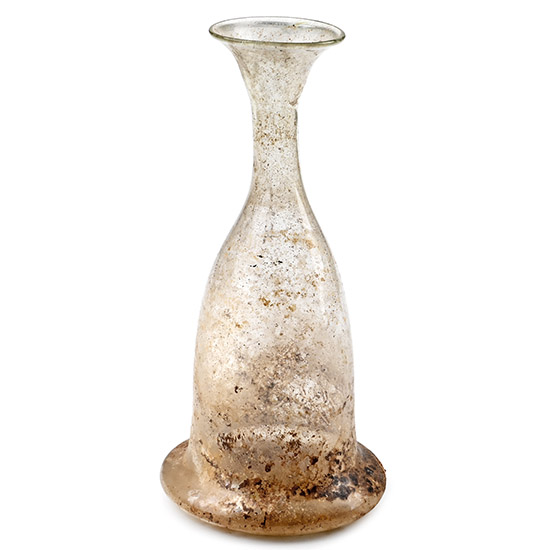
Roman Translucent Glass Wide Bottomed Bottle
Circa 1st-4th century A.D.Estimate: £200 - 300 (+bp*)
Opening Bid: £100
With a wide discoid base, conical body with slender neck and expanding rim; old label reading 'Weachler's Gallery 690'. 30.5 grams, 13.7 cm
From the private collection of Lloyd and Jeanne Raport, Washinton D.C. and Florida, formed between 1972-2000. Estate auction, Weschlers, Maryland, 10 June 1984, lot 690. -
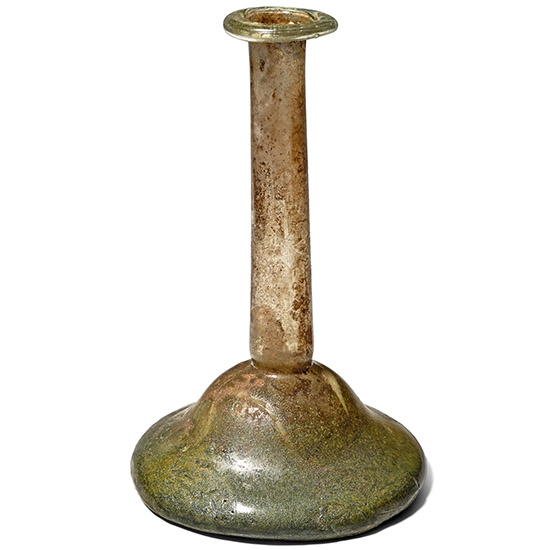
Large Roman Green Glass Candlestick Unguentarium
Circa 2nd-3rd century A.D.Estimate: £80 - 100 (+bp*)
Opening Bid: £5
With a low bell-shaped body, a tall, pinched neck, and a flared and rolled rim to the mouth. 56.4 grams, 16 cm
Ex London, UK, collection, 1990s. -
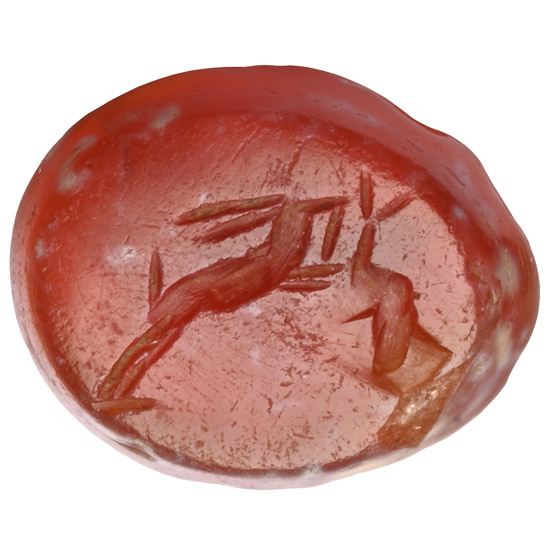
Roman Carnelian Gemstone with Leaping Rabbit
2nd-3rd century A.D. or laterEstimate: £120 - 170 (+bp*)
Opening Bid: £5
Ellipsoid in plan with intaglio profile leaping animal; chipped; supplied with an impression. 1.27 grams, 15 mm
From the private collection of a European gentleman (1942-2024), formed since the 1970s. -
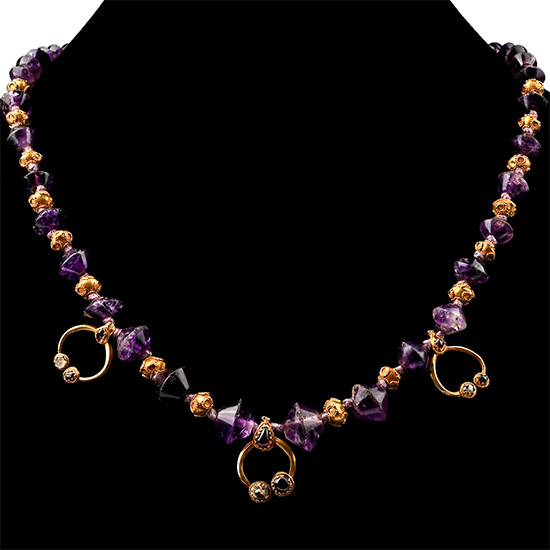
Roman Amethyst, Gold and Garnet Bead Necklace
1st-3rd century A.D.Estimate: £3,000 - 4,000 (+bp*)
Bids: 1 | Current Bid: £1,500
Restrung group of graduated biconical amethyst beads with gold interstitial beads with granulation detailing, three crescent pendants, each with a cabochon gemstone to each of the finials. Cf. Christie's, 13 December 2013, no.297. 51 grams, 52 cm
From the collection of former Italian Ambassador Carlo Perrone-Capano. The majority of this collection was established during his period in office in Damascus during the 1960s. His later life was spent near Grantham, and his collection was disposed of by his descendants at Golding Young Chartered Auctioneers & Valuers, Arts & Antiques Surveyors. Christie’s, New York, 11 December 2009, no.401. This lot has been checked against the Interpol Database of stolen works of art and is accompanied by search certificate number no.13123-248087.
Amethyst was widely used in Graeco-Roman Egypt. We know that the amethyst mines of Abu Diyeiba, near Semna, were in use from the time of Ptolemy VI through to the Roman era. Pliny says that Indian amethysts were the best, but he also refers to amethysts from Egypt. The Egyptian amethysts are typically flawed and of a pale, almost pink, hue. They were seldom set in gold and were most usually made into beads. Ptolemaic and Roman inscriptions and artefacts have been found at amethyst mines in Egypt’s eastern deserts. -
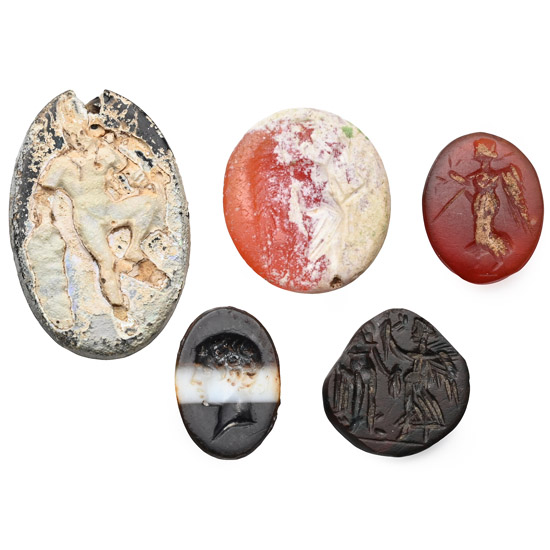
Roman Carved Gemstone Collection
1st-3rd century A.D.Estimate: £300 - 400 (+bp*)
Bids: 11 | Current Bid: £10
Comprising: a banded agate intaglio with profile male bust; a red carnelian intaglio with winged Victory; an orange carnelian intaglio with winged Victory; a glass intaglio with a nude figure resting his hand on a boulder; a round intaglio with Victory and another figure. 1.91 grams total, 8-17 mm
UK private collection assembled 1970s-90s, and thence to the liquidated state of above. -
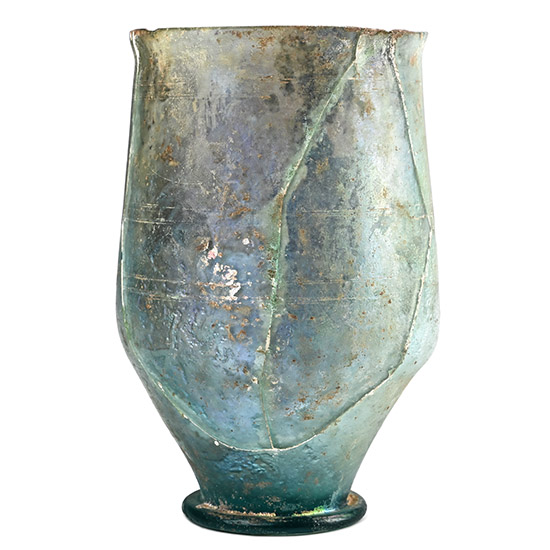
Roman Iridescent Glass Beaker
Circa 1st-2nd century A.D.Estimate: £100 - 140 (+bp*)
Bids: 1 | Current Bid: £5
Conical body with pontil base, slightly flared rim; repaired. 94 grams, 10.7 cm
From the collection of Dr. Gerhard Muller-Afers, Speyer; thence by family descent. Private collection, Europe, acquired from the above. -
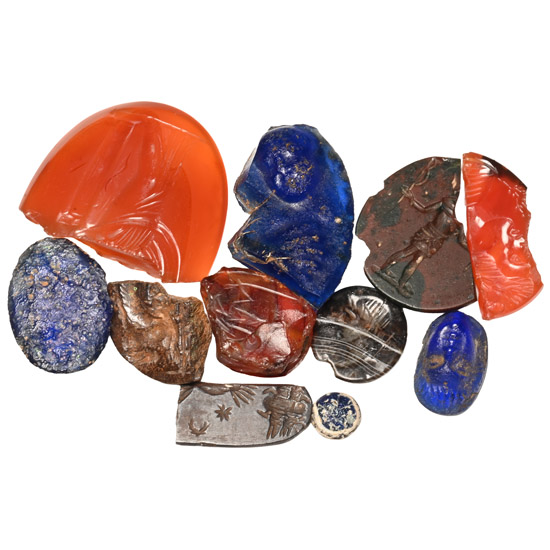
Roman Stone and Glass Gem Collection
2nd-3rd century A.D. or laterEstimate: £120 - 170 (+bp*)
Opening Bid: £5
Including profile female bust, standing figure with pedestal or altar, bearded head in three-quarter view and other types; some supplied with a museum-quality impression. 15.17 grams total, 5-24 mm
From the private collection of a European gentleman (1942-2024), formed since the 1970s.
