
Ancient Art, Antiquities, Books, Natural History, Stamps & Coins

-
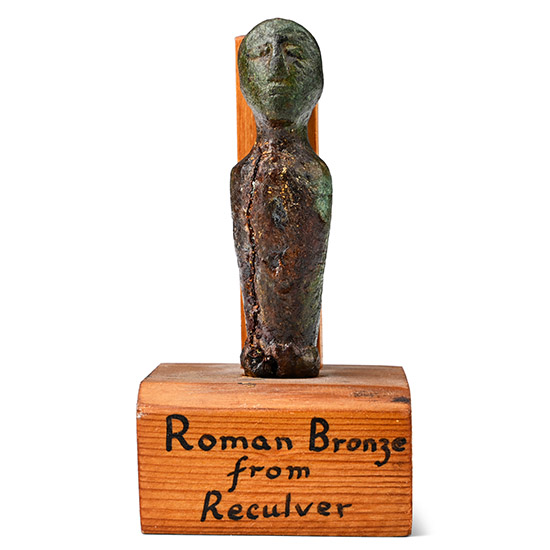
Romano-British Bronze Human Figural Pendant
Circa 2nd century A.D.Estimate: £80 - 100 (+bp*)
Bids: 1 | Current Bid: £5
With a conical body and oval head with low-relief nose and eyes, hair combed to the back forming an attachment loop; mounted on a custom-made stand. 57 grams total, 73 mm high including stand
Found at Reculver, Kent, UK, in 1957. From the private collection of Peter Clayton, FCILIP, Dip, Arch, FSA, FRNS, Hemel Hempstead, Hertfordshire, UK; formed since the late 1950s. Accompanied by an old handwritten information card by Peter Clayton, collection no.26. -
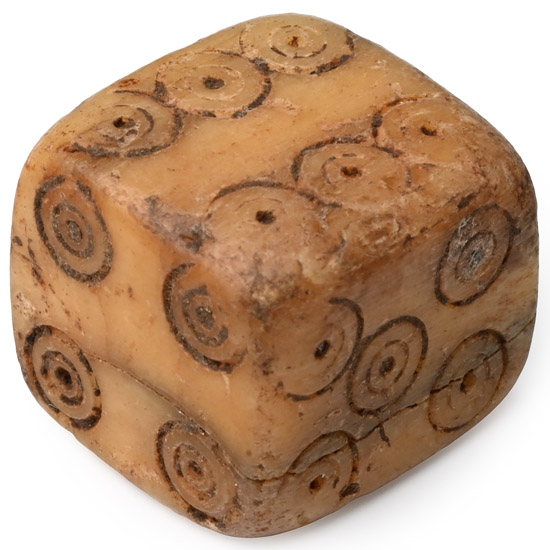
Roman Bone Gaming Die
Circa 1st-4th century A.D.Estimate: £100 - 140 (+bp*)
Opening Bid: £50
Light brown cuboid dice with ring-and-dot markings disposed 1:6, 3:4, 5:2. 4.83 grams, 14 mm
From the collection of the late Mr S.M., London, UK, 1970s, by descent. -
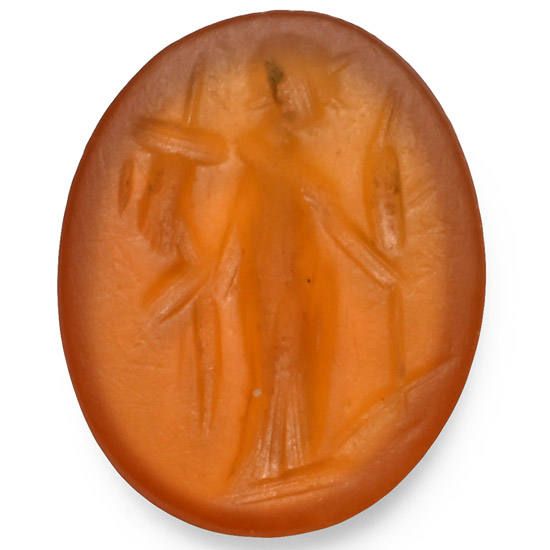
Roman Carnelian Gemstone with the Goddess Demeter Standing
2nd-3rd century A.D.Estimate: £100 - 140 (+bp*)
Bids: 1 | Current Bid: £5
Ellipsoid type with intaglio figure of Demeter standing facing, holding a frond and cornucopia; supplied with an impression. 0.20 grams, 10 mm
From the private collection of a European gentleman (1942-2024), formed since the 1970s. -
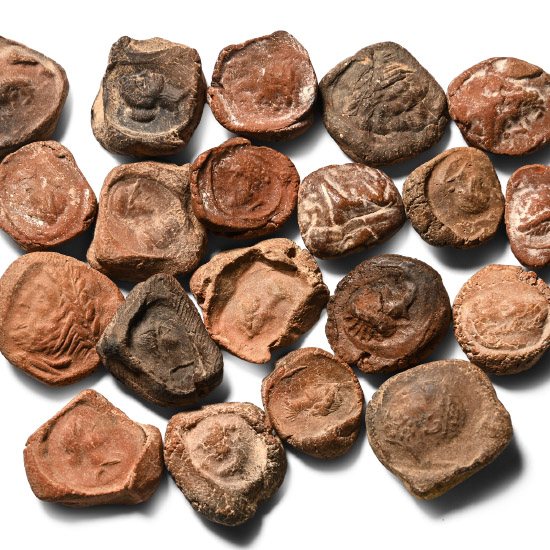
Roman Terracotta Bullae, Tesserae or Token Group
3rd century B.C.-1st century A.D.Estimate: £100 - 140 (+bp*)
Opening Bid: £5
A mixed group of ceramic bullae, tesserae or theatre tokens bearing low-relief motifs, mainly consisting of profile busts of deities. 28.4 grams total, 14-20 mm
From the private collection of a European gentleman (1942-2024), formed since the 1970s.
The term 'tessera' was used in Roman times to convey the Greek term σύμβολον (token). Small tiles are known as tokens, often shaped like coins, made of metal (copper, lead, iron), clay, bone, wood, or glass, stamped as well as engraved. The tokens, however, are not exclusively coin-shaped, as the Latin term 'tessera' suggests by etymologically referring to a square or at least a four-sided shape and confirmed in several cases by material remains of the past. Tokens and tesserae seem to have been used both in Athens and Rome for the distribution of goods. According to written sources, the term token is identified with credentials of the official authorities. They have also been interpreted as tokens of identity, as entrance tickets to theatre performances, tribunals or assemblies of citizens, archival material of seal engraving, as pawns in games, Charon’s obols and even as amulets. -
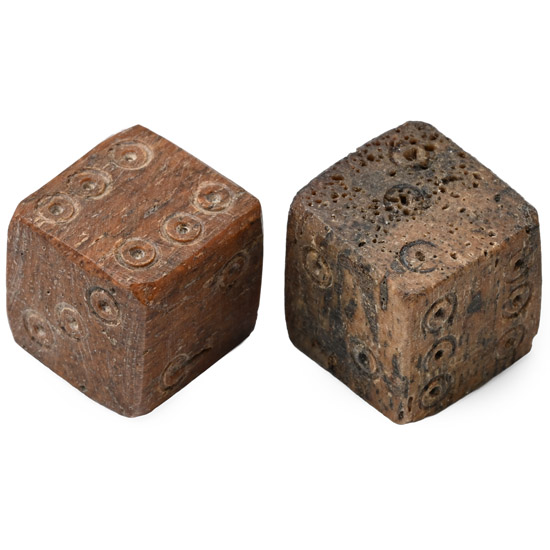
Roman Bone Gaming Dice Pair
Circa 1st-4th century A.D.Estimate: £80 - 100 (+bp*)
Opening Bid: £5
Comprising two cuboid dice with ring-and-dot markings disposed 1:6, 2:5, 3:4. 7.28 grams total, 12-13 mm
Ex German art market, 2000s. Acquired from an EU collector living in London. From the collection of a Surrey, UK, gentleman. -
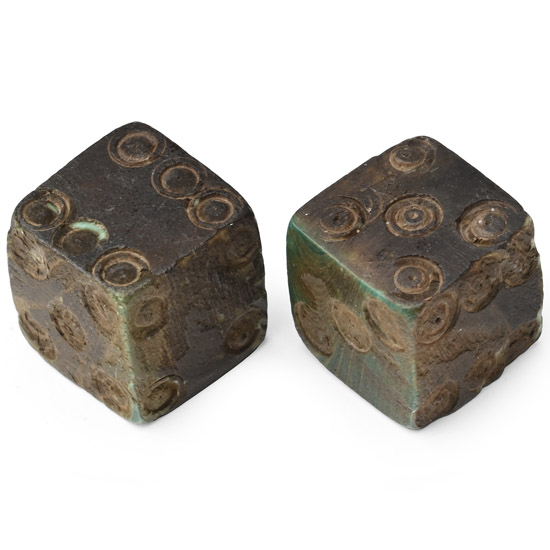
Roman Bone Gaming Dice Pair
Circa 1st-4th century A.D.Estimate: £200 - 300 (+bp*)
Opening Bid: £100
Comprising two cuboid dice with ring-and-dot markings disposed 1:6, 2:5, 3:4. 5.04 grams total, 11 mm each
From the collection of the late Mr S.M., London, UK, 1970s, by descent. -
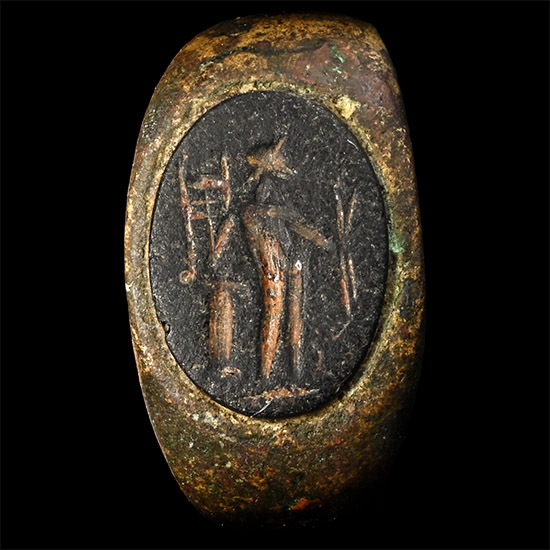
Roman Bronze Ring with Mercury Glass Intaglio
2nd-3rd century A.D.Estimate: £100 - 140 (+bp*)
Opening Bid: £5
Broad plaque with raised ellipsoid panel, incuse standing figure of Mercury with a caduceus. 5.43 grams, 21.96 mm overall, 18.64 x 14.95 mm internal diameter (approximate size British L, USA 5 3/4, Europe 11.24, Japan 10)
From the private collection of a European gentleman (1942-2024), formed since the 1970s. -
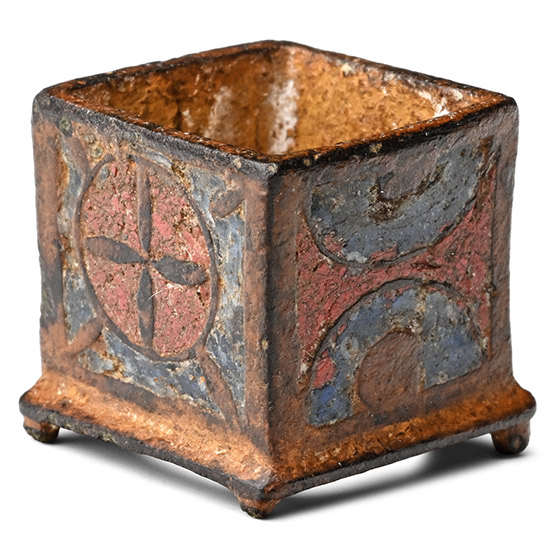
Romano-British Enamelled Bronze Miniature Altar
Circa 2nd century A.D.Estimate: £300 - 400 (+bp*)
Opening Bid: £150
A hollow-formed miniature altar or incense burner with four short legs, panels of red and red enamelled ornament to the sides. 16.1 grams, 20.15 mm
Acquired on the UK art market in the 1980s. From an East Anglian private collection. -
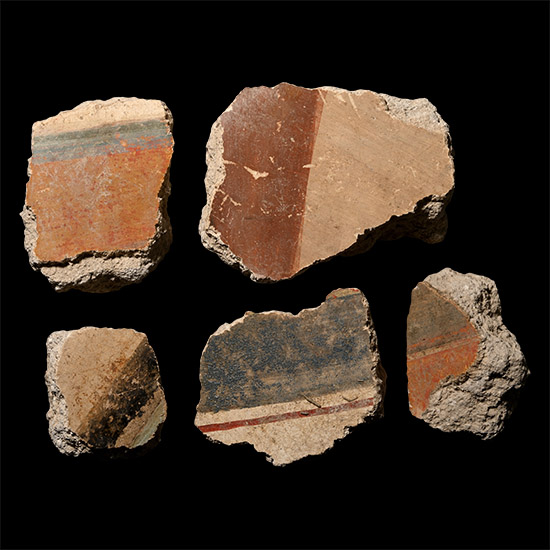
Roman Fresco Wall Plaster Collection
1st century A.D.Estimate: £50 - 70 (+bp*)
Opening Bid: £5
Fragments of wall plaster with rendered surface painted with mainly Pompeii red, pale blue, brown and cream detailing; some with an impression of timber laths to the reverse. 1.21 kg total, 7.2-14.7 cm
Acquired in the 19th century. Ex Jeger collection, Switzerland. UK gallery, early 2000s.
These small fragments, by analogy with the fragments of Pompeii, seem to belong to the second style of Roman painting - red panels representing highlight and shadow, decorated with vegetal interlaces. A red grenade fillet probably framed some panels. A fragment shows alternate blue and red colours over a cream background, maybe pertinent to a socle. -
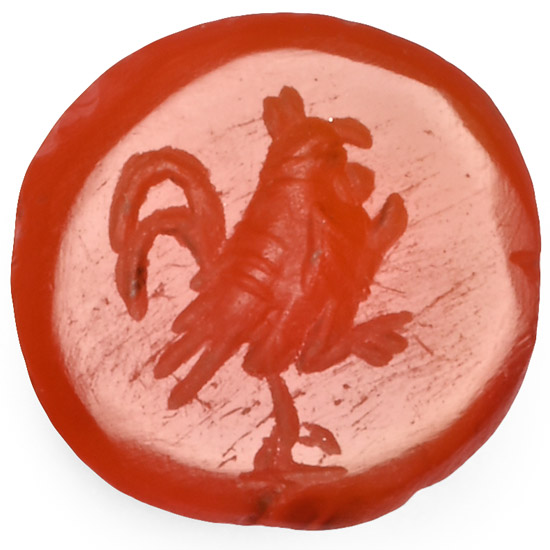
Roman Carnelian Gemstone with Cockerel
1st century B.C.-1st century A.D.Estimate: £100 - 140 (+bp*)
Bids: 1 | Current Bid: £5
Ellipsoid in plan with intaglio cockerel standing with curved tail-feathers; supplied with an impression. 0.29 grams, 8 mm
From the private collection of a European gentleman (1942-2024), formed since the 1970s. -
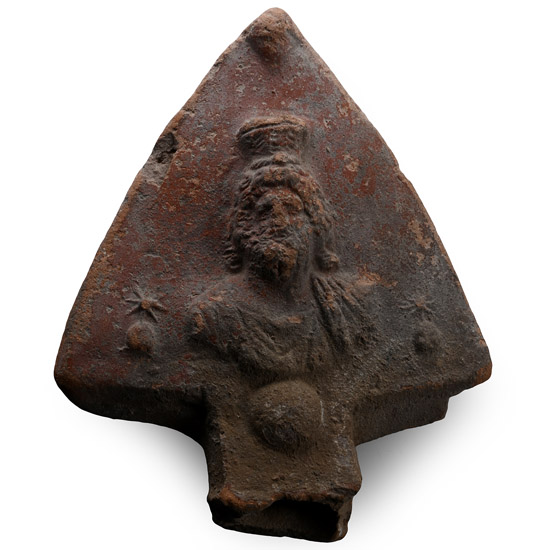
Roman Terracotta Lamp Handle with the Bust of the God Jupiter-Serapis
Circa 1st century A.D.Estimate: £40 - 60 (+bp*)
Opening Bid: £5
A large hollow-formed triangular handle from a lamp, with a low-relief bust of a bearded Jupiter-Serapis wearing a crown on a globe, a smaller globe with a star on each side. 152 grams, 11.8 cm
From the Puys-Aubert collection, March 1963, for 10 shillings. From the private collection of Peter Clayton, FCILIP, Dip, Arch, FSA, FRNS, Hemel Hempstead, Hertfordshire, UK; formed since the late 1950s. Accompanied by an old handwritten information card by Peter Clayton, collection no.100. -
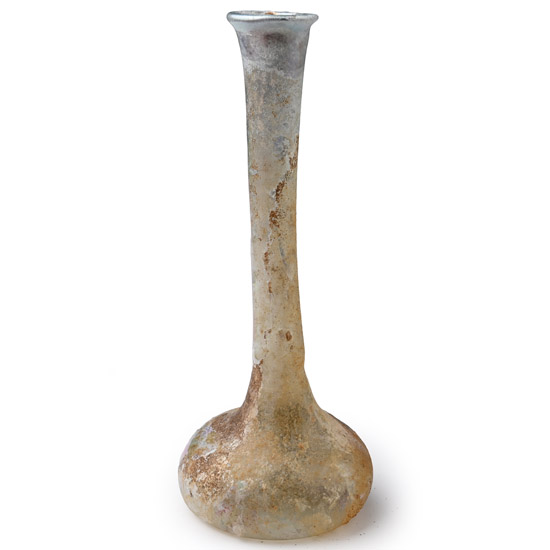
Roman Translucent Glass Candlestick Bottle
Circa 1st century A.D.Estimate: £100 - 140 (+bp*)
Opening Bid: £50
Wide, shallow body with a flattened base, a long tubular neck expanding towards the rim. 13 grams, 11.7 cm
Roman glass from an important London collection, acquired from the early 1980s.
