
Ancient Art, Antiquities, Books, Natural History, Stamps & Coins

-
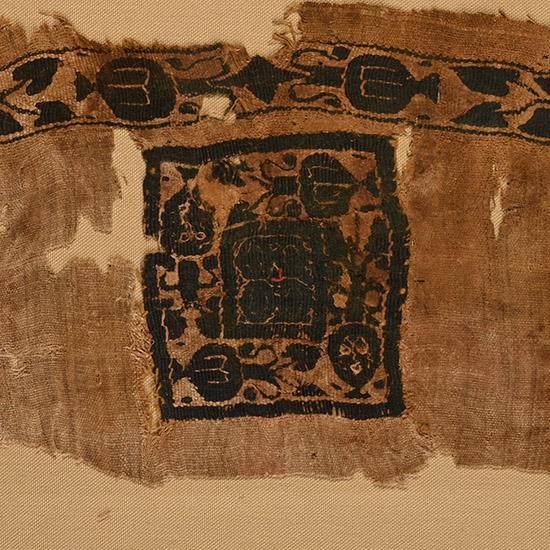
Egyptian Mounted Coptic Tunic Textile Fragment with Clavus and Tabula
Circa 6th century A.D.Estimate: £80 - 100 (+bp*)
Bids: 2 | Current Bid: £15
Showing a large portion of a tunic, decorated with a clavus and a tablion, both featuring foliate ornaments alternating with kantharoi, the centre of the tablion patterned with rosettes surrounded by kantharoi on the four sides; mounted on a backing board. 174 grams total, 57 cm
Acquired 1970s-1996. Property of a North American collector. London collection, 2016.
This type of embroidery was typical of tunics and garments characterised by full-length clavi and segmenta, decorated with either intricate geometric patterns or floral and vegetal motifs. In Christian symbology, the kantharos was an ancient Greek wine cup that symbolised resurrection and eternal life through Christ. -
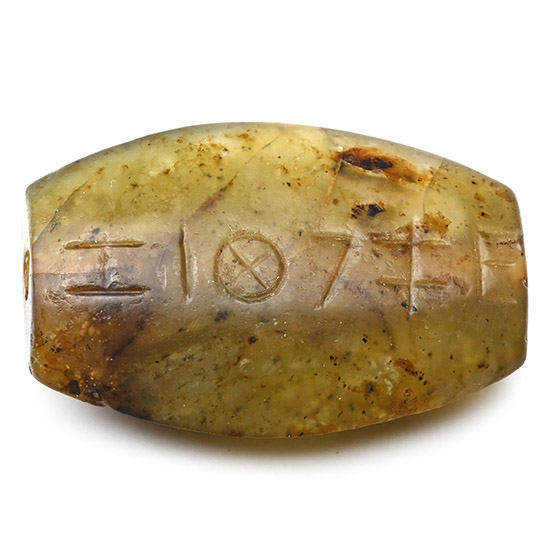
Phoenician Bifacial Green Stone Bead with Inscriptions
Circa 800-600 B.C.Estimate: £400 - 600 (+bp*)
Bids: 3 | Current Bid: £15
Lentoid in section and fusiform in plan with a median line of characters to each face. 8.6 grams, 31 mm
From the private collection of a European gentleman (1942-2024), formed since the 1970s. -
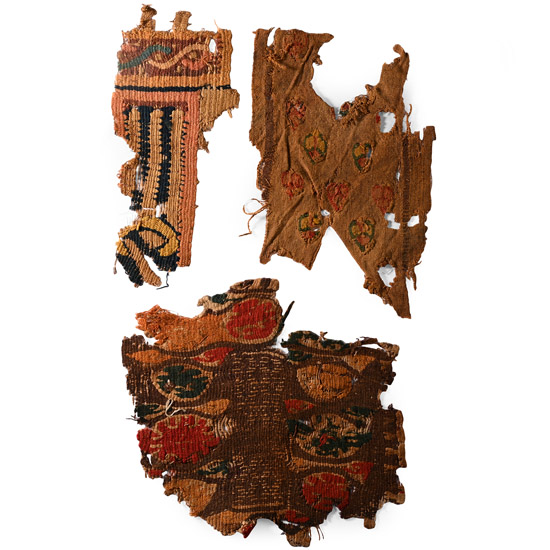
Egyptian Coptic Tunic and Tapestry Textile Fragments with Flowers and Geometric Ornaments
Circa 6th-8th century A.D.Estimate: £80 - 100 (+bp*)
Opening Bid: £5
Comprising a fragment of a clavus decorated with rows of heart-shaped buds in green, red, and yellow wool on linen, with edges marked by brown bands; a large fragment of coarse wool, consisting of a central rectangle with lozenge ornamentation in yellow and brown wool, surrounded by rectangular sections enclosing images of rabbits within yellow, green, and red medallions, facing left; and a textile fragment with geometric decoration in purple, yellow, light red, green, and black wool. 33 grams total, 21-26 cm
Acquired 1970s-1996. Property of a North American collector. London collection, 2016.
The large fragment featuring lozenge decoration, despite displaying figures associated with the Dionysian retinue (rabbits or hares), may date to the early period of the Islamic conquest, when tunic ornamentation began to take on an increasingly abstract and geometric character. -
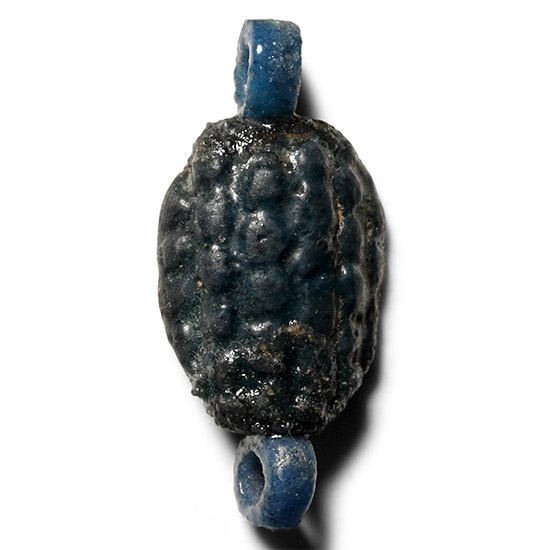
Egyptian Faience Grape Amulet
New Kingdom, 18th Dynasty, Amarna Period, 1353-1336 B.C.Estimate: £80 - 100 (+bp*)
Bids: 1 | Current Bid: £5
Plano-convex in section with integral loop to each end. 0.26 grams, 16 mm
From a mid 20th century collection. -
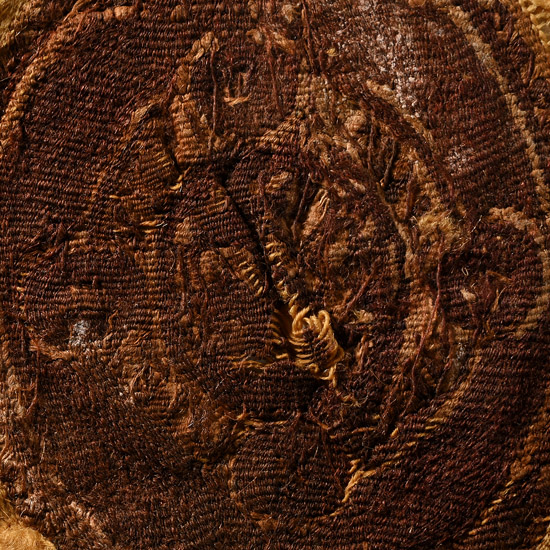
Egyptian Coptic Textile Fragment of an Orbiculus from a Tunic
Circa 4th century A.D.Estimate: £30 - 40 (+bp*)
Bids: 1 | Current Bid: £5
In purple wool and coarse linen, on a brown linen background, S-torsion, embroidered with vegetal ornaments, and the borders decorated with meanders. 6.38 grams, 10 x 9.8 cm
Acquired 1970s-1996. Property of a North American collector. London collection, 2016.
In the Late Roman Period, round orbiculi decorated the shoulders and the lower part of tunics and kamisia (inner tunics). These fabrics were of great decorative finesse, displaying an unusual and extremely well-preserved colour palette. When the tunic was removed from use, these embroideries could be recycled and patched onto another garment. -
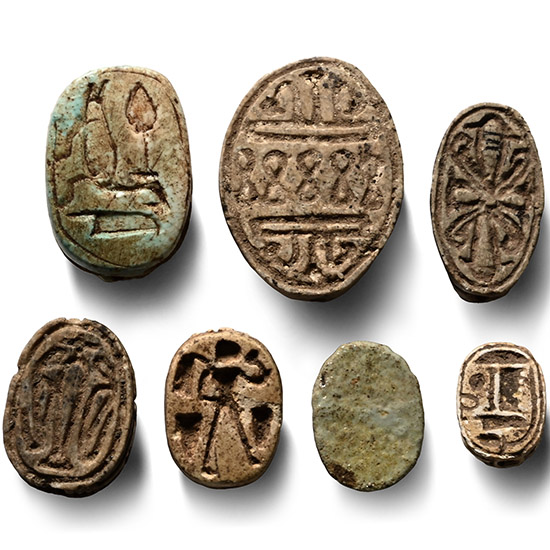
Egyptian Mixed Scarab and Scaraboid Collection
2nd-1st millennium B.C.Estimate: £400 - 600 (+bp*)
Opening Bid: £200
Comprising (from left to right, top to bottom): 1) a scarab with an oval border containing a goose, nefer(?), and a reed leaf; 2) a scarab with an oval border featuring a triple lotus flower motif at the top and bottom, with a middle row of floral bundles; 3) a scaraboid with a long oval border containing a cross pattern incorporating scrolls, coiled cords, and floral elements; 4) a scarab with an oval border featuring a hes-jar flanked by two cobras; 5) a scarab with a standing male figure holding a sceptre/mace and a flail, flanked by two highly stylised rearing cobras; 6) a plain scarab; 7) and a scarab with an oval border containing the name Amun-Re, a neb symbol, and a lotus flower. 13 grams total, 11-23 mm
From the collection of a gentleman, acquired on the London art market in the 1990s. This lot is accompanied by an illustrated lot declaration signed by the Head of the Antiquities Department, Dr Raffaele D'Amato. -
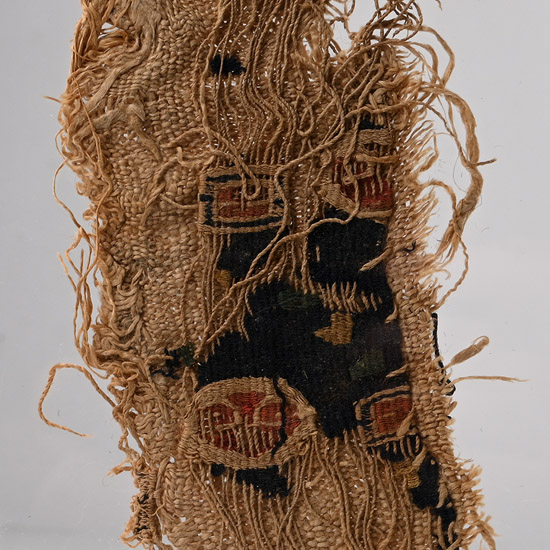
Egyptian Textile Fragment in Display Stand
Coptic, circa 6th-8th century A.D.Estimate: £50 - 70 (+bp*)
Opening Bid: £5
Open-structured fragment of a decorative garment ornament (likely a tabula or portion of clavus band); mounted in a protective acrylic display. 83 grams total, 16 cm including stand
with a privately curated collection, 1980s-early 2000s. From the private collection and estate of Christine Simons (1943-2025), West Midlands, UK. -
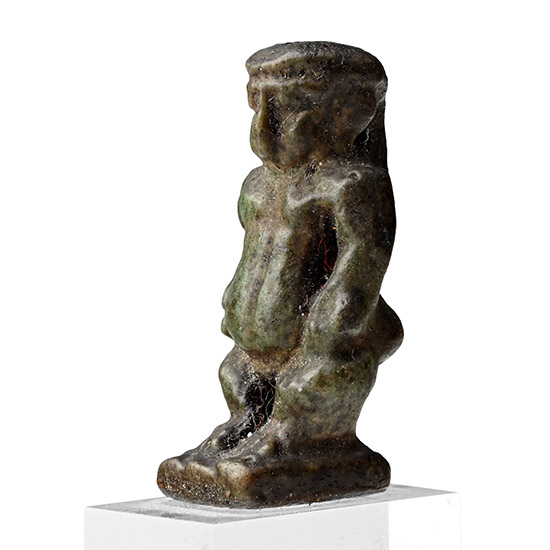
Egyptian Faience Amulet of Pataikos
Late Period, 664-332 B.C.Estimate: £100 - 140 (‡+bp*)
Opening Bid: £45
Depicted as a naked dwarf with short limbs; pierced to rear of the neck for use as an amulet; mounted on a display stand. 7.88 grams total, 40 mm high including stand
Ex Herbert A.Cahn, Basle, 1960s.
Herodotus mentions Pataikos as a dwarf-like depiction of Ptah, although the god’s ancient Egyptian name remains unclear. These small amulets symbolise Ptah’s immense magical power, which helps protect the wearer from dangerous creatures such as snakes and crocodiles. The deity’s role in the funerary sphere is explained in Spell 164 of the Book of the Dead, where Pataikos is used to safeguard the deceased’s heart from attacks by enemies and from bodily decay. -
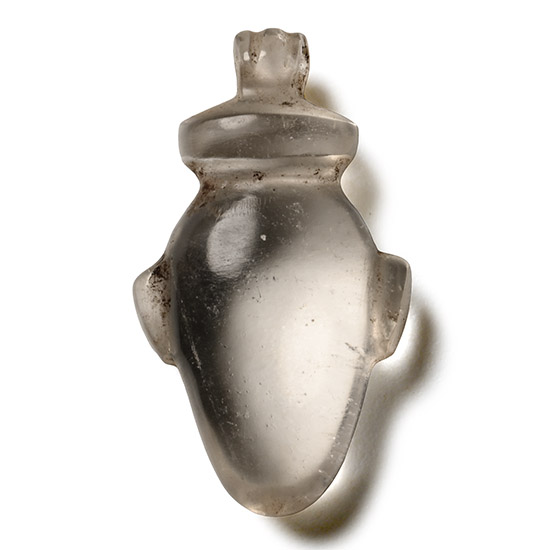
Egyptian Rock Crystal Heart Amulet
Late Period, 664-332 B.C.Estimate: £100 - 140 (+bp*)
Bids: 2 | Current Bid: £90
Carved with lateral lugs, a pronounced rim surmounted by a ribbed suspension loop. 1.05 grams, 18 mm
Ex London collection, 1990s.
Ancient Egyptians regarded the heart (ib) as the seat of intelligence, emotions, behaviour, and memory. During the ‘Weighing of the Heart’ ceremony, the heart spoke for the deceased before Osiris and accounted for their actions. For this reason, Egyptians placed heart amulets on mummies to protect the organ and secure a favourable judgement. -
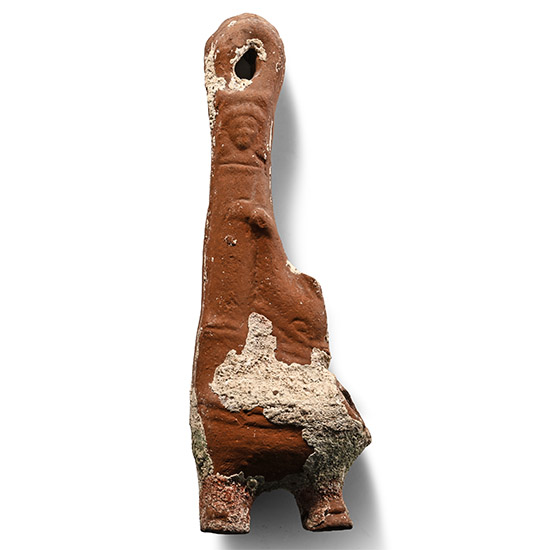
Egyptian Terracotta Alexandrian Figure
Roman Period, 30 B.C.-323 A.D.Estimate: £120 - 170 (+bp*)
Bids: 1 | Current Bid: £5
Hollow-formed vessel with bulbous body and two flared feet below, vertical handle with loop finial and moulded mummy and dolphin motif; marine accretion; inked to underside 'Ex M. Suzanne / Alexandria / 1903-1920'. 178 grams, 19.5 cm
From the collection of David Donlan (1947-2025), a dedicated and lifelong collector with a passion for the ancient world and the natural sciences, forming his collection from 1960s onwards, using many reputable dealers across the United Kingdom, including the well-regarded Coincraft and The Parthenon Gallery. -
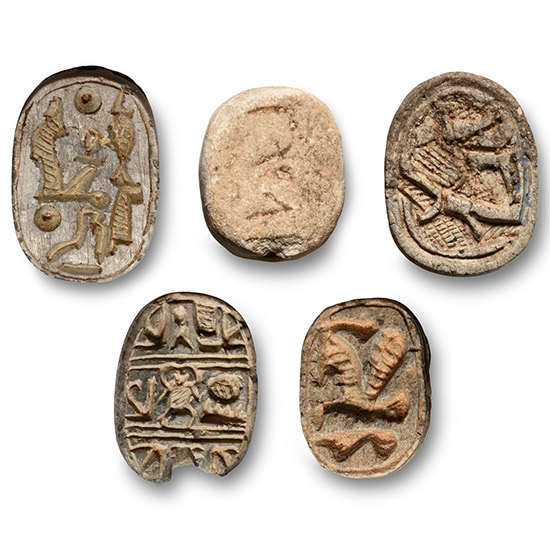
Egyptian and Phoenician Stone Scarab Group
Late Period-Ptolemaic Period, 664-30 B.C.Estimate: £120 - 170 (+bp*)
Bids: 1 | Current Bid: £5
Mixed group of scarabs and scaraboids, with hieroglyphs and symbols to the underside. 12.08 grams total, 16-19 mm
From the private collection of a European gentleman (1942-2024), formed since the 1970s. -
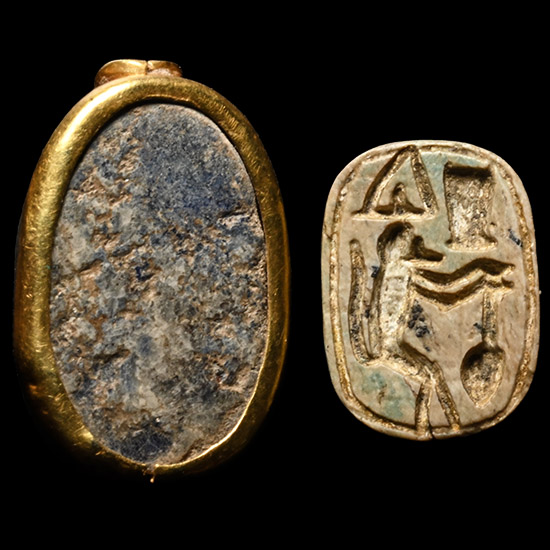
Egyptian Scarab Group
Circa 2nd-1st century B.C.Estimate: £100 - 140 (‡+bp*)
Bids: 1 | Current Bid: £50
Comprising: a lapis lazuli scarab in a gold funda from a ring; a glazed composition bead with a high-relief sleeping monkey motif on the obverse with a figurative and hieroglyphic legend on the reverse. 2.86 grams total, 12-17 mm
Private collection of Kal Noselson, New York, acquired between 1976 and the late 1990s; thence by descent.
