
Ancient Art, Antiquities, Books, Natural History, Stamps & Coins

-
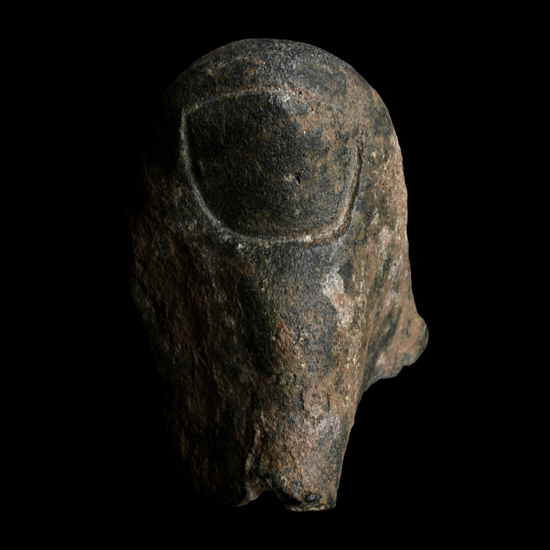
Twice the Life-Size Roman Bronze Statue Big Toe
1st-4th century A.D.Estimate: £300 - 400 (+bp*)
Opening Bid: £5
Comprising the tip of a big toe with nail detailing; hollow-form. 179 grams, 57 mm
From the private collection of a European gentleman (1942-2024), formed since the 1970s. -
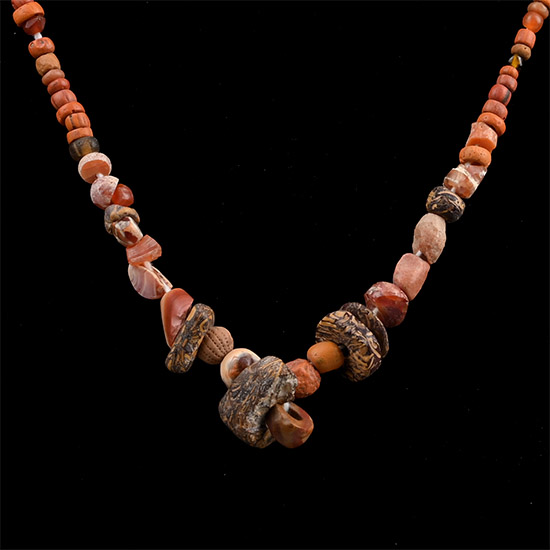
Roman and Other Coral-Coloured Glass Bead Necklace String
1st-4th century A.D. and laterEstimate: £50 - 70 (+bp*)
Opening Bid: £5
Composed of graduated oblate, annular and other beads with larger beads as a central feature, restrung. 22 grams, 44.5 cm
Ex London, UK, collection, 1990s. -
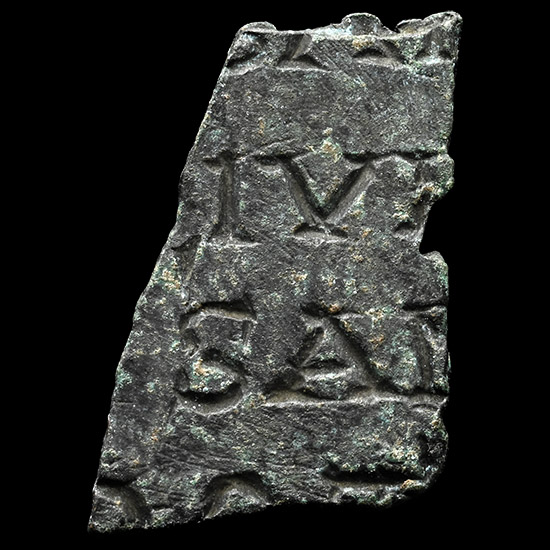
Roman Bronze Military Diploma Fragment
Circa 129 A.D.Estimate: £150 - 200 (+bp*)
Opening Bid: £75
Irregular fragment of a thin tablet engraved with portions of several horizontal lines of Latin capitals, identified as part of the exterior witness list of the second tablet, or tabella II, of a Roman military diploma; the surviving letter groups may be restored as: '[C.] IV[LI …] [L.] PV[LLI …] [P.] AT[TI …]?'. 3.57 grams, 24 mm
Acquired on the European art market. UK, private collection.
This sequence closely parallels the witness list on a diploma fragment in the Museo de Huelva, inventory 10.619, published as a copy of Hadrian’s constitution for auxiliary troops serving in Syria, issued on 22 March AD 129. Published restorations of the witnesses include Gaius Iulius Eutychius, Lucius Pullius Anthus or Daphnus, and Publius Attius Severus. González Fernández and Bermejo Meléndez, Diplomata Militaria del Museo de Huelva. Military diplomas were certified bronze copies of imperial grants recording citizenship, marriage rights and related privileges. -
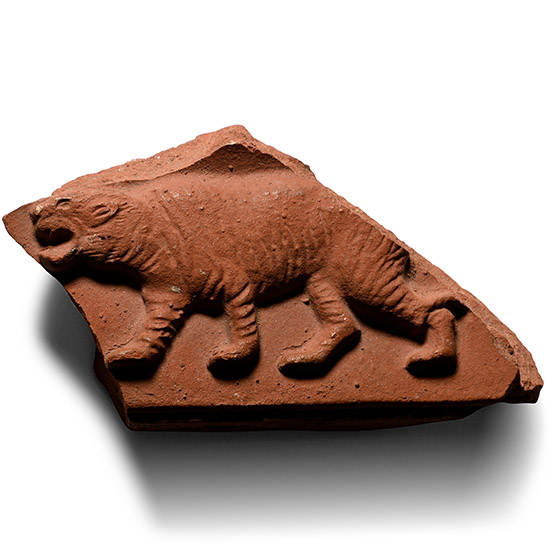
Roman Terracotta Sigillata Fragment with Tiger
3rd-4th century A.D.Estimate: £300 - 400 (‡+bp*)
Opening Bid: £180
Fragment of a vessel with an advancing tiger with an open mouth on a profiled ground line with finely engraved fur; the shard ending smoothly on the underside and reverse indicating that it might be the edge fragment of a rectangular or polygonal plate (lanx). 40.6 grams, 79 mm
French art market, 2021. -

Roman Banded Glass Pyxis
1st century A.D.Estimate: £300 - 400 (‡+bp*)
Opening Bid: £167
Drum-shaped in profile with stepped rim; repaired. 87 grams, 60 mm
Acquired in the late 1980s. Private collection, thence by descent. Private collection, since the late 1990s. -
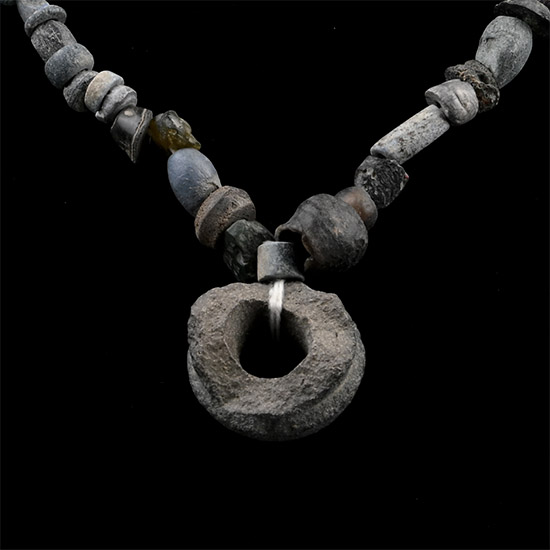
Roman and Other Mixed Glass Bead Necklace String
1st-4th century A.D. and laterEstimate: £50 - 70 (+bp*)
Opening Bid: £5
Composed of mixed beads, including a large doughnut-shaped bead fragment as a central feature, restrung. 38.6 grams, 36.5 cm
Ex London, UK, collection, 1990s. -
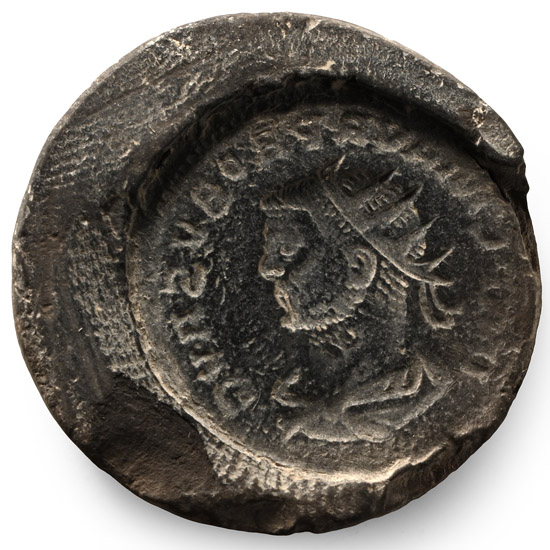
Roman Terracotta Coin Forger's Mould
Circa 3rd-4th century A.D.Estimate: £50 - 70 (+bp*)
Bids: 1 | Current Bid: £5
Discoid clay mould with an impressed design of a radiate profile bust on each face. 4.49 grams, 27 mm
London gentleman's collection, 1970-1990s, by descent. -
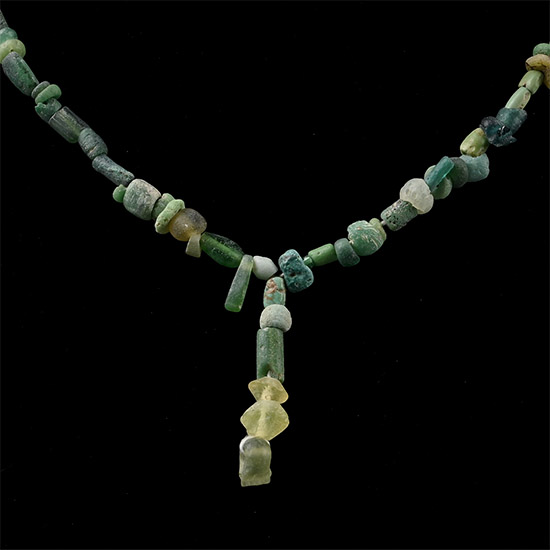
Roman and Other Green Glass Bead Necklace String
1st-4th century A.D. and laterEstimate: £50 - 70 (+bp*)
Opening Bid: £5
Composed of mixed beads and restrung to a Y-shape. 15.66 grams, 37 cm
Ex London, UK, collection, 1990s. -
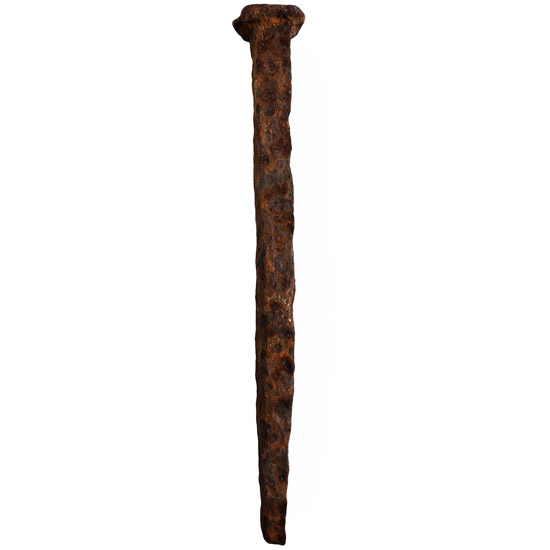
Very Large Romano-Scottish Legion XX Valeria Victrix 'Inchtuthil Fort' Iron Nail
Circa 83-87 A.D.Estimate: £100 - 140 (+bp*)
Bids: 1 | Current Bid: £5
Sturdy rectangular-section clout-nail with a slightly domed top. 228 grams, 21 cm
From excavations started by Richmond in Perthshire, Scotland, in the 1950s, and discovered in the summer of 1960. Selected and boxed by David Colville & Sons by 1963. Acquired on the UK art market in the 1990s. Property of a Middlesex gentleman.
The fortress at Inchtuthil was a fortified headquarters and forward supply depot for the forces led by the Roman governor, Gnaeus Julius Agricola, when he undertook a lengthy campaign against the Caledonian tribes in the north of Britain. The campaign is mentioned in the biographical work written by his son-in-law, the historian Tacitus, which has been studied in order to understand the Roman plan for the subjugation of the island. The troops chosen for the campaign were drawn from the 20th Legion (Legio XX Valeria Victrix). While the construction of Inchtuthil and other strongholds took place, the troops lived in temporary encampments which were also fortified and formed a chain of defensive sites from which domination of the surrounding territory could be achieved. Subsequently, once the site was abandoned late in the 1st century A.D. (around 86 A.D.), no further building took place there or in the area. Excavation in the 20th century by Sir Ian Richmond (begun in 1952) revealed a pristine site with its complete plan recoverable - unique in the Roman Empire. The defences were a broad ditch and turf wall with stone facing, with watchtowers and gatehouses. The site was thought to have been abandoned due to the relocation of troops to counter an invasion from Eastern Europe into the province of Dacia, although this is no longer certain. A huge quantity of iron nails (more than 875,000) was recovered from a pit in the fort as well as other ironware; the goods had been buried in order not to let them fall into the hands of the Caledonians. The excavated nails and other items were sorted and sold in small parcels, which was completed by 1963. The nails range in size from small nails between thirty-eight and seventy millimetres long, up to the massive spikes three hundred and seventy-two millimetres long. These kinds of long nails were also used for crucifixions. -
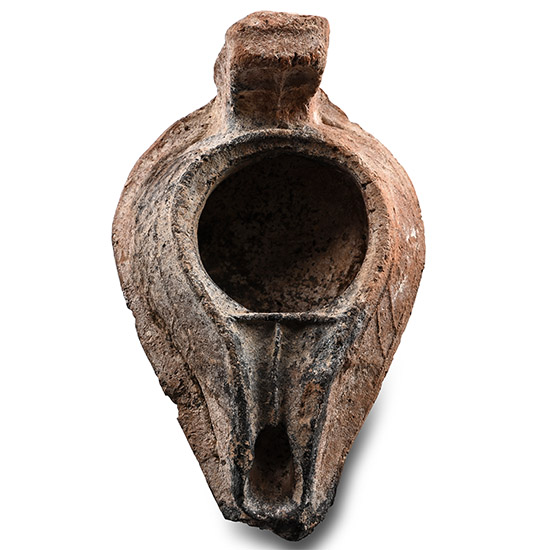
Late Roman Terracotta Oil Lamp
6th-7th century A.D.Estimate: £80 - 100 (+bp*)
Opening Bid: £5
Slipper-shaped type with hatching to the shoulder, ribbed nozzle, rectangular handle with raised cruciform motif, underside with cross-in-circle motif and inked '397' legend. 185 grams, 12.5 cm
Ex important German collection, 1970s onwards. -
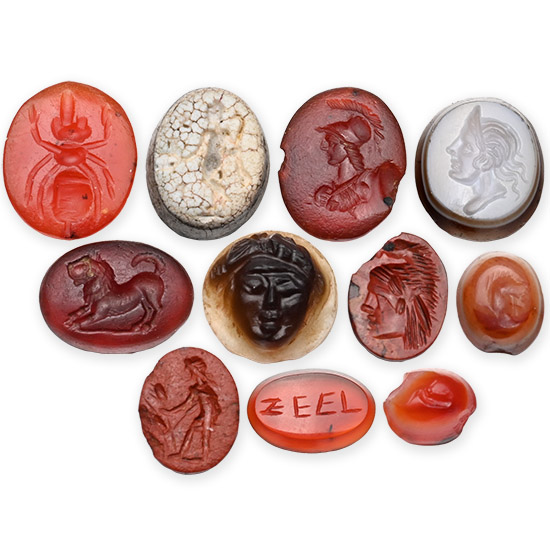
Large Roman Carnelian and Other Gemstone Collection
1st-2nd century A.D.Estimate: £1,500 - 2,000 (+bp*)
Opening Bid: £750
Comprising eleven gemstones with various motifs, including: a cameo with a face, a profile bust wearing a filet, an insect with a stinger, a bust of Minerva, a lion on a baseline, a helmetted head of a warrior, a harvesting scene, two with a bird(?), an advancing nude female with an inscription before, and one inscribed 'ZEEL'. 5.33 grams total, 7-13 mm
Private collection, London. -
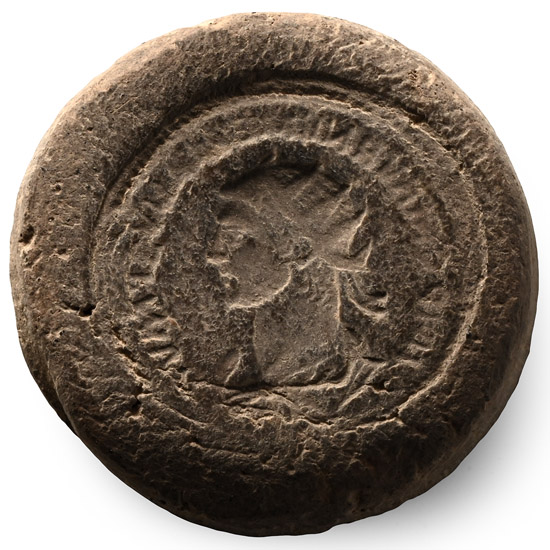
Roman Terracotta Coin Forger's Mould
Circa 3rd-4th century A.D.Estimate: £50 - 70 (+bp*)
Bids: 1 | Current Bid: £5
Discoid clay mould with an impressed design of a coin on each face, one side with a radiate profile bust. 4.12 grams, 27 mm
London gentleman's collection, 1970-1990s, by descent.
