
Ancient Art, Antiquities, Books, Natural History, Stamps & Coins

-
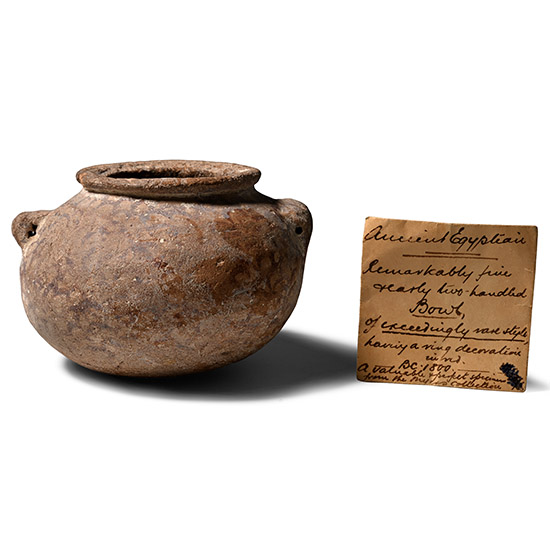
Egyptian Painted Terracotta Bowl
Predynastic-Protodynastic Period, circa 3900-3200 B.C.Estimate: £80 - 100 (+bp*)
Bids: 2 | Current Bid: £25
Squat in profile with everted rim to the mouth, two lateral pierced lugs; old collector's handwritten card 'Ancient Egyptian remarkably fine & early two-handled bowl of exceedingly rare style, having a ring decoration in red. B.C. 1800. A valuable and perfect specimen from the Myers Collection'. 271 grams, 10.3 cm wide
From the private collection of Major William Joseph Myers (1858-1899). From the estate of a deceased Sussex private collector since the early 20th century. Accompanied by a copy of an illustrated academic report by Simone Musso. Accompanied by an old original handwritten information card.
The painted decoration imitates the veining of a hardstone such as basalt or breccia. -
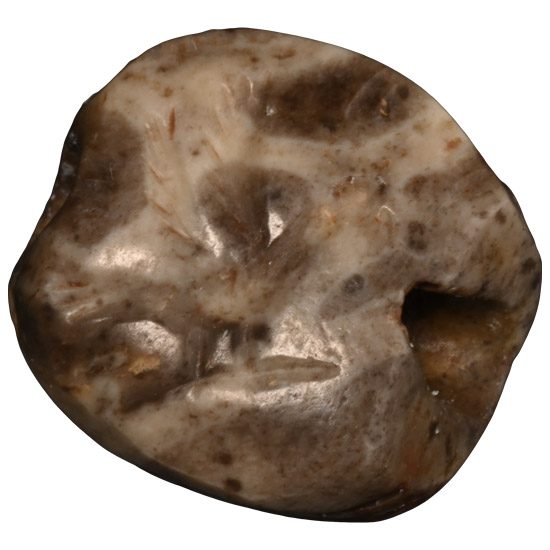
Phoenician Marbled Grey Stone Scarab with Bird
Late 1st millennium B.C.Estimate: £40 - 60 (+bp*)
Opening Bid: £5
Plano-convex in section, with hatched segmentation on the upper face; underside with bird in flight, with radiating strokes to the border; edge chipped; supplied with an impression. 4.11 grams, 17 mm
From the private collection of a European gentleman (1942-2024), formed since the 1970s. -
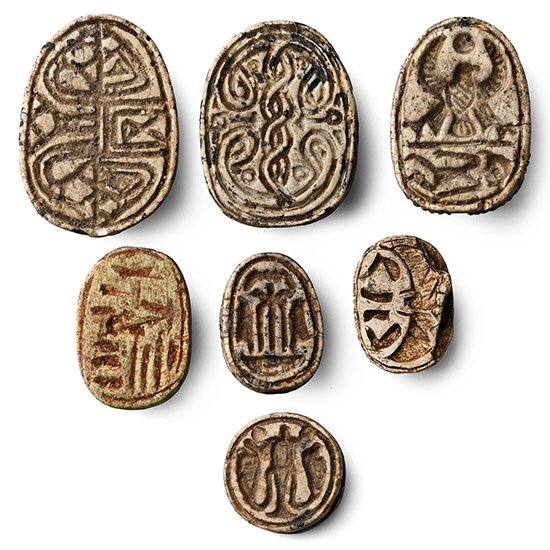
Egyptian Steatite Scarab Collection
Mostly Late Middle Kingdom, Second Intermediate Period, 1780-1500 B.C.Estimate: £600 - 800 (+bp*)
Opening Bid: £300
Mixed group of scarabs and scaraboids, including: stylised foliate motif with a sa sign; central entwined cords with curled tops and tails, and nefer signs; a falcon with outspread wings and sun disc above, surmounting a fallen enemy; a group of hieroglyphs: a central mes flanked by reed leaves, with a water sign n above, and a neb sign below; a falcon with outspread wings, with two maat feathers and stylised cobras above; a central hes vase flanked by rearing cobras. 32.6 grams total, 15-28 mm
From the collection of a gentleman, acquired on the London art market in the 1990s. -
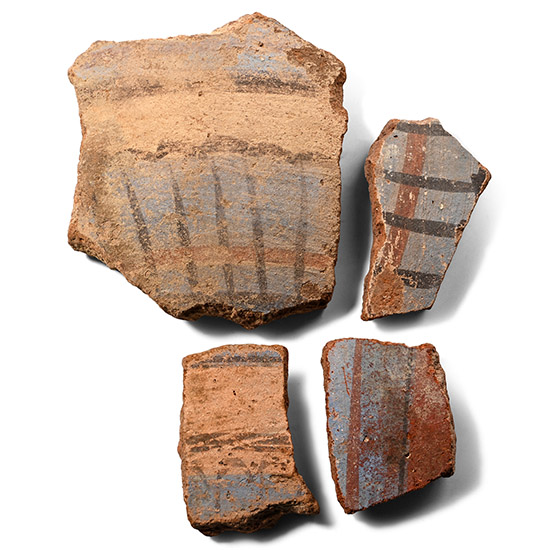
Egyptian Amarna Painted Pottery Fragments
New Kingdom, Amarna Period, 1353-1336 B.C.Estimate: £50 - 70 (+bp*)
Opening Bid: £5
Including bowl fragment with painted flower detailing, and other types. 65 grams total, 36-70 mm
From a private collection formed 1970s-1990s. -
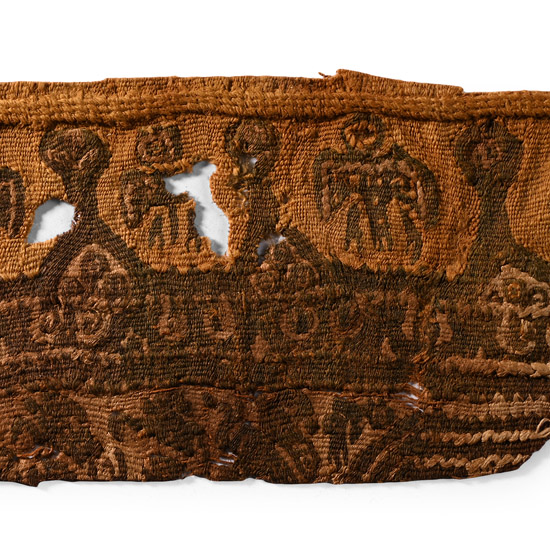
Egyptian Coptic Tunic Textile Fragment of a Segmentum with Eagles and Other Birds
Circa 7th century A.D.Estimate: £50 - 70 (+bp*)
Bids: 1 | Current Bid: £5
Fragment of a large segmentum in linen and wool, embroidered with rows of eagles and other birds, the borders with geometric decorations. 8 grams, 19 cm
Acquired 1970s-1996. Property of a North American collector. London collection, 2016.
The segment is realised in the tapestry technique. They were part of the decoration of a tunic, and the presence of the Imperial eagle, not a common pattern, could refer to a military tunic. -
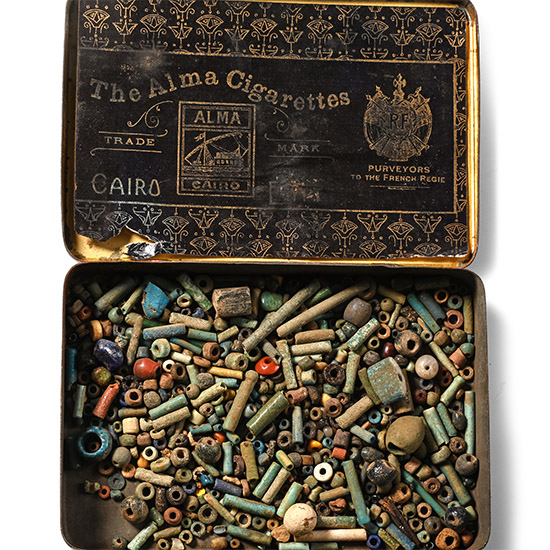
Egyptian Assorted Faience and Other Beads in Early 20th Century Tin Box
Late Period-Ptolemaic Period, circa 664-30 B.C.Estimate: £60 - 80 (+bp*)
Bids: 1 | Current Bid: £5
Comprising mostly glazed tubular, globular, barrel and other beads, in a vintage red cigarette box with an old label 'The Alma Cigarettes Company, Ltd., Boulak Square Cairo'. 87 grams total including tin, 1-18 mm
Excavated from Egypt in 1914. From the private collection of Mr David Sams and his wife Elizabeth Kate Sams, gentry and amateur archaeologists who travelled to Egypt in 1914 with their daughter Ethel. Mr Sams and his wife led digging expeditions from which these items come from the family estate of Mr and Mrs Sams, by direct descent to their granddaughter. -
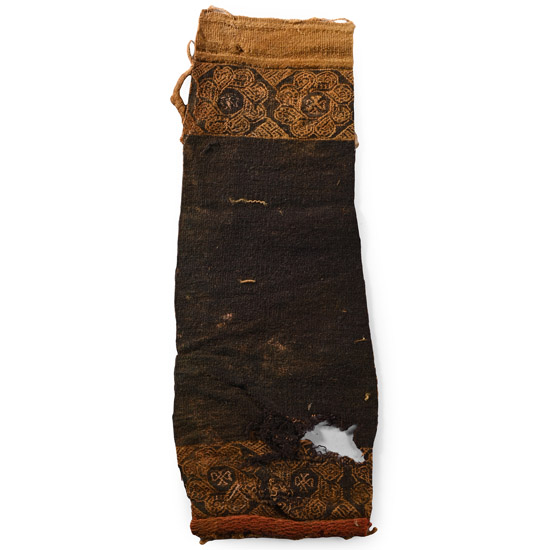
Egyptian Coptic Tunic Textile Fragment with Segmenta Decorated with Crosses
Circa 6th-7th century A.D.Estimate: £60 - 80 (+bp*)
Bids: 2 | Current Bid: £15
Comprising a long element from a tunic, possibly a sleeve from a child’s garment, in brown wool with a red edge, a pair of segmenta at both sides in purple and yellow, ornamented with crosses inside lozenges and spirals. 27 grams, 30.5 cm
Acquired 1970s-1996. Property of a North American collector. London collection, 2016.
This decorative part of a tunic is possibly a part of the sleeve of a child's garment, and the crosses reiterate the fact that these fabrics were produced in a by then heavily Christianised Roman Empire. -
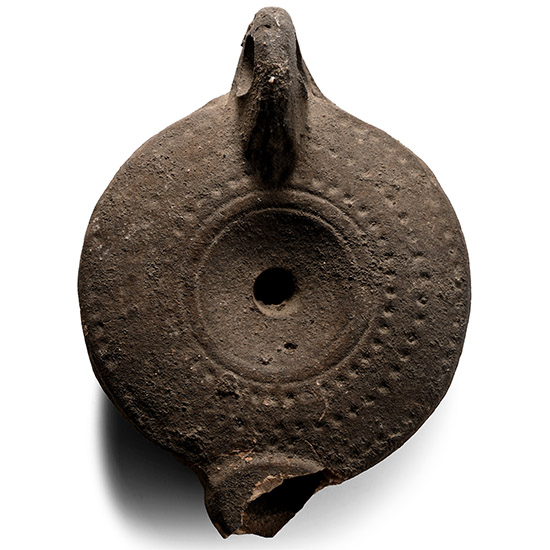
Romano-Egyptian Terracotta Toad Oil Lamp
Roman Period, 3rd century A.D.Estimate: £40 - 60 (+bp*)
Bids: 1 | Current Bid: £5
Squat in profile and discoid in plan, with a central perforation on the upper face and a pierced lug handle at the rear; concentric bands of pointillé ornament on the upper face and incised rings on the base; nozzle broken; supplied with an old handwritten collector's record slip made from an envelope. 97 grams, 11.3 cm
Found Alexandria, Egypt. From the estate of a deceased Sussex private collector since the early 20th century. Accompanied by an old original handwritten information slip. -
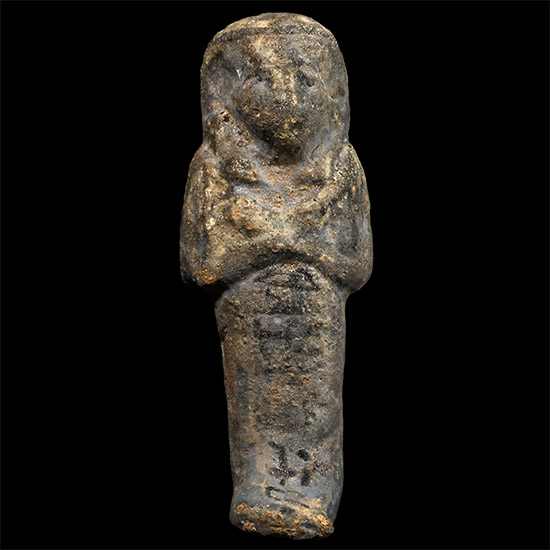
Egyptian Grey-Blue Faience Shabti for a Songstress of Amun
Third Intermediate Period, 22nd Dynasty, circa 945-715 B.C.Estimate: £150 - 200 (+bp*)
Opening Bid: £50
Mummiform figure modelled with a heavy lappet wig, encircled at the top by a sash band; low-relief crossed arms, with painted implements, a seed bag on the back, and a column of hieroglyphs on the front dedicated to: 'The Osiris, songstress of Amun Sedjet(?), true of voice'. 52.8 grams, 90 mm
From the collection of a London gentleman, 2000s. -
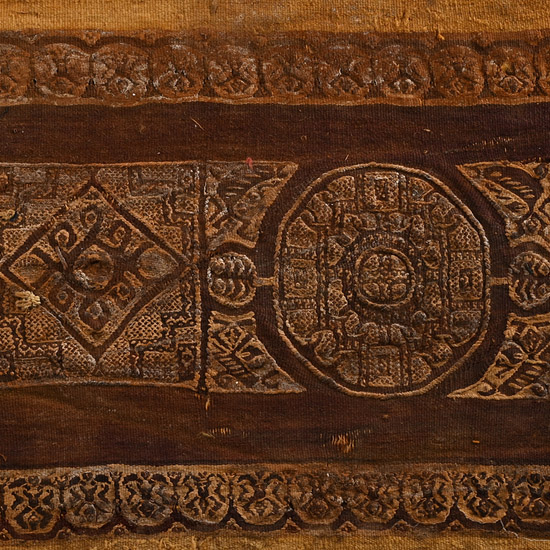
Large Egyptian Coptic Tunic Textile Fragment with Central Broad Clavus and Side Clavus
Circa 7th-8th century A.D.Estimate: £200 - 300 (+bp*)
Bids: 3 | Current Bid: £30
Comprising a large portion of tunic, with a complete section of the collar (maniakion) divided in successive decorative circular bands, ornamented with geometric patterns of floral elements, plants, interlaces; a central segmentum broadly decorated with geometric patterns, palmettes, triangles, and a round medallion with an impressive floral design; the segmentum is bordered by two purple stripes, flanked by other two bands of vegetal ornaments enclosed in medallions; the terminal part of the tunic still presents the fastening stripes of selvedges in rope forming the lowed border; S-twist yellow-orange and purple wool warp on linen; a long clavus in purple wool on linen decorated with vegetal interlaces, the borders meander decorated. 236 grams total including paper folder, 57.5 cm
Acquired 1970s-1996. Property of a North American collector. London collection, 2016.
The large fragment featuring geometric and vegetal decoration may date to the early period of the Islamic conquest, when tunic ornamentation began to take on an increasingly abstract and geometric character, often linked to the representation of plants and Nilotic flora. The rich decoration of the tunic and the use of purple suggest that it may have belonged to an aristocrat or a wealthy ecclesiastic of the Coptic-Greek population, or perhaps to a dignitary of the Umayyad Empire. -
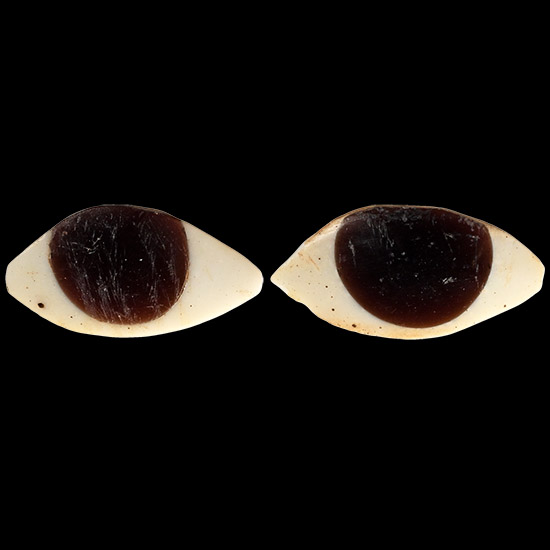
Egyptian Glass Eye Inlays
Ptolemaic Period, 332-30 B.C.Estimate: £200 - 300 (+bp*)
Bids: 3 | Current Bid: £24
Almond-shaped with large black irises and white sclerae. 4.12 grams total, 27-29 mm
Acquired on the UK art market, 1977-1979. Private collection, London.
Egyptian coffin eye inlays were both decorative and symbolic, designed to make the coffin appear more lifelike and to assist the deceased in the afterlife. Typically, they featured a white sclera (glass, travertine, alabaster, or quartz), a dark iris (glass or, more often, obsidian), and sometimes red paint at the inner corner. The eyes were often set in bronze or copper frames, occasionally with faience or bronze eyebrows. -
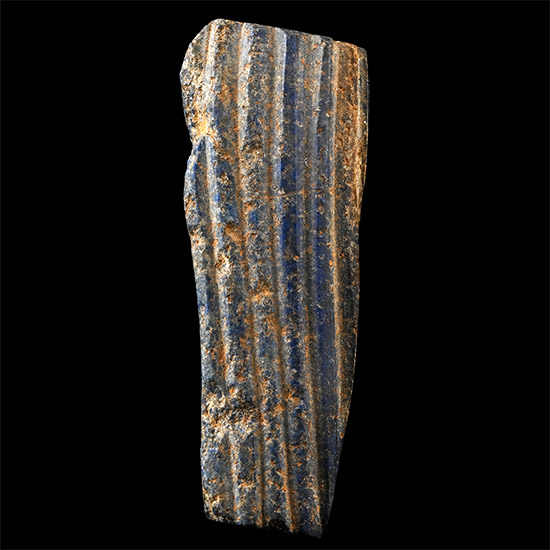
Egyptian Carved Lapis Lazuli Inlay
New Kingdom, 1550-1070 B.C.Estimate: £200 - 300 (+bp*)
Opening Bid: £5
Rectangular-section panel with tapering profile, fluting to the upper face. 23.6 grams, 48 mm
From the private collection of a European gentleman (1942-2024), formed since the 1970s.
This fragment most likely belongs to a striated skirt or wig.
