
Ancient Art, Antiquities, Books, Natural History, Stamps & Coins

-
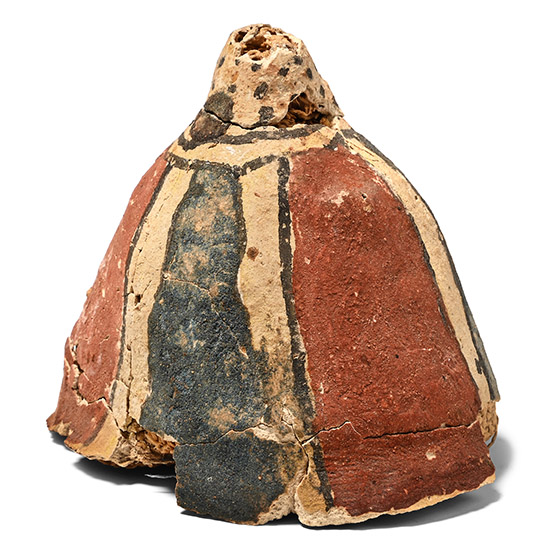
Egyptian Bell-Shaped Cartonnage Element from a Mummy Case
Graeco-Roman Period, circa 3rd century B.C.-2nd century A.D.Estimate: £100 - 140 (+bp*)
Opening Bid: £5
Bell-shaped in form with a conical top feature, the outer face is primed to accept painted petal detailing; inner layers are in loosely woven fabric. 20 grams, 69 mm
with a privately curated collection, 1980s-early 2000s. From the private collection and estate of Christine Simons (1943-2025), West Midlands, UK.
This is an intriguing object, possibly a breast from a cartonnage mummy case. For example, some Roman-period cartonnage cases from Akhmim were modelled with female physiognomies, including wide hips and modelled breasts. -
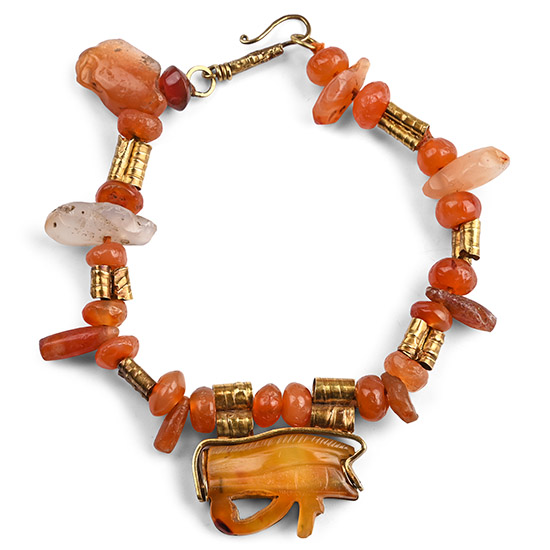
Egyptian Hardstone Eye of Horus Amulet Bracelet
Late Period, 664-332 B.C.Estimate: £600 - 800 (+bp*)
Bids: 1 | Current Bid: £300
Groups of ancient Egyptian carnelian beads restrung as a wearable bracelet with a wedjat-eye amulet suspended from the middle, using old gold by Belinda Elliston, collector and Egyptologist. 25.19 grams, 20 cm
Ex Belinda Elliston collection, a member of the Egyptian Exploration Society, 1940s onwards. -
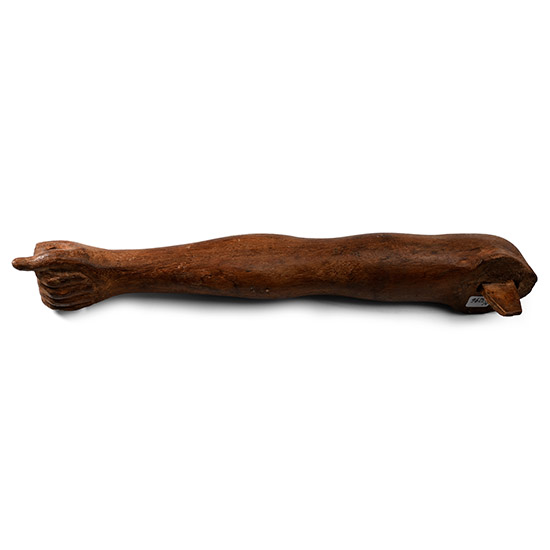
Large Egyptian Wooden Right Arm from Male Statuette
Old Kingdom, 2700-2200 B.C.Estimate: £2,000 - 3,000 (‡+bp*)
Opening Bid: £1,150
Carved in acacia wood and preserved in its entirety, from an under-life-size male statuette; slender fingers forming a fist and originally holding a tool; attachment tenon at the inner shoulder. 160 grams, 27 cm
Natural traces of ageing. Intact.
Ex Galerie Cybele, Paris, acquired in 1999. with Binoche et Giquello auction, Paris, 20 March 2017, no.88. This lot has been checked against the Interpol Database of stolen works of art and is accompanied by search certificate no.13474-263055.
Separately manufactured arms did not need to touch the body's sides or be stabilised by bars. Thus, the figure, which presumably stood upright with one leg advanced, was given a freer and more lifelike appearance. -
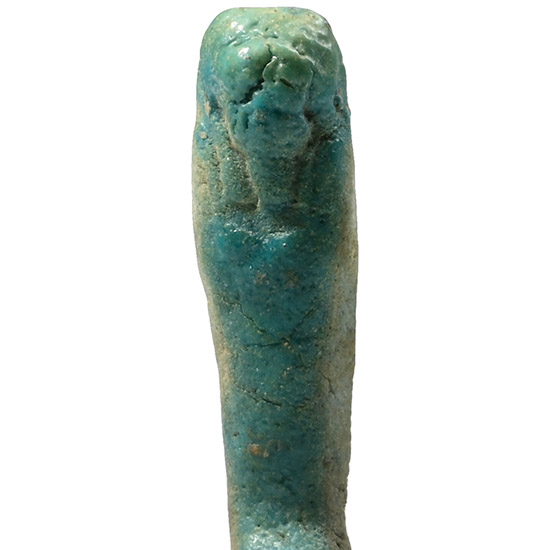
Egyptian Blue-Green Glazed Shabti
Late Period, 664-332 B.C. or laterEstimate: £40 - 60 (+bp*)
Bids: 1 | Current Bid: £5
Mummiform shape with a deep blue-green glaze, moulded facial details and crossed arms; supplied with a custom-made stand. 6.25 grams, 53 mm (14.15 grams total, 70 mm high including stand)
Acquired from John L. Homan, Lincolnshire, UK, 1990. Accompanied by a copy of the original receipt dated 15th March 1989. -
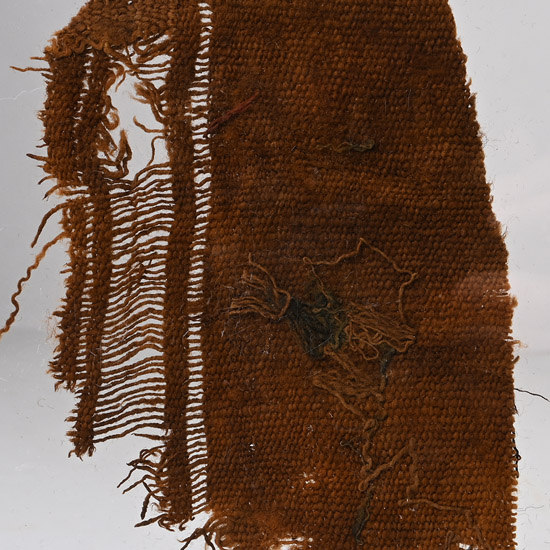
Egyptian Mummy Wrapping Fragment in Display Stand
Circa 1500 B.C.-300 A.D.Estimate: £50 - 70 (+bp*)
Opening Bid: £5
Textile fragment with a decorative openwork section on one side; mounted in a protective acrylic display. 83 grams total, 16 cm including stand
with a privately curated collection, 1980s-early 2000s. From the private collection and estate of Christine Simons (1943-2025), West Midlands, UK. -
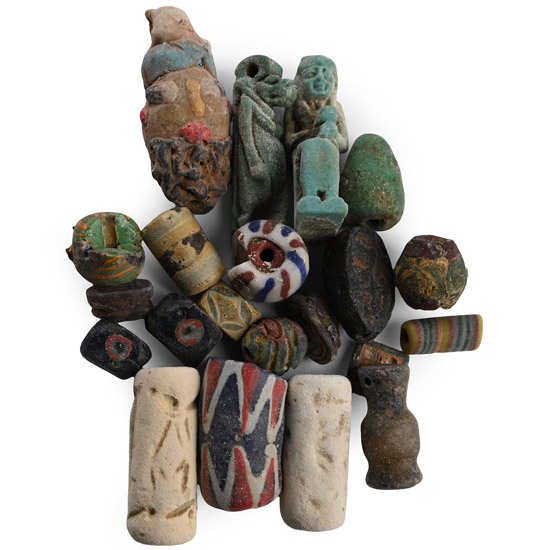
Egyptian Faience and Glass Bead and Amulet Collection
Late-Roman Period, circa 664-323 A.D.Estimate: £150 - 200 (+bp*)
Opening Bid: £75
Including pendant amulets of Isis Lactans and Taweret; an amethyst scarab with wadj, nefer, and neb hieroglyphs on the underside; tubular beads with dragged trails; a face pendant; and other types. 59 grams total, 10-33 mm
London gentleman's collection, 1970-1990s, by descent. -
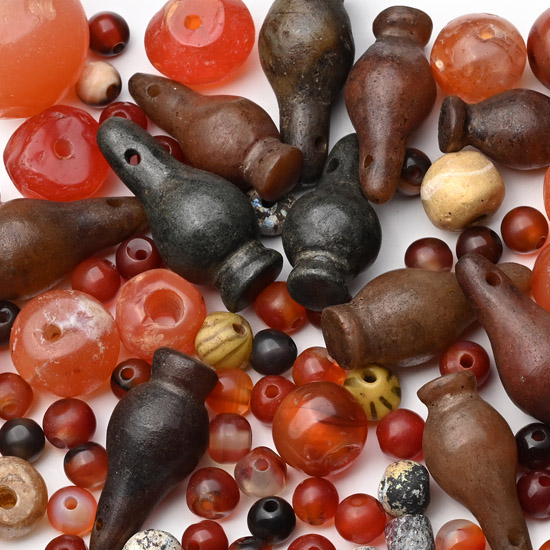
Egyptian Carnelian and Other Beads with Jasper Poppy Bead Amulets
Late Period, circa 664-332 B.C.Estimate: £400 - 600 (+bp*)
Opening Bid: £200
Including poppy- or cornflower-shaped, spherical, biconvex, and other types. 38 grams total, 4-20 mm
London gentleman's collection, 1970-1990s, by descent. -
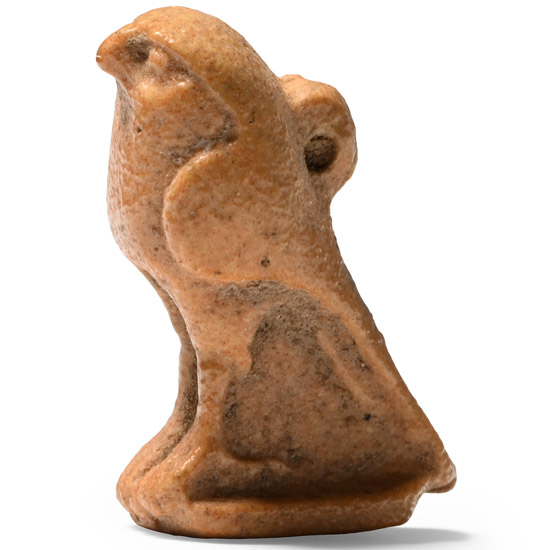
Egyptian Horus Amulet
Late Period, 664-332 B.C.Estimate: £150 - 200 (+bp*)
Bids: 2 | Current Bid: £100
Perching Horus falcon with talons gripping the front edge of the integral plinth; detailed wings and head and a suspension loop on the back. 1.24 grams, 19 mm
Ex London gentleman's collection, by descent 1980s.
Horus is one of the most significant and widely worshipped gods in ancient Egyptian mythology. His importance spans many aspects of Egyptian religion, including serving as a symbol of the living king, offering protection, representing the sky, and symbolising the sun. -
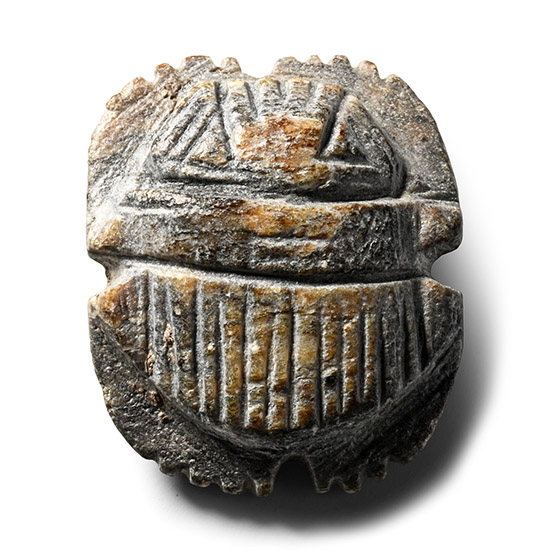
Egyptian Stone Scarab
Late Period, 664-332 B.C.Estimate: £120 - 170 (+bp*)
Bids: 1 | Current Bid: £5
With incised anatomical detailing on the body, the underside ground smooth, with a faint trace of an original horizontal suspension hole. 3.28 grams, 20 mm
London, UK, art market, 1980s. Private collection, London, UK. -
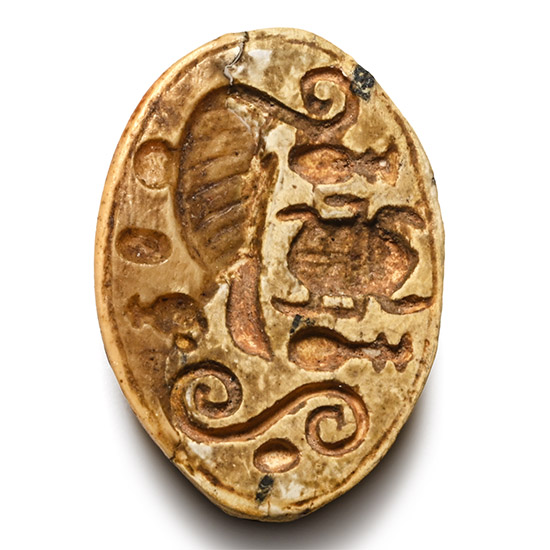
Egyptian Stone Scarab
Late Period, 664-332 B.C.Estimate: £40 - 60 (+bp*)
Bids: 1 | Current Bid: £5
Scaphoid plaque with a ribbed dome on the obverse and a flared mouth at the socket; underside with incuse hieroglyphs and symbols, including a scarab flanked by two nefer signs, an S-scroll, a standing vulture, and others; supplied with an impression. 1.22 grams, 18 mm
From the private collection of a European gentleman (1942-2024), formed since the 1970s. -
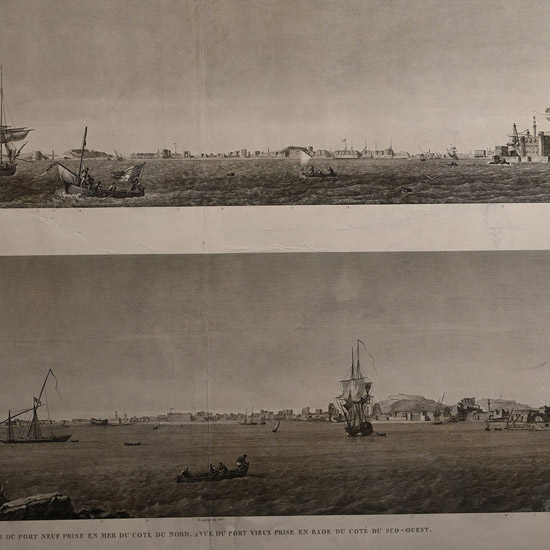
Very Large Egyptian Expedition Lithograph of Views of Alexandria
Early 19th century A.D.Estimate: £80 - 100 (+bp*)
Opening Bid: £40
Proof etching on laid paper of plate 88 from Description de l'Égypte : ou, Recueil des observations et des recherches qui ont été faites en Égypte pendant l'expédition de l'armée française. entitled 1. Vue du port neuf en mer du cote du nord. 2. Vue du port vieux prise en rade du cote du sud-ouest. 259 grams, 104.5 x 69 cm
From the collection of a North American priest. Acquired between 1981-1996. Property of a North American collector.
Produced between February 1802 and 1830 on the orders of Napoleon Bonaparte; published between 1809 and 1828. Just 1,000 copies were distributed to various institutions, printed on laid paper with an 'Égypte ancienne et moderne' watermark. The book is subtitled Recueil des observations et des recherches qui ont été faites en Égypte pendant l’expédition de l’Armée française, publié par les ordres de Sa Majesté l’Empereur Napoléon le Grand (Gathering of observations and discoveries which were made in Egypt during the expedition of the French army, published on the orders of His Majesty the Emperor Napoleon the Great). It was the world's first encyclopedia devoted exclusively to the remains of ancient Egypt. The plates of this book are the first to present the archaeological sites of Thebes (Luxor). -
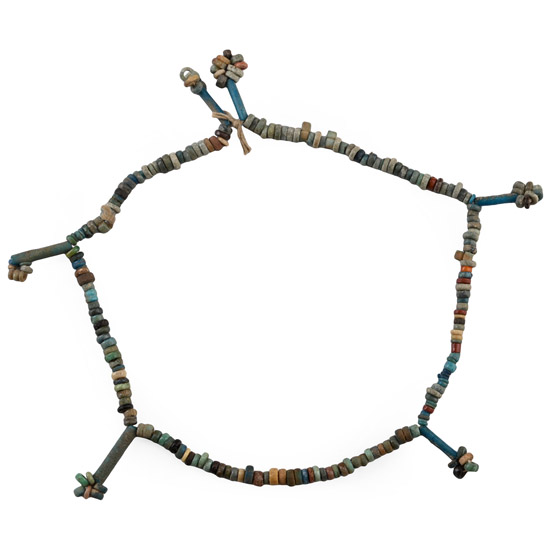
Egyptian Faience Mummy Bead Bracelet with Drops
Late Period-Ptolemaic Period, circa 664-30 B.C.Estimate: £60 - 80 (+bp*)
Opening Bid: £5
Composed of green- and blue-glazed disc and tubular beads, restrung. 4.64 grams, 27 cm
Excavated from Egypt in 1914. From the private collection of Mr David Sams and his wife Elizabeth Kate Sams, gentry and amateur archaeologists who travelled to Egypt in 1914 with their daughter Ethel. Mr Sams and his wife led digging expeditions from which these items come from the family estate of Mr and Mrs Sams, by direct descent to their granddaughter.
