
Ancient Art, Antiquities, Books, Natural History, Stamps & Coins

-
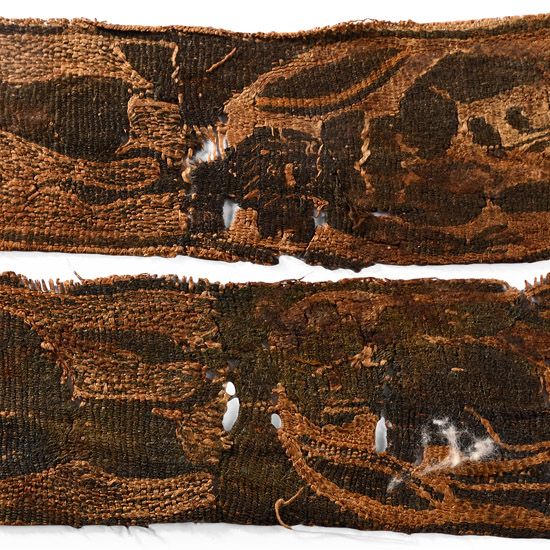
Egyptian Coptic Tunic Clavus Textile Fragments with Armed Puttoes, Lion and Hound
Circa 5th century A.D.Estimate: £100 - 140 (+bp*)
Bids: 1 | Current Bid: £5
Comprising two long strips (clavus) with alternating figures of hunting puttoes with shields, hares and lions. 16.14 grams total, 22-23 cm
Acquired 1970s-1996. Property of a North American collector. London collection, 2016.
The theme of rabbits or hares, in association with other characters and animals of the Dionysian thiasos in a hunting setting, has notable parallels. Such representations are linked to narratives of the Dionysian cycle. -
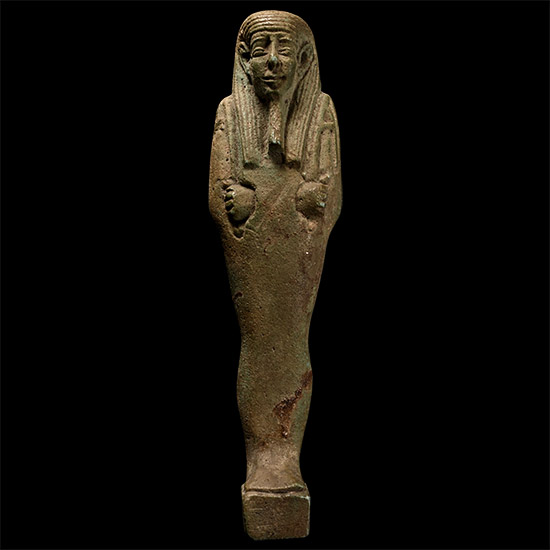
Egyptian Green Glazed Faience Shabti
Late Period, 664-332 B.C.Estimate: £1,000 - 1,400 (‡+bp*)
Opening Bid: £550
Modelled with a slender mummiform body on a small rectangular base; the long face framed by a striated tripartite wig and false beard; the hands of the imperceptibly crossed arms hold a hoe and a pick; the right hand also holds a cord from which a seed bag hangs over the figure's back; a dorsal pillar on the reverse; uninscribed. 102 grams, 14 cm
Ex Ms.E.C.(1923-2014), Israel. Inherited by his son D.L., Switzerland.
Although uninscribed, the distinctive long face, manner of hand styling and long striated wig lappets suggest that it may come from the same mould as another shabti in the World Museum, Liverpool (Janes, G., The Shabti Collections 6: A Selection from the World Museum, Liverpool, Lymm, 2016, p. 501, no. 264b). -
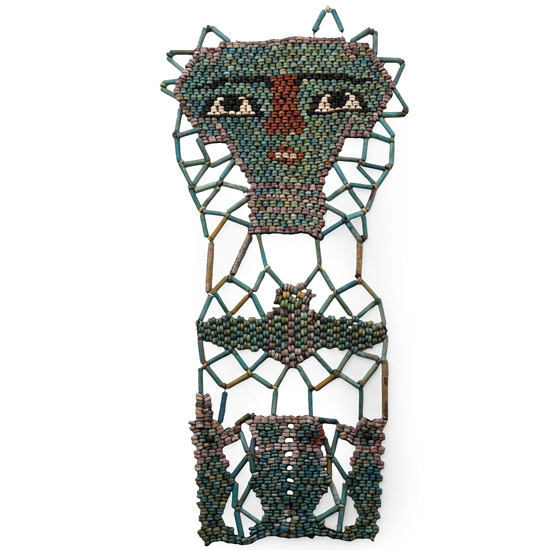
Egyptian Mummy Bead Mask with Four Sons of Horus and Winged Scarab
Late-Ptolemaic Period, circa 664-30 B.C.Estimate: £300 - 400 (+bp*)
Bids: 1 | Current Bid: £270
Beaded polychrome mummy mask with a false beard, a winged scarab and the Four Sons of Horus beneath. 56.8 grams, 26 cm
From the collection of Mariaud de Serres, Paris, France, 1980s-1990s.
Bead masks like this were attached to the outside of a mummy's wrappings and often formed part of an elaborate beaded feature covering the entire body. -
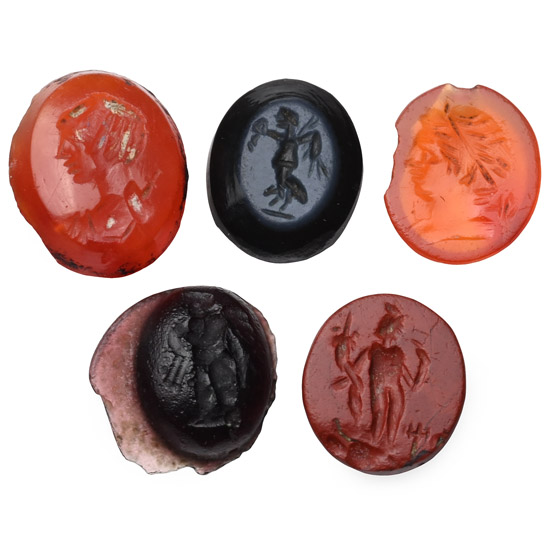
Romano-Egyptian Carved Gemstone Collection
1st-3rd century A.D.Estimate: £400 - 600 (+bp*)
Bids: 3 | Current Bid: £15
Comprising: an oval intaglio with a female profile bust; a red jasper intaglio with a standing figure holding a cornucopia; a translucent carnelian intaglio with a profile bust; a glass intaglio with a putto; a banded agate intaglio with a winged figure. 1.86 grams total, 9-11 mm
UK private collection assembled 1970s-90s, and thence to the liquidated state of above. -
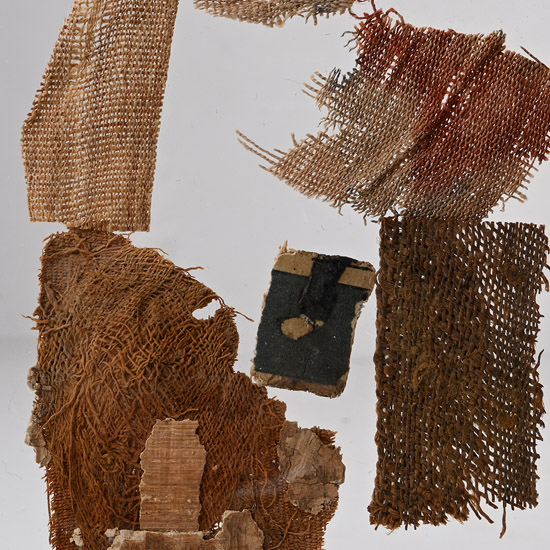
Egyptian Mummy Textile and Cartonnage Fragments in Display Stand
Circa 1500 B.C.-300 A.D.Estimate: £50 - 70 (+bp*)
Opening Bid: £5
Comprising fragments of open-structured, loose-weave brown fabric, a painted cartonnage piece, and another fabric piece with attached fragments of plaster; mounted in a protective acrylic display. 82 grams total, 16 cm including stand
with a privately curated collection, 1980s-early 2000s. From the private collection and estate of Christine Simons (1943-2025), West Midlands, UK. -
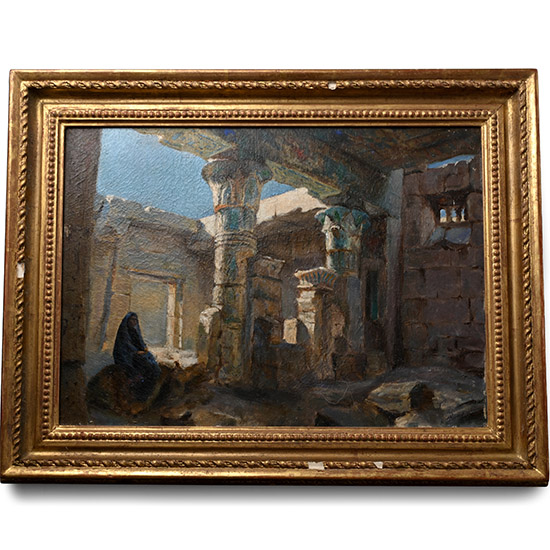
Framed Oil Painting on Canvas of a Temple at Thebes by Dimitri Gnedko
1993 A.D.Estimate: £80 - 100 (+bp*)
Bids: 1 | Current Bid: £5
Showing the inside of the temple with papyrus-topped columns, elaborate polychrome decoration visible on the ceiling; in the foreground, a woman dressed in blue robes, set in a gilt frame, old collector's notes on the reverse. 2.7 kg, 69 x 53.5 cm
From the private collection of a Knightsbridge gentleman. -
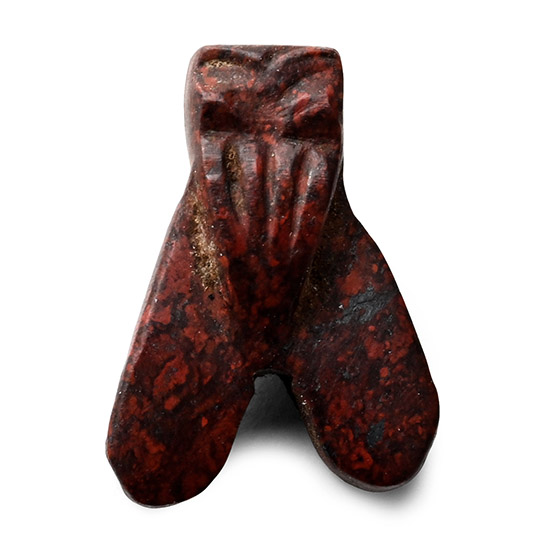
Egyptian Hardstone Fly Amulet
Late Period, circa 664-332 B.C.Estimate: £80 - 100 (+bp*)
Opening Bid: £5
With stylised detailing to the body and head, longitudinally pierced for suspension. 0.37 grams, 11 mm
London gentleman's collection by descent 1980s. -
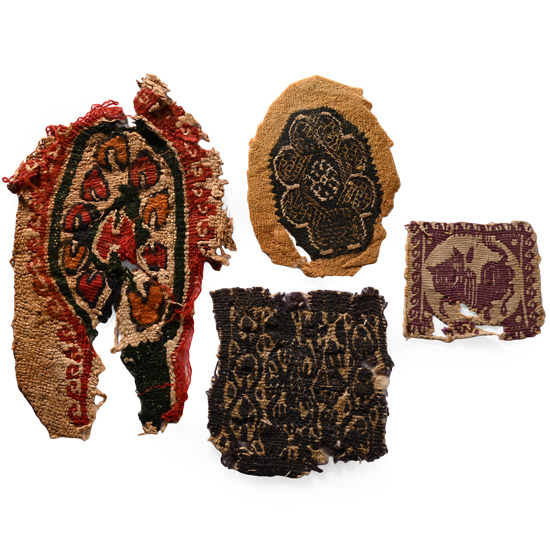
Egyptian Coptic Tunic Textile Fragments of Orbiculi, Tablia and Segmenta with Vegetation, Animals and Geometric Ornament
Circa 6th-7th century A.D.Estimate: £80 - 100 (+bp*)
Bids: 1 | Current Bid: £5
Comprising a tablion in purple and blue wool over white linen, with floral ornaments featuring ivy leaves; another smaller tablion in purple wool over white linen, the borders meander decorated, featuring a bull inside a medallion; an orbiculus with lozenge decoration, featuring a vegetal ornament inscribed in a polilobated flower; and a very large foliate ornament in red, green, yellow, orange and red wool on white linen, with vegetal decoration, the borders meander decorated, tapestry work (S-twist). 10.56 grams total, 5.8-15.5 cm
Acquired 1970s-1996. Property of a North American collector. London collection, 2016.
The fragments are decorative parts of tunics. These are fabrics of great decorative finesse, with some elements displaying an unusual and extremely well-preserved colour palette. -
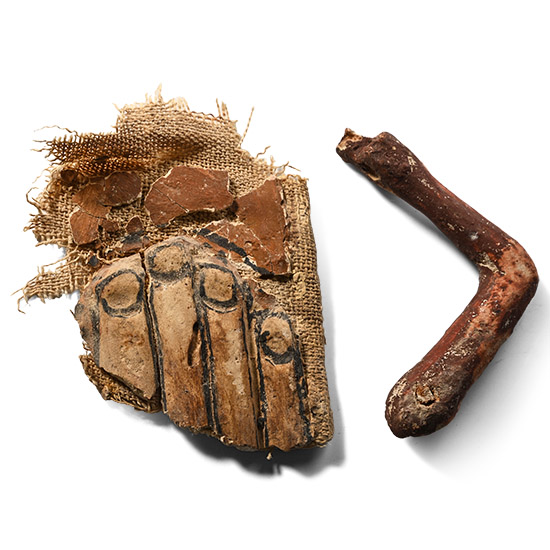
Egyptian Cartonnage Hand Fragment and Wooden Model Arm
Late Period-Ptolemaic Period, circa 664-30 B.C.Estimate: £30 - 40 (+bp*)
Opening Bid: £5
The arm modelled in bent pose with hand pierced to accept the handle of a tool; cartonnage fragment with finger detailing. 18 grams total, 73-82 mm
with a privately curated collection, 1980s-early 2000s. From the private collection and estate of Christine Simons (1943-2025), West Midlands, UK. -
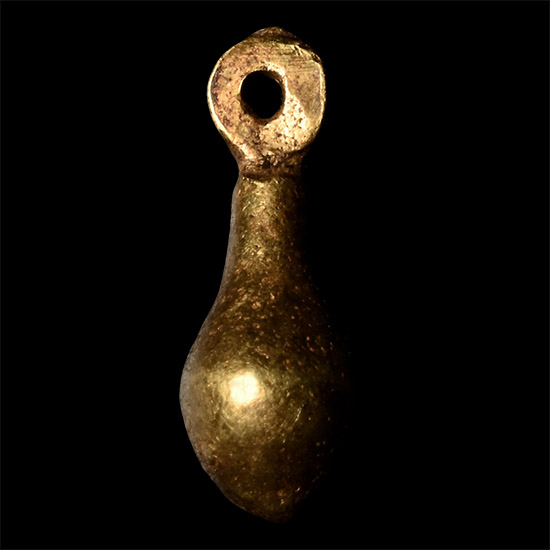
Egyptian Gold Pendant Amulet
Late New Kingdom-Third Intermediate Period, circa 1069-900 B.C.Estimate: £100 - 140 (+bp*)
Opening Bid: £50
Formed as a bulbous seed with a tapering stalk, a ribbed suspension loop above. 0.56 grams, 9 mm
Ex early 20th century French collection. -
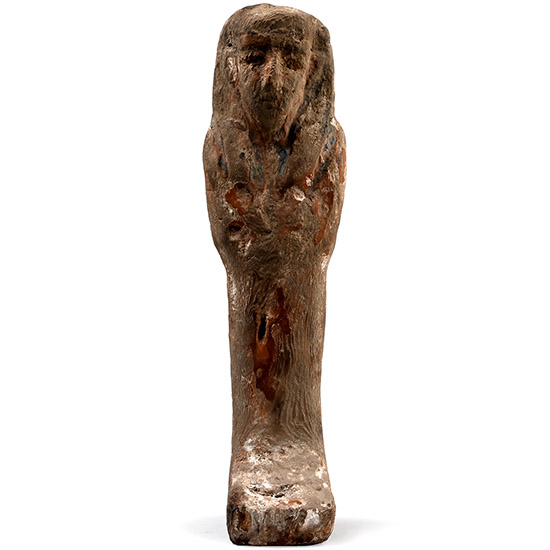
Large Egyptian Painted Wooden Ptah-Sokar-Osiris Figure
New Kingdom, circa 12th century B.C. or laterEstimate: £800 - 1,000 (+bp*)
Opening Bid: £400
Mummiform figure wearing a long lappet wig, with traces of blue and white pigment; a hole in the top of the head, likely to accept a separately fashioned headdress. 460 grams, 34.5 cm
with a privately curated collection, 1980s-early 2000s. From the private collection and estate of Christine Simons (1943-2025), West Midlands, UK.
Initially representing Osiris, this statuette type gradually merged with the Memphite deity Ptah-Sokar. It became a common grave good in the Late Period and the Graeco-Roman era. It was typically depicted standing on a long, rectangular base, wearing a tall, distinctive crown of two large, opposing feathers, with a sun disc on the lower front and ram's horns beneath. The recess in the crown of the present example was likely intended to accommodate this crown. -
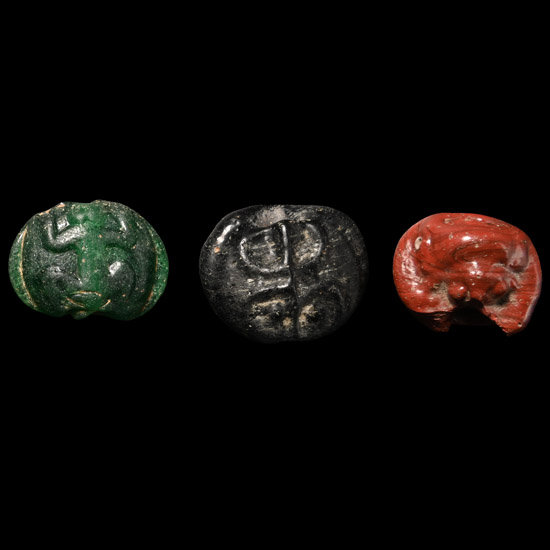
Phoenician Glass Amuletic Bead Group
Mid 1st millennium B.C.Estimate: £60 - 80 (+bp*)
Bids: 1 | Current Bid: £5
Including a grotesque mask, a squatting figure and a scorpion. 5.32 grams total, 14-16 mm
From the private collection of a European gentleman (1942-2024), formed since the 1970s.
