
Ancient Art, Antiquities, Books, Natural History, Stamps & Coins

-
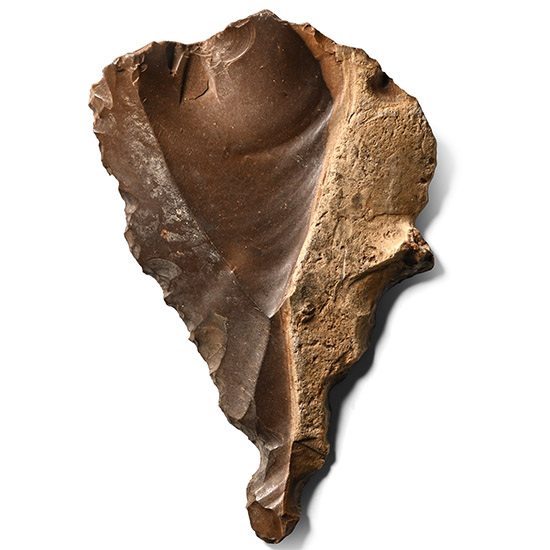
'Valley of the Kings' Egyptian Stone Age Knapped Boring Tool
Neolithic Period, circa 6,000 B.P.Estimate: £50 - 70 (+bp*)
Opening Bid: £5
Triangular in plan with broad curved butt and cortex to one edge; marked 'Tombs of the Kings Valley, Thebes, 1912'. 80.8 grams, 97 mm
Found near the tombs of the Valley of the Kings, Thebes, Egypt, 1912. Acquired from Sotheby's, 16 June 1959 (part), £4.10. From the private collection of Peter Clayton, FCILIP, Dip, Arch, FSA, FRNS, Hemel Hempstead, Hertfordshire, UK; formed since the late 1950s. Accompanied by a copy of an old handwritten identification card written by Peter Clayton. -
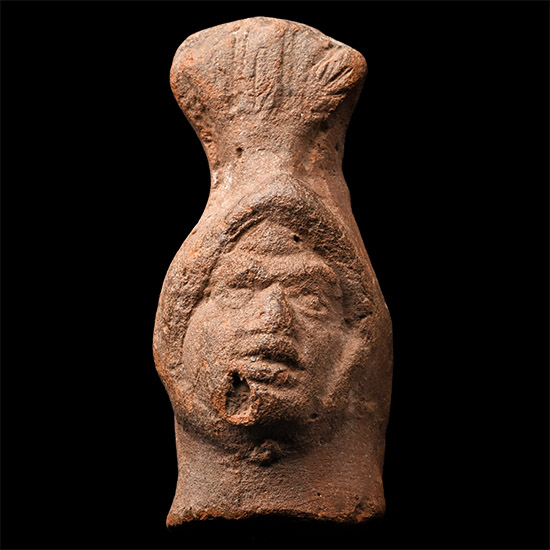
Egyptian Terracotta Statuette Head of the God Harpocrates
Graeco-Roman Period, circa 2nd-3rd century A.D.Estimate: £40 - 60 (+bp*)
Opening Bid: £5
Boldly modelled facial features, wearing a tall lotus flower crown. 58.16 grams, 70 mm
From the private collection of Peter Clayton, FCILIP, Dip, Arch, FSA, FRNS, Hemel Hempstead, Hertfordshire, UK; formed since the late 1950s. -
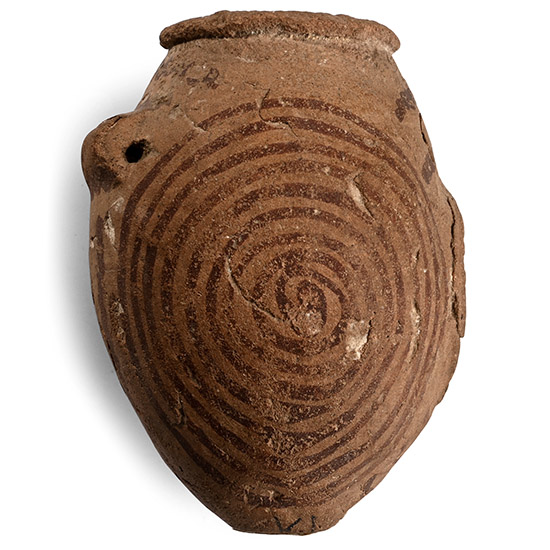
Egyptian Terracotta Pot with Painted Decoration
Predynastic Period, circa 3,500-3000 B.C.Estimate: £300 - 400 (+bp*)
Bids: 1 | Current Bid: £5
One half of a buff-coloured double-ovoid vessel, originally joined on one side to another identical pot, with a single pierced lug handle and a bold design of radiating circles. 68.4 grams, 75 mm
Ex Puys-Aubert collection in Alexandria, March 1963, paid 18 shillings. From the private collection of Peter Clayton, FCILIP, Dip, Arch, FSA, FRNS, Hemel Hempstead, Hertfordshire, UK; formed since the late 1950s. Accompanied by an old handwritten information card by Peter Clayton, collection no.99.
This small pot was originally attached to an identical vessel. Intact examples of which were found by the famous archaeologist Flinders Petrie during his excavations at the predynastic cemetery at Naqada, the site that gave its name to the chronology of the periods before Egyptian dynastic history. -
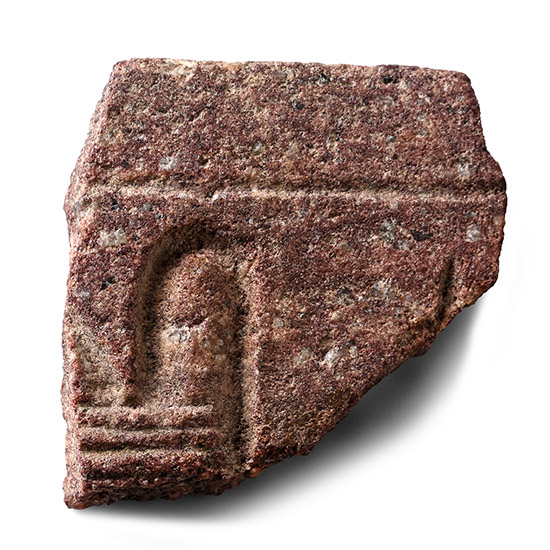
Egyptian Red Quartzite Granite Fragment with Part of Cartouche
New Kingdom, 18th Dynasty, Amarna Period, 1379-1362 B.C.Estimate: £60 - 80 (+bp*)
Opening Bid: £5
Dressed stone fragment with a vertical border and the lower portion of a cartouche with rope bands. 70 grams, 58 mm
Acquired in April 1980. From the private collection of Peter Clayton, FCILIP, Dip, Arch, FSA, FRNS, Hemel Hempstead, Hertfordshire, UK; formed since the late 1950s. Accompanied by an old handwritten information card by Peter Clayton, collection no.146.
After Akhenaten's reign, his monuments and statuary were systematically smashed. As a result, most evidence of the Amarna period's sculptural and architectural output survives only in fragments (for examples of stone fragments from statues and other objects recovered from Akhenaten's capital city, Akhetaten, see Seyfried, F. (ed.), In the Light of Amarna: 100 Years of the Nefertiti Discovery, Berlin, 2012, pp. 164-169; 230-231; 390-391). -
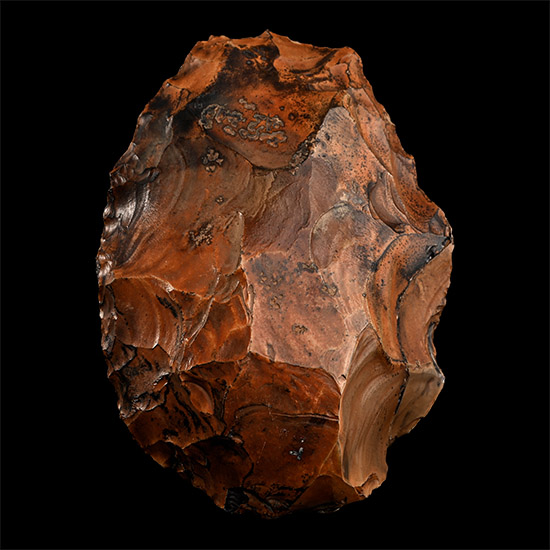
Egyptian Stone Age Knapped Handaxe
Lower Palaeolithic Period, circa 500,000-250,000 B.P.Estimate: £150 - 200 (+bp*)
Opening Bid: £5
Expertly shaped through percussion flaking, creating zigzagging lateral edges, with a roughly ovate or teardrop form and a heavy, thick butt, tapering down to a distinct working edge. 363 grams, 12.5 cm
From the collection of A.D. Passmore (1879-1958), his collection of flints from the area of Stonehenge was donated to the Ashmolean Museum in the 1950s. From the private collection of Peter Clayton, FCILIP, Dip, Arch, FSA, FRNS, Hemel Hempstead, Hertfordshire, UK; formed since the late 1950s. Accompanied by a copy of an old handwritten information card by Peter Clayton.
The Egyptian flint hand axe, or biface, is a prehistoric stone tool with two faces. This tool holds the record for being the longest-used tool in human history. The technical term 'biface' comes from the archetypal model, generally a bifacial Lithic flake with an almond-shaped morphology. Hand axes typically have a pointed end and a rounded base, giving them their characteristic shape, and both faces have been knapped to remove the natural cortex, at least partially. -
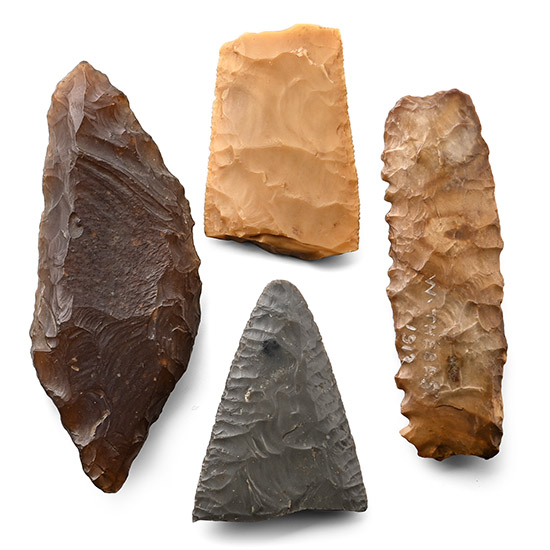
Egyptian Stone Age Knapped Tool Group from Thebes
Neolithic Period, 11,000-5,200 B.P.Estimate: £60 - 80 (+bp*)
Opening Bid: £5
Comprising: a long, bifacially flaked blade, a rectangular scraper or adze, a slender, elongated blade or knife, and a triangular projectile point or axe head. 89 grams total, 52-94 mm
Found Thebes. From the collection of A.D. Passmore (1879-1958), his collection of flints from the area of Stonehenge was donated to the Ashmolean Museum in the 1950s. From the private collection of Peter Clayton, FCILIP, Dip, Arch, FSA, FRNS, Hemel Hempstead, Hertfordshire, UK; formed since the late 1950s. Accompanied by a copy of an old handwritten information card by Peter Clayton. -
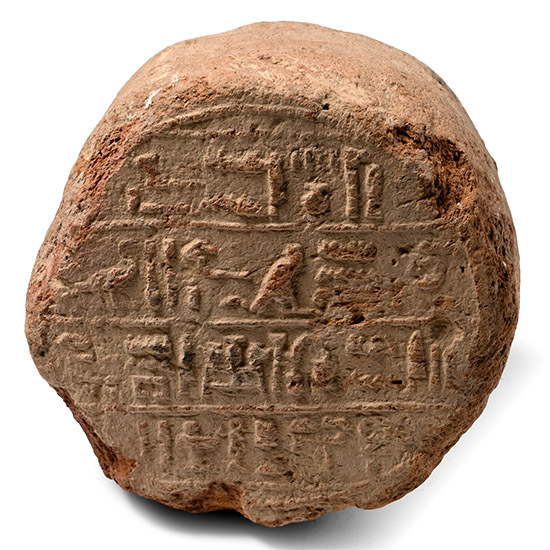
Egyptian Terracotta Funerary Cone of Montuemhat
Late Period, 25th-26th Dynasty, circa 700-650 B.C.Estimate: £300 - 400 (+bp*)
Bids: 3 | Current Bid: £110
The front part of a large tapering funerary cone, with the circular flat end impressed with four horizontal lines of hieroglyphic text, reading: "Fourth prophet of Amun, mayor of the city Montuemhat, true of voice, son of the prophet of Amun, scribe of the offering-table in the house of Amun, mayor of the city Nesptah, true of voice". 380 grams, 86 mm wide
Acquired from Abdoul Rassoul on the West Bank at Luxor, 1974-1980 when a guest lecturer. From the private collection of Peter Clayton, FCILIP, Dip, Arch, FSA, FRNS, Hemel Hempstead, Hertfordshire, UK; formed since the late 1950s.
Montuemhat, Mayor of Thebes and Governor of Upper Egypt, was possibly the most powerful official in southern Egypt of his era. He built one of the largest and most lavishly decorated non-royal tombs known (TT34), which still dominates the Asasif landscape today. -
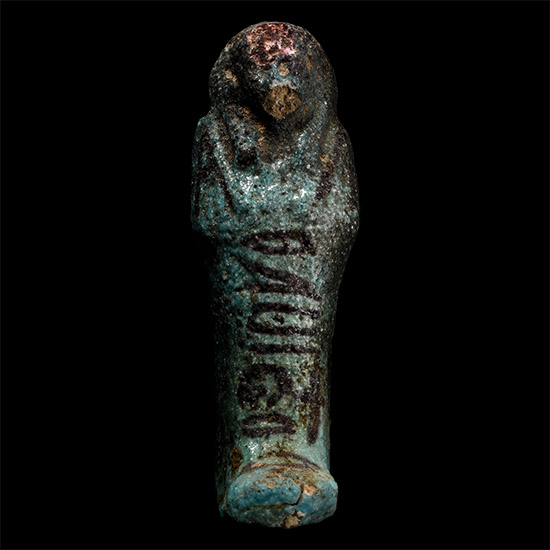
Egyptian Turquoise Blue Glazed Faience Shabti Ten-ankhet
Third Intermediate Period, 21st Dynasty, circa 1077-943 B.C.Estimate: £300 - 400 (+bp*)
Bids: 1 | Current Bid: £5
Squat mummiform body wearing a lappet wig encircled at the top by a sash band, with crossed arms and hands holding black-painted hoes, a seed bag across the mid-back, and a column of black-painted hieroglyphic text on the lower body reading: 'The Osiris, Ten-ankhet, true of voice.' 74.17 grams, 96 mm
From the private collection of Peter Clayton, FCILIP, Dip, Arch, FSA, FRNS, Hemel Hempstead, Hertfordshire, UK; formed since the late 1950s. -
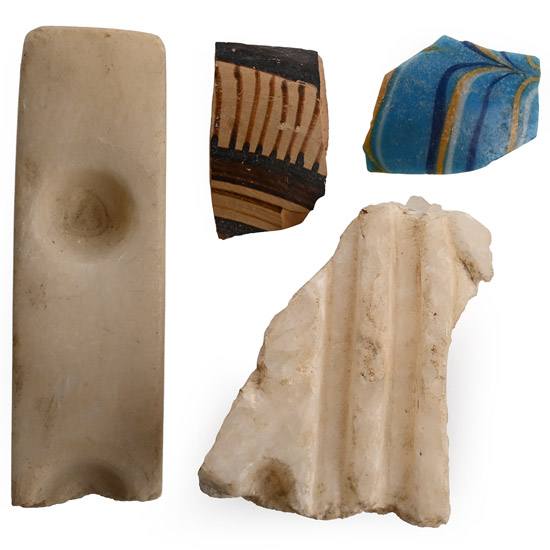
Egyptian Alabaster and Ceramic Group
New Kingdom, 18th Dynasty, Amarna Period, 1353-1336 B.C.Estimate: £60 - 80 (+bp*)
Opening Bid: £5
Comprising: an alabaster fragment with two deeply incised lines and part of a hieroglyph; a portion of a narrow rectangular inkwell with two feet on the underside; a fragment of an opaque blue glass vessel with dark blue, yellow and white decoration; and a fragment of a decorated Mycenaean vessel. 94 grams total, 29-78 mm
From the private collection of Peter Clayton, FCILIP, Dip, Arch, FSA, FRNS, Hemel Hempstead, Hertfordshire, UK; formed since the late 1950s. -
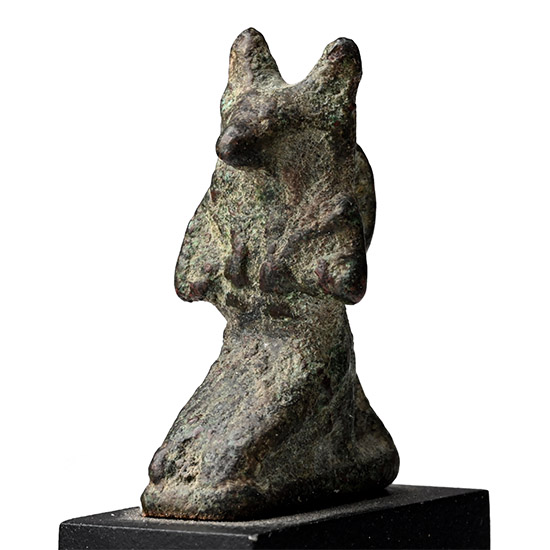
Egyptian Bronze Jackal Amulet
Late Period-Ptolemaic Period, 664-30 B.C.Estimate: £80 - 100 (+bp*)
Bids: 3 | Current Bid: £22
Kneeling jackal-headed figure wearing a pleated shendyt - kilt and holding regalia in its hands; on an integral, tongue-shaped base with a suspension loop at the back. 13.6 grams total, 34 mm including stand
From the private collection of Peter Clayton, FCILIP, Dip, Arch, FSA, FRNS, Hemel Hempstead, Hertfordshire, UK; formed since the late 1950s.
An interesting amulet. The jackal-headed figure is likely Anubis, the prominent funerary deity, though it could also be Wepwawet or Duamutef, one of the Four Sons of Horus. -
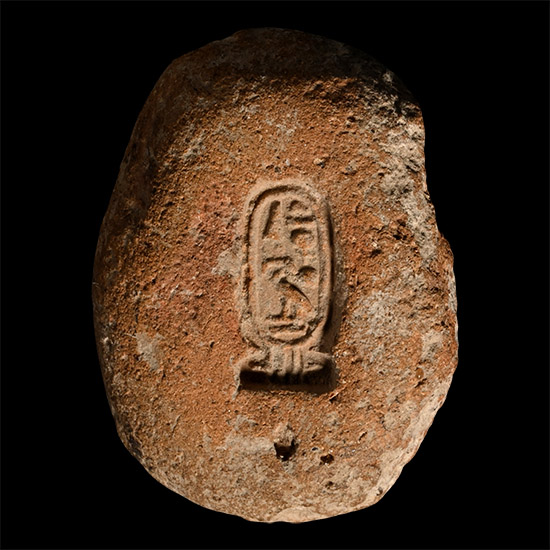
Egyptian Terracotta Mould with Impression of the Cartouche of Pharaoh Akhenaten
New Kingdom, 18th Dynasty, Amarna Period, 1379-1362 B.C.Estimate: £400 - 600 (+bp*)
Bids: 1 | Current Bid: £5
Oblate type with incuse cartouche of Akhenaten. 4.96 grams, 27 mm
Acquired 7th February 1962, for 5 shillings. From the private collection of Peter Clayton, FCILIP, Dip, Arch, FSA, FRNS, Hemel Hempstead, Hertfordshire, UK; formed since the late 1950s. Accompanied by an old handwritten information card by Peter Clayton, collection no.87.
This mould was probably used to produce a jewellery element, an inlay, or an amulet. -
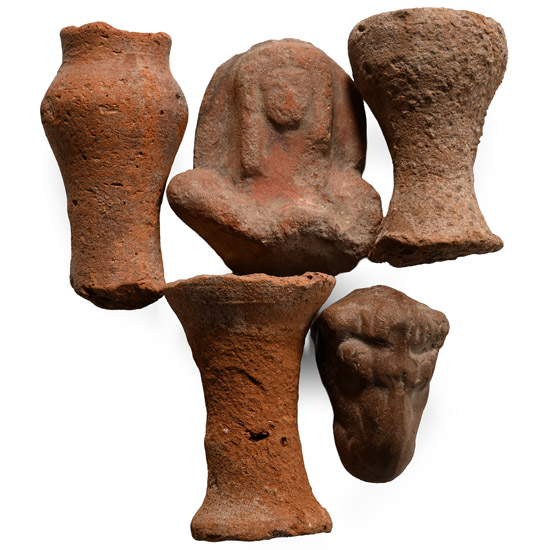
Romano-Egyptian Pottery Artefact Collection
Roman Period, 30 B.C.-323 A.D.Estimate: £50 - 70 (+bp*)
Opening Bid: £5
Including a moulded mummiform bust, a camel's head and pottery items. 200 grams total, 46-67 mm
From the private collection of Peter Clayton, FCILIP, Dip, Arch, FSA, FRNS, Hemel Hempstead, Hertfordshire, UK; formed since the late 1950s.
