
Ancient Art, Antiquities, Books, Natural History, Stamps & Coins

-
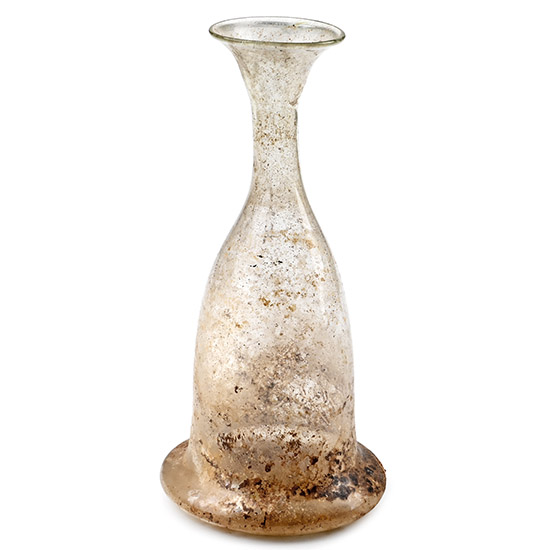
Roman Transluscent Glass Wide Bottomed Bottle
Circa 1st-4th century A.D.Estimate: £200 - 300 (+bp*)
Opening Bid: £100
With a wide discoid base, conical body with slender neck and expanding rim; old label reading 'Weachler's Gallery 690'. 30.5 grams, 13.7 cm
From the private collection of Lloyd and Jeanne Raport, Washinton D.C. and Florida, formed between 1972-2000. Estate auction, Weschlers, Maryland, 10 June 1984, lot 690. -
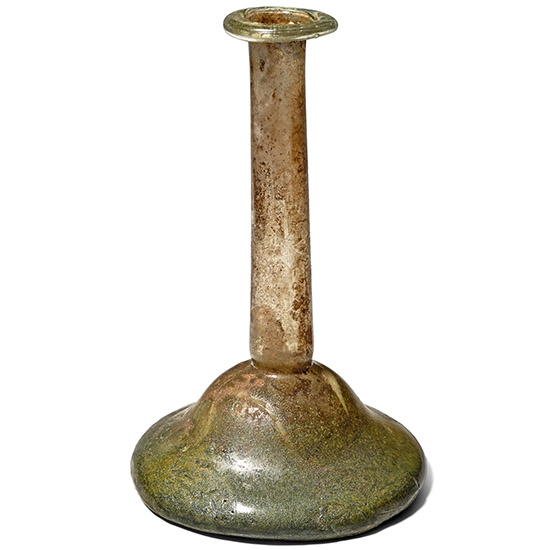
Large Roman Green Glass Candlestick Unguentarium
Circa 2nd-3rd century A.D.Estimate: £80 - 100 (+bp*)
Opening Bid: £5
With a low bell-shaped body, a tall, pinched neck, and a flared and rolled rim to the mouth. 56.4 grams, 16 cm
Ex London, UK, collection, 1990s. -
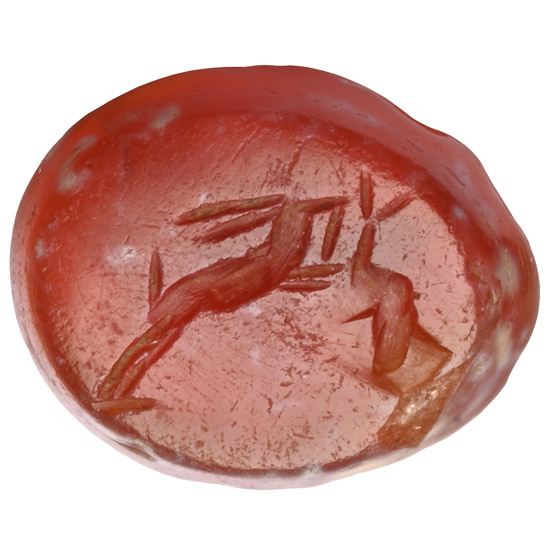
Roman Carnelian Gemstone with Leaping Rabbit
2nd-3rd century A.D. or laterEstimate: £120 - 170 (+bp*)
Opening Bid: £5
Ellipsoid in plan with intaglio profile leaping animal; chipped; supplied with an impression. 1.27 grams, 15 mm
From the private collection of a European gentleman (1942-2024), formed since the 1970s. -
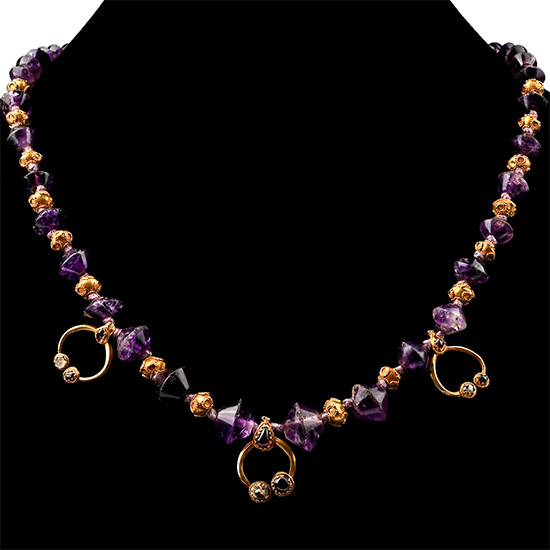
Roman Amethyst, Gold and Garnet Bead Necklace
1st-3rd century A.D.Estimate: £3,000 - 4,000 (+bp*)
Opening Bid: £1,500
Restrung group of graduated biconical amethyst beads with gold interstitial beads with granulation detailing, three crescent pendants, each with a cabochon gemstone to each of the finials. Cf. Christie's, 13 December 2013, no.297. 51 grams, 52 cm
From the collection of former Italian Ambassador Carlo Perrone-Capano. The majority of this collection was established during his period in office in Damascus during the 1960s. His later life was spent near Grantham, and his collection was disposed of by his descendants at Golding Young Chartered Auctioneers & Valuers, Arts & Antiques Surveyors. Christie’s, New York, 11 December 2009, no.401. This lot has been checked against the Interpol Database of stolen works of art and is accompanied by search certificate number no.13123-248087.
Amethyst was widely used in Graeco-Roman Egypt. We know that the amethyst mines of Abu Diyeiba, near Semna, were in use from the time of Ptolemy VI through to the Roman era. Pliny says that Indian amethysts were the best, but he also refers to amethysts from Egypt. The Egyptian amethysts are typically flawed and of a pale, almost pink, hue. They were seldom set in gold and were most usually made into beads. Ptolemaic and Roman inscriptions and artefacts have been found at amethyst mines in Egypt’s eastern deserts. -
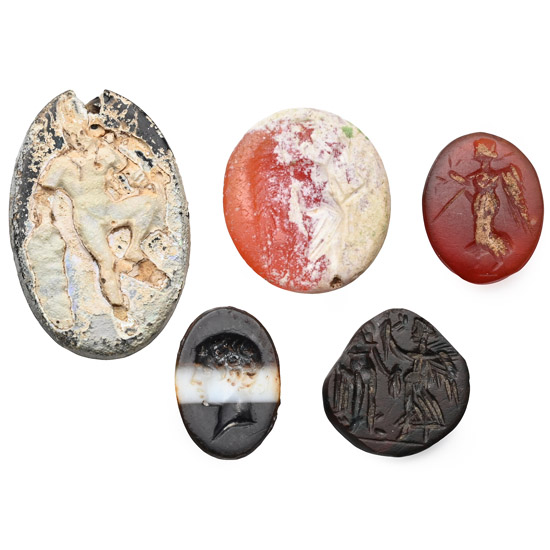
Roman Carved Gemstone Collection
1st-3rd century A.D.Estimate: £300 - 400 (+bp*)
Bids: 1 | Current Bid: £5
Comprising: a banded agate intaglio with profile male bust; a red carnelian intaglio with winged Victory; an orange carnelian intaglio with winged Victory; a glass intaglio with a nude figure resting his hand on a boulder; a round intaglio with Victory and another figure. 1.91 grams total, 8-17 mm
UK private collection assembled 1970s-90s, and thence to the liquidated state of above. -
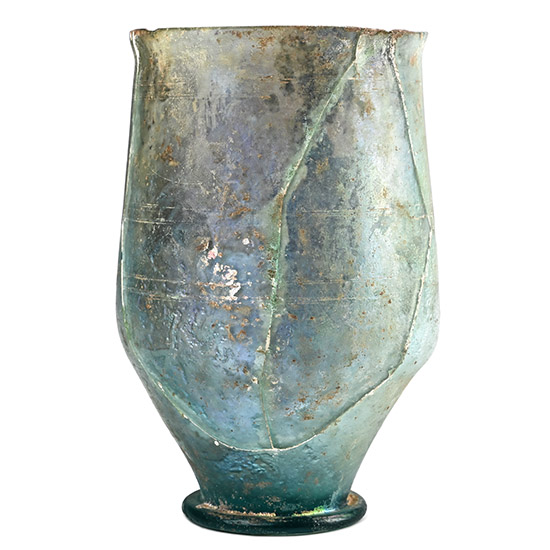
Roman Iridescent Glass Beaker
Circa 1st-2nd century A.D.Estimate: £100 - 140 (+bp*)
Opening Bid: £5
Conical body with pontil base, slightly flared rim; repaired. 94 grams, 10.7 cm
From the collection of Dr. Gerhard Muller-Afers, Speyer; thence by family descent. Private collection, Europe, acquired from the above. -
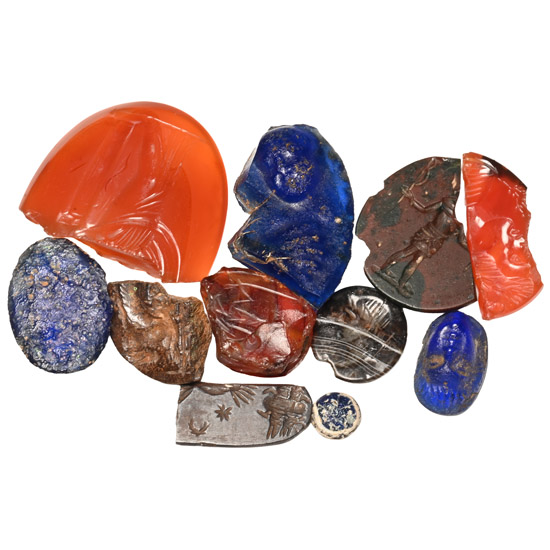
Roman Stone and Glass Gem Collection
2nd-3rd century A.D. or laterEstimate: £120 - 170 (+bp*)
Opening Bid: £5
Including profile female bust, standing figure with pedestal or altar, bearded head in three-quarter view and other types; some supplied with a museum-quality impression. 15.17 grams total, 5-24 mm
From the private collection of a European gentleman (1942-2024), formed since the 1970s. -
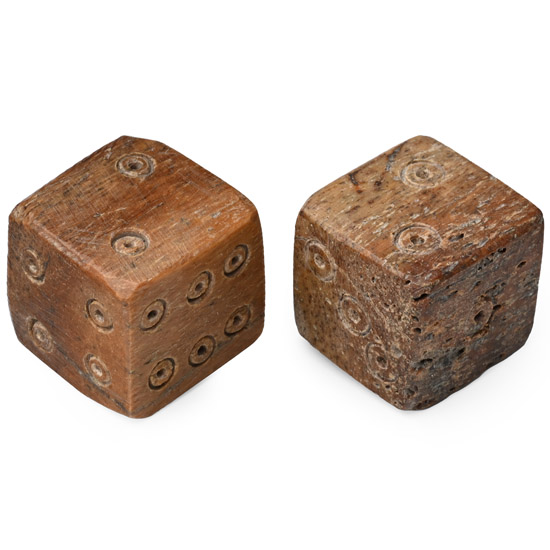
Roman Bone Gaming Dice Pair
Circa 1st-4th century A.D.Estimate: £80 - 100 (+bp*)
Opening Bid: £5
Comprising two cuboid dice with ring-and-dot markings disposed 1:6, 2:5, 3:4. 6.6 grams total, 12 mm each
Ex German art market, 2000s. Acquired from an EU collector living in London. From the collection of a Surrey, UK, gentleman. -
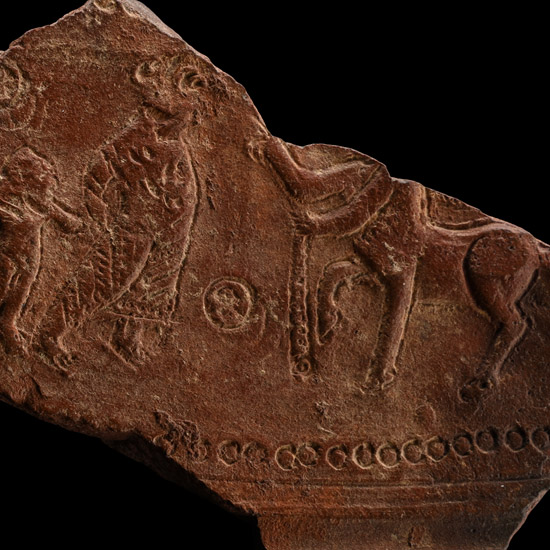
Roman Redware Vessel Sherd with Centaur Scene
Circa 4th century A.D.Estimate: £60 - 80 (+bp*)
Opening Bid: £5
Fragment of a vessel with rouletting and corrugations, low-relief frieze depicting a small child led by the hand by an advancing figure in a large cloak, towards a centaur holding a staff; rosettes in the field and band of pellets below; old collector's label to reverse 'Young Achilles with his mother, Thetis, taken to centaur Chiron to school'. 85 grams, 95 mm
From the private collection of Peter Clayton, FCILIP, Dip, Arch, FSA, FRNS, Hemel Hempstead, Hertfordshire, UK; formed since the late 1950s. -
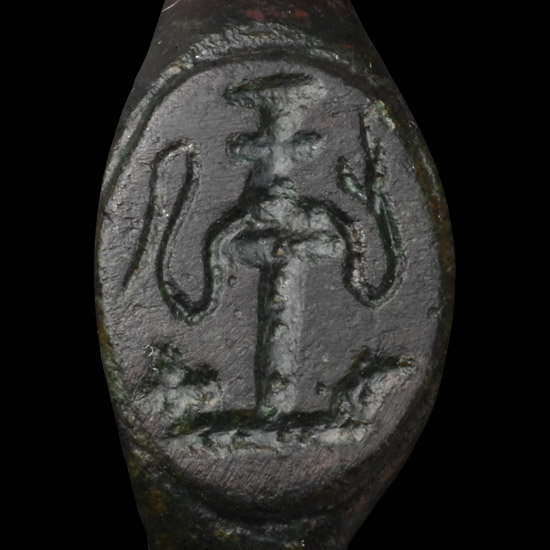
Late Roman Bronze Ring with Serpent on a Pedestal
5th-6th century A.D.Estimate: £150 - 200 (+bp*)
Opening Bid: £5
D-section hoop expanding towards the shoulders, ellipsoid bezel with a snake draped over an altar. 4.63 grams, 23.46 mm overall, 17.53 x 13.46 mm internal diameter (approximate size British H, USA 3 3/4, Europe 6.18, Japan 6)
Previously with Richard Trescott, London, UK. Acquired on UK art market in the 1990s. Property of a Middlesex gentleman. -
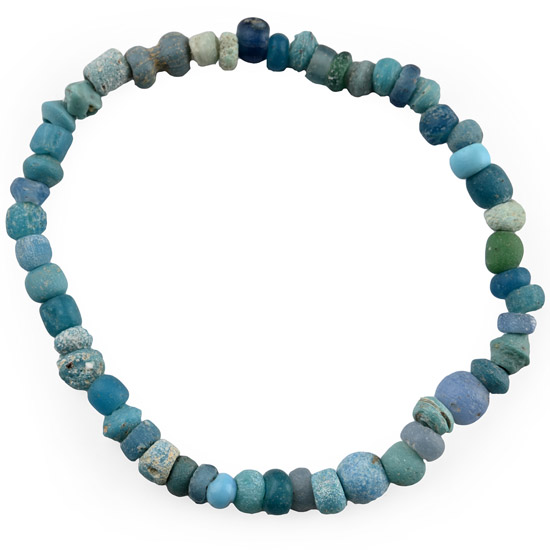
Roman Light Blue Glass Bead Bracelet
Circa 1st-4th century A.D.Estimate: £50 - 70 (+bp*)
Opening Bid: £5
Composed mainly of oblate beads, restrung with an elasticated string. 6 grams, 16 cm
Ex Ancient Art Shop, Windsor, UK, 1990s. Ex private collection. -
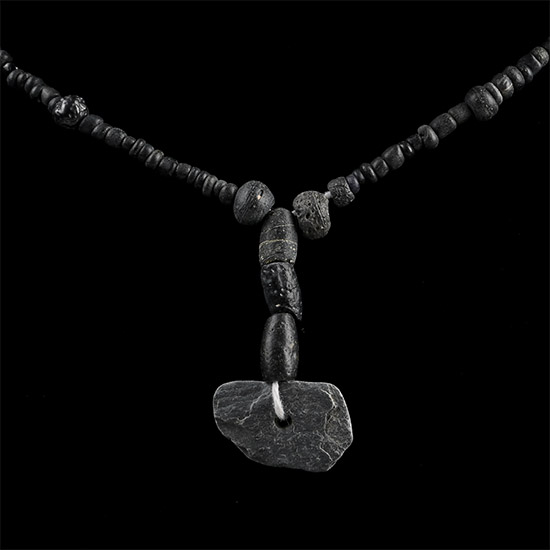
Roman and Other Black Glass Bead Necklace String
1st-4th century A.D. and laterEstimate: £50 - 70 (+bp*)
Opening Bid: £5
Composed of oblate, annular, and other beads with a large discoid stone pendant, restrung. 10.55 grams, 33.5 cm
Ex London, UK, collection, 1990s.
