
Ancient Art, Antiquities, Books, Natural History, Stamps & Coins

-
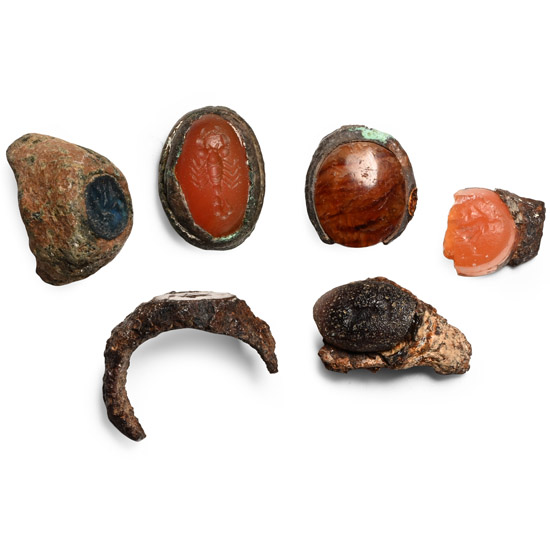
Roman Bronze and Iron Ring Bezel Group
2nd-3rd century A.D. or laterEstimate: £120 - 170 (+bp*)
Bids: 1 | Current Bid: £5
Including inset cloison with butterfly, cabochon with scorpion, similar with running deer and other types. 15.3 grams total, 11-21 mm
From the private collection of a European gentleman (1942-2024), formed since the 1970s. -
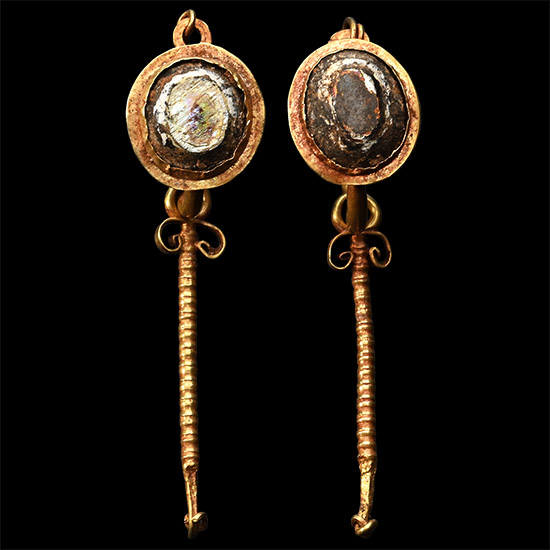
Roman Gold Earring Pair
Circa 1st-2nd century A.D.Estimate: £700 - 900 (+bp*)
Opening Bid: £350
Matched pair, each comprising an oval plaque with raised bezel with glass insert, round-section tear-shaped hoop with hook-and-eye closure, tubular dangle with ribbed body and coiled ends. 3.07 grams total, 43 mm each
London gentleman's collection, 1970-1990s, by descent. -
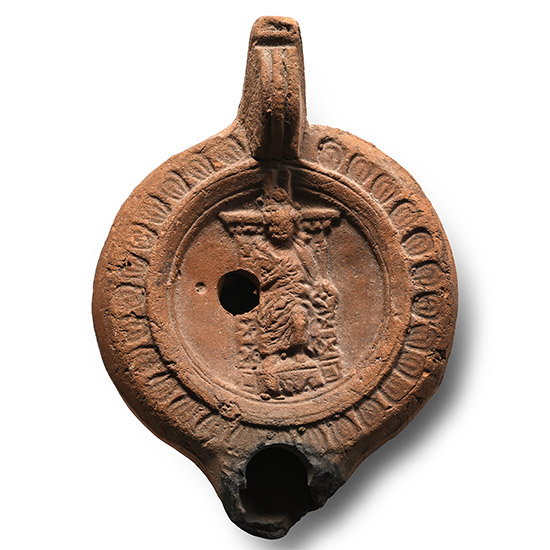
Roman Terracotta Oil Lamp with Figure with Bushel Maker's Mark
2nd century A.D.Estimate: £50 - 70 (+bp*)
Opening Bid: £5
Squat in profile with small handle and D-shaped nozzle (broken), shoulder with radiating egg motifs, discus with low-relief facing togate figure on a throne; impressed bushel motif to underside. 64.8 grams, 92 mm
From the private collection of Peter Clayton, FCILIP, Dip, Arch, FSA, FRNS, Hemel Hempstead, Hertfordshire, UK; formed since the late 1950s. -
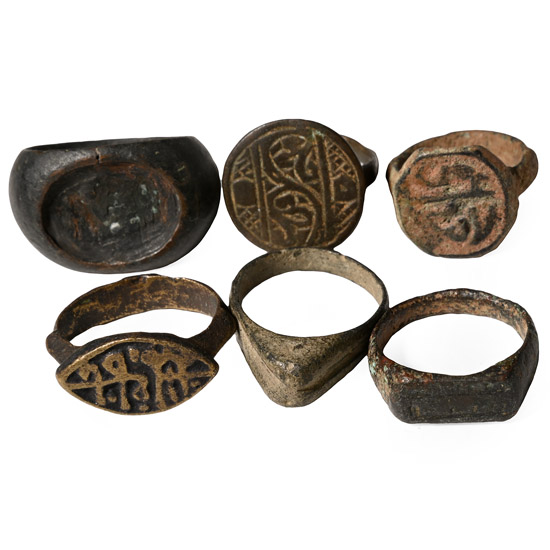
Roman to Medieval Bronze Ring Collection
1st-16th century A.D.Estimate: £80 - 100 (+bp*)
Opening Bid: £5
Including disc bezel with reserved foliage, octagonal bezel with reserved script on an enamelled field, conical bezel with lateral slots and other types. 37.8 grams total, 19-27 mm
From the private collection of a European gentleman (1942-2024), formed since the 1970s. -
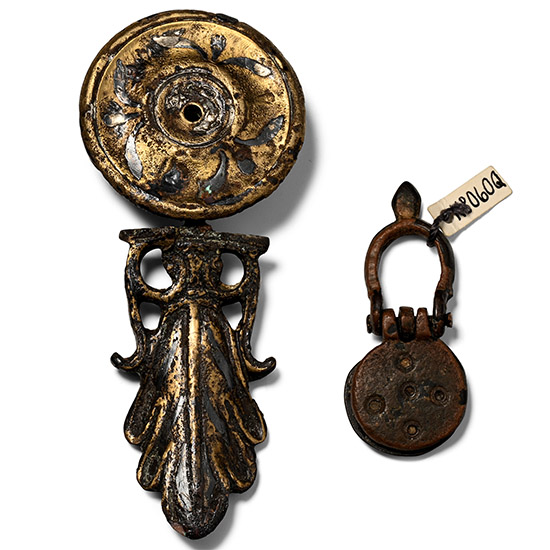
Roman Gilt Bronze Phalera and Seal Capsule
Mid-1st century A.D. and laterEstimate: £400 - 600 (+bp*)
Opening Bid: £5
Comprising: a hinged phalera composed of a niello-decorated gilt boss with a leaf design, a later restored double eyelet on the reverse and a hinged openwork palmette-shaped plate, likely from a horse harness; a hinged seal capsule depicting a cat and a horseman with five ring-and-dot motifs on the outer faces, loop above. 45 grams total, 43-81 mm
The Ernst and Marthe Kofler-Truniger Collection (1903-1990 & 1918-1999), Lucerne (Inv.Nos.K8060Q and K8065J). Swiss private collection, Lucerne, acquired from the above circa 1974. By inheritance in the same Swiss family, Lucerne. -
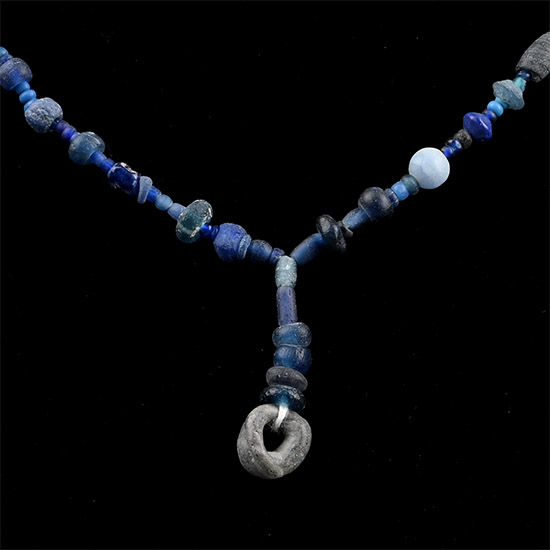
Roman and Other Dark Blue Glass Bead Necklace String
1st-4th century A.D. and laterEstimate: £50 - 70 (+bp*)
Opening Bid: £5
Composed of small annular and oblate beads interspersed with larger oblate and other beads, the central feature a larger doughnut-shaped bead, restrung. 8.88 grams, 33 cm
Ex London, UK, collection, 1990s. -
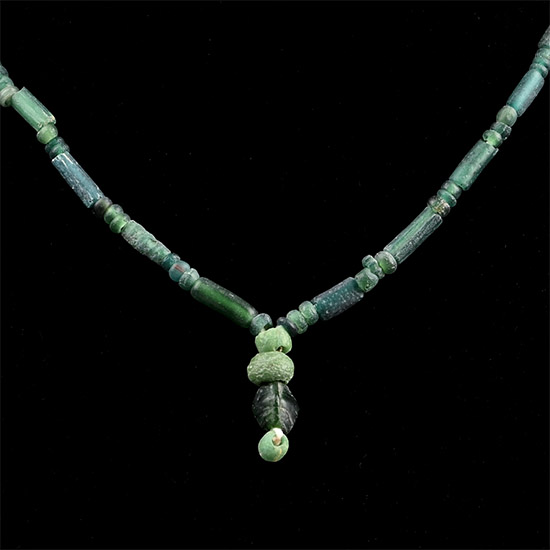
Roman and Other Emerald Green Glass Bead Necklace String
1st-4th century A.D. and laterEstimate: £50 - 70 (+bp*)
Opening Bid: £5
Composed of tubular and oblate beads with a bead drop as the central feature, restrung. 10.53 grams, 36.3 cm
Ex London, UK, collection, 1990s. -
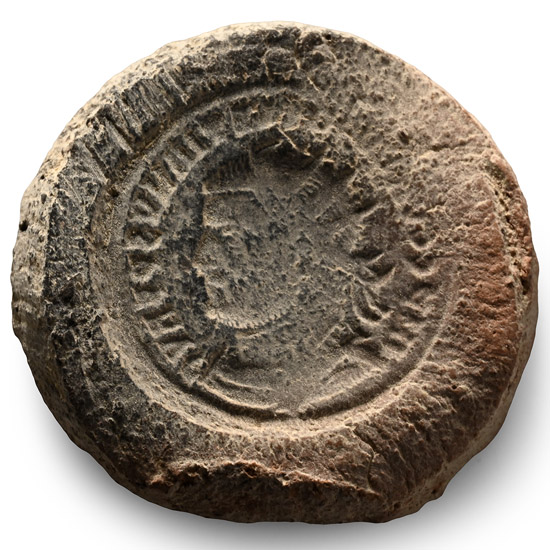
Roman Terracotta Coin Forger's Mould
Circa 3rd-4th century A.D.Estimate: £50 - 70 (+bp*)
Opening Bid: £5
Discoid clay mould with an impressed design of a coin on each face. 5.26 grams, 27 mm
London gentleman's collection, 1970-1990s, by descent. -
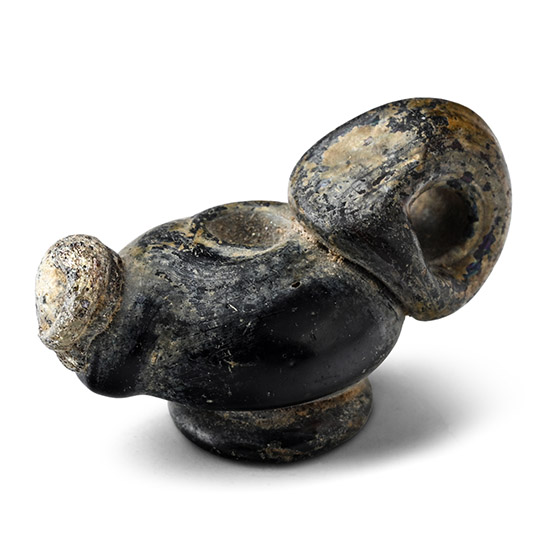
Roman Ceramic Miniature Oil Lamp Pendant
1st-4th century A.D.Estimate: £100 - 140 (+bp*)
Opening Bid: £50
Formed as a small oil lamp with a loop handle to the rear. 3.85 grams, 25 mm
Ex the private collection of the late Mr S.M., London, UK, 1970s-1990s. -
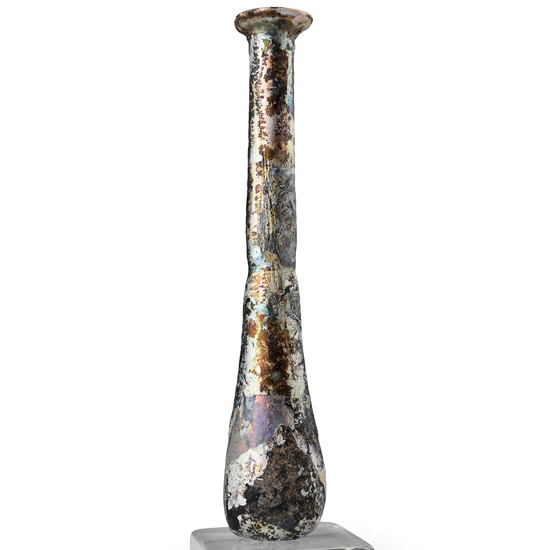
Roman Translucent Glass Unguentarium
Circa 1st-2nd century A.D.Estimate: £80 - 100 (+bp*)
Opening Bid: £5
With piriform lower body, extended cylindrical neck and rolled flange rim; mounted on a custom-made stand. 56.8 grams total, glass:14 cm (15 cm including stand)
From the private collection of Lloyd and Jeanne Raport, Washinton D.C. and Florida, formed between 1972-2000. Estate auction, Weschlers, Maryland, 1985, lot 250. -
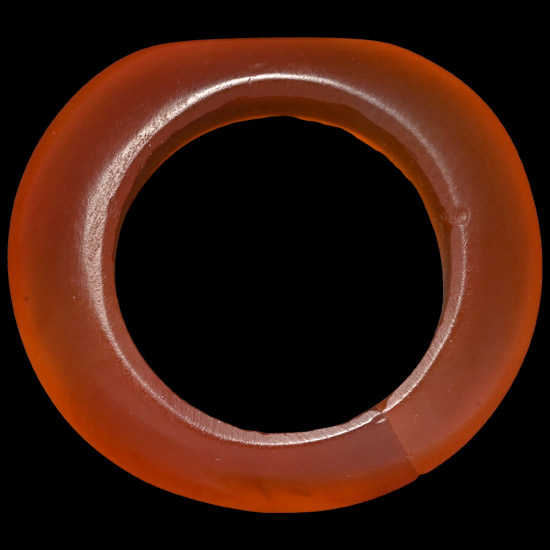
Roman Carved and Polished Carnelian Ring
1st-4th century A.D. or laterEstimate: £40 - 60 (+bp*)
Opening Bid: £5
D-section hoop and a flat bezel; repaired. 2.89 grams, 24.74 mm overall, 15.24 mm internal diameter (approximate size British I 1/2, USA 4 1/2, Europe 8.07, Japan 7)
From the private collection of a European gentleman (1942-2024), formed since the 1970s. -
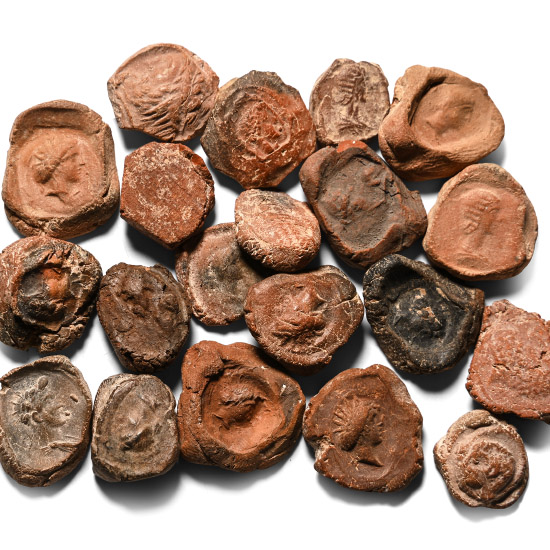
Roman Terracotta Bullae, Tesserae or Token Group
1st-3rd century A.D.Estimate: £100 - 140 (+bp*)
Opening Bid: £5
A mixed group of ceramic bullae, tesserae or theatre tokens bearing low-relief motifs, mainly consisting of profile busts of deities. 30.8 grams total, 14-21 mm
From the private collection of a European gentleman (1942-2024), formed since the 1970s.
The term 'tessera' was used in Roman times to convey the Greek term σύμβολον (token). Small tiles are known as tokens, often shaped like coins, made of metal (copper, lead, iron), clay, bone, wood, or glass, stamped as well as engraved. The tokens, however, are not exclusively coin-shaped, as the Latin term 'tessera' suggests by etymologically referring to a square or at least a four-sided shape and confirmed in several cases by material remains of the past. Tokens and tesserae seem to have been used both in Athens and Rome for the distribution of goods. According to written sources, the term token is identified with credentials of the official authorities. They have also been interpreted as tokens of identity, as entrance tickets to theatre performances, tribunals or assemblies of citizens, archival material of seal engraving, as pawns in games, Charon’s obols and even as amulets.
