
Ancient Art, Antiquities, Books, Natural History, Stamps & Coins

-
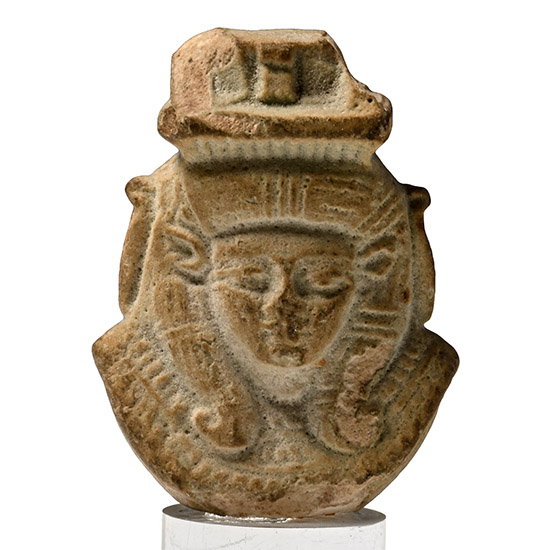
Egyptian Green Glazed Faience Head of the Goddess Hathor from a Sistrum
Late Period, 26th Dynasty, circa 600-700 B.C.Estimate: £300 - 400 (+bp*)
Bids: 1 | Current Bid: £5
Bifacial bust of Hathor, depicted as a woman's head with cow ears, wearing a heavy wig with curled lappet ends and uraei on either side, mounted on a custom-made stand. 18.7 grams total, 49 mm including stand
Acquired from Caledonian market, 16th March 1962, for 5 shillings. From the private collection of Peter Clayton, FCILIP, Dip, Arch, FSA, FRNS, Hemel Hempstead, Hertfordshire, UK; formed since the late 1950s. Accompanied by an old handwritten information card by Peter Clayton, collection no.92.
This carefully modelled fragment is undoubtedly from a sistrum, a musical instrument often played during Hathoric rituals and festivals. -
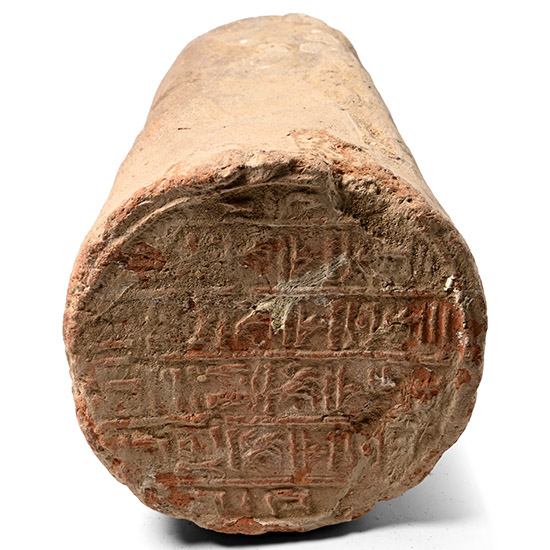
Egyptian Terracotta Funerary Cone of Minnakht
New Kingdom, mid-18th Dynasty, circa 1450-1350 B.C.Estimate: £300 - 400 (+bp*)
Bids: 2 | Current Bid: £25
Large portion of a tapering cone, with the circular flat end impressed with six columns of hieroglyphic text reading: 'The Osiris, wab-priest, lector-priest of Mut, Minnakht, wab-priest who goes ahead, god's father of Mut, Minnakht, scribe of the divine book(s) of Mut, Minnakht, the Osiris, scribe of the divine offerings of Mut, Minnakht, true of voice.' 323 grams, 10 cm
Acquired from Abdoul Rassoul on the West Bank at Luxor, 1974-1980 when a guest lecturer. From the private collection of Peter Clayton, FCILIP, Dip, Arch, FSA, FRNS, Hemel Hempstead, Hertfordshire, UK; formed since the late 1950s.
Although Minnakht's tomb has yet to be identified in the Theban necropolis, his funerary cones have long been known. Some details of his career are known from a unique block statue in the Cairo Museum (inv. no. CG 624/JE 27585), which includes important funerary religious texts (El Gabry, D., Journal of Egyptian Archaeology, 110, no. 1-2, 2024, pp. 131-149). -
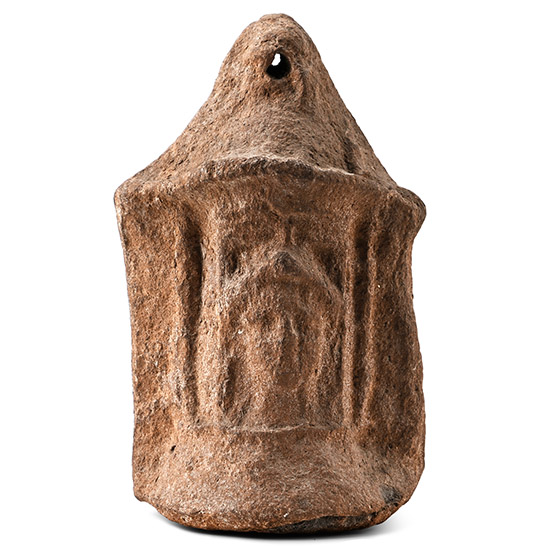
Graeco-Egyptian Terracotta Hanging Shrine with Face of Athena
Roman Period, circa 2nd-3rd century A.D.Estimate: £200 - 300 (+bp*)
Bids: 1 | Current Bid: £5
Tubular type with the facing head of Athena on the obverse, void on the reverse. 158 grams, 11.2 cm
Ex E.B.W. Chapplelow collection, January 1958. Certificate of antiquity no.668 of Blanchard's Egyptian Museum, Cairo. From the private collection of Peter Clayton, FCILIP, Dip, Arch, FSA, FRNS, Hemel Hempstead, Hertfordshire, UK; formed since the late 1950s. Accompanied by an old handwritten information card by Peter Clayton, collection no.14.
Hanging shrine-like terracottas often served as lanterns for nighttime lamp festivals of the syncretic Romano-Egyptian goddess Athena-Neith, as shown in this example by the large, possibly soot-stained, opening at the back. This object type is characteristic of the so-called 'Fayum terracottas', as large numbers of terracotta figurines were recovered from the Fayum Oasis. -
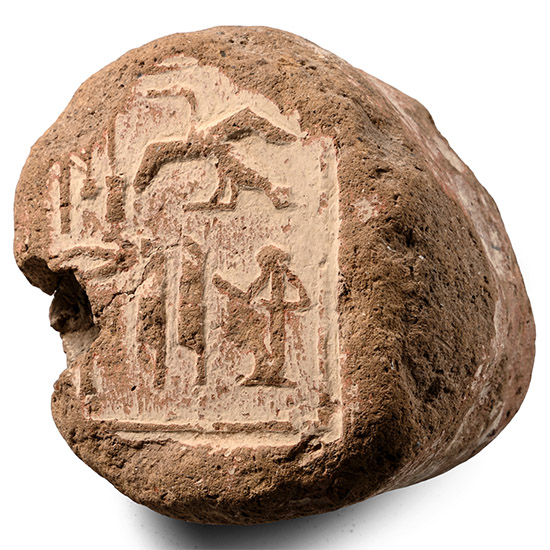
Egyptian Terracotta Funerary Cone for Paroy
New Kingdom, 18th Dynasty, circa late 15th-early 14th century B.C.Estimate: £200 - 300 (+bp*)
Bids: 2 | Current Bid: £25
Front portion of a tapering cone with the circular flat end impressed with a square-bordered design consisting of two short horizontal lines of inscription, reading: 'Scribe, Paroy'. 240 grmas, 75 mm
Acquired from Abdoul Rassoul on the West Bank at Luxor, 1974-1980 when a guest lecturer. From the private collection of Peter Clayton, FCILIP, Dip, Arch, FSA, FRNS, Hemel Hempstead, Hertfordshire, UK; formed since the late 1950s.
It is suggested that this cone comes from the Theban tomb of Thutmose, also known as Paroy (TT 295). However, the titles of the latter individual (Head of the Secrets in the Chest of Anubis, Sem-priest in the Good House, and Embalmer) differ from those of the person named on this cone. -
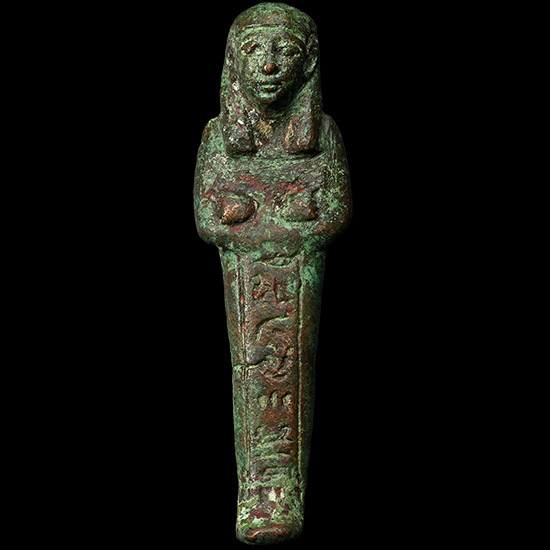
Egyptian Bronze Shabti for General Wendjebauendjed
Third Intermediate Period, 21st Dynasty, circa 1047-1001 B.C.Estimate: £500 - 700 (+bp*)
Bids: 2 | Current Bid: £10
Mummiform figure wearing a plain tripartite wig, with crossed arms and prominently modelled hands, and a vertical panel of hieroglyphs on the front reading: 'The Osiris, the General Wendjebauendjed, true of voice'. 68.9 grams, 78 mm
From the private collection of Peter Clayton, FCILIP, Dip, Arch, FSA, FRNS, Hemel Hempstead, Hertfordshire, UK; formed since the late 1950s.
Shabtis made of bronze are uncommon. Ramesses II and Ramesses III were the first pharaohs to use bronze shabtis, a practice Pharaoh Psusennes I reestablished in the 21st Dynasty. In addition to Psusennes I, bronze shabtis were produced for Queen Mutnedjemet, his sister and wife, and for General Wendjebauendjed, who was buried in the same royal hypogeum at Tanis. The exact number of shabtis provided for the general remains unknown, though he had at least twenty mummiform and one overseer shabti in bronze, and many more in faience. -
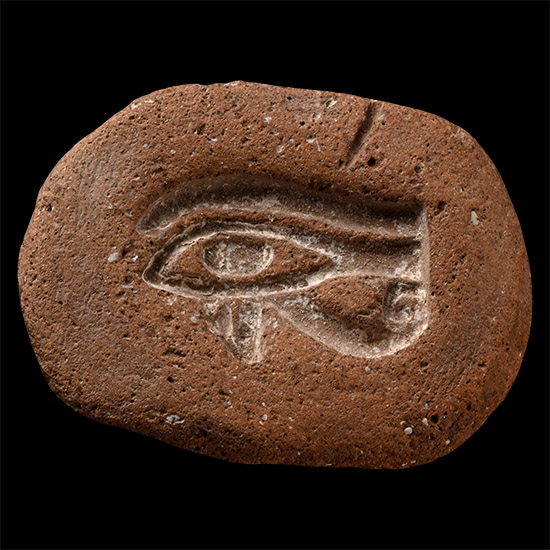
Egyptian Terracotta Mould for a Wedjat Eye
New Kingdom, 18th Dynasty, Amarna Period, 1379-1362 B.C.Estimate: £50 - 70 (+bp*)
Bids: 2 | Current Bid: £16
Oblate terracotta mould with an impression of the 'eye of Horus' (wedjat) on one side, accompanied by an old collector's record card detailing findspot, place of purchase and other details. 8.8 grams, 36 mm
Acquired in March 1977. From the private collection of Peter Clayton, FCILIP, Dip, Arch, FSA, FRNS, Hemel Hempstead, Hertfordshire, UK; formed since the late 1950s. Accompanied by an old handwritten information card by Peter Clayton, collection no.127.
Moulds like this example were used to cast metal or faience items. When used for faience, traces of white paste often appear in the mould, suggesting that this example was used to produce faience wedjat eyes. -
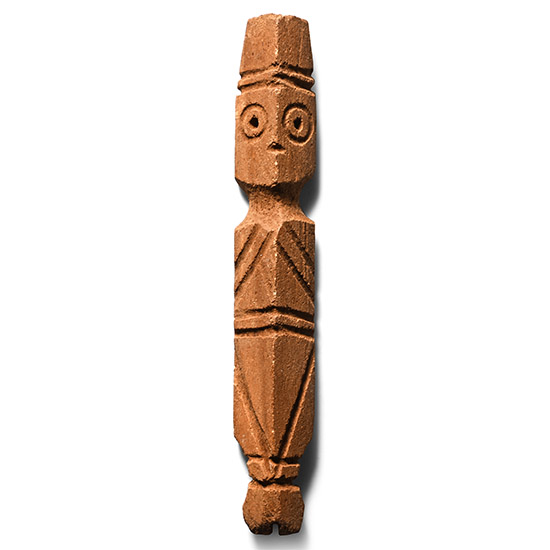
Coptic Carved Bone Doll
Circa 4th-7th century A.D.Estimate: £50 - 70 (+bp*)
Opening Bid: £5
Plano-convex in section with carinated upper face, incised linear and drilled detailing. 6.9 grams, 83 mm
From the private collection of Peter Clayton, FCILIP, Dip, Arch, FSA, FRNS, Hemel Hempstead, Hertfordshire, UK; formed since the late 1950s. -
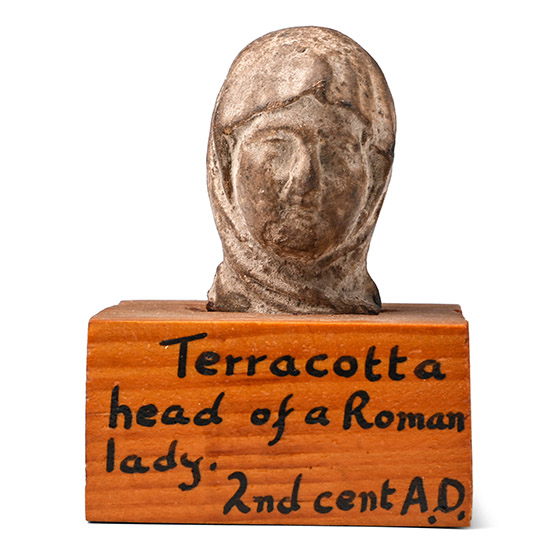
Egyptian Terracotta Head of a Roman Lady
Hellenistic Period, circa 3rd-2nd century B.C.Estimate: £100 - 140 (+bp*)
Opening Bid: £5
Depicting the cloth-wrapped head of a lady, mounted on a wooden stand. 40.9 grams total, 51 mm including stand
Acquired from High Street, Herne Bay, circa June 1957, for £1.00. Certificate of antiquity no.668 of Blanchard's Egyptian Museum, Cairo. From the private collection of Peter Clayton, FCILIP, Dip, Arch, FSA, FRNS, Hemel Hempstead, Hertfordshire, UK; formed since the late 1950s. Accompanied by an old handwritten information card by Peter Clayton, collection no.11.
This head comes from a draped female figure, known as the Tanagra-type, often wearing elegant himations (cloaks) and wide-brimmed hats (tholia), or holding accessories such as fans, wreaths, and mirrors. -
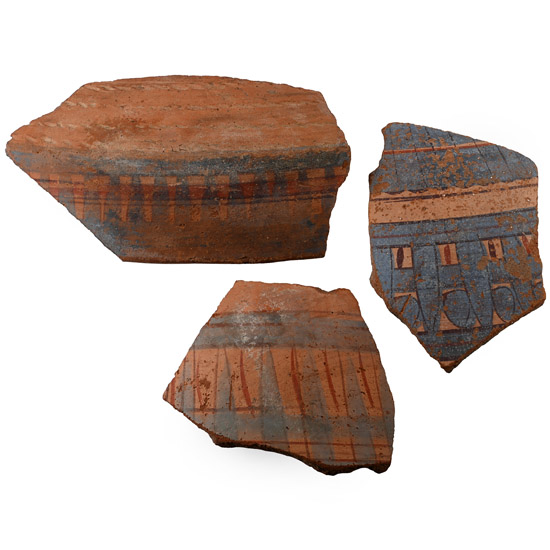
Large Egyptian Painted Bowl Fragments
New Kingdom, 18th Dynasty, Amarna Period, 1379-1362 B.C.Estimate: £80 - 100 (+bp*)
Bids: 1 | Current Bid: £5
Three fragments from three highly decorated blue-painted vessels. 545 grams total, 11.5-18 cm
Acquired in February 1978. From the private collection of Peter Clayton, FCILIP, Dip, Arch, FSA, FRNS, Hemel Hempstead, Hertfordshire, UK; formed since the late 1950s. Accompanied by an old handwritten information card by Peter Clayton, collection no.140.
The distinctive blue colour on these pottery fragments came from a cobalt-and-aluminium slip that reacted during firing. -
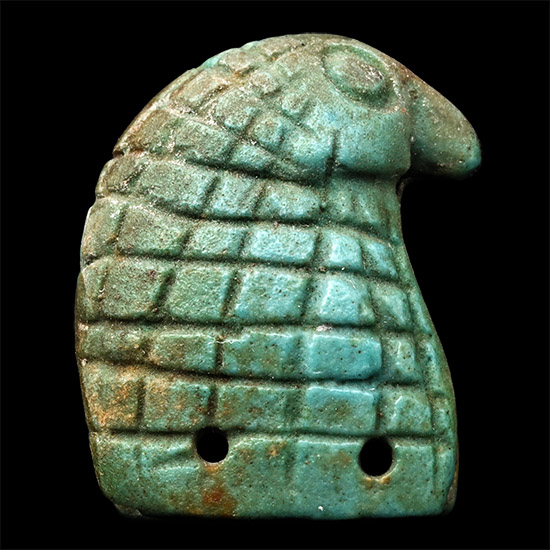
Egyptian Green Glazed Faience Qebehsenuef Attachment
Late-Ptolemaic Period, 664-30 B.C.Estimate: £100 - 140 (+bp*)
Bids: 1 | Current Bid: £5
Highly stylised head of the falcon god Qebehsenuef, one of the Four Sons of Horus, with incised feather decoration to the front, flat-backed, with two holes for attachment. 5.45 grams, 25 mm
From the private collection of Peter Clayton, FCILIP, Dip, Arch, FSA, FRNS, Hemel Hempstead, Hertfordshire, UK; formed since the late 1950s.
This amulet was likely attached to a visceral package or sewn onto mummy bandages. Qebehsenuef protected the intestines. -
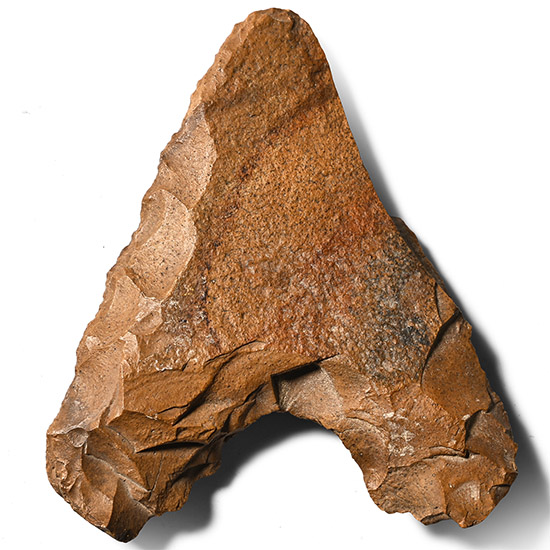
'Saqqara' Egyptian Stone Age Knapped Spearhead
Neolithic Period, circa 6,000 B.P.Estimate: £50 - 70 (+bp*)
Opening Bid: £5
Triangular in plan with swept barbs to the rear edge; marked 'Near Great Pyramid 1912' and 'G[.]RRA'. 59.5 grams, 84 mm
Found near the Great Pyramid, Saqqara, Egypt, 1912. Acquired from Sotheby's, 16 June 1959 (part), £4.10. From the private collection of Peter Clayton, FCILIP, Dip, Arch, FSA, FRNS, Hemel Hempstead, Hertfordshire, UK; formed since the late 1950s. Accompanied by a copy of an old handwritten identification card written by Peter Clayton. -
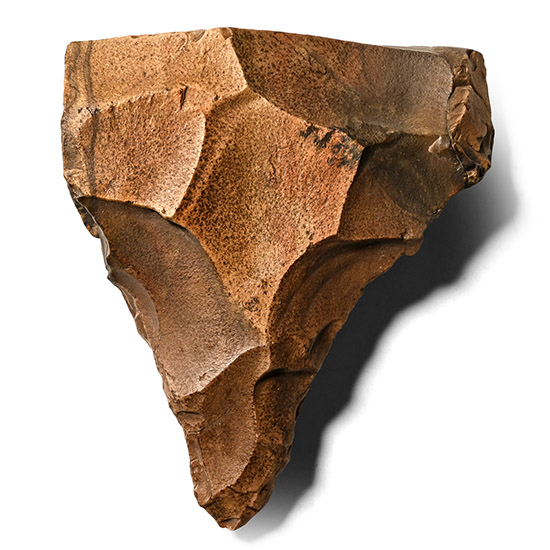
'Saqqara' Egyptian Stone Age Knapped Boring Tool
Neolithic Period, circa 6,000 B.P.Estimate: £50 - 70 (+bp*)
Bids: 1 | Current Bid: £5
Triangular in plan with flat butt; inked 'Step Pyramid Sakkara' findspot. 90 grams, 83 mm
Found near the Step Pyramid, Saqqara, Egypt. Acquired from Sotheby's, 16 June 1959 (part), £4.10. From the private collection of Peter Clayton, FCILIP, Dip, Arch, FSA, FRNS, Hemel Hempstead, Hertfordshire, UK; formed since the late 1950s. Accompanied by a copy of an old handwritten identification card written by Peter Clayton.
