
Ancient Art, Antiquities, Books, Natural History, Stamps & Coins

-
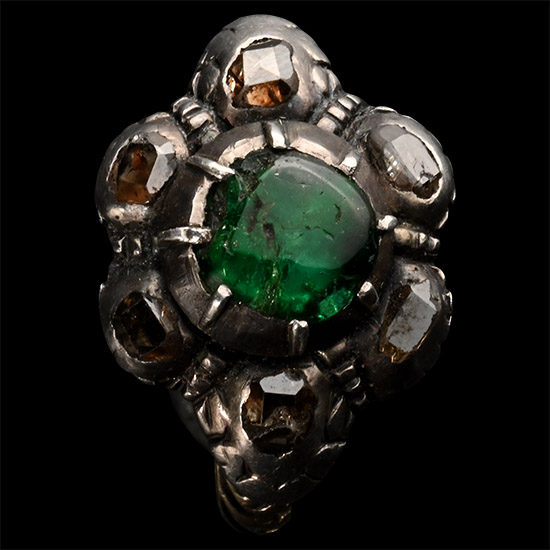
Baroque Gold and Silver Diamond and Emerald Ring
Spain, late 17th century A.D.Estimate: £1,500 - 2,000 (+bp*)
Opening Bid: £750
Comprising a silver cluster bezel centred by an emerald cabochon and surrounded by diamonds, the reverse of the bezel enamelled with white and black enamel, and the setting resting on an engraved gold hoop with remains of black enamel. 4.79 grams, 22.25 mm overall, 15.89 x 14.78 mm internal diameter (approximate size British I 1/2, USA 4 1/2, Europe 8.07, Japan 7)
Acquired on the European art market. UK, private collection. -
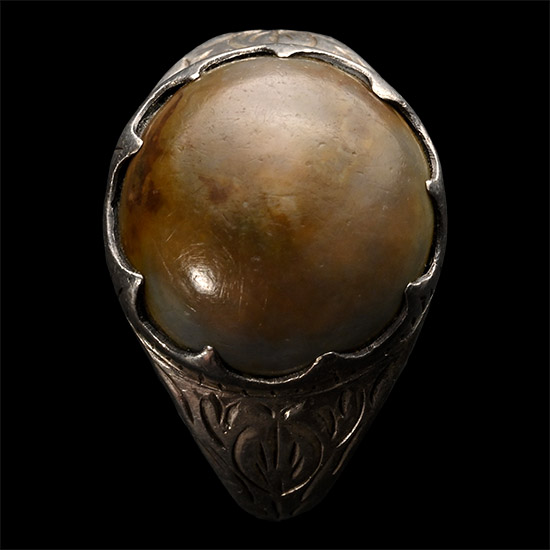
Renaissance Silver Amuletic Toadstone Ring
Western Europe, 16th-17th century A.D.Estimate: £2,000 - 3,000 (+bp*)
Opening Bid: £1,000
Substantial ring set with engraved foliate decoration on the shoulders, set with a large rounded toadstone in a lobed bezel. 9.93 grams, 30.39 mm overall, 20.34 x 19.41 mm internal diameter (approximate size British T, USA 9 1/2, Europe 21.26, Japan 20)
Acquired on the European art market. UK, private collection. This lot has been checked against the Interpol Database of stolen works of art and is accompanied by search certificate no.13490-263465.
Toadstones are fossil fish teeth historically credited with protective properties, particularly the ability to detect or counteract poison. -
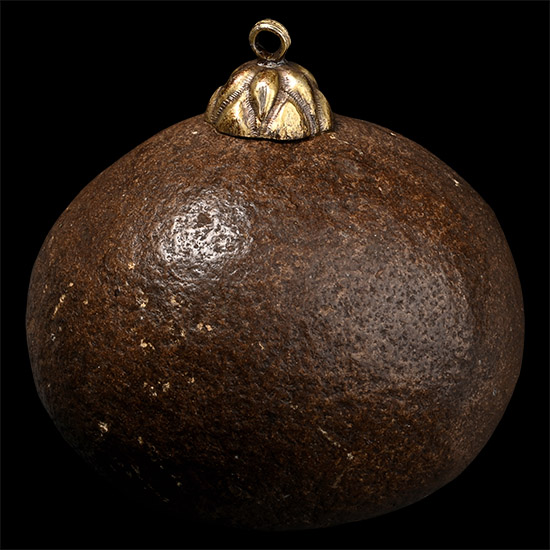
Bezoar with Silver-Gilt Suspension Mount
Circa 17th-18th century A.D.Estimate: £2,000 - 3,000 (+bp*)
Opening Bid: £1,000
Dark brown, rounded bezoar with a granular surface, fitted with a domed silver-gilt cap and circular suspension loop, the cap decorated with pointed leaves, their outlines and central veins defined against textured grounds. 74 grams, 80 mm
Acquired on the European art market. UK, private collection. This lot has been checked against the Interpol Database of stolen works of art and is accompanied by search certificate no.13478-263372.
Bezoars were valued in European and Asian medicinal traditions for their supposed ability to counteract poison. Natural examples are concretions formed around indigestible material within the digestive systems of animals. Their historical reputation is reflected in the name, derived from the Persian p ādzahr, meaning “antidote”. During the early modern period, bezoars were furnished with precious-metal caps, cages and containers. Mounted examples could be worn as protective pendants, suspended for medicinal use, or preserved among the natural specimens and costly objects assembled in cabinets of curiosities. The present leaf-decorated cap belongs to this tradition of combining a valued specimen with ornamental metalwork. Surviving comparisons include a 17th-century brown bezoar pendant in a silver mount at the London Museum and an 18th-century silver-mounted example in the Museo Nacional de Ciencias Naturales, Madrid. These documents the continued use of silver mounts for bezoars across both centuries and provide the historical setting for the present example. -
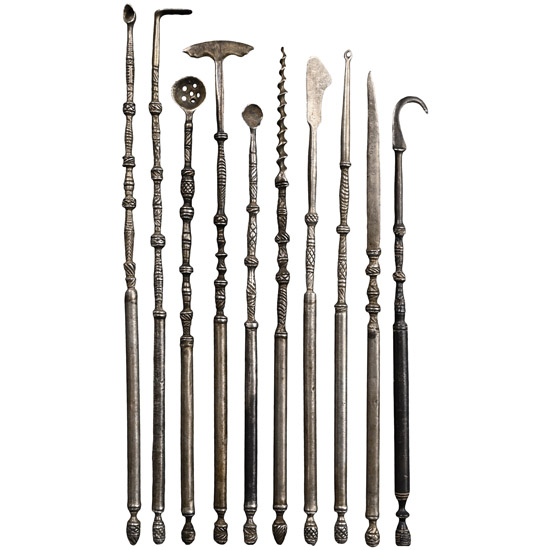
Post Medieval Silver Instrument Collection
Circa 18th century A.D.Estimate: £600 - 800 (+bp*)
Bids: 7 | Current Bid: £55
Assemblage of non-medical instruments, each with a balustered shank and knop finial; hook, narrow blade, pierced spoon, probe, scoop, corkscrew and other types; possibly for apothecary, culinary or artistic use. 195 grams total, 15.5-18.8 cm
Acquired at auction in Geneva or Basel circa 1989. From the private collection of a Swiss gentleman collector, thence by decent 2018. -
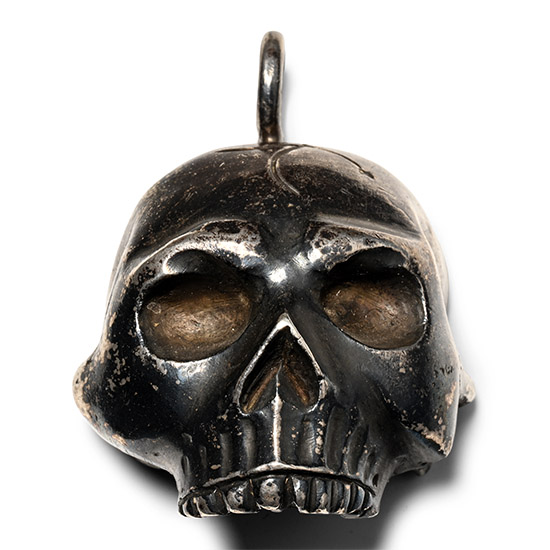
Post Medieval Silver Skull Pendant
20th century A.D.Estimate: £600 - 800 (+bp*)
Opening Bid: £300
Modelled in the three-quarter view with hollow eye sockets and nasal cavity, detailed upper teeth and a large suspension loop on the top. 50.3 grams, 50 mm
Acquired on the European art market. UK, private collection. -
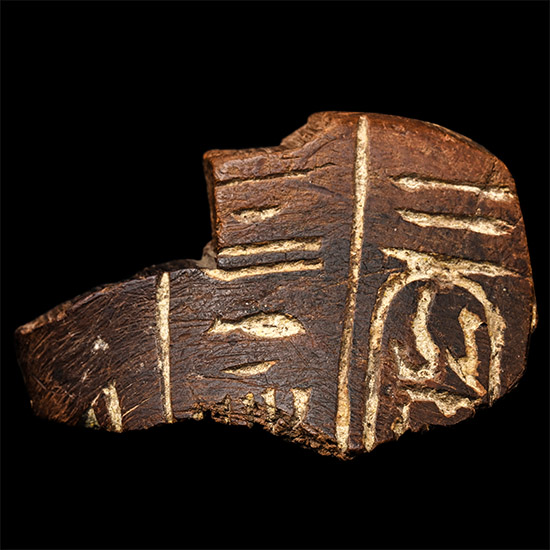
Egyptian Fragment from a Wooden Shabti of Pharaoh Amenhotep III
New Kingdom, 18th Dynasty, 1386-1349 B.C.Estimate: £100 - 140 (+bp*)
Bids: 1 | Current Bid: £5
Fragment of chocolate-coloured wood with incised hieroglyphs inlaid with white paste, preserving the lower part of a cartouche containing Amenhotep III's birth name, with the epithet "Ruler of Thebes" still legible, and two fragmentary columns of hieroglyphs to the right, belonging to a version of the shabti spell. 8.41 grams, 42 mm
From the private collection of Peter Clayton, FCILIP, Dip, Arch, FSA, FRNS, Hemel Hempstead, Hertfordshire, UK; formed since the late 1950s.
Amenhotep III was buried at Thebes in the Valley of the Kings (tomb KV22). His funerary equipment included shabtis in various hardstones and wood. The preserved text, ...ḫnt sḏm.t[n]... ('...forefront; and when you hear...'), belongs to a less common variant of the shabti spell found on other examples of Amenhotep III's shabtis. -
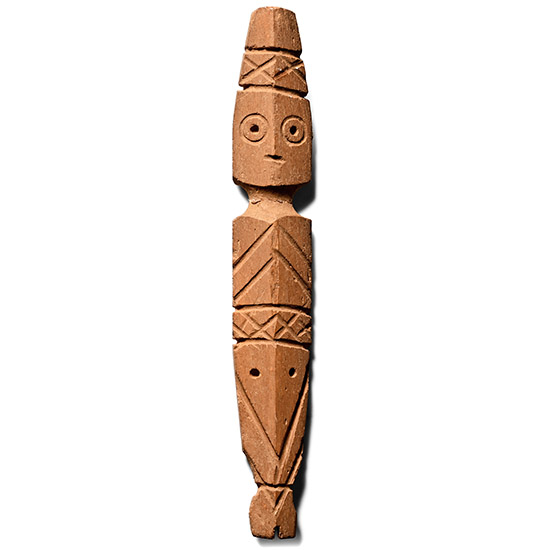
Coptic Carved Bone Doll
Circa 4th-7th century A.D.Estimate: £60 - 80 (+bp*)
Bids: 2 | Current Bid: £15
Plano-convex in section with carinated upper face, incised linear and drilled detailing. 7.92 grams, 10.3 cm
From the private collection of Peter Clayton, FCILIP, Dip, Arch, FSA, FRNS, Hemel Hempstead, Hertfordshire, UK; formed since the late 1950s. -
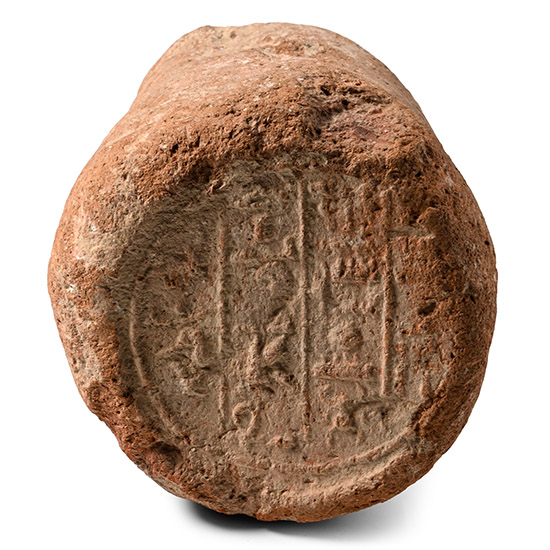
Egyptian Terracotta Funerary Cone of Menkheperreseneb
New Kingdom, 18th Dynasty, 15th century B.C.Estimate: £400 - 600 (+bp*)
Bids: 4 | Current Bid: £150
Front portion of a tapering funerary cone, with the circular flat surface impressed with four vertical columns of hieroglyphs, reading: 'The Osiris, hereditary prince, count, chancellor of the king of Lower Egypt, first god's servant of Amun, Menkheperreseneb, true of voice.' 554 grams, 10.4 cm
Acquired from Abdoul Rassoul on the West Bank at Luxor, 1974-1980 when a guest lecturer. From the private collection of Peter Clayton, FCILIP, Dip, Arch, FSA, FRNS, Hemel Hempstead, Hertfordshire, UK; formed since the late 1950s.
Menkheperreseneb served under the 18th Dynasty pharaoh Thutmosis III. His tomb (TT 86) is in the Theban necropolis at Sheikh Abd el-Qurna. -
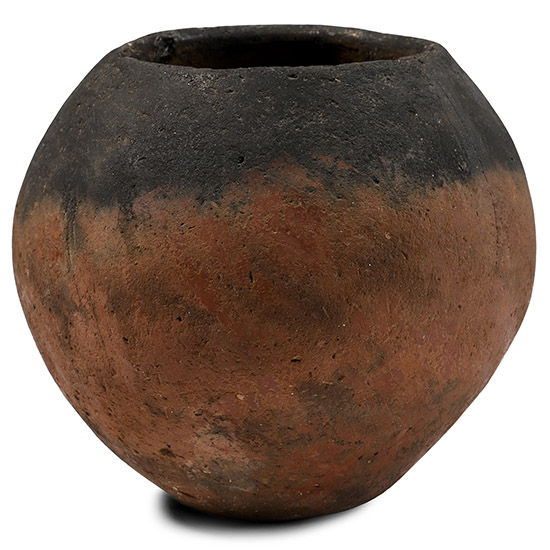
Egyptian Black-Topped Vase
Predynastic Period, Naqada II, circa 4000 B.C.Estimate: £300 - 400 (+bp*)
Bids: 3 | Current Bid: £95
Squat, spherical black-topped storage vase with a flattened base; old collector's ticket: 'Small predynastic Egyptian pot. Round form, flat bottom, usual black top and red body. From Naqada, c. 4000 B.C. Richardson St. Christopher's Mail(?), 27/10/61'. 391 grams, 10.5 cm
From the private collection of Peter Clayton, FCILIP, Dip, Arch, FSA, FRNS, Hemel Hempstead, Hertfordshire, UK; formed since the late 1950s. Accompanied by an old handwritten identification card written by Peter Clayton.
This decorative style's distinctive appearance came from an open-fire or pit-firing method in which the vessel was inverted into ash, organic matter, or smoke-heavy fuel. The buried or inverted top was starved of oxygen and turned black, while the exposed lower portion oxidised to red. -
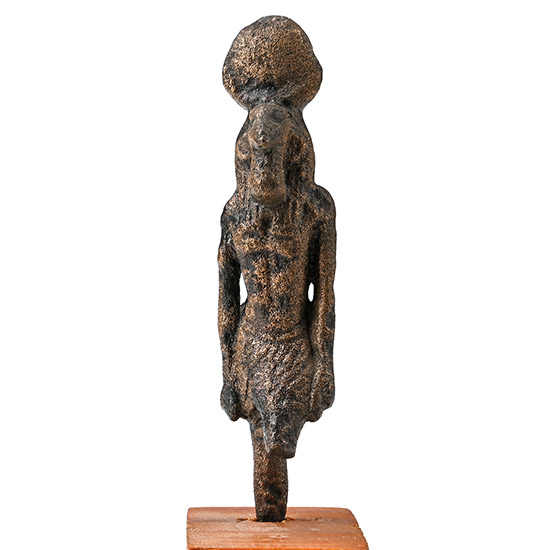
Egyptian Bronze Figure of the God Thoth
Late Period, circa 664-332 B.C.Estimate: £80 - 100 (+bp*)
Bids: 2 | Current Bid: £15
Modelled in the round in advancing pose with ibis head and sun-disc headdress, loop to rear, lower legs absent, display stand; restored in the Institute of Archaeology laboratory. 32.8 grams total, 80 mm including stand
Acquired from Caledonian market, January 1960, for 4 shillings. From the private collection of Peter Clayton, FCILIP, Dip, Arch, FSA, FRNS, Hemel Hempstead, Hertfordshire, UK; formed since the late 1950s. Accompanied by an old handwritten information card by Peter Clayton, collection no.90. -
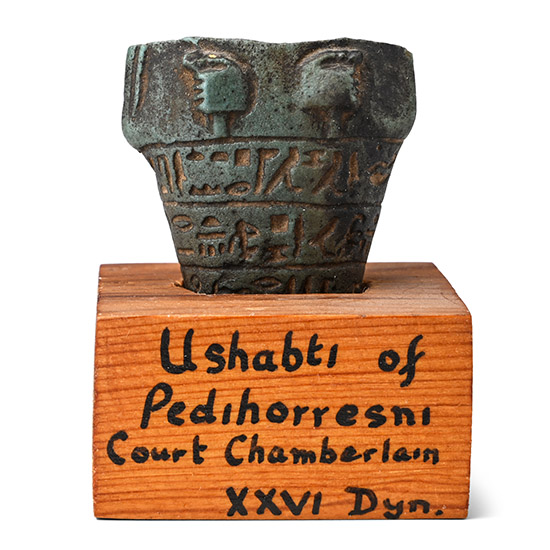
Egyptian Green Stone Shabti Fragment of Padihorresnet, Chief Steward of Amun
Late Period, Reign of Necho, 26th Dynasty, 609-593 B.C.Estimate: £100 - 140 (+bp*)
Bids: 1 | Current Bid: £5
Upper torso fragment with crossed hands, horizontal bands of hieroglyphic text to back and front, display stand with legend 'Ushabti of Pedihorresni, Court Chamberlain XXVI Dyn.'; son of Akhanenru. 30.6 grmas total, 48 mm including stand
Acquired Portabello Road, 14 December 1957, for 5 shillings. From the private collection of Peter Clayton, FCILIP, Dip, Arch, FSA, FRNS, Hemel Hempstead, Hertfordshire, UK; formed since the late 1950s. Accompanied by an old handwritten information card by Peter Clayton, collection no.5.
Padihorresnet served as the chief steward of the God’s Wife of Amun, Nitokris, during the reign of Necho. His monumental tomb (TT 196) is in the Asasif necropolis at Thebes alongside other high officials of the early 26th Dynasty. Padihorresnet's hardstone shabtis lack a back pillar, linking them more closely to the previous 25th Dynasty than to those of the 26th. -
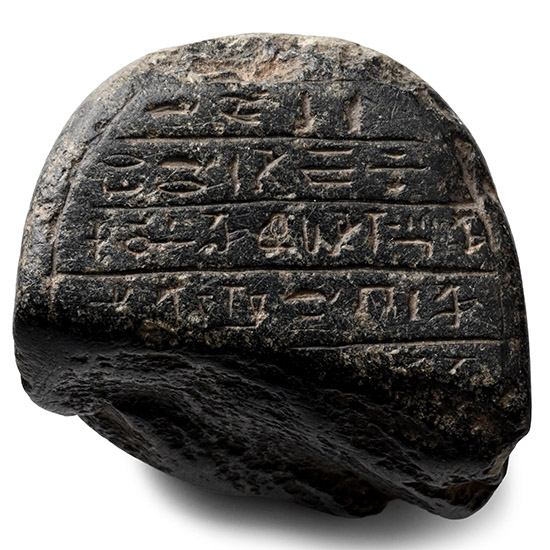
Large Egyptian Black Stone Heart Scarab Fragment
New Kingdom, 1580-1077 B.C.Estimate: £300 - 400 (+bp*)
Bids: 3 | Current Bid: £25
Upper half modelled as a scarab beetle with midlegs and hindlegs, and plain elytra separated from the prothorax by double border lines; the underside bearing five lines of hieroglyphic inscription. 70 grams, 45 mm
From the private collection of Peter Clayton, FCILIP, Dip, Arch, FSA, FRNS, Hemel Hempstead, Hertfordshire, UK; formed since the late 1950s.
The hieroglyphic text presents the final part of Chapter 30b of the Book of the Dead, a spell designed to prevent the deceased's heart from betraying them during the Weighing of the Heart judgment before Osiris.
