-
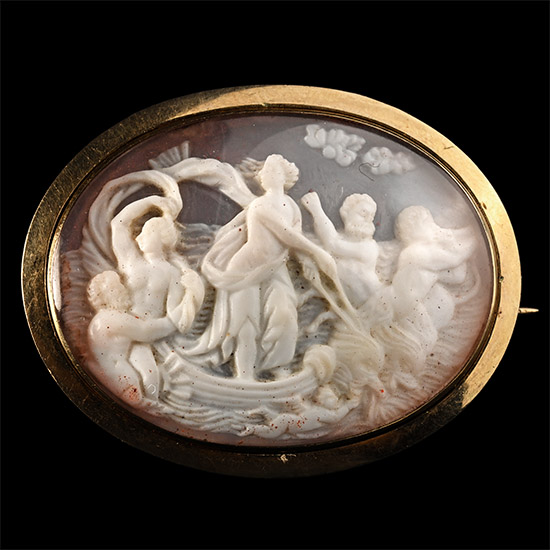
Renaissance Shell Cameo of the Triumph of Galatea, after Raphael, in a Later Gold Brooch
Circa 1530–1560 A.D.Estimate: £1,800 - 2,400 (+bp*)
Opening Bid: £900
An oval cameo carved in high relief in shell, with opaque white figures against a pale greylilac ground, depicting the Triumph of Galatea, the composition centring on the partially draped sea nymph standing in a shell-shaped marine chariot, surrounded by a closely arranged procession of Tritons, Nereids and fantastic sea creatures, on the left, a marine figure and companion incorporated among the curling drapery and sea forms; immediately to the right of Galatea a prominently modelled bearded Triton, while a further male marine figure projecting forwards at the far right, the curved, ribbed vehicle beneath the principal figure represents her shell chariot; the small forms in the upper field may represent remnants of the airborne putti included in the engraved compositions; the cameo enclosed beneath a high convex glass cover in a plain gold brooch mount, a narrow bezel around the oval perimeter, and a long projecting brooch pin, the gold mount probably British, early 19th century. 11.6 grams, 40 mm
Acquired on the European art market. UK, private collection. This lot has been checked against the Interpol Database of stolen works of art and is accompanied by search certificate no.13507-263384.
The subject derives from Raphael’s Triumph of Galatea, painted for Agostino Chigi at the Villa Farnesina in Rome around 1512. Raphael represented Galatea amid a marine procession of Tritons and Nereids, combining classical imagery with a treatment of the subject associated with Angelo Poliziano’s Stanze per la Giostra. The composition was rapidly disseminated through prints, which made it available to artists and craftsmen working beyond Rome. Uffizi Galleries, The Triumph of Galatea. The Royal Collection preserves an Italian cameo, dated to the late 16th century, depicting a putto in a shell-shaped chariot drawn through the waves by a Triton carrying a Nereid. That cameo was subsequently placed in an 18th-century mount. It provides a related example for both Renaissance marine imagery and the later mounting of an earlier carving as a jewel. Royal Collection Trust, Putto, Triton and Nereid, RCIN 43770. The present cameo combines an ambitious multifigure relief with a composition derived from Raphael’s Galatea and its engraved adaptations. -
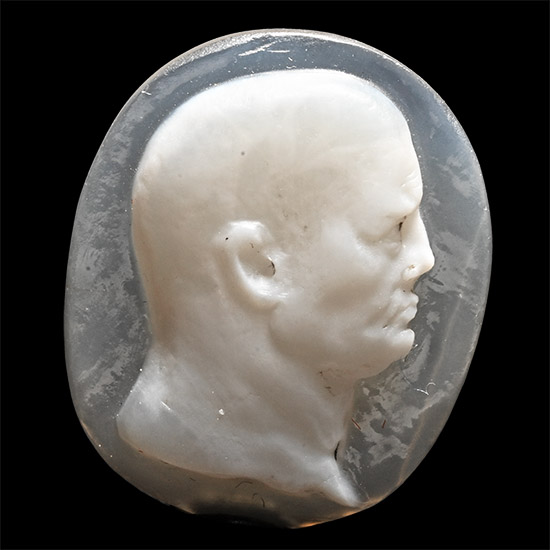
Renaissance Agate Cameo with Male Portrait
16th century A.D.Estimate: £700 - 900 (+bp*)
Opening Bid: £350
Translucent oval cameo with a mature male bust with short hair and deep frown lines on his forehead, stern expression, likely depicting an emperor or a ruler, possibly after Vespasian or Titus models. 1.16 grams, 17 mm
Private collection, London. -
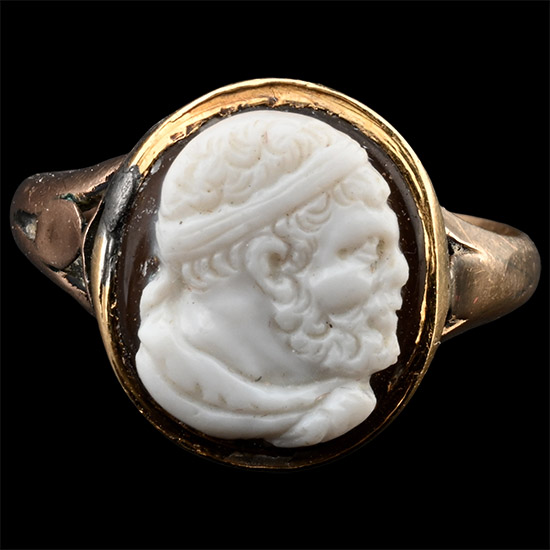
Renaissance Sardonyx Cameo of a Bearded Man in a Later Gold Ring
Probably Europe, circa 16th century A.D.Estimate: £800 - 1,000 (+bp*)
Opening Bid: £400
An oval cameo carved in high relief with the right-facing profile bust of a bearded man wearing a broad fillet or headband, a prominent nose, curled hair and a closely worked beard; the carving using the pale upper layer of the stone for the head and bust, contrasting with the darker ground beneath; set in a later, probably 19th-century, gold ring with a plain oval bezel, tapering shoulders and an openwork underside. 2.27 grams, 20.71 mm overall, 15.61 x 15.46 mm internal diameter (approximate size British I 1/2, USA 4 1/2, Europe 8.07, Japan 7)
Acquired on the European art market. UK, private collection. -
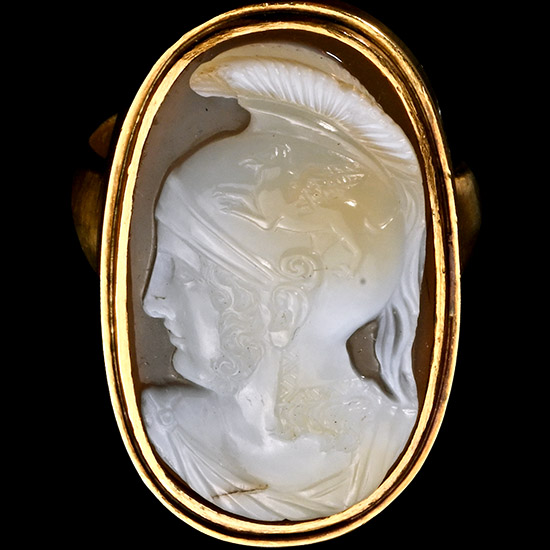
Post Medieval Agate Cameo of a Greek Warrior in Gold Ring
Italy, early 19th century A.D.Estimate: £1,200 - 1,700 (+bp*)
Opening Bid: £600
Carved in high relief with the profile bust of a helmetted Greek warrior, the helmet with a prominent crest, and a leaping gryphon on the side; set within a later ring mount. 13.12 grams, 27.95 mm overall, 17.07 mm internal diameter (approximate size British M 1/2, USA 6 1/4, Europe 13.09, Japan 12)
Acquired on the European art market. UK, private collection. -
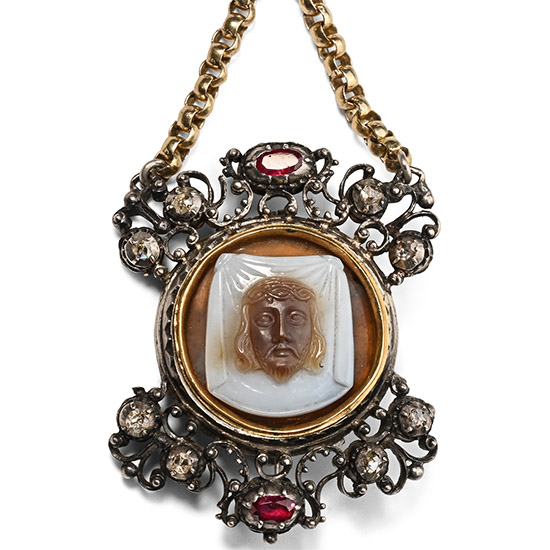
Sardonyx Cameo of Veronica’s Veil in an Eighteenth-Century Pendant
Cameo 17th century A.D.; pendant 18th century A.D.Estimate: £4,000 - 6,000 (+bp*)
Opening Bid: £2,222
Circular cameo depicting the face of Christ wearing the crown of thorns, appearing at the centre of a veil; set in an openwork silver frame with a gold collar surrounding the cameo; the elaborate frame with rose-cut diamonds and rubies in rub-over settings; a pin on the reverse and a later set chain with a suspension loop above for suspension. 13.14 grams, 67 mm long
Acquired on the European art market. UK, private collection. This lot has been checked against the Interpol Database of stolen works of art and is accompanied by search certificate no.13508-263389.
The Veil of Veronica is a sacred Christian relic said to bear the miraculous, unpainted image of the face of Jesus Christ. -
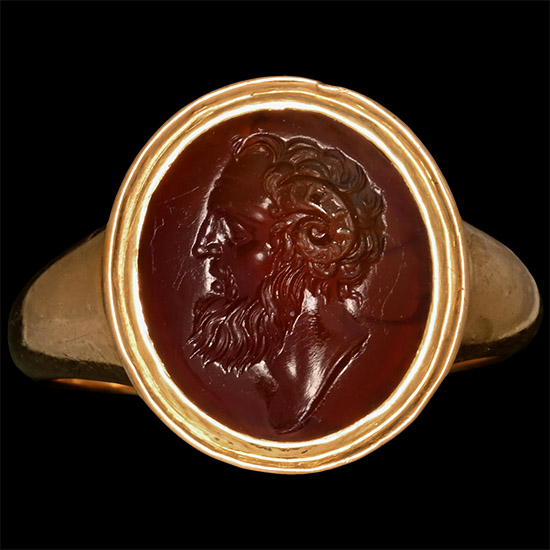
Post Medival Gold Ring with a Carnelian Intaglio of Jupiter Ammon
Circa 19th century A.D.Estimate: £1,500 - 2,000 (+bp*)
Opening Bid: £750
D-section hoop set with an oval carnelian intaglio depicting the mature bearded head of Jupiter Ammon in profile, the face framed by curled hair and a substantial beard, the curling ram’s horn around the ear, the deity’s distinguishing attribute. 4.41 grams, 20.20 mm overall, 16.59 x 15.14 mm internal diameter (approximate size British L 1/2, USA 6, Europe 11.87, Japan 11)
Acquired on the European art market. UK, private collection. -
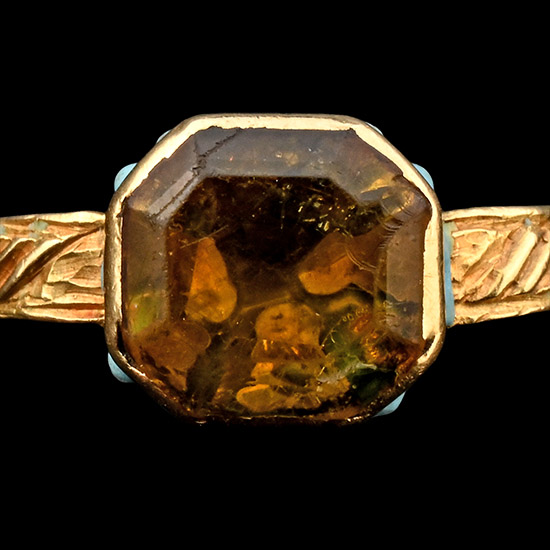
Stuart Period Gold and Enamel Ring with Citrine-Coloured Table-Cut Paste
England, mid-17th century A.D.Estimate: £1,500 - 2,000 (+bp*)
Opening Bid: £750
Set with a vivid orange-yellow table-cut paste in a raised octagonal collet, turquoise-coloured enamel decorating the bezel; the hoop chased with diagonal ornament, with remains of light-blue enamel. 2.58 grams, 22.63 mm overall, 17.40 x 15.66 mm internal diameter (approximate size British N, USA 6 1/2, Europe 13.72, Japan 13)
Acquired on the European art market. UK, private collection.
The projecting collet and table-cut paste belong to the seventeenth-century tradition of enamelled gemstone and imitation gem rings. -
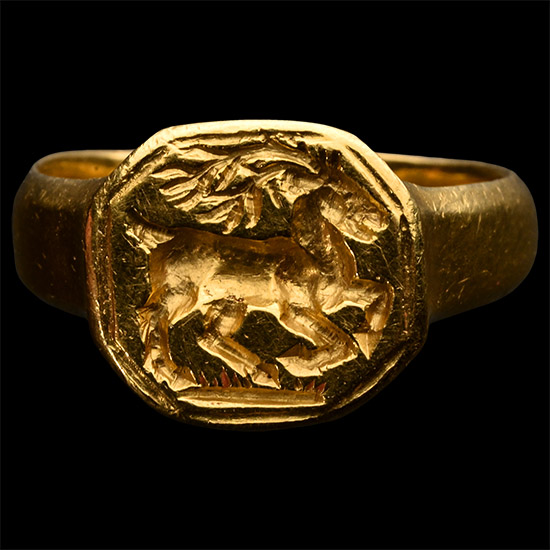
Post Medieval Signet Ring with a Galloping Stag
Germany, mid-17th century A.D.Estimate: £5,000 - 7,000 (+bp*)
Opening Bid: £2,500
Comprising a thick D-section hoop with facetted shoulders, an octagonal bezel with a deeply engraved image of a galloping stag on a baseline. 10.99 grams, 23.27 mm overall, 18.43 x 19.06 mm internal diameter (approximate size British P 1/2, USA 7 3/4, Europe 16.86, Japan 16)
Acquired on the European art market. UK, private collection. This lot has been checked against the Interpol Database of stolen works of art and is accompanied by search certificate no.13506-263461.
The ring's style indicates a 17th-century origin, reflecting the period's fascination with equine motifs in Germany following the publication of Georg Engelhard von Löhneysen’s pioneering equestrian treatise, Die neu eröffnete Hof-, Kriegs- und Reitschul. -
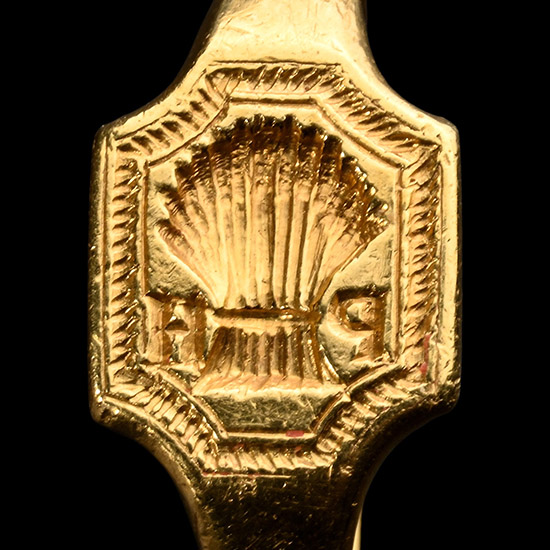
Post Medieval Gold Signet Ring with a Wheat Sheaf
Germany, 15th-16th century A.D.Estimate: £5,000 - 7,000 (+bp*)
Opening Bid: £2,500
Comprising a large hoop with a cut-cornered bezel engraved with a wheat sheaf flanked by the initials P and H. 9.51 grams, 24.71 mm overall, 21.03 x 17.66 mm internal diameter (approximate size British R 1/2, USA 8 3/4, Europe 19.38, Japan 18)
Acquired on the European art market. UK, private collection. This lot has been checked against the Interpol Database of stolen works of art and is accompanied by search certificate no.13488-263468.
The family name of the coat of arms with the owner’s initials P and H cannot be identified, but it is possibly German. The garb of wheat, often simply called a ‘garb’ in heraldry, is a bound sheaf of grain and one of the most recognisable agricultural charges in coats of arms. Its traditional meaning is abundance, fertility, harvest, prosperity, and the honest reward of labour. Because wheat was a staple crop, the garb often points to a family connection with farming, landholding, milling, food supply, or rural prosperity. In heraldic terminology, it may be shown in gold to emphasise wealth and ripeness, or in natural colours to stress its agricultural character. -
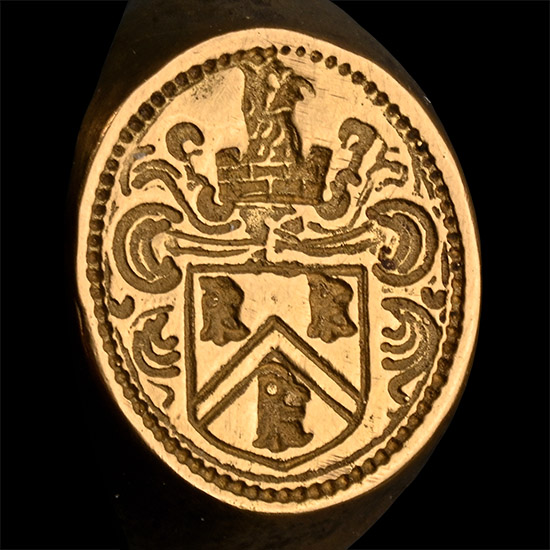
Solid 21 Carat Gold Replica of the Colman Family Armorial Signet Ring
21st century A.D.Estimate: £1,200 - 1,700 (+bp*)
Opening Bid: £600
A copy of a 16th-17th century ring found near Lomond, Scotland, belonginging to the Colman family of Brent Eleigh, Suffolk. 12.68 grams, 21.95 mm overall, 18.86 mm internal diameter (approximate size British R 1/2, USA 8 3/4, Europe 19.38, Japan 18)
From the collection of a London gentleman. -
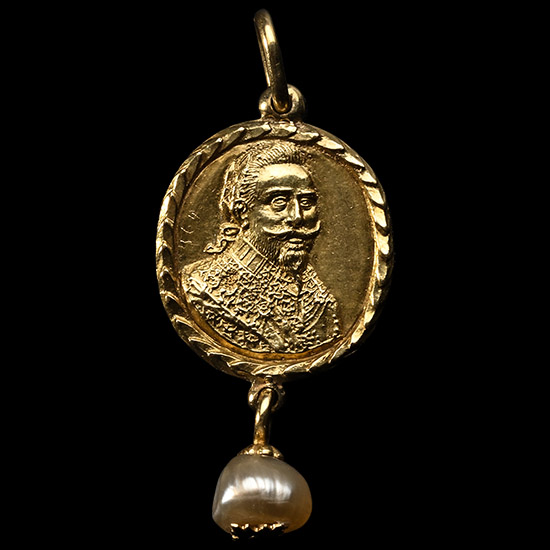
Post Medieval Gold and Enamel Supporters’ Medal of Gustavus II Adolphus of Sweden
German, circa 1631 A.D.Estimate: £1,500 - 2,000 (+bp*)
Bids: 1 | Current Bid: £1,010
Pendant medal with a three-quarter portrait bust of Gustavus II Adolphus wearing royal dress and a laurel crown, enclosed within a laurel border, the reverse decorated in black champlevé enamel and inscribed: 'ADOLPHUS GUSTAVUS, GOTT MIT UNS' meaning 'Adolphus Gustavus, God with us'; a baroque pearl suspended from a loop beneath the medal, with a suspension bail above. 4.32 grams, 37 mm
Acquired on the European art market. UK, private collection.
The pendant belonged to the supporters’ jewellery associated with the Swedish king’s campaigns during the Thirty Years’ War. -
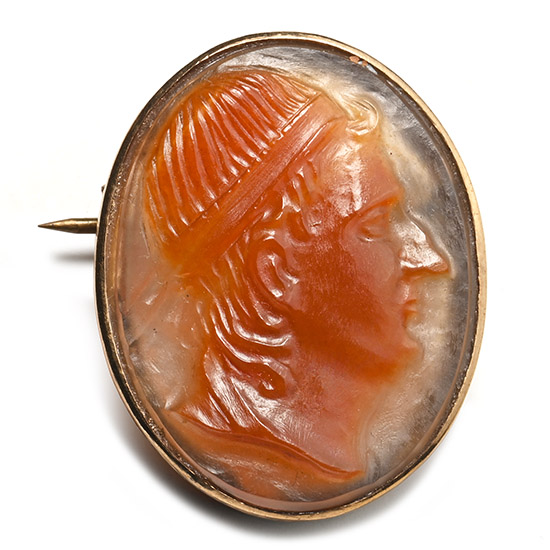
Frederician Agate Cameo of a Man in Brooch
19th century A.D.Estimate: £1,500 - 2,000 (+bp*)
Opening Bid: £750
Translucent oval cameo featuring profile head of a mature man with a Roman nose, his hair arranged neatly and wearing a tainia; set in a gold brooch mount. 6.1 grams, 27 mm
Private collection, London, UK.

