
Ancient Art, Antiquities, Books, Natural History, Stamps & Coins

-
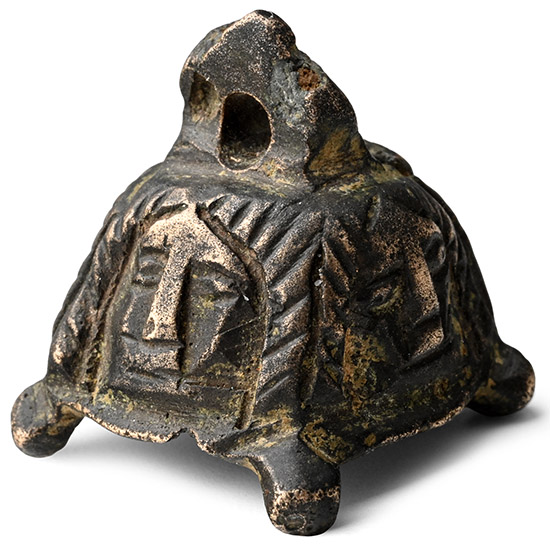
Egyptian Bronze Bell with Faces
Late-Ptolemaic Period, 664-30 B.C.Estimate: £100 - 140 (+bp*)
Opening Bid: £50
Hollow-formed miniature bell with integral loop handle, four radiating female faces to the sidewall - possibly depicting the goddess Hathor. 14 grams, 20 mm
London gentleman's collection, 1970-1990s, by descent.
The bell may have been part of a musical instrument. Many musical rituals centred on Hathor, often accompanied by musicians playing sistrums. -
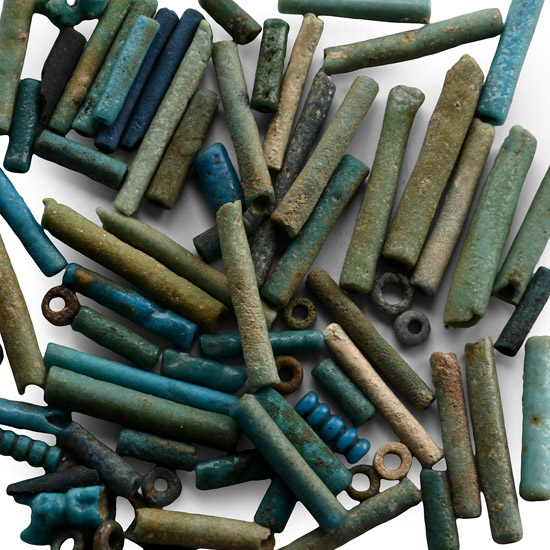
Egyptian Faience Mummy Beads and Cat Amulet
Late Period-Ptolemaic Period, circa 664-30 B.C.Estimate: £80 - 100 (+bp*)
Opening Bid: £5
Comprising tubular, ribbed and annular beads, offered with the top part of a cat amulet. 8.4 grams total, 3-24 mm
From a mid 20th century London, UK, collection. -
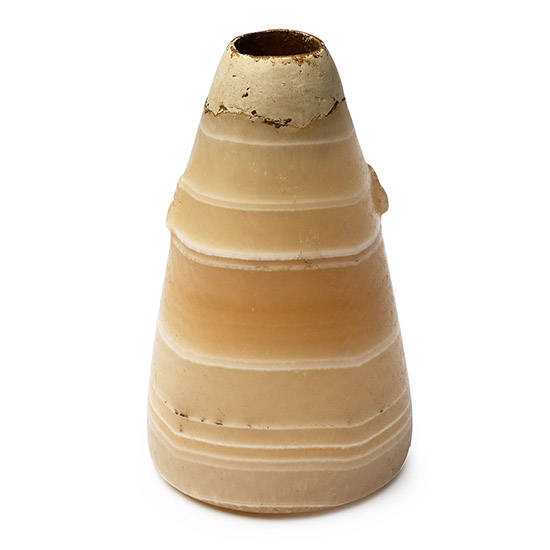
Egyptian Banded Agate Kohl Pot
Late Period, 664-332 B.C.Estimate: £400 - 600 (+bp*)
Opening Bid: £5
Cone-shaped body with traces of lug handles on the upper third; narrow opening at the top with a thin, flattened rim. 94 grams, 75 mm
UK private collection before 2000. Acquired on the UK art market. Private collection, London, UK.
This vessel's unusual triangular shape is thought to be limited to the Late Period; other comparable examples are known (e.g. Barbotin, C., Collection égyptienne: Musée Granet - Aix-en-Provence, Aix-en-Provence, 1995, p. 166, no. 97). -
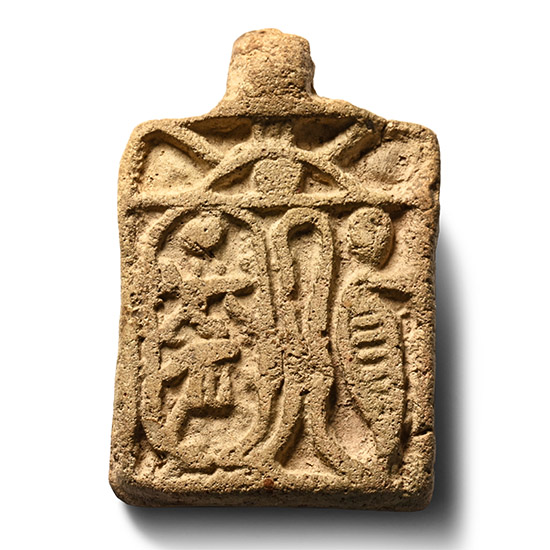
Egyptian Faience Amuletic Plaque with Cartouche of Pharaoh Thutmose III
New Kingdom, circa 1400-1292 B.C.Estimate: £200 - 300 (+bp*)
Bids: 1 | Current Bid: £5
Formed as a rectangular plaque with the cartouche of Thutmosis III and a uraeus; attachment loop to the top. 4.68 grams, 33 mm
London, UK, art market, 1980s. Private collection, London, UK. -
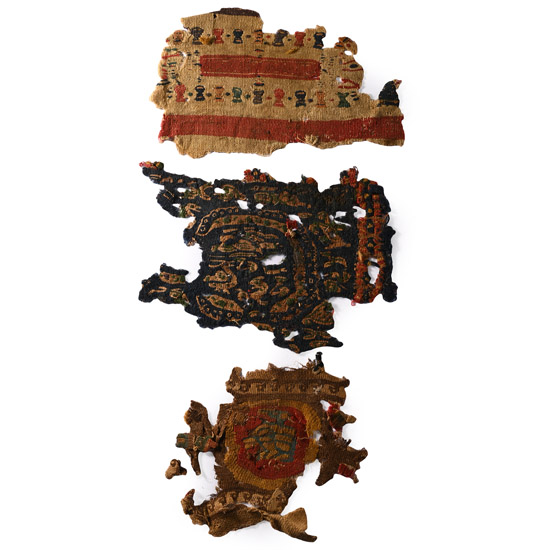
Egyptian Coptic Tunic and Tapestry Textile Fragments with Animals and Geometric Ornamets
Circa 7th-8th century A.D.Estimate: £80 - 100 (+bp*)
Opening Bid: £5
Comprising: a tapestry fragment (part of a pillow?) decorated with red bands and alternating figures of cups in green, red, blue, purple and yellow wool on linen; a large fragment of a segmentum from a tunic in coarse wool, consisting of a central medallion with a bird in red, yellow, light blue and yellow colour, with the borders decorate with meanders, tapestry, S-swift; a large portion of a tapestry with a central medallion ornamented with animals (lion, fish, birds) surrounded on the outside by dancing human figures and birds, one side circumscribed by a red stripe with vegetal ornaments, in red, blue-purple and yellow wool. 27 grams total, 15-22 cm
Acquired 1970s-1996. Property of a North American collector. London collection, 2016.
Large fragments of Coptic textiles display figures associated with the Dionysian retinue (lions, birds); however, they may date to the early period of the Islamic conquest, when tunic ornamentation began to take on an increasingly abstract and geometric character, preserving only stylised traces of the ancient Pagan symbology. -
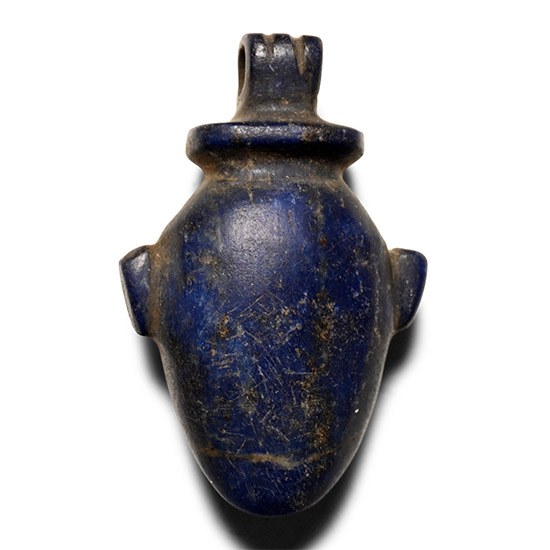
Egyptian Lapis Lazuli Heart Amulet
Late Period-Ptolemaic Period, circa 664-30 B.C.Estimate: £150 - 200 (+bp*)
Bids: 1 | Current Bid: £50
Carved with lateral lugs, a pronounced rim surmounted by a ribbed suspension loop. 2.14 grams, 21 mm
Property of a London, UK, gentleman, 1970-2000. -
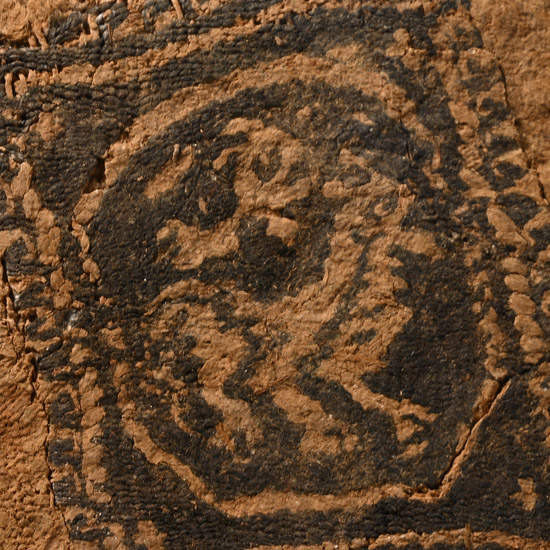
Egyptian Coptic Textile Fragments from a Tunic Tablion with Putto and Horse
Circa 5th-6th century A.D.Estimate: £50 - 70 (+bp*)
Opening Bid: £5
In white linen and blue wool, tapestry work (S-twist), showing a flying putto with a horse, borders with meander decorations. 3.84 grams total, 67-74 mm
Acquired 1970s-1996. Property of a North American collector. London collection, 2016.
The tabula, or tablion, was a square embroidery used to decorate tunics or mantles. -
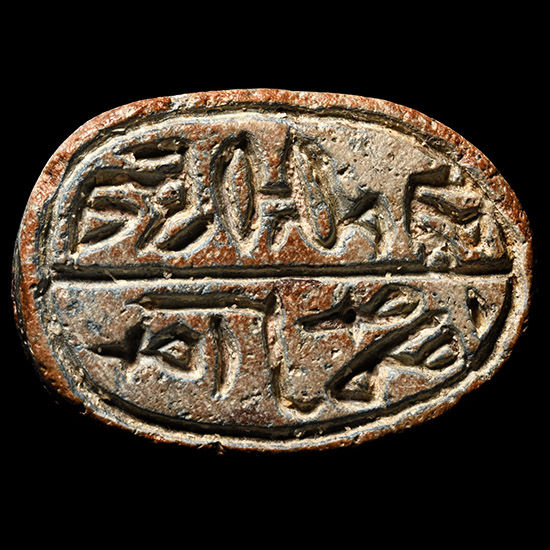
Large Egyptian Scarab for the Overseer of the Treasury Har
Second Intermediate Period, circa 1650–1530 B.C.Estimate: £100 - 140 (‡+bp*)
Opening Bid: £50
Stylised scarab body with low-relief clypeus and head, two notches marking the division between prothorax and elytra, and legs modelled along the sides; underside divided vertically into two panels with incised hieroglyphs reading: 'Seal-bearer of the King of Lower Egypt, Overseer of the Treasury, Har'. 4.54 grams, 22 mm
Private collection of Kal Noselson, New York, acquired between 1976 and the late 1990s; thence by descent. Accompanied by the collector's original inked images. -
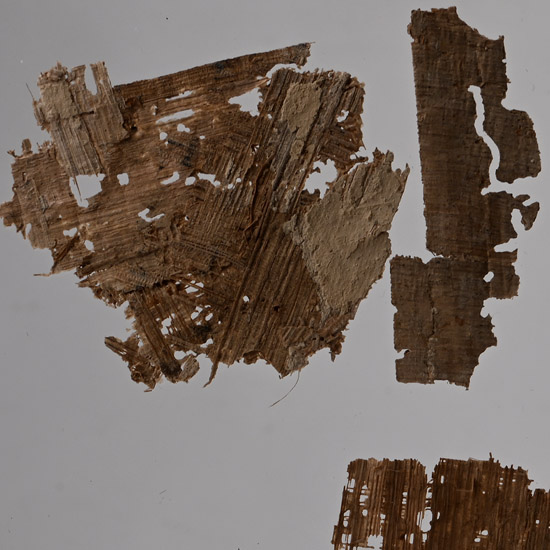
Egyptian Papyrus Fragments in Display Stand
Demotic, 300 B.C.-300 A.D.Estimate: £50 - 70 (+bp*)
Opening Bid: £5
Irregular papyrus fragments with faint traces of Demotic script; mounted in a protective acrylic display. 81 grams total, 16 cm including stand
with a privately curated collection, 1980s-early 2000s. From the private collection and estate of Christine Simons (1943-2025), West Midlands, UK. -
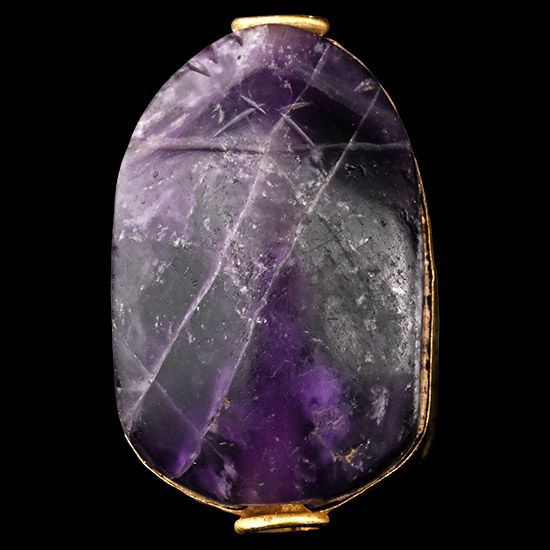
Egyptian Amethyst Scarab with Gold Fitting
Late Period, 664-332 B.C.Estimate: £400 - 600 (‡+bp*)
Opening Bid: £200
Dark-coloured carved amethyst with incised segmentation and notching to the mouth, gold frame with loops to the ends to protect the mounting holes. 5.53 grams, 23 mm
Acquired from Derek Content, 21 February 1975. Private collection of Kal Noselson, New York, acquired between 1976 and the late 1990s; thence by descent. Accompanied by an original handwritten invoice from Derek Content, dated 21 February 1975. -
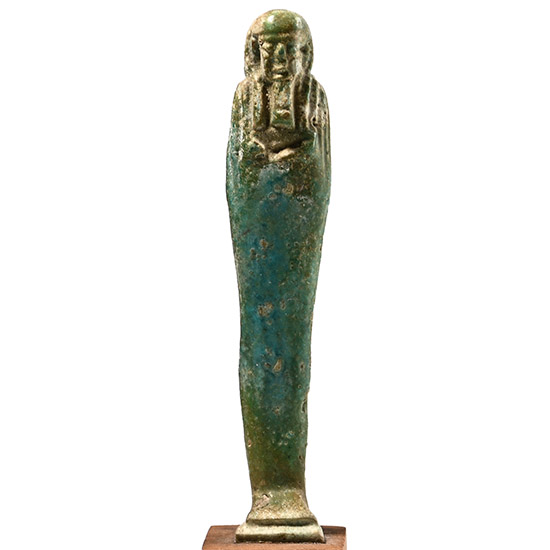
Egyptian Blue Glazed Shabti
30th Dynasty-Ptolemaic Period, 380-30 B.C.Estimate: £80 - 100 (+bp*)
Bids: 2 | Current Bid: £15
Slender mummiform type standing on an integral plinth, wearing a lappet wig with crossed arms holding agricultural tools; plain, broad dorsal pillar; with an old collector's note: 'Ancient Egyptian Exceedingly fine statuette in beautiful blue glaze B.C. 700 A very choice & desirable specimen from Lord Grenfell's collection. Excavated at Thebes'; mounted on a custom-made stand with label on the underside: 'Egyptian B.C. 700 Lord Grenfell's Collection. Excavated at Thebes'. 28 grams, 10.8 cm (38 grams total, 12.6 cm high including stand)
Excavated Thebes, Egypt. Ex Lord Grenfell's (1896-1926) collection, UK. From the estate of a deceased Sussex private collector since the early 20th century. -

Egyptian Brown Quartzite Figure of the Baboon God Thoth
New Kingdom, circa 1550-1070 B.C.Estimate: £4,500 - 5,500 (‡+bp*)
Opening Bid: £2,500
Carved in a typical pose, sitting on its haunches with its tail curving around the right side, its front paws resting on its knees and protruding beneath its thick furry pelt, with incised detailing, its feet either side of the phallus, the head with bulbous, striated hair on either side, chipped, snout restored; seated on a high shrine-shaped plinth with squared front and rounded back, featuring a cavetto cornice and roll detailing on the upper part. 1.15 kg, 15 cm
From a deceased American estate, 1970-1989. with Bonhams, London, 28 October 2009, no.35. Accompanied by copies of the relevant Bonhams catalogue pages. This lot has been checked against the Interpol Database of stolen works of art and is accompanied by a search certificate no.12368-226706.
The baboon was an animal manifestation of the god Thoth, the patron deity of Hermopolis Magna, who was revered for his association with knowledge, writing, and healing.
