
Ancient Art, Antiquities, Books, Natural History, Stamps & Coins

-
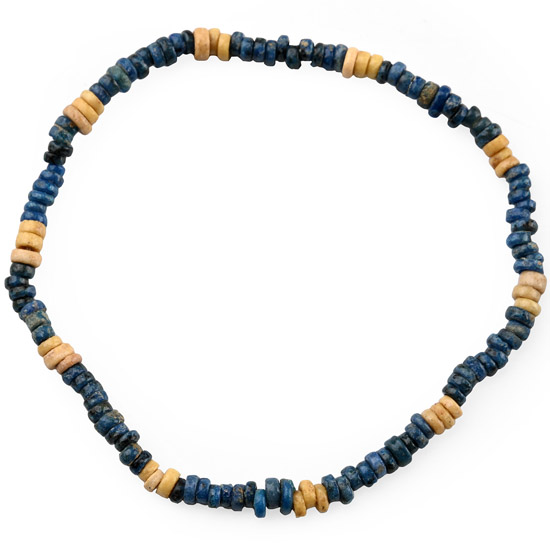
Egyptian Faience Mummy Bead Bracelet
Late Period, 664-332 B.C.Estimate: £60 - 80 (+bp*)
Opening Bid: £5
Composed of alternating blue and cream annular beads, restrung with an elasticated string. 2.19 grams, 17 cm
Ex Ancient Art Shop, Windsor, UK, 1990s. Ex private collection. -
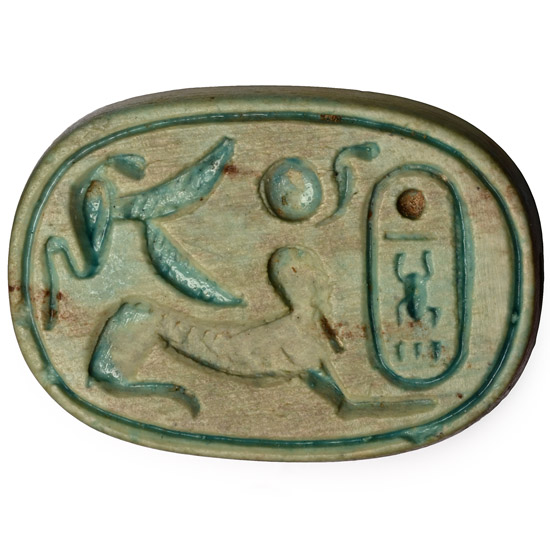
Egyptian Glazed Steatite Plaque with Thutmosis IV Cartouche and Hieroglyphs
New Kingdom, 18th Dynasty, circa, 1419-1386 B.C.Estimate: £80 - 100 (+bp*)
Bids: 2 | Current Bid: £25
Bifacial amuletic bead with designs: Side A: cartouche of Thutmosis IV (Menkkheperure), recumbent sphinx, winged uraeus, and sun disc with uraeus; Side B: falcon with neb, nefer, and nwb signs, among others. 6.01 grams, 26 mm
From the private collection of a European gentleman (1942-2024), formed since the 1970s. -
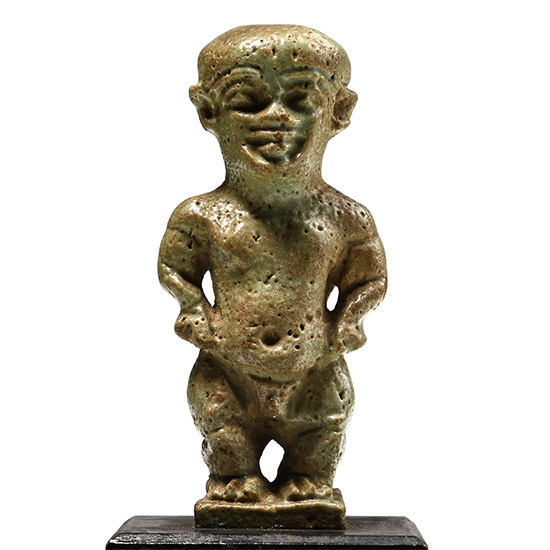
Large Egyptian Green Glazed Faience Bifacial Pataikos Amulet
Late Period, 664-332 B.C.Estimate: £500 - 700 (‡+bp*)
Opening Bid: £275
Nude Pataikos standing with slightly bent legs on a rectangular base; his short arms bent, and his clenched fists resting at the sides of his slightly protruding belly; janiform head topped with a smooth, closely fitting cap similar to the one worn by the god Ptah; loop at the nape of the neck for use as an amulet; mounted on a custom-made stand. 54.3 grams total, 95 mm including stand
Ex Mr E.C.(1923-2014), Israel. Inherited by his son D.L., Switzerland.
Amulets had a diverse range of functions: they were either worn by the living or used as small votive offerings in private and official cult contexts. They also played an important role in funerary practices, as they were either wrapped into the mummy, placed on it (mummy amulets), or given to the deceased as grave goods. In the Late Period, dwarfs were venerated as popular protective deities, in analogy to Bes and Harpocrates. Moreover, since the Late Period, the creator god Ptah, who was worshipped in Memphis, was also represented as a childlike dwarf. -
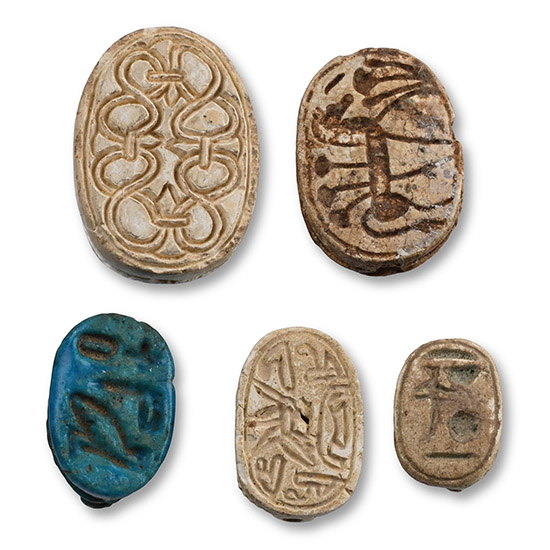
Egyptian Steatite and Other Scarab Group
Mainly Second Intermediate Period, circa 1660-1500 B.C.Estimate: £150 - 200 (‡+bp*)
Opening Bid: £75
Designs include: a line border enclosing a decorative symmetrical scroll-work pattern; a line border enclosing a horse with papyrus clumps above and in front; deeply impressed bird and other signs behind; a line border enclosing a nwb (gold) sign flanked by Red Crowns, with a bee above flanked by coiled cobras; a line border enclosing a djed, neb, and sun disc, with narrow neb(?) signs above and below. 8.76 grams total, 12-21 mm
Acquired on the European art market in the early 2000s. with Galerie Rhéa, Zurich, Switzerland. This lot is accompanied by an illustrated lot declaration signed by the Head of the Antiquities Department, Dr Raffaele D'Amato. -
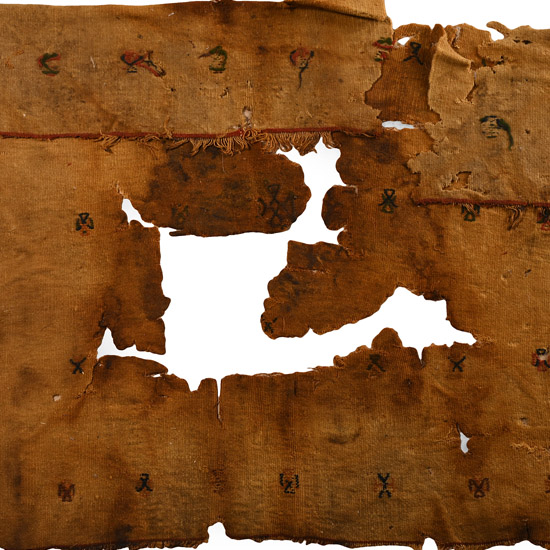
Large Egyptian Coptic Wall Tapestry Textile Fragment with Geometric Ornaments
Circa 7th century A.D.Estimate: £150 - 200 (+bp*)
Opening Bid: £5
Fragment from a tapestry or a cloak in light fabric, S-twist tapestry, embroidered with red, green, yellow, and blue geometric ornaments in wool and linen. 236 grams total including paper folder, 55 cm wide
Acquired 1970s-1996. Property of a North American collector. London collection, 2016.
Most of the linen or wool garments found by A. Gayet in the Antinoe necropolis were woven in a specific pattern, in a single piece, on a horizontal warp. Another relatively common pattern for linen garments consisted of assembling three pieces woven on a single warp and forming the upper part of the garment, with the collar and sleeves. -
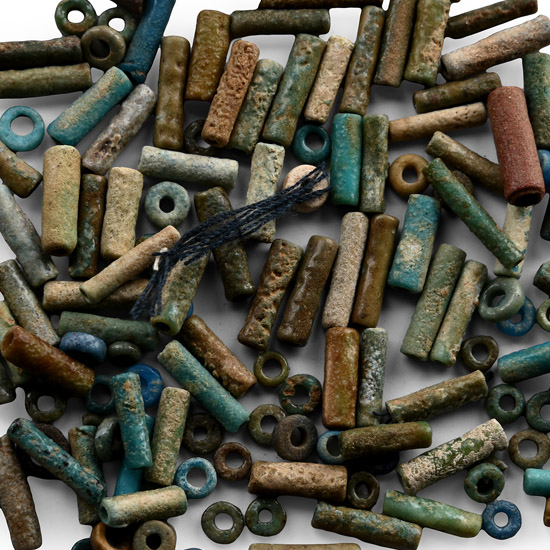
Egyptian Mummy Bead Group
Late Period-Ptolemaic Period, circa 664-30 B.C.Estimate: £40 - 60 (+bp*)
Opening Bid: £5
Group of tubular and annular beads in green, blue, and beige colours. 7.4 grams total, 3-12 mm
Ex Art Shop Windsor, 1990s. From a private UK collection. -
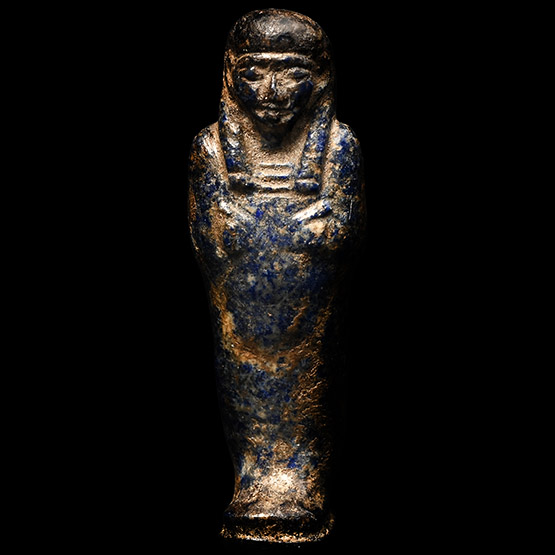
Egyptian Lapis Lazuli Shabti Amulet
New Kingdom, 1550-1070 B.C.Estimate: £1,200 - 1,700 (‡+bp*)
Opening Bid: £600
Carved in the round as a mummiform figure, with a multi-row collar and tripartite wig; rear suspension loop. 3.12 grams, 31 mm
Private collection, acquired on the Swiss art market in 1992; thence by descent. -
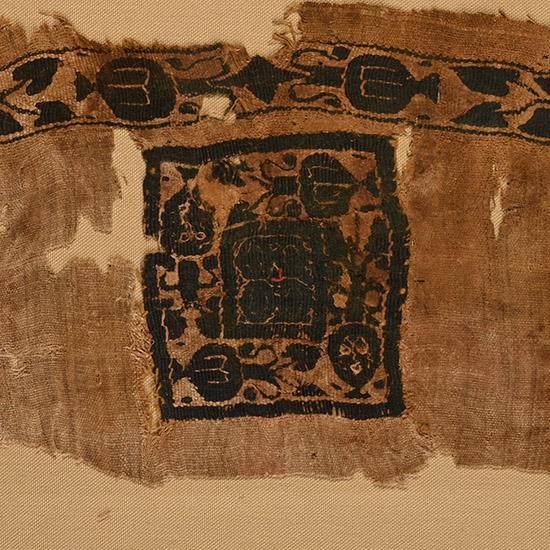
Egyptian Mounted Coptic Tunic Textile Fragment with Clavus and Tabula
Circa 6th century A.D.Estimate: £80 - 100 (+bp*)
Opening Bid: £5
Showing a large portion of a tunic, decorated with a clavus and a tablion, both featuring foliate ornaments alternating with kantharoi, the centre of the tablion patterned with rosettes surrounded by kantharoi on the four sides; mounted on a backing board. 174 grams total, 57 cm
Acquired 1970s-1996. Property of a North American collector. London collection, 2016.
This type of embroidery was typical of tunics and garments characterised by full-length clavi and segmenta, decorated with either intricate geometric patterns or floral and vegetal motifs. In Christian symbology, the kantharos was an ancient Greek wine cup that symbolised resurrection and eternal life through Christ. -
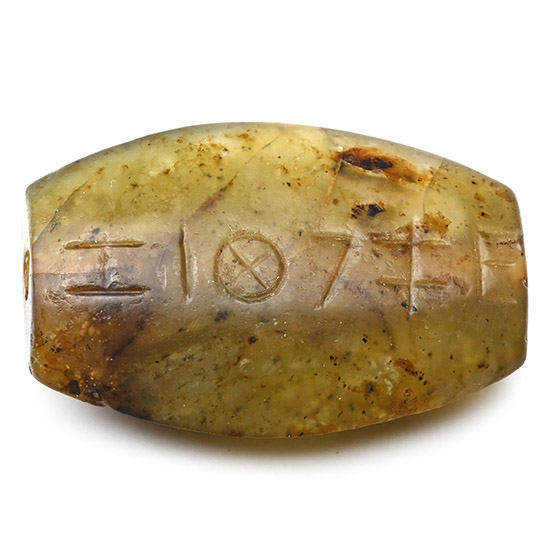
Phoenician Bifacial Green Stone Bead with Inscriptions
Circa 800-600 B.C.Estimate: £400 - 600 (+bp*)
Bids: 2 | Current Bid: £10
Lentoid in section and fusiform in plan with a median line of characters to each face. 8.6 grams, 31 mm
From the private collection of a European gentleman (1942-2024), formed since the 1970s. -
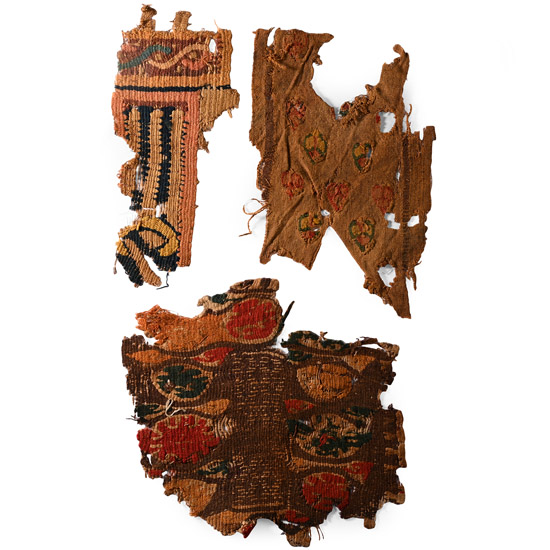
Egyptian Coptic Tunic and Tapestry Textile Fragments with Flowers and Geometric Ornaments
Circa 6th-8th century A.D.Estimate: £80 - 100 (+bp*)
Opening Bid: £5
Comprising a fragment of a clavus decorated with rows of heart-shaped buds in green, red, and yellow wool on linen, with edges marked by brown bands; a large fragment of coarse wool, consisting of a central rectangle with lozenge ornamentation in yellow and brown wool, surrounded by rectangular sections enclosing images of rabbits within yellow, green, and red medallions, facing left; and a textile fragment with geometric decoration in purple, yellow, light red, green, and black wool. 33 grams total, 21-26 cm
Acquired 1970s-1996. Property of a North American collector. London collection, 2016.
The large fragment featuring lozenge decoration, despite displaying figures associated with the Dionysian retinue (rabbits or hares), may date to the early period of the Islamic conquest, when tunic ornamentation began to take on an increasingly abstract and geometric character. -
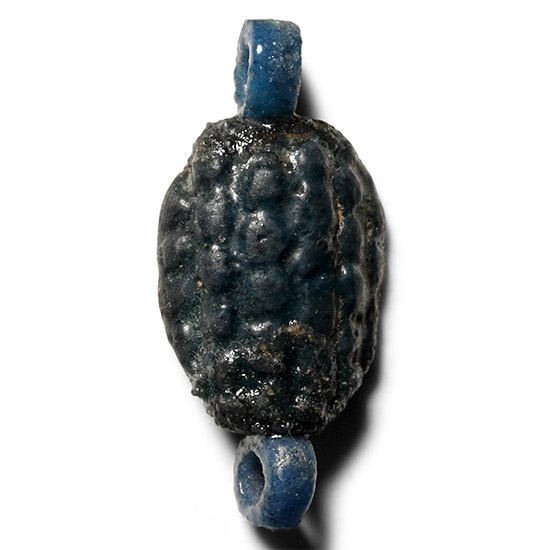
Egyptian Faience Grape Amulet
New Kingdom, 18th Dynasty, Amarna Period, 1353-1336 B.C.Estimate: £80 - 100 (+bp*)
Opening Bid: £5
Plano-convex in section with integral loop to each end. 0.26 grams, 16 mm
From a mid 20th century collection. -
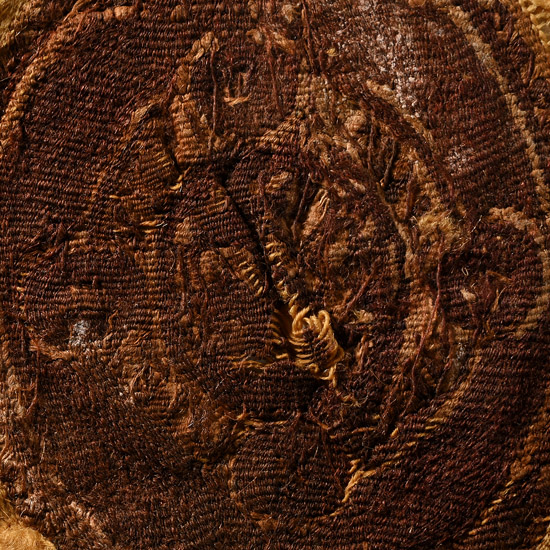
Egyptian Coptic Textile Fragment of an Orbiculus from a Tunic
Circa 4th century A.D.Estimate: £30 - 40 (+bp*)
Opening Bid: £5
In purple wool and coarse linen, on a brown linen background, S-torsion, embroidered with vegetal ornaments, and the borders decorated with meanders. 6.38 grams, 10 x 9.8 cm
Acquired 1970s-1996. Property of a North American collector. London collection, 2016.
In the Late Roman Period, round orbiculi decorated the shoulders and the lower part of tunics and kamisia (inner tunics). These fabrics were of great decorative finesse, displaying an unusual and extremely well-preserved colour palette. When the tunic was removed from use, these embroideries could be recycled and patched onto another garment.
