
Ancient Art, Antiquities, Books, Natural History, Stamps & Coins

-
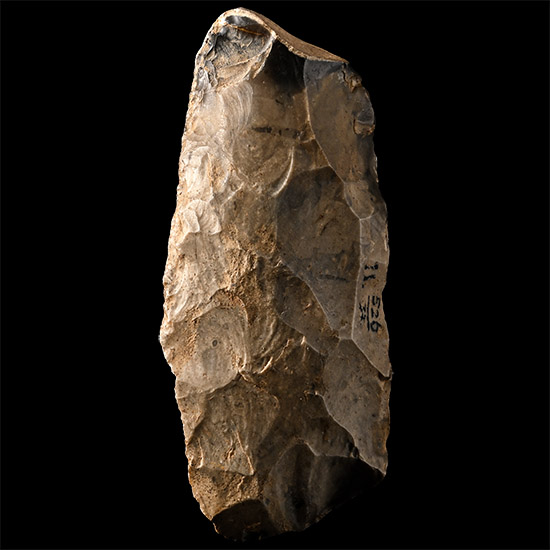
Farnham Stone Age Knapped Flint Axe
Neolithic Period, circa 6000 B.P.Estimate: £80 - 100 (+bp*)
Opening Bid: £5
Biconvex in section with cortex to the butt, inked '11 526/32' legend. 153 grams, 10.5 cm
Found during the original official excavations in the Farnham area, Surrey, UK, which were conducted by Harold Falkner (1875-1963) and William Francis Rankine (c.1877-1962), who were instrumental in the excavation works and pit dwellings at sites including Six Bells, Frensham, Tilford, Thursley and Bagshot, and Waverley, amongst others, at and near Farnham in the 1930s and 1940s. Much of the material is now in the prestigious Farnham museum. The present part of the collection having been gifted to their good friend and Haselmere Parish Priest, Charles Borelli (c.1914-2000) of Farnham, who was part of the Borelli family from Italy who emigrated from Lake Como in 1828 to set up the Borelli family watch and jewellery business; thence by family descent to his nephew.
Farnham district is one of the most interesting prehistoric regions in England, and has been visited by a succession of prehistoric peoples from Palaeolithic times onwards. Along the southern slope of the Farnham valley are three gravel terraces, which are famous prehistorically and have yielded large quantities of flint implements and bones of prehistoric animals, notably the mammoth. In prehistoric times, the chalk deposits played an important role in attracting settlers, as they contained rich layers of flint nodules used to make implements. The Farnham Gravels have been an abundant source of Palaeolithic finds, most prominent being hand axes. The axes differ in type, and each type is associated with a cultural phase of the Palaeolithic period. Types similar to these are found in similar deposits in the Somme valley and in many English valley gravels. Flint mining was also carried out by the Neolithic folk. Polished axes and leaf forms, arrowheads and knives, or possibly lance heads, are characteristic of the Neolithic flint work. -
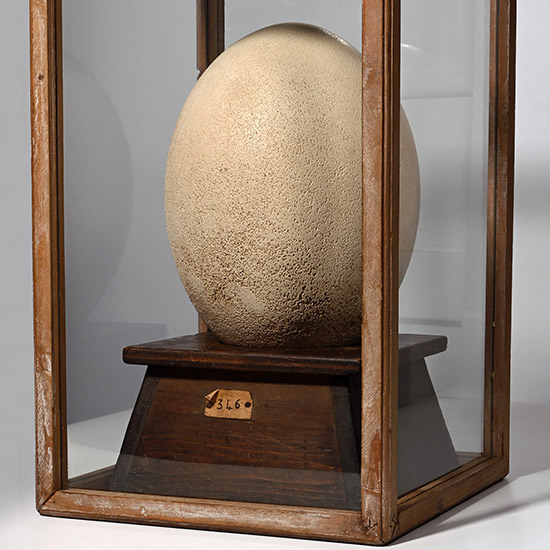
Intact Egg of the Aepyornis Maximus 'Elephant Bird'
Estimate: £40,000 - 60,000 (+bp*)
Opening Bid: £22,222
A remarkable specimen of a fine, large, sub-fossilised egg of the Aepyornis maximus, popularly known as the 'giant elephant bird', featuring a beautifully mineralised surface, with an area where the hatchling exited, expertly reattached, leaving little visible trace. 6.3 kg total, 49.5 cm high including stand, egg: 30 cm
Private collection of Professor Raniero Gnoli, located in Castel Giuliano, Bracciano, in the Province of Rome. According to Professor Gnoli, the egg was acquired by a relative in a Parisian gallery approximately a century ago.
The Aepyornis maximus was one of the largest birds to ever exist, a flightless giant reaching nearly 10 feet in height and native to the island of Madagascar. Extinct by the 17th century, this extraordinary bird has captivated human imagination for centuries and inspired numerous myths and literary works. The eggs surpass the size of any known dinosaur egg and could accommodate the volume of seven ostrich eggs, approximately 160 chicken eggs, or an astonishing 12,000 hummingbird eggs. These eggs, once common on the island, are now among the few physical remnants of this magnificent species. While the precise cause of the elephant bird’s extinction is unknown, evidence strongly points to human activity, including hunting and habitat destruction. As the bird vanished from Madagascar’s landscapes, its myth grew, merging with folklore to leave an enduring legacy that connects history with imagination. This intact egg stands as a rare and tangible link to a bygone era, offering a profound sense of wonder for a species that once roamed the earth as the largest bird in recorded history. -
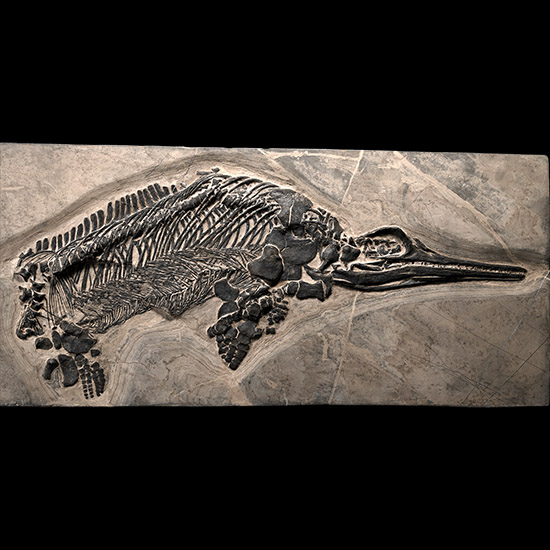
Fossil Ichthyosaur Skeleton
Triassic Period, circa 246-237 million years B.P.Estimate: £5,000 - 7,000 (+bp*)
Bids: 1 | Current Bid: £1,000
Ichthyosaur from the Mixosaurus genus, with several small teeth visible in the mouth, large eye sockets, many of the spinous processes present on the spine, and a large number of the flipper bones present on both the fore and hind paddles. 10 kg, 64.5 cm
From the Guanling Biota formation, China. Previously with Shishang Corporation, Taiwan. From a West London gentleman collector; acquired from a professional fossil company in Taiwan.
Originally, ichthyosaur fossils were misidentified as ‘Saurian ’-being either lizards or forms of crocodile. The term 'Ichthyosaur' was first used in 1817 by the German naturalist Karl Dietrich Eberhard Konig, and he did not publish the name until 1825. By the 1830s, the name Ichthyosaur was widely used. Mixosaurus is considered to be a transitional genus that was smaller in size than the later dolphin-like Ichthyosaurs. -
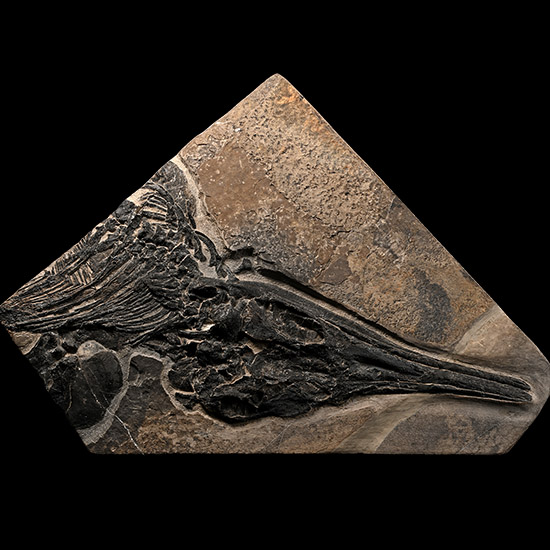
Fossil Ichthyosaur Skull and Partial Skeleton
Triassic Period, circa 246-237 million years B.P.Estimate: £2,000 - 3,000 (+bp*)
Opening Bid: £500
Featuring the top of the skull with an exposed left eye socket and part of the lower jaw also visible, a number of the cervical vertebrae present, as well as ribs and part of the right scapula. 5.75 kg, 36 cm
From the Guanling Biota formation, China. Previously with Shishang Corporation, Taiwan. From a West London gentleman collector; acquired from a professional fossil company in Taiwan.
Originally, ichthyosaur fossils were misidentified as ‘Saurian’, being either lizards or forms of crocodile. The term 'Ichthyosaur' was first used in 1817 by the German naturalist Karl Dietrich Eberhard Konig, and he did not publish the name until 1825. By the 1830s, the name Ichthyosaur was widely used. -
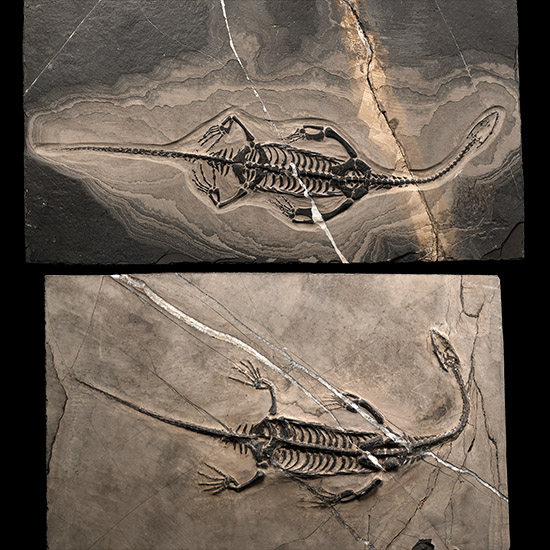
Fossil Keichousaurus Skeleton Male and Female Pair
Triassic Period, circa 250 million years B.P.Estimate: £800 - 1,000 (+bp*)
Opening Bid: £250
Pair of Keichousaurus hui skeletons on matrices prepared underneath from a ventral view; the larger male with its back legs bent towards the tail, both with exposed hip bones and scapulae. 2.89 kg total, 23-26.4 cm
From the Guizhou formation, China. Previously with Shishang Corporation, Taiwan. From a West London gentleman collector; acquired from a professional fossil company in Taiwan.
Keichousaurus was a late Triassic marine reptile, a member of the Pleurosaur family, which went extinct 250 million years ago during the Triassic-Jurassic extinction event. They were specialised fish eaters and were highly unusual amongst marine reptiles in that they gave birth to live young rather than laying eggs. The male had more pronounced ulnar bones on its front legs. -
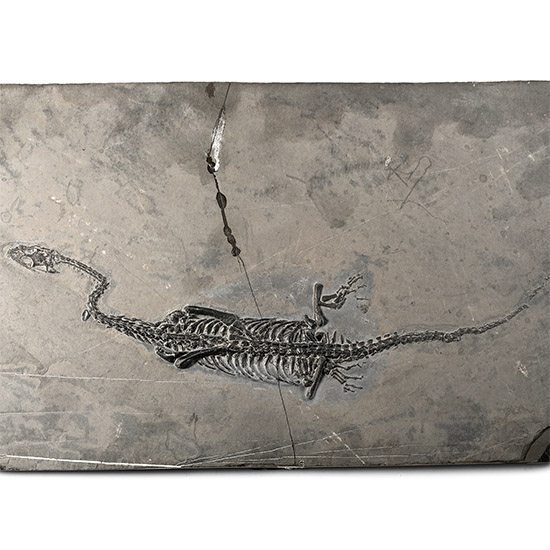
Fossil Keichousaurus Skeleton in Three-Dimensional Dorsal View
Triassic Period, circa 250 million years B.P.Estimate: £800 - 1,000 (+bp*)
Bids: 1 | Current Bid: £250
Showing a complete skeleton Keichousaurus hui shown from above with clearly defined spinous processes, the front legs tucked partially above the ribs, a curving neck and a long tail. 17.7 kg, 28.9 cm
From the Guizhou formation, China. Previously with Shishang Corporation, Taiwan. From a West London gentleman collector; acquired from a professional fossil company in Taiwan.
Keichousaurus was a late Triassic marine reptile, a member of the Pleurosaur family, which went extinct 250 million years ago during the Triassic-Jurassic extinction event. They were specialised fish eaters and were highly unusual amongst marine reptiles in that they gave birth to live young rather than laying eggs. -
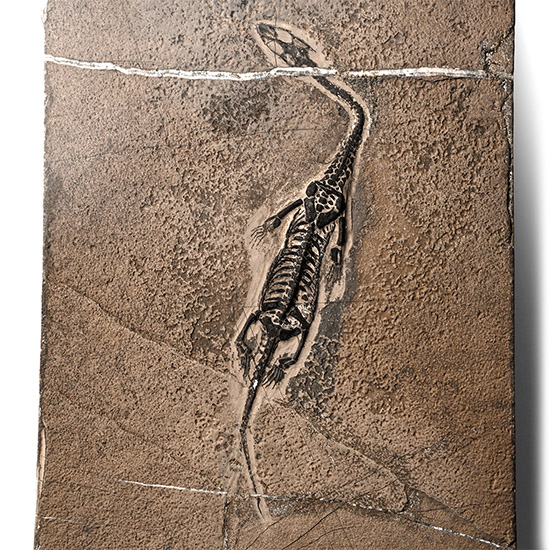
Fossil Keichousaurus Skeleton
Triassic Period, circa 250 million years B.P.Estimate: £300 - 400 (+bp*)
Bids: 1 | Current Bid: £150
Complete skeleton of a small Keichousaurus hui on a rectangular matrix, shown from the ventral side with visible hip bones and scapulae, front and hind limbs shown along the body and neck curving to the left. 567 grams, 16.9 cm
From the Guizhou formation, China. Previously with Shishang Corporation, Taiwan. From a West London gentleman collector; acquired from a professional fossil company in Taiwan.
Keichousaurus was a late Triassic marine reptile, a member of the Pleurosaur family, which went extinct 250 million years ago during the Triassic-Jurassic extinction event. They were specialised fish eaters and were highly unusual amongst marine reptiles in that they gave birth to live young rather than laying eggs. -
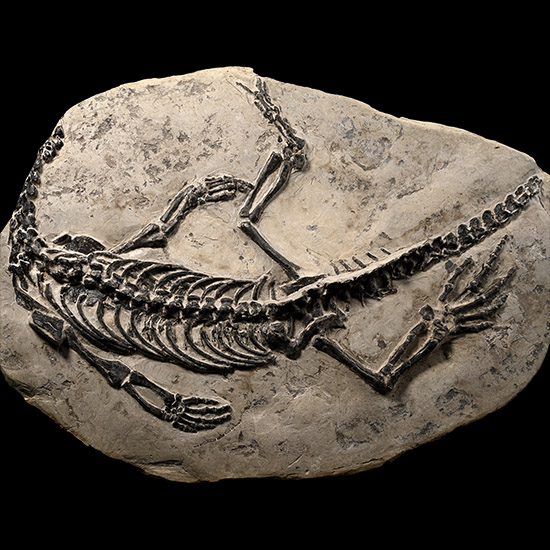
Claudiosaurus Fossil Marine Reptile Skeleton in Matrix
Late Permian Period, circa 260 million years B.P.Estimate: £1,200 - 1,700 (+bp*)
Opening Bid: £600
An extinct genus of diapsid reptiles, Claudiosaurus germanini, beautifully preserved and featuring a full ribcage, limbs, the majority of the tail and neck vertebrae. 7.75 kg, 40 cm
From a UK collection formed in the 1980s. Property of an Essex, UK, gentleman.
In life, the Claudiosaurus's splayed feet would have been webbed. It had a relatively long body and neck, reaching an overall length of about 60 centimetres. It is presumed to have been partially oceanic, living in a similar way to the modern marine iguana. -
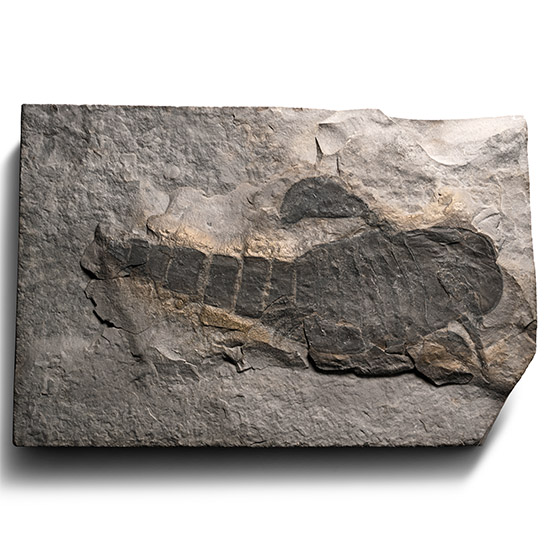
Eurypterid Fossil Sea Scorpion
Silurian Period, circa 432-418 million years B.P.Estimate: £350 - 450 (+bp*)
Opening Bid: £175
Showing the armoured shell of the marine arthropod on a rectangular matrix. 1.89 kg, 22 cm
From a Lincolnshire, UK, collection.
Eurypterids could grow to up to one metre in size to compete with armoured fish for food and territory. -
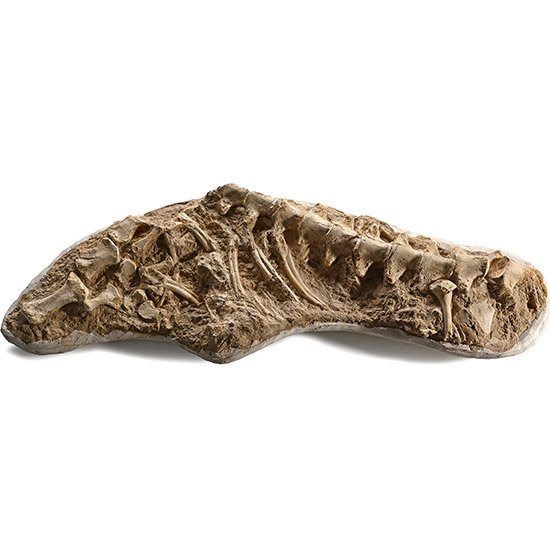
Mosasaur 'Marine Dinosaur' Fossilised Part Paddle, Ribs and Vertebrae
Cretaceous Period, circa 145-65 million years B.P.Estimate: £500 - 700 (+bp*)
Opening Bid: £250
The spine section comprising ten large dorsal vertebrae with transverse processes, various other rib sections and bones from the paddle-like flippers; on a sedimentary matrix wrapped in a plaster field jacket. 15.25 kg, 88 cm
Ex Cambridgeshire, UK, collection.
The Mosasaur is an extinct, large marine reptile with an elongated body, long snout and paddle-like limbs. Found worldwide, they competed with other well-known sea predators of the Late Cretaceous, such as plesiosaurs and ichthyosaurs, for food, existing primarily on a diet of ammonoids, cuttlefish and fish. -
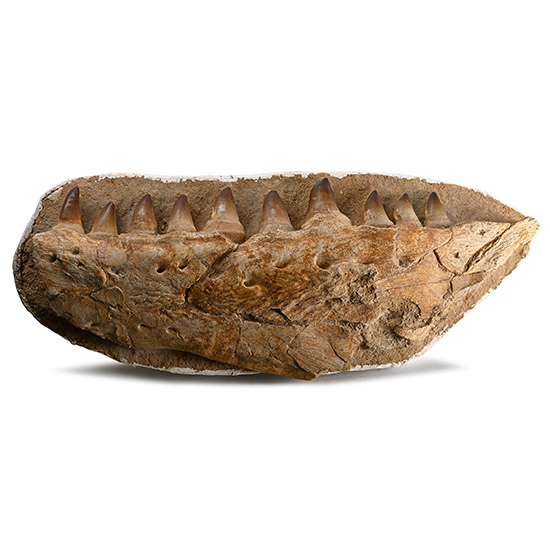
Very Large Mosasaur 'Marine Dinosaur' Fossil Lower Jaw
Cretaceous Period, circa 145-65 million years B.P.Estimate: £1,000 - 1,400 (+bp*)
Opening Bid: £500
Large assembled section of a jaw with ten large teeth displaying dark brown patina, set on a sandstone matrix. 9.37 kg, 63 cm
From a Cambridgeshire, UK, collection.
The Mosasaur is an extinct, large marine reptile with an elongated body, long snout and paddle-like limbs. Found worldwide, they competed with other well-known sea predators of the Late Cretaceous, such as plesiosaurs and ichthyosaurs, for food, existing primarily on a diet of ammonoids, cuttlefish and fish. -
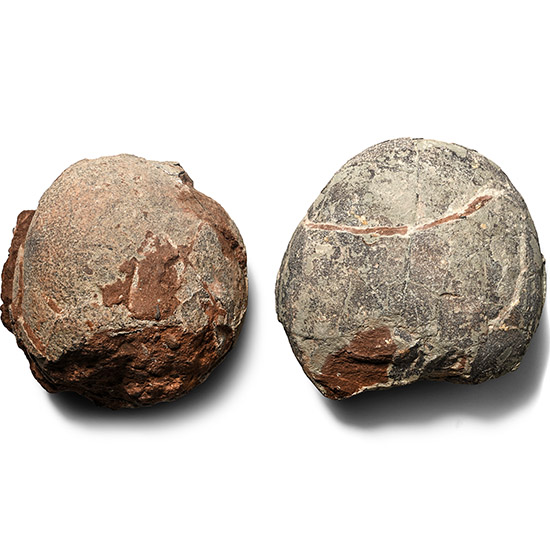
Fossil Hadrosaur Egg Pair
Cretaceous Period, circa 145-65 million years B.P.Estimate: £600 - 800 (+bp*)
Opening Bid: £250
Comprising two hadrosaur eggs retaining evidence of the original leathery surface and how the eggshell was crushed before fossilising. 1.56 kg total, 10.2-10.9 cm
From the Nanxiong formation, China. Previously with Shishang Corporation, Taiwan. From a West London gentleman collector; acquired from a professional fossil company in Taiwan.
Dinosaur eggs are known from about 200 sites around the world, the majority in Asia and mostly in terrestrial (non-marine) rocks of the Cretaceous Period. It may be that thick calcite eggshells evolved during the Cretaceous (145 to 65 million years ago). Most dinosaur eggs have one of two forms of eggshell that are distinct from the shells of related modern animal groups, such as turtles or birds; however, some eggs closely resemble the type of shells seen in present-day ostrich eggs.
