
Ancient Art, Antiquities, Books, Natural History, Stamps & Coins

-
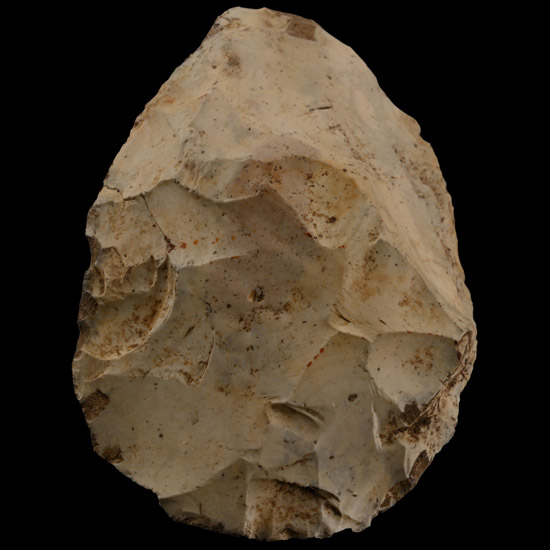
Norfolk Stone Age Knapped Ovate Flint Handaxe
Neolithic Period, circa 6,000 B.P.Estimate: £120 - 170 (+bp*)
Opening Bid: £60
Leaf-shaped in plan and biconvex in section, raised at the centre. 117 grams, 83 mm
Found Norfolk, UK. Acquired on the UK art market in the 1980s. From an East Anglian private collection. -
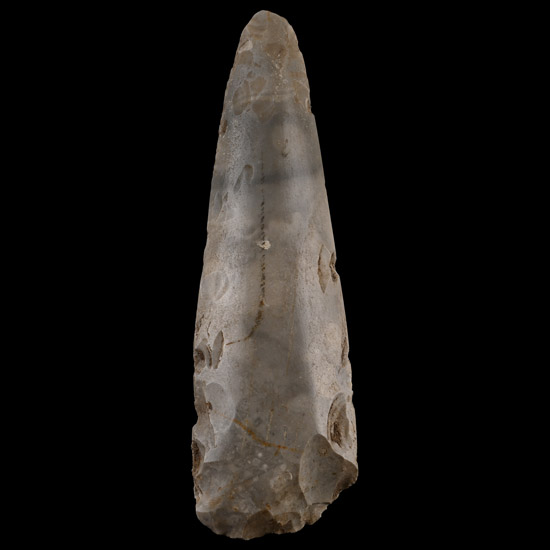
Norfolk Stone Age Polished Stone Axehead
Neolithic Period, circa 6,000 B.P.Estimate: £50 - 70 (+bp*)
Opening Bid: £5
Leaf-shaped in plan, with a rounded butt and tip. 55 grams, 10.9 cm
Found Norfolk, UK. Acquired on the UK art market in the 1980s. From an East Anglian private collection. -
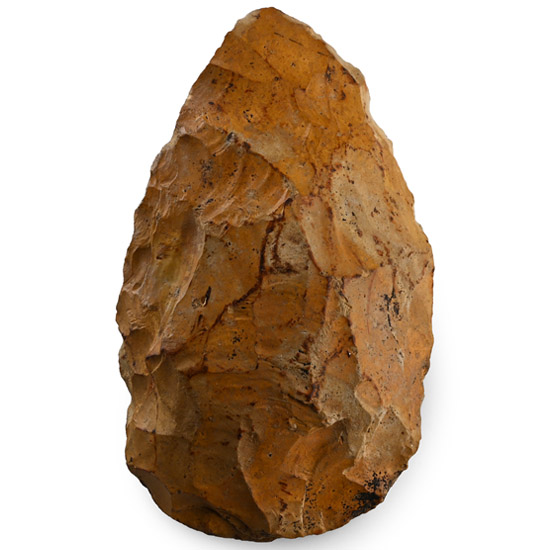
Hampshire Stone Age Knapped Flint Handaxe
Middle Palaeolithic Period, circa 150,000-60,000 B.P.Estimate: £150 - 200 (+bp*)
Opening Bid: £5
Leaf-shaped in plan with broad rounded butt; inked legend 'Privett Hants PAL 170'. 161 grams, 99 mm
Found Privett, Hampshire, UK. Ex Martin Doyle collection, Leverstock, UK, 1980s-2000s. -
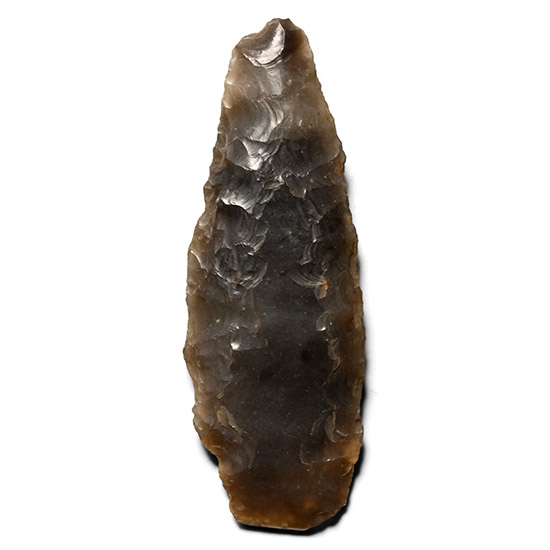
Farnham Stone Age Knapped Spearhead
Neolithic Period, circa 6,000 B.P.Estimate: £60 - 80 (+bp*)
Opening Bid: £5
Lentoid in section and leaf-shaped in plan with square butt and cortex to the rear of the upper face. 8 grams, 56 mm
Found during the original official excavations in the Farnham area, Surrey, UK, which were conducted by Harold Falkner (1875-1963) and William Francis Rankine (c.1877-1962), who were instrumental in the excavation works and pit dwellings at sites including Six Bells, Frensham, Tilford, Thursley and Bagshot, and Waverley, amongst others, at and near Farnham in the 1930s and 1940s. Much of the material is now in the prestigious Farnham museum. The present part of the collection having been gifted to their good friend and Haselmere Parish Priest, Charles Borelli (c.1914-2000) of Farnham, who was part of the Borelli family from Italy who emigrated from Lake Como in 1828 to set up the Borelli family watch and jewellery business; thence by family descent to his nephew. -
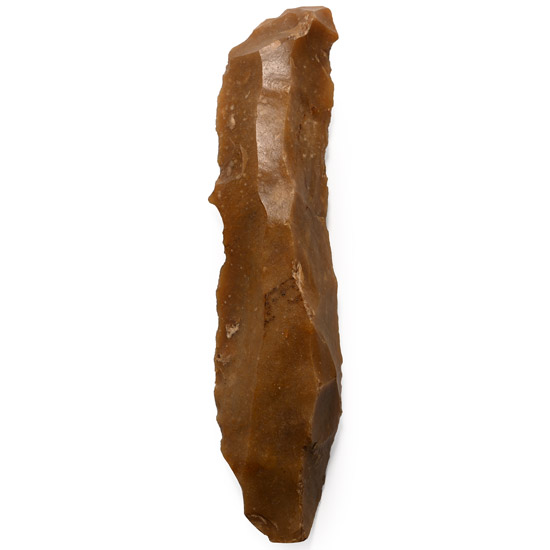
Gran Pressigny French Stone Age Knapped Long Blade Knife
Neolithic Period, circa 6000 B.P.Estimate: £50 - 70 (+bp*)
Opening Bid: £5
Slender leaf-shaped in plan and triangular in section, with tapering ends. 113 grams, 15.4 cm
From the famed and desired region of Gran Pressigny, France. Ex Chauvais collection, formed in the early 1900s. From the private collection of an East Anglian, UK, specialist collector. -
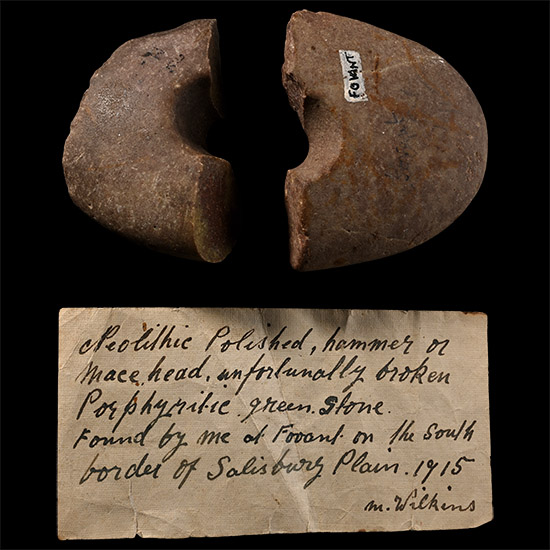
Salisbury Plain Stone Age Polished Stone Macehead Section Group with Handwritten Finder's Note
Neolithic Period, circa 6,000 B.P.Estimate: £80 - 100 (+bp*)
Bids: 1 | Current Bid: £5
Polished porphyritic macehead fragment, lentoid in section; another from Wiltshire, UK, similar, plano-convex in section; accompanied by an old manuscript note signed by M. Wilkins: 'Neolithic polished hammer or macehead, unfortunately broken; porphyritic green stone, found by me at Fovant on the south border of Salisbury Plain. 1915'. 247 grams total, 71-73 mm
Found by M Wilkins on the South border of Salisbury Plain in 1915. This collection was gifted to Haselmere Parish Priest, Charles Borelli (c.1914-2000) of Farnham; who was part of the Borelli family from Italy who emigrated from Lake Como in 1828 to set up the Borelli family watch and jewellery business; thence by family descent to his nephew. Accompanied by an original handwritten note from the finder. -
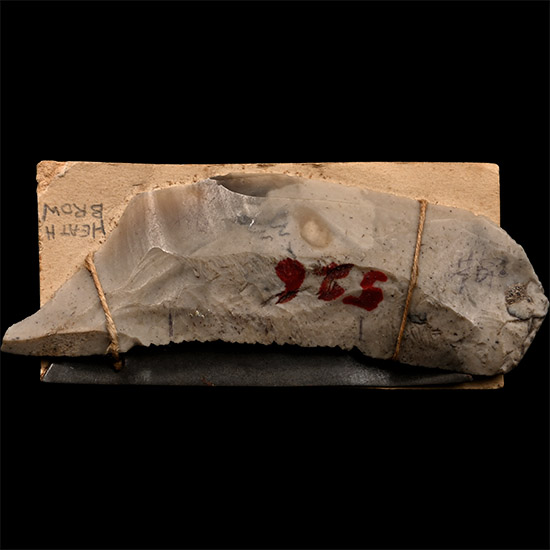
Brown Heath Cheshire Stone Age Flint Saw on Card
Neolithic Period, circa 6,000 B.P.Estimate: £80 - 100 (+bp*)
Opening Bid: £5
Parallel-sided with rounded butt and one serrated edge; inked '526' legend and some faded pencil notations; card with 'Heath Brow' legend. 11.8 grams total including card, 75 mm
Found Brown Heath, Cheshire, UK in 1911. This saw was gifted to Haselmere Parish Priest, Charles Borelli (c.1914-2000) of Farnham; who was part of the Borelli family from Italy who emigrated from Lake Como in 1828 to set up the Borelli family watch and jewellery business; thence by family descent to his nephew. -
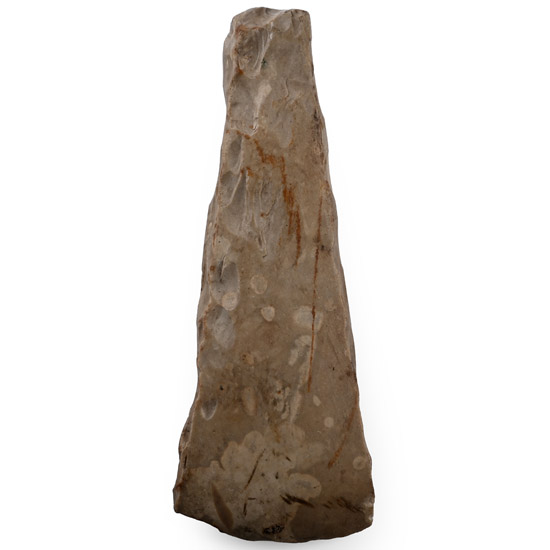
Danish Stone Age Knapped Thick-Butted Polished Axehead
Neolithic Period, circa 6,000 B.P.Estimate: £120 - 170 (+bp*)
Opening Bid: £5
Rectangular-section shank flaring to a broad cutting edge, square butt; a handwritten label reading 'Dr. A.E.Peake coll., Danish Neolithic axe' 190 grams, 13.5 cm
From the collection of Dr A.E.Peake. From the private collection of Peter Clayton, FCILIP, Dip, Arch, FSA, FRNS, Hemel Hempstead, Hertfordshire, UK; formed since the late 1950s. -
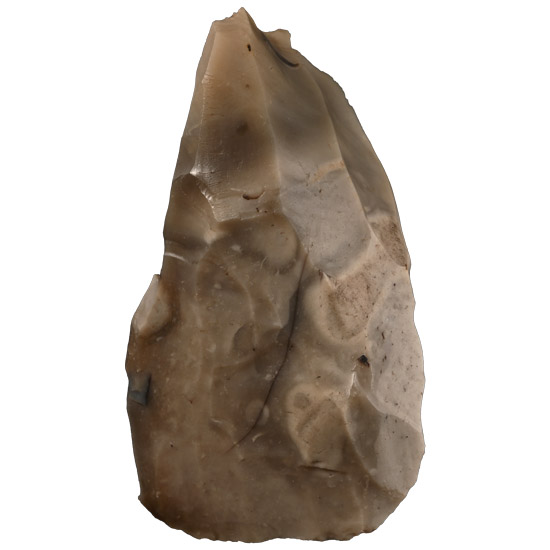
Farnham Trottsford Stone Age Knapped Flint Chisel
Neolithic Period, circa 6,000 B.P.Estimate: £80 - 100 (+bp*)
Opening Bid: £5
Cordate in profile with transverse cutting edge; old typed label 'Trottsford Lay, 1948' and inked 'Trottsford [..]48'. 46.3 grams, 58 mm
Found Trottsford, near Farnham, Surrey, UK, May 1948. Found during the original official excavations in the Farnham area, Surrey, UK, which were conducted by Harold Falkner (1875-1963) and William Francis Rankine (c.1877-1962), who were instrumental in the excavation works and pit dwellings at sites including Six Bells, Frensham, Tilford, Thursley and Bagshot, and Waverley, amongst others, at and near Farnham in the 1930s and 1940s. Much of the material is now in the prestigious Farnham museum. The present part of the collection having been gifted to their good friend and Haselmere Parish Priest, Charles Borelli (c.1914-2000) of Farnham, who was part of the Borelli family from Italy who emigrated from Lake Como in 1828 to set up the Borelli family watch and jewellery business; thence by family descent to his nephew.
Farnham district is one of the most interesting prehistoric regions in England, and has been visited by a succession of prehistoric peoples from Palaeolithic times onwards. Along the southern slope of the Farnham valley are three gravel terraces, which are famous prehistorically and have yielded large quantities of flint implements and bones of prehistoric animals, notably the mammoth. In prehistoric times, the chalk deposits played an important role in attracting settlers, as they contained rich layers of flint nodules used to make implements. The Farnham Gravels have been an abundant source of Palaeolithic finds, most prominent being hand axes. The axes differ in type, and each type is associated with a cultural phase of the Palaeolithic period. Types similar to these are found in similar deposits in the Somme valley and in many English valley gravels. Flint mining was also carried out by the Neolithic folk. Polished axes and leaf forms, arrowheads and knives, or possibly lance heads, are characteristic of the Neolithic flint work. -
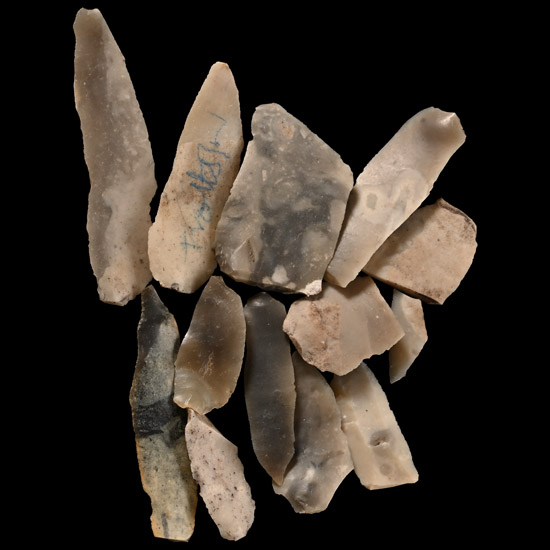
Farnham Stone Age Knapped Blade Group
Mesolithic Period, circa 9000 B.P.Estimate: £60 - 80 (+bp*)
Opening Bid: £5
Microlith edge and end scrapers; in an old safety-match box with inked label to top 'Mesolithic blade Trottsford' and another to one end with same legend. 24.8 grams total including box, 16-51 mm
Found Trottsford during the original official excavations in the Farnham area, Surrey, UK, which were conducted by Harold Falkner (1875-1963), and William Francis Rankine (c.1877-1962), who were instrumental in the excavation works and pit dwellings at sites including Six Bells, Frensham, Tilford, Thursley, Bagshot, and Waverley, amongst others, at and near Farnham in the 1930s and 1940s. Much of the material is now in the prestigious Farnham museum. The present part of the collection having been gifted to their good friend and Haselmere Parish Priest, Charles Borelli (c.1914-2000) of Farnham, who was part of the Borelli family from Italy who emigrated from Lake Como in 1828 to set up the Borelli family watch and jewellery business; thence by family descent to his nephew.
Farnham district is one of the most interesting prehistoric regions in England, and has been visited by a succession of prehistoric peoples from Palaeolithic times onwards. Along the southern slope of the Farnham valley are three gravel terraces, which are famous prehistorically and have yielded large quantities of flint implements and bones of prehistoric animals, notably the mammoth. In prehistoric times, the chalk deposits played an important role in attracting settlers, as they contained rich layers of flint nodules used to make implements. The Farnham Gravels have been an abundant source of Palaeolithic finds, most prominent being hand axes. The axes differ in type, and each type is associated with a cultural phase of the Palaeolithic period. Types similar to these are found in similar deposits in the Somme valley and in many English valley gravels. Flint mining was also carried out by the Neolithic folk. Polished axes and leaf forms, arrowheads and knives, or possibly lance heads, are characteristic of the Neolithic flint work. -
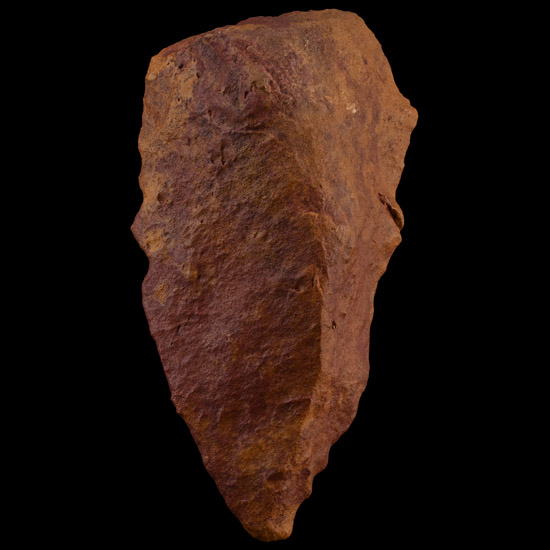
Large Stone Age Red Quatzite Pointed Handaxe
Lower Palaeolithic Period, circa 1,000,000-500,000 B.P.Estimate: £100 - 140 (+bp*)
Bids: 1 | Current Bid: £5
Leaf-shaped in plan and triangular in section, inked inscription 'Libyen 82'. 605 grams, 16 cm
Found Libya, North Africa. From a private collection formed during the 1970s-1980s, having been acquired on the British art market; thence by descent to the current owner in 1998. -
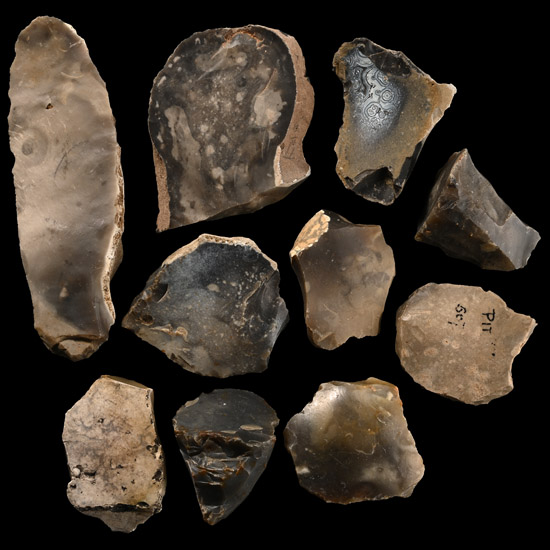
Farnham Stone Age Knapped Flint Tool and Blade Core Group
Neolithic Period, circa 6000 B.P.Estimate: £150 - 200 (+bp*)
Opening Bid: £5
Blades and blade-cores, some with inked findspot 'Moor Park (B) 38', 'Pit 507' and other data. 380 grams total, 4.1-11.2 cm
Found during the original official excavations in the Farnham area, Surrey, UK, which were conducted by Harold Falkner (1875-1963) and William Francis Rankine (c.1877-1962), who were instrumental in the excavation works and pit dwellings at sites including Six Bells, Frensham, Tilford, Thursley and Bagshot, and Waverley, amongst others, at and near Farnham in the 1930s and 1940s. Much of the material is now in the prestigious Farnham museum. The present part of the collection having been gifted to their good friend and Haselmere Parish Priest, Charles Borelli (c.1914-2000) of Farnham, who was part of the Borelli family from Italy who emigrated from Lake Como in 1828 to set up the Borelli family watch and jewellery business; thence by family descent to his nephew.
Farnham district is one of the most interesting prehistoric regions in England, and has been visited by a succession of prehistoric peoples from Palaeolithic times onwards. Along the southern slope of the Farnham valley are three gravel terraces, which are famous prehistorically and have yielded large quantities of flint implements and bones of prehistoric animals, notably the mammoth. In prehistoric times, the chalk deposits played an important role in attracting settlers, as they contained rich layers of flint nodules used to make implements. The Farnham Gravels have been an abundant source of Palaeolithic finds, most prominent being hand axes. The axes differ in type, and each type is associated with a cultural phase of the Palaeolithic period. Types similar to these are found in similar deposits in the Somme valley and in many English valley gravels. Flint mining was also carried out by the Neolithic folk. Polished axes and leaf forms, arrowheads and knives, or possibly lance heads, are characteristic of the Neolithic flint work.
