
Ancient Art, Antiquities, Books, Natural History, Stamps & Coins

-
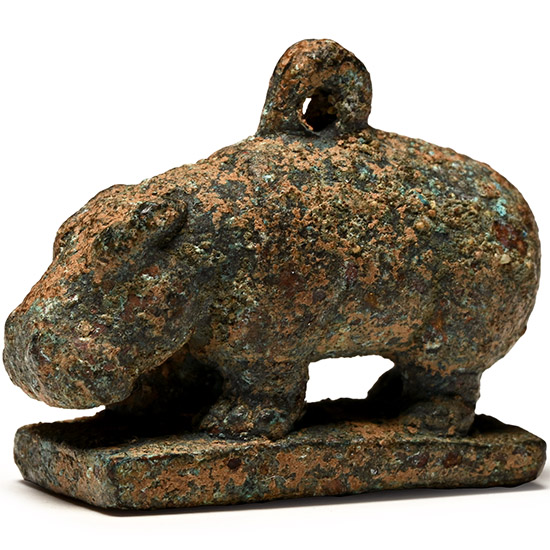
Egyptian Bronze Hippopotamus Amulet
Late Period, 664-332 B.C. or laterEstimate: £600 - 800 (+bp*)
Opening Bid: £300
Modelled in the round on a rectangular base with a dorsal loop. 20.5 grams, 26 mm
Ex mid 19th century London, UK, collection.
Metal hippopotamus amulets are comparatively rare compared with faience and stone examples. A gold hippopotamus amulet of similar size was discovered in Tomb W 643 at Meroe, Sudan, and is now in the Museum of Fine Arts, Boston (inv. no. 23.380). Egyptian art depicted the Nile hippopotamus in Old, Middle, and New Kingdom limestone reliefs, as well as in faience, stone, and metal statuettes. Egyptians both admired and feared them: powerful and unpredictable, hippos attack when threatened. Their fearsome reputation made them potent apotropaic amulets, giving the wearer power over evil and chaotic forces. -
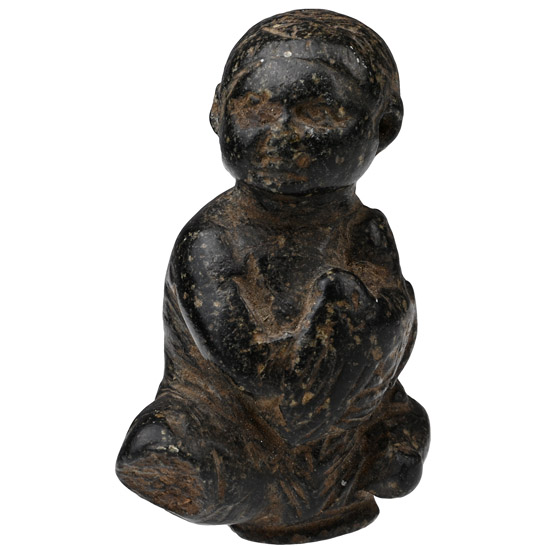
Egyptian Steatite Statuette of a Boy
Alexandria, 3rd century B.C.Estimate: £250 - 350 (‡+bp*)
Opening Bid: £135
Modelled in the round figure of a child crouching holding a bird close to his chest; socket to each ear; mounted on a custom-made stand. 67.4 grams total, 5 cm, 10 cm high including stand
Ex Herbert A.Cahn, Basle, 1960s. -
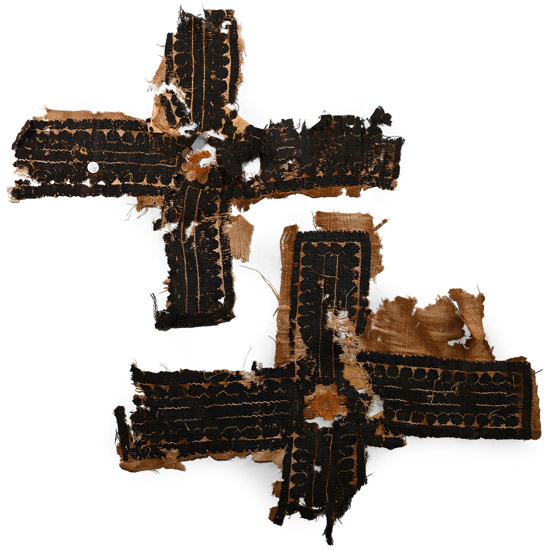
Large Egyptian Coptic Tunic Textile Fragments Embroidered with Geometric Patterns
Circa 5th century A.D.Estimate: £80 - 100 (+bp*)
Opening Bid: £5
Comprising a large portion of a clavi of a tunic, with the complete section passing across the shoulders ornamented with striped bands, filled with geometric lines and patterns, bordered with plain stripes, decorated at the intersection by a yellow flower; in wool, yellow and dark blue tapestry on linen. 94 grams total including paper folder, 55.5 cm
Acquired 1970s-1996. Property of a North American collector. London collection, 2016.
The fragments are decorative parts of tunics. These are fabrics of great decorative finesse, with some elements displaying an unusual and extremely well-preserved colour palette. -
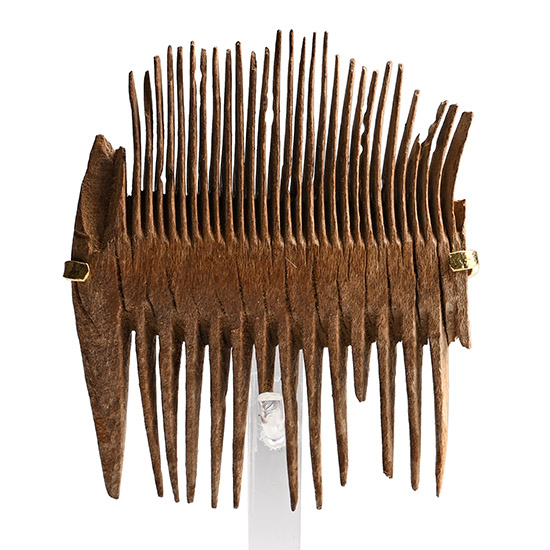
Egyptian Coptic Wooden Comb
Circa 4th-7th century A.D.Estimate: £500 - 700 (‡+bp*)
Opening Bid: £230
With fine teeth cut on one side and coarser teeth on the other; some absent; mounted on a custom-made stand. 12.62 grams total, comb: 51 mm, 85 mm high including stand
Ex Carl Leonhard Burckhardt-Reinhard (1902-1965), formed since 1922, Egypt. Inherited by his son Christopher Burckhardt in 1966, Switzerland. Since then in the possession of his wife, Switzerland.
The type is attested in Egypt, where it is particularly well documented in the Coptic Period. The lack of decoration makes a more precise chronological classification difficult. As evidenced by a wooden comb of the same type from Antinoë, the fine-toothed side was also used for removing head lice. In the present example, the comb continued on one side for an indeterminate length. -
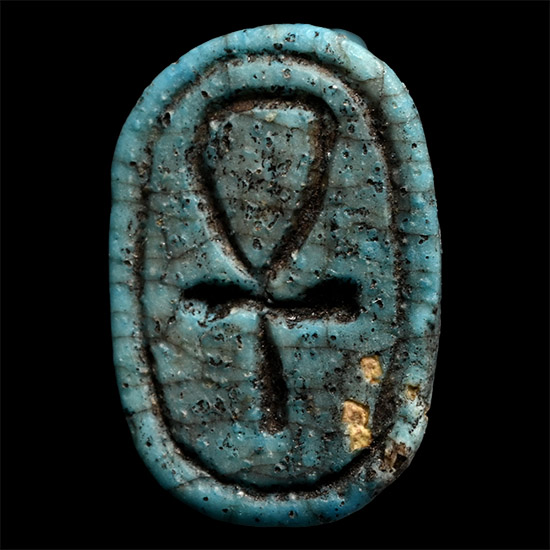
Egyptian Faience Scaraboid Frog Amulet with Ankh
Late Period, 664-332 B.C.Estimate: £120 - 170 (+bp*)
Opening Bid: £60
Modelled in the round, crouching on a rectangular base, incised ankh to the underside. 0.48 grams, 11 mm
From an important UK collection, 1940s.
Frog amulets in ancient Egypt symbolised fertility, rebirth, and renewal. Associated with the goddess Heqet, linked to childbirth and life-giving forces, they were especially popular for fertility and for protection during pregnancy and labour. Their association with the annual Nile flood, which brought new life to the land, further emphasised their symbolism of revival and abundance. The ancient Egyptian ankh hieroglyph on the amulet's base, meaning "life," reinforces the creature's symbolism. -
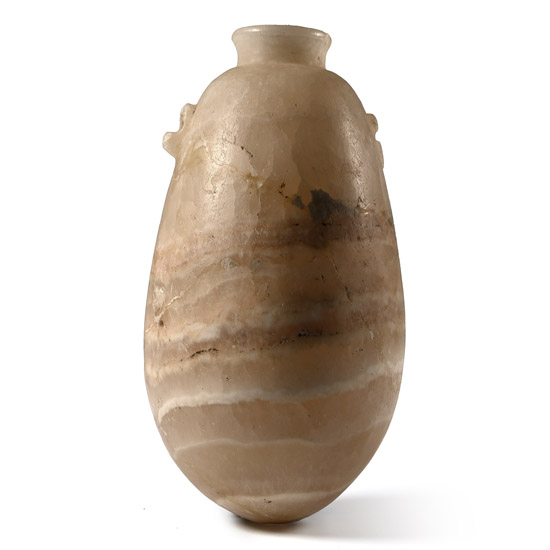
Egyptian Alabaster Alabastron
Late Period, 664-332 B.C.Estimate: £500 - 700 (‡+bp*)
Opening Bid: £250
Ovoid jar with a rounded base, concave shoulders and flared neck; remains of lug handles, restored. 332 grams, 14 cm
Acquired in the mid 1980s-1990s. Private collection, Switzerland, thence by descent. Private collection, since the late 1990s. -
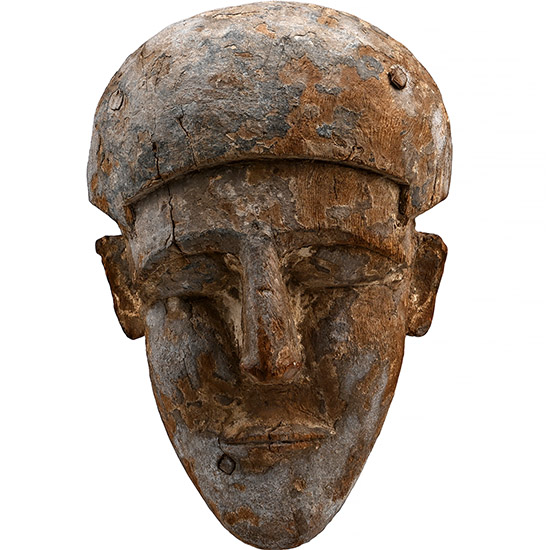
Egyptian Carved Cedar Wood Sarcophagus Mask
Ptolemaic-Roman Period, 332 B.C.-100 A.D.Estimate: £1,000 - 1,400 (+bp*)
Opening Bid: £500
From the lid of an anthropoid coffin, representing the idealised features of the deceased beneath a broad, rounded wig, the elongated face modelled with large almond-shaped eyes beneath extended brows, a prominent nose, delineated lips and projecting ears, the chin tapering to a rounded point; a curved incision separates the headdress from the forehead, the broadly flattened reverse preserving sockets and wooden plugs from the original pegged attachment to the coffin lid; preparatory gesso and traces of polychrome decoration remaining across the face and headdress; mounted on a modern metal display stand. 1.43 kg total, 32.5 cm including stand
Private collection, Yorkshire, UK, acquired in the mid-20th century.
Wooden coffins were mostly manufactured from multiple elements, often with the face and front portion of the headdress carved separately and attached to the lid using dowels. -
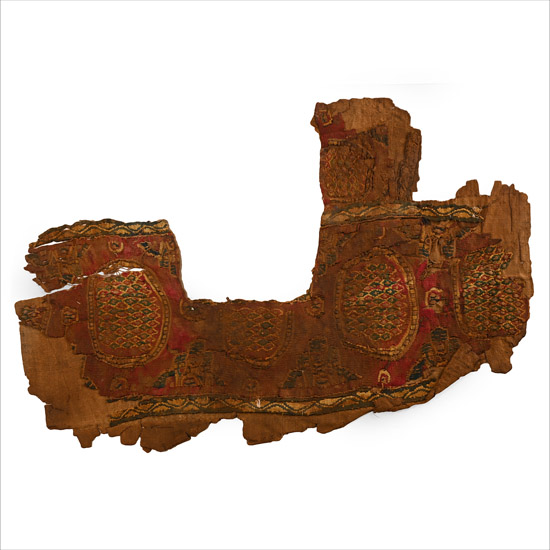
Large Egyptian Coptic Textile Fragment of a Tunic Collar Embroidered with Geometric Patterns
Circa 5th century A.D.Estimate: £80 - 100 (+bp*)
Opening Bid: £5
The complete collar section (maniakion) ornamented with decorative circular bands, filled with geometric patterns of floral elements, bordered with stripes of interlaced vegetal motifs in yellow-orange, green, red, yellow and purple wool warp on linen; a part of the right clavus still preserved, decorated in the same manner. 142 grams total including paper folder, 49 cm
Acquired 1970s-1996. Property of a North American collector. London collection, 2016.
In Late Roman Egypt, this type of tunic, with wide decorative collars around the neck, was worn by rich aristocratic women and was part of the decoration of rich garments like the tunica talaris. -
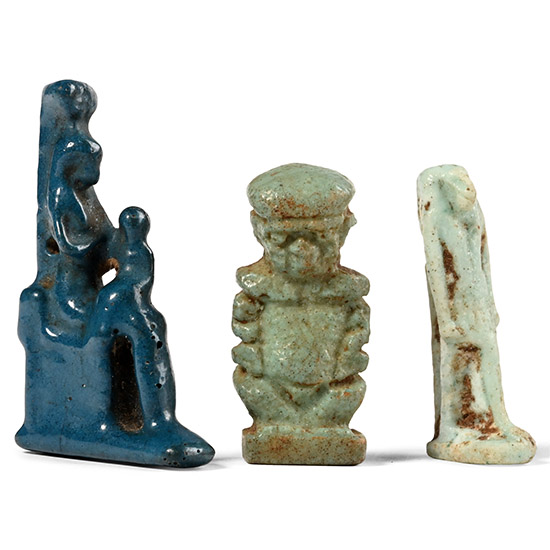
Egyptian Faience Amulet Group
Late-Ptolemaic Period, circa 664-30 B.C. and laterEstimate: £300 - 400 (+bp*)
Opening Bid: £100
Comprising a glassy faience Isis Lactans, depicted with Nephthys's headdress; a bandy-legged nude Pataikos; and a striding anthropomorphic Thoth. 6.59 grams total, 25-32 mm
Ex Chris Belton Artefacts, 1980s. -
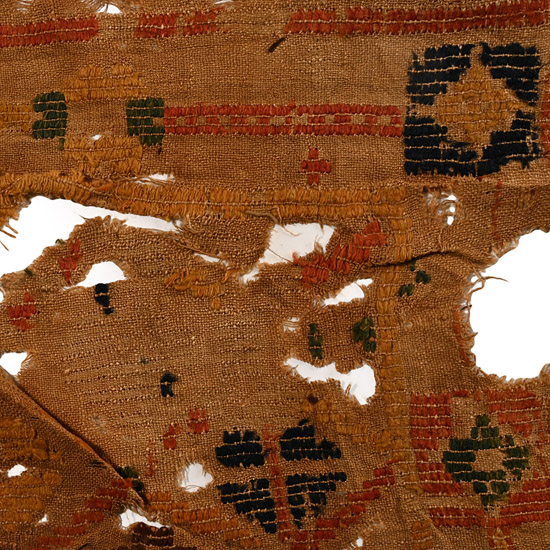
Egyptian Coptic Wall Tapestry Textile Fragment with Geometric Ornament
Circa 6th century A.D.Estimate: £60 - 80 (+bp*)
Opening Bid: £5
Fragment of tapestry or a cloak in light fabric, S-twist tapestry, embroidered with red, green, yellow, blue geometric ornaments in wool and linen. 37 grams total including paper folder, 37 cm
Acquired 1970s-1996. Property of a North American collector. London collection, 2016.
Most of the linen or wool garments found by A. Gayet in the Antinoe necropolis were woven in a specific pattern, in a single piece, on a horizontal warp. Another relatively common pattern for linen garments consisted of assembling three pieces woven on a single warp and forming the upper part of the garment, with the collar and sleeves. -
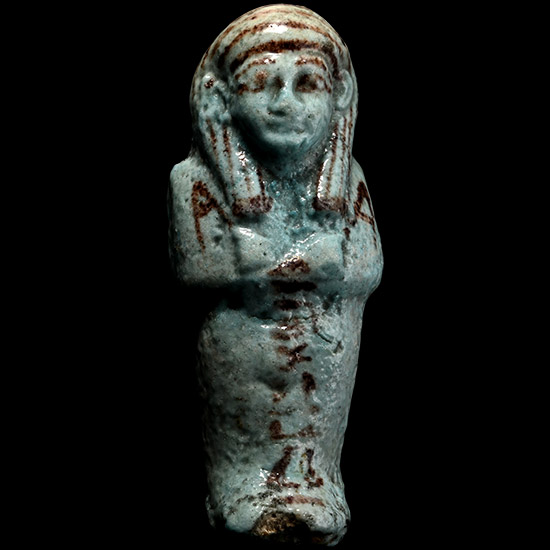
Egyptian Blue Glazed Shabti of Payefadjer
Third Intermediate Period, 21st Dynasty, circa 1070-945 B.C.Estimate: £500 - 600 (‡+bp*)
Opening Bid: £275
Squat mummiform type with face framed by a tripartite wig, hands modelled in relief, holding agricultural tools applied in paint; seed-bag at the back; central vertical hieroglyphic inscription on the lower front reading: 'The Osiris, wab-(priest), lector-(priest), Payefadjer (pꜢy.f-Ꜥḏr), true of voice'. 93 grams, 96 mm
Ex Ms E.C.(1923-2014), Israel. Inherited by her son D.L., Switzerland. -
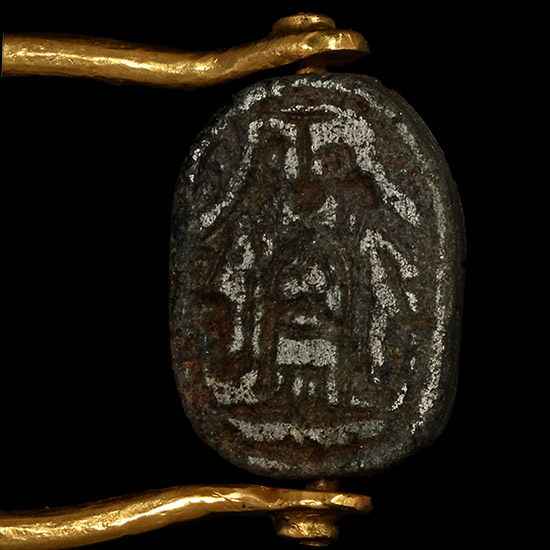
Phoenician Lapis Lazuli Scarab in Gold Swivel Ring
6th-4th century B.C. and laterEstimate: £1,200 - 1,700 (‡+bp*)
Opening Bid: £600
With lightly incised anatomical detailing to the scarab; the underside with a central cartouche flanked by two rearing crowned uraei, a pair of falcons standing above the cartouche facing a smꜣ hieroglyph symbolising union (of the two lands, Upper and Lower Egypt); set into a later gold swivel ring. 4.34 grams, 26.44 mm overall, 15.68 mm internal diameter (approximate size British J 1/2, USA 5, Europe 9.32, Japan 9)
with Bonhams, London, UK, 21 October 1999, no.36. Private collection, Europe. This lot has been checked against the Interpol Database of stolen works of art and is accompanied by a search certificate number no.12370-226696.
