-
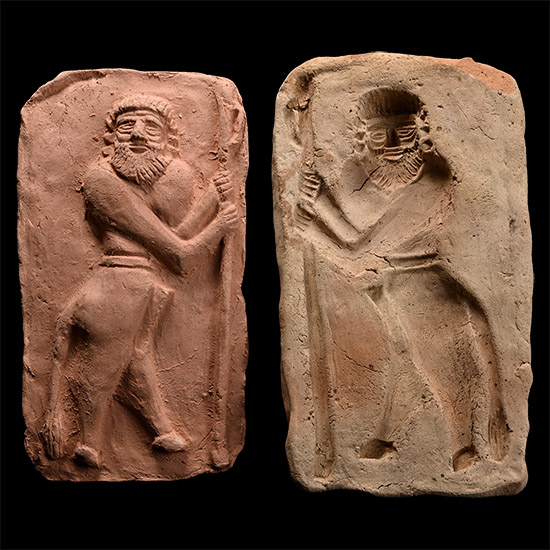
Old Babylonian Ceramic Plaque Mould of a Standing God
Early 2nd millennium B.C.Estimate: £2,000 - 3,000 (+bp*)
Opening Bid: £1,000
Rectangular mould with a recess formed as Kusarikku holding a long standard, his bearded face depicted frontally, whereas his lower body formed as a bull's legs and tail is depicted facing the staff; accompanied by an impression of the mould. 330 grams, 13.3 cm
Mayfair gallery, early 1990s. Ex North American gentleman collection. This lot has been checked against the Interpol Database of stolen works of art and is accompanied by search certificate no.13480-263297.
Kusarikku was a benevolent protective deity used to ward off evil spirits from temples and homes. -

Amlash Terracotta Horse Rhyton
10th century B.C.Estimate: £4,000 - 6,000 (+bp*)
Opening Bid: £2,222
Hollow-formed rhyton with four splayed legs, curved neck with tall mane, loop handle forming the tail; filler hole to the middle of the back, spout to the chest; incised hatched bands to the mane and flank. 2.1 kg, 37 cm
Sakae Art Gallery, Nagoya, Japan, 1982. with Aaron Gallery, acquired from the above. Accompanied by thermoluminescence analysis report no.N121q65 by Oxford Authentication. This lot has been checked against the Interpol Database of stolen works of art and is accompanied by search certificate no.12822-241329.
Amlash terracotta rhytons, significant objects of this culture, are ancient Near Eastern terracotta vessels, dating back to around 1000 BC, often in the shape of animals, particularly zebu bulls. Rhytons were used for holding and drinking wine or other liquids, and characterised by their detailed animal forms and often featuring incised details; some restoration. -
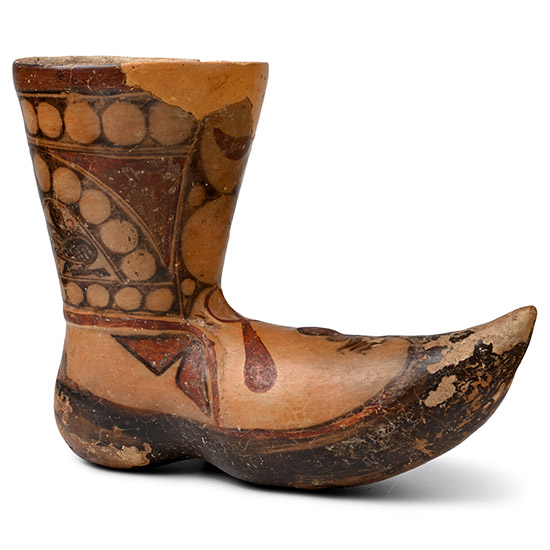
Western Asiatic Rhyton in the Form of a Boot
Late 1st millennium B.C.Estimate: £1,500 - 2,000 (‡+bp*)
Opening Bid: £825
With rich bichrome ornamentation in black and beige bordered by a red line, pointed tip with a small pouring hole on the underside; funicular upper section decorated with red ornamentation of a stylised bird surrounded by an arcade with reserved circles on each side; band of reserved circles above at the rim; bootleg and heel partly restored, interior encrusted. 475 grams, 20 cm long
Ex Elie Borowski, Basel, March 1975. From the collection of Italian palaeontologist and Scholar Giancarlo Ligabue (1931-2015). -

Late Hittite Shoe-Shaped Vessel
2nd millennium B.C.Estimate: £2,500 - 3,500 (‡+bp*)
Opening Bid: £1,389
Hollow-formed shoe-shaped jug with rolled rim to the ankle, tab with hole for thong and stopper; welt-line to upper face and around sole. 585 grams, 23 cm
Private collection, acquired on the German art market in 1993; thence by descent. This lot has been checked against the Interpol Database of stolen works of art and is accompanied by a search certificate no.13226-249313.
These upturned shoes are characteristic of the whole Hittite era. They are attested until the Late Hittite age. This kind of footwear appears later in the Aegean area, probably due to the influence of Anatolian fashion on Bronze Age Greek culture. It may have been the case that the Akkiyawa (Achaeans) living on the western coast of Anatolia adopted such items (as many others) from the Anatolian Indo-Europeans and exported them to the Greek lands, with the first examples attested in Greece only around the 14th century BC. -
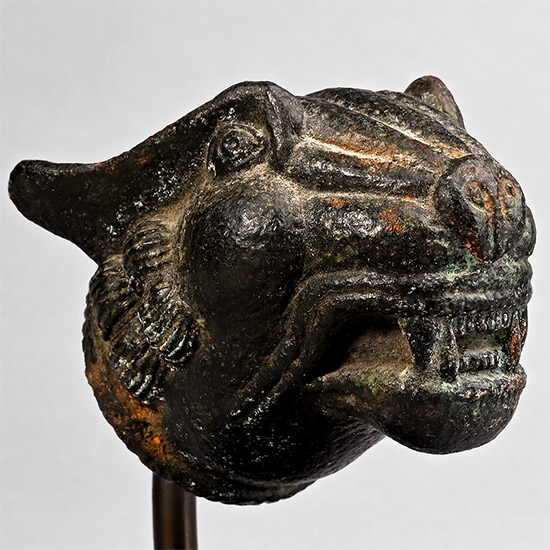
Amlash Bronze Lion Protome
8th-6th centuries B.C.Estimate: £1,000 - 1,400 (+bp*)
Opening Bid: £500
Modelled in the round and hollow to the reverse with segmented collar, ribbing to the muzzle and fur texture to the cheeks, mouth with parted lips and fangs exposed; swept ears and lentoid eyes; mounted on a custom-made display stand. 523 grams total, lion: 67.7 mm long
Acquired on the UK art market, 1990s-2000s. Private collection, London, UK. -

Western Asiatic Bronze Statuette of a Levantine Cavalryman
7th-4th century B.C.Estimate: £3,500 - 4,500 (‡+bp*)
Opening Bid: £1,900
Modelled in the round figurine of a sturdy horse with saddlecloth and chest-band, bridle and reins, integral rider wearing a Phrygian helmet. 140 grams, 88 mm wide
Formerly in a private collection, Beirut, Lebanon, 1990s. Swiss private collection, acquired from Mr H., Geneva, 2010. Accompanied by an academic report by Dr Raffaele D’Amato. This lot has been checked against the Interpol Database of stolen works of art and is accompanied by search certificate number no.13178-249181.
The figure possibly represents a Phrygian cavalryman of the Persian Achaemenid army. It shows minute details of the harness, with a muzzle and snaffle bit, which suggest Assyrian or Syrian origin. The transversal decoration of the antilina strap recalls that of the Persian cavalry of the period (Cassin Scott, 1977, plate D). -
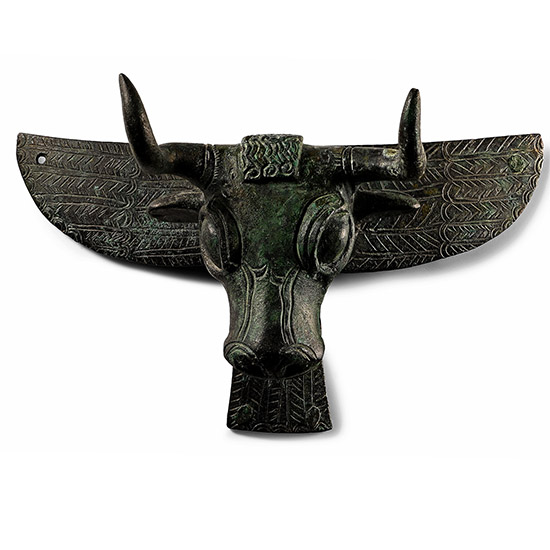
Urartu Bull-Headed Bronze Cauldron Applique
8th century B.C.Estimate: £6,000 - 8,000 (‡+bp*)
Opening Bid: £3,333
Formed as D-shaped wings and a tail with low-relief feather detailing and holes to accept rivets; central head and neck of a bull with prominent horns, bands of curly hair to the plate and throat, large scaphoid eyes, incised contour detailing to muzzle, socket to reverse. 437 grams, 13.4 cm
From the warehouse of Lane Hope Ltd, London, UK, 1980s (company dissolved December 1991). Private collection, UK; anonymous sale, Gorny & Mosch, Munich, Auction 206, 20 June 2012, no.85 (Part). European private collection, acquired from the above. Accompanied by a copy of an Art Loss Register certificate, no.6210.AM. Accompanied by a copy of the relevant Gorny & Mosch catalogue pages. This lot has been checked against the Interpol Database of stolen works of art and is accompanied by a search certificate no.12696-234610.
The fitting would have formed part of a group of four around the rim of a large bronze cauldron. Urartu was centred in eastern Anatolia, around Lake Van; the capital, Tushpa, was located on the eastern shore, situated on a high and elongated rock outcrop. Most sites boasted a well-built temple situated at the highest point, as well as a number of large storage rooms containing rows of large vessels for storing oil and grains, and massive, well-built fortification walls. -
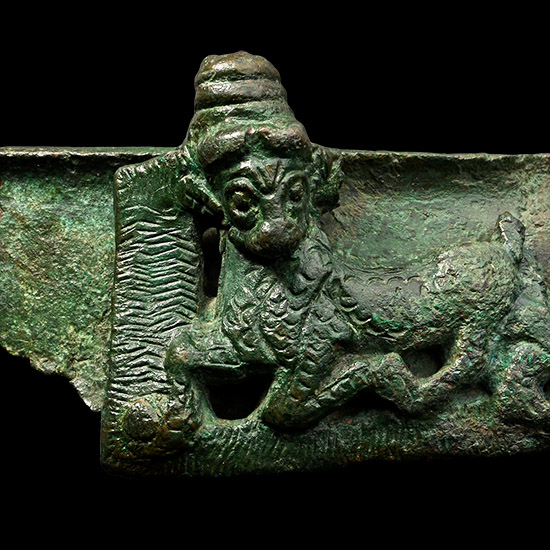
Elamite Bronze Bowl Section with Mythical Beast
1st millennium B.C.Estimate: £1,500 - 2,000 (+bp*)
Opening Bid: £750
Curved section from the rim of a large bowl with an applied plaque depicting a reclining cow with a tiered headdress; accompanied by a custom-made display stand. 397 grams total, 10 cm wide including stand
UK collection, acquired 1970s to 1990s. -
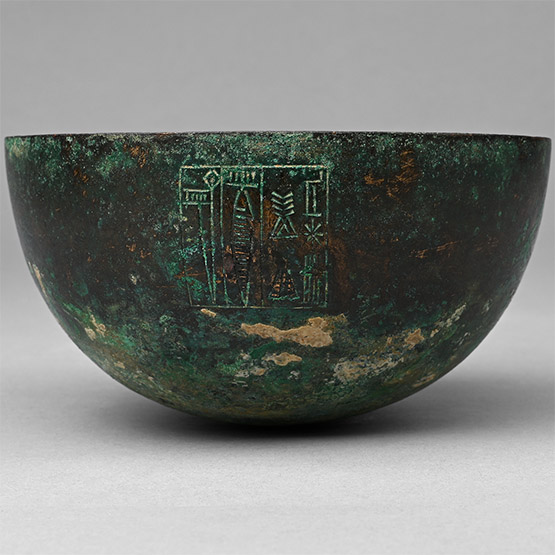
Akkadian Bronze Bowl for King Manishtushu, King of the World
2270–2255 B.C.Estimate: £35,000 - 45,000 (‡+bp*)
Opening Bid: £17,500
Hemispherical in profile with a thin rim; inscribed rectangular panel with three fields, two each with a glyph and the right field with five cuneiform characters referencing King Manishtushu. 273 grams, 13.5 cm
Private collection, London, UK. Swiss private family collection. Believed to be from the same ownership as the bronze bowl sold at Sotheby’s, London, 21 April 1975, no.238. Accompanied by a copy of an Art Loss Register certificate, no.99066. This lot has been checked against the Interpol Database of stolen works of art and is accompanied by search certificate no.13197-249183.
Manishtushu (Akkadian: Man-iš-tušu), son of Sargon of Akkad and brother and successor of Rimush, reigned as king of the Akkadian Empire c. 2270-2255 BC (Middle Chronology). His reign is known primarily from royal inscriptions, administrative texts, and later king lists. Manishtushu consolidated imperial control following internal revolts suppressed under Rimush and pursued military campaigns in both southern Mesopotamia and the Persian Gulf region, notably leading an expedition across the sea, probably to Magan (modern Oman), to secure supplies of diorite and metals for monumental construction. He is particularly associated with extensive land purchases in northern Babylonia, recorded on inscribed stone monuments, which provide rare insight into Akkadian legal and economic practices. These texts suggest a deliberate policy of royal acquisition and redistribution of land, possibly to strengthen central authority. Manishtushu also undertook significant building projects, including temple works at Nippur and elsewhere, dedicating offerings to major deities such as Enlil. His reign ended violently, and later tradition suggests he was assassinated in a palace conspiracy, after which he was succeeded by his son Naram-Sim, under whom the empire reached its greatest territorial extent. -
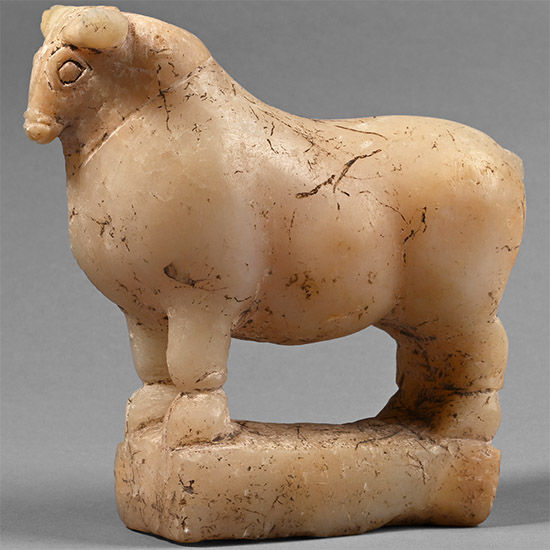
Western Asiatic Alabaster Standing Bull
Sabaean, 3rd-1st century B.C.Estimate: £3,000 - 4,000 (+bp*)
Opening Bid: £1,500
Carved in the round with integral rectangular base; of sturdy build with thick shoulders, rump and legs; latticed hair texture to the brow. 1.14 kg, 14 cm wide
Mrs Janssens, Belgium, formed during the 1970s. Private collection, London, UK. This lot has been checked against the Interpol Database of stolen works of art and is accompanied by search certificate no.12980-245246.
In Sabaean religion, the bull signalled strength, fertility, and divine protection, and is often linked by scholarship with the moon-god Almaqah, the principal deity of the kingdom. Small alabaster figures of this type were likely set up as temple offerings or served as fittings within cultic furnishings; flat undersides or discreet mounting points on some examples suggest attachment to a larger ensemble. -
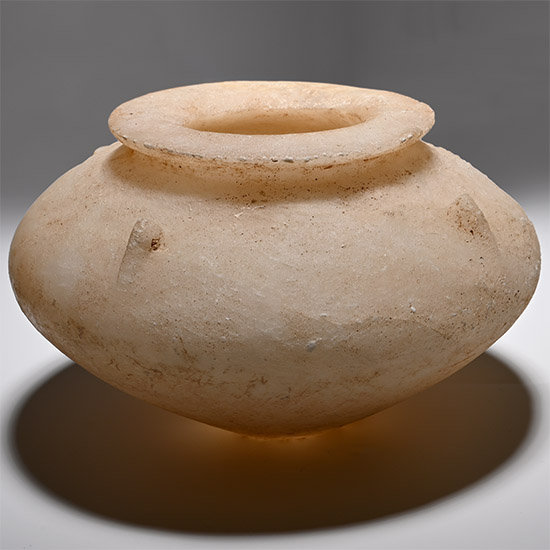
Large Mesopotamian Decorated Alabaster Bowl
3rd millennium B.C.Estimate: £1,200 - 1,700 (+bp*)
Opening Bid: £600
With a conical lower body, broad rounded shoulder and four radiating integral pierced lugs; narrow neck and broad flat rim to the mouth. 2.2 kg, 18.5 cm wide
Acquired on the French art market, formerly in a French collection since the 1970s. with Bonhams, London, 1 May 2013, no.162. Accompanied by copies of the relevant Bonhams catalogue pages. -
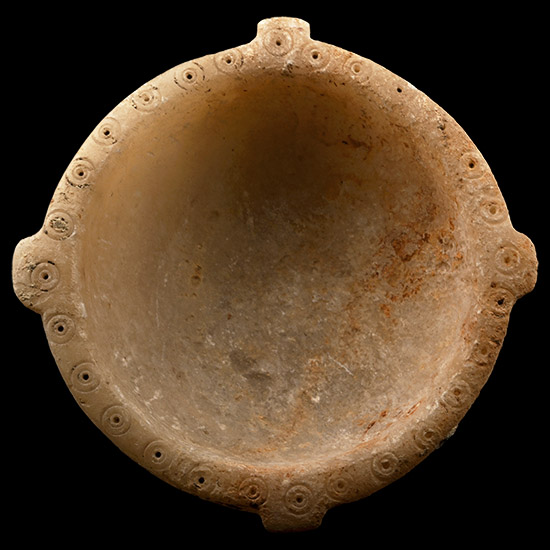
Mesopotamian Alabaster Bowl
1st millennium B.C.Estimate: £800 - 1,000 (‡+bp*)
Opening Bid: £444
With flat rim and four projecting lugs; band of incised concentric rings to the rim and shoulder; curving sidewall to a narrow flat base. 503 grams, 13.2 cm wide
Private collection, USA and Switzerland, acquired in the late 1980s-early 1990s; by descent to the current owner.
Vessels of this typology were used mainly as mortars for crushing legumes, cereals, fruit, spices, the bare minimum needed for preparing daily food, but also for pharmaceutical products and for painting, for mixing colours and ointments.

