
Ancient Art, Antiquities, Books, Natural History, Stamps & Coins

-
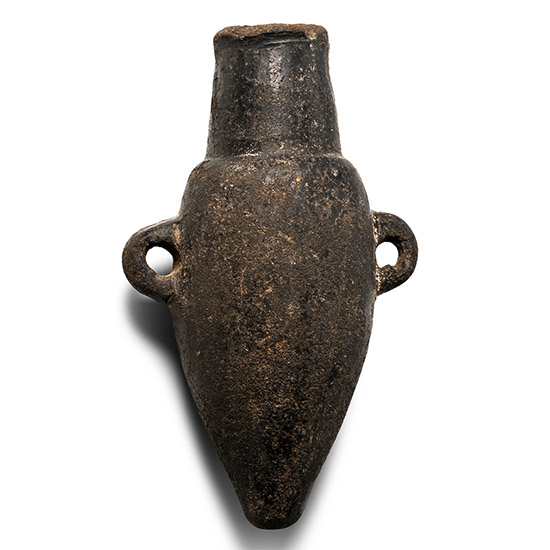
Pre-Columbian Black Ware Terracotta Oil Vessel
Chimu Culture, circa 900 A.D.Estimate: £80 - 100 (+bp*)
Opening Bid: £5
Amphora-shaped vessel with two loop handles and a funicular neck. 117 grams, 11.4 cm
From Paracas, May 1978. Acquired on the UK art market since the 1990s. From the property of a late Lincolnshire, UK, gentleman; thence by descent. Accompanied by a previous catalogue information slip. -
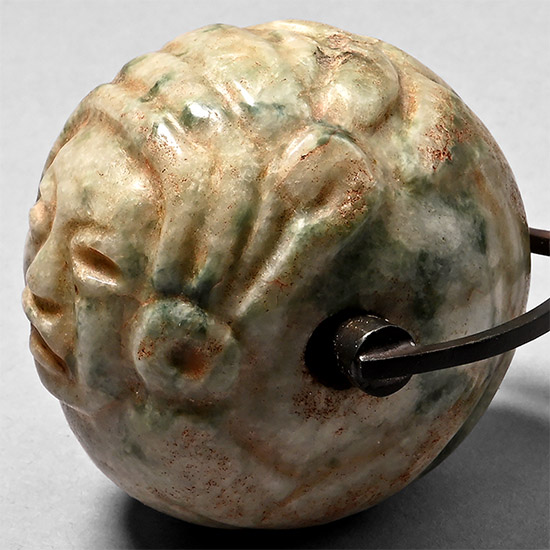
Olmec Jade Circular Pendant with Transformation Deity
Southern Mexico to Guatemala, circa 900-400 B.C. or laterEstimate: £4,000 - 6,000 (+bp*)
Opening Bid: £2,000
Large and circular in profile with carved head and body of a deity with the body of a jaguar and the head of a human, facing with emphasised hair and ears; old inked legend 'GHI.002'; mounted on a custom-made display stand. 309 grams total, pendant: 58.6 mm
Ex William and Carol Thbadeau, acquired 1960s-1980s. Ex private collection, Georgia, USA. Ex Americas Artifacts, Roswell, GA, USA. with Artemis Gallery, 28 November 2016. Private collection, London, UK. This lot has been checked against the Interpol Database of stolen works of art and is accompanied by search certificate no.13463-262416.
The 'transformation figure' is the art-historical name given to the 'were-jaguar' combination of human and feline attributes, probably a shaman in the process of adopting his spirit animal persona. -
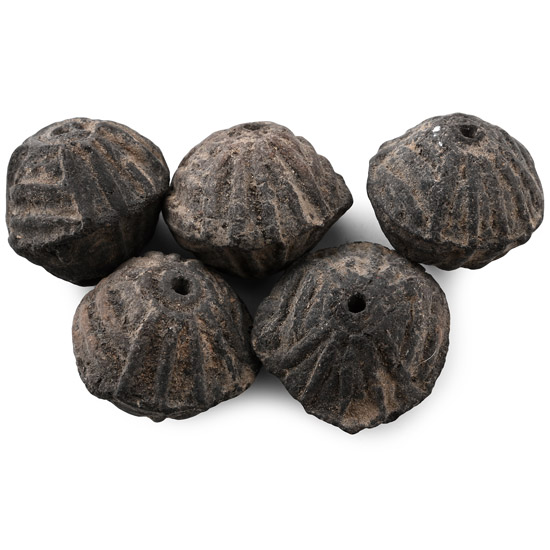
Pre-Columbian Terracotta Bead or Spindle Whorl Collection
Circa 1st millennium A.D.Estimate: £30 - 40 (+bp*)
Opening Bid: £5
Comprising five biconical whorls with radiating line details and a raised rib on the equator. 30 grams total, 20-23 mm
From Chiapas in 1950. Acquired on the UK art market since the 1990s. From the property of a late Lincolnshire, UK, gentleman; thence by descent. Accompanied by a previous catalogue information slip. -
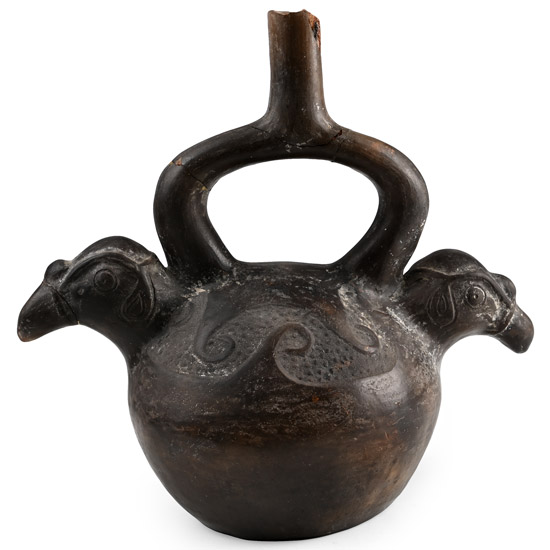
Pre-Columbian Black Ware Stirrup Vessel with Birds Heads
Chimu Culture, circa 1100-1500 A.D.Estimate: £100 - 140 (+bp*)
Bids: 1 | Current Bid: £5
Globular jar with broad base, stirrup-type neck and spout; lateral bird-heads to the shoulder and band of pounced texture with reserved wave-pattern detailing. 315 grams, 22 cm wide
Acquired on the UK art market since the 1990s. From the property of a late Lincolnshire, UK, gentleman; thence by descent. -
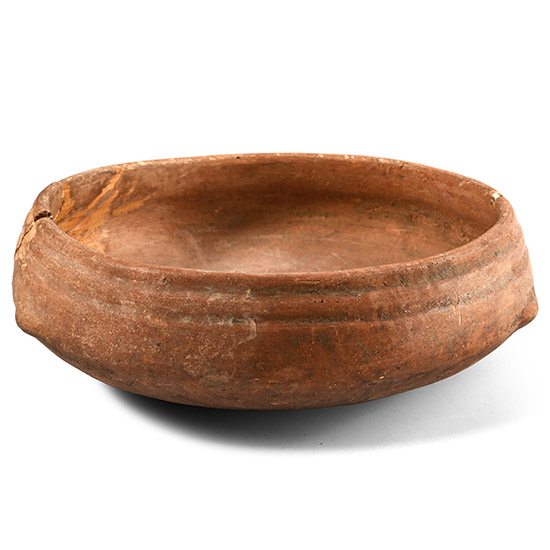
Pre-Columbian Terracotta Ribbed Bowl
Nicoya, circa 800-1200 A.D.Estimate: £50 - 70 (+bp*)
Opening Bid: £5
Shallow round-bottomed bowl with a banded rim, three small lug handles on the shoulder; repaired. 535 grams, 20 cm
From an old Carmarthan, UK, collection, acquired prior to 1930. Acquired on the UK art market since the 1990s. From the property of a late Lincolnshire, UK, gentleman; thence by descent. -
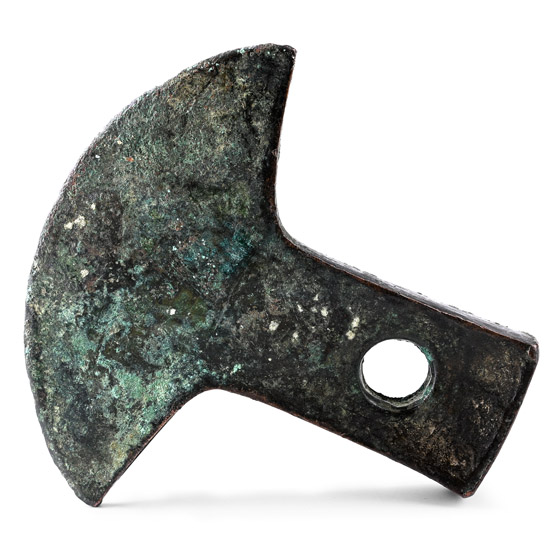
Pre-Columbian Semilunar 'Tumi' Bronze Knife
Inca, 500 A.D.Estimate: £700 - 900 (‡+bp*)
Opening Bid: £389
Curving blade and rectangular shank to the rear with large central socket; square butt. 740 grams, 14.3 cm
Private collection, Israel. Acquired in the 1992. Private collection, Switzerland, thence by descent. Private collection, since the late 1990s.
The Inca inherited a sophisticated metalworking tradition whose origins long predated the rise of their empire. Drawing on skilled artisans from across their territories, especially the north coast, they produced a wide range of objects in gold, silver, copper, and bronze at centres such as Cuzco. Among the most characteristic metal forms of the Inca period were tumis, ceremonial knives typically made of copper or tin bronze, distinguished by a long, curved blade set at a right angle to the handle. These handles could be flat or cylindrical and were often ornamented, while loops at the top suggest that some were suspended from the belt or worn as pendants. Tumis held an important place in ritual life in the Andes and had long been associated with sacrifice, both in ceremonial practice and in visual imagery, where they frequently appear in the hands of deities or supernatural beings. This example is especially striking: the upper handle is formed as the strong talons of a bird of prey, and the textured shaft recalls the rough surface of a raptor’s leg. Such imagery would have carried powerful associations with death and sacrifice, as scavenging and predatory birds were naturally linked with both. The blade also preserves textile impressions, probably the result of long burial. -
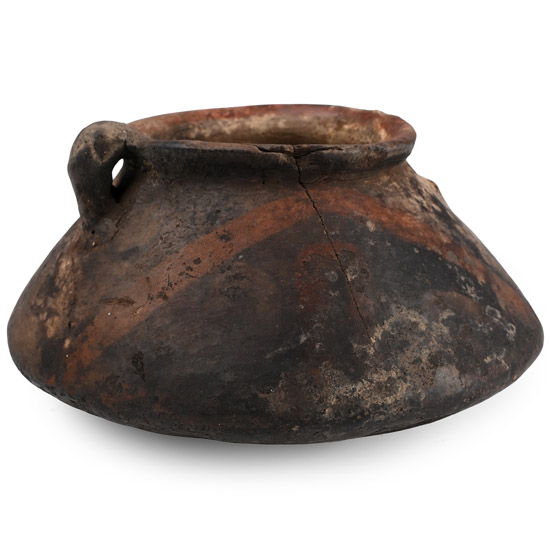
Pre-Columbian Painted Terracotta Handled Jar
Carchi Culture, circa 800-1500 A.D.Estimate: £40 - 60 (+bp*)
Opening Bid: £5
Squat and biconvex in profile with flared rim to the mouth and loop; painted chevron designs to the shoulder. 227 grams, 10.9 cm
Acquired on the UK art market since the 1990s. From the property of a late Lincolnshire, UK, gentleman; thence by descent. -
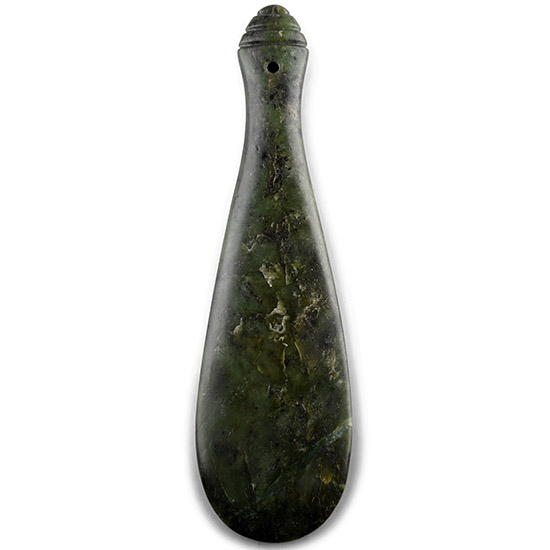
Massive Oceanic Polished Green Nephrite Jade Maori Hand War Club Mere Pounamu
New Zealand, early-mid 20th century A.D.Estimate: £800 - 1,000 (+bp*)
Opening Bid: £400
Polished and of flattened spatulate form with a ribbed terminal pierced for attachment. 1.33 kg, 37 cm
From the collection of Mr Carlos Bahamonde, Manchester, UK.
Pounamu was highly prized by Māori, and the mere pounamu, as the weapon of a chief or rangatira, was the most revered of all Māori weapons. These mere were passed down through generations. The mere was a type of Māori fighting mace also used as a symbol of authority. The mere is one of the three types of patu fighting mace. It is the simplest of the three. It is paddle-shaped and flat and wide at the striking end. It has three or four grooves in the handle, along with a hole through which a cord or strap passes to attach it to the wrist. -
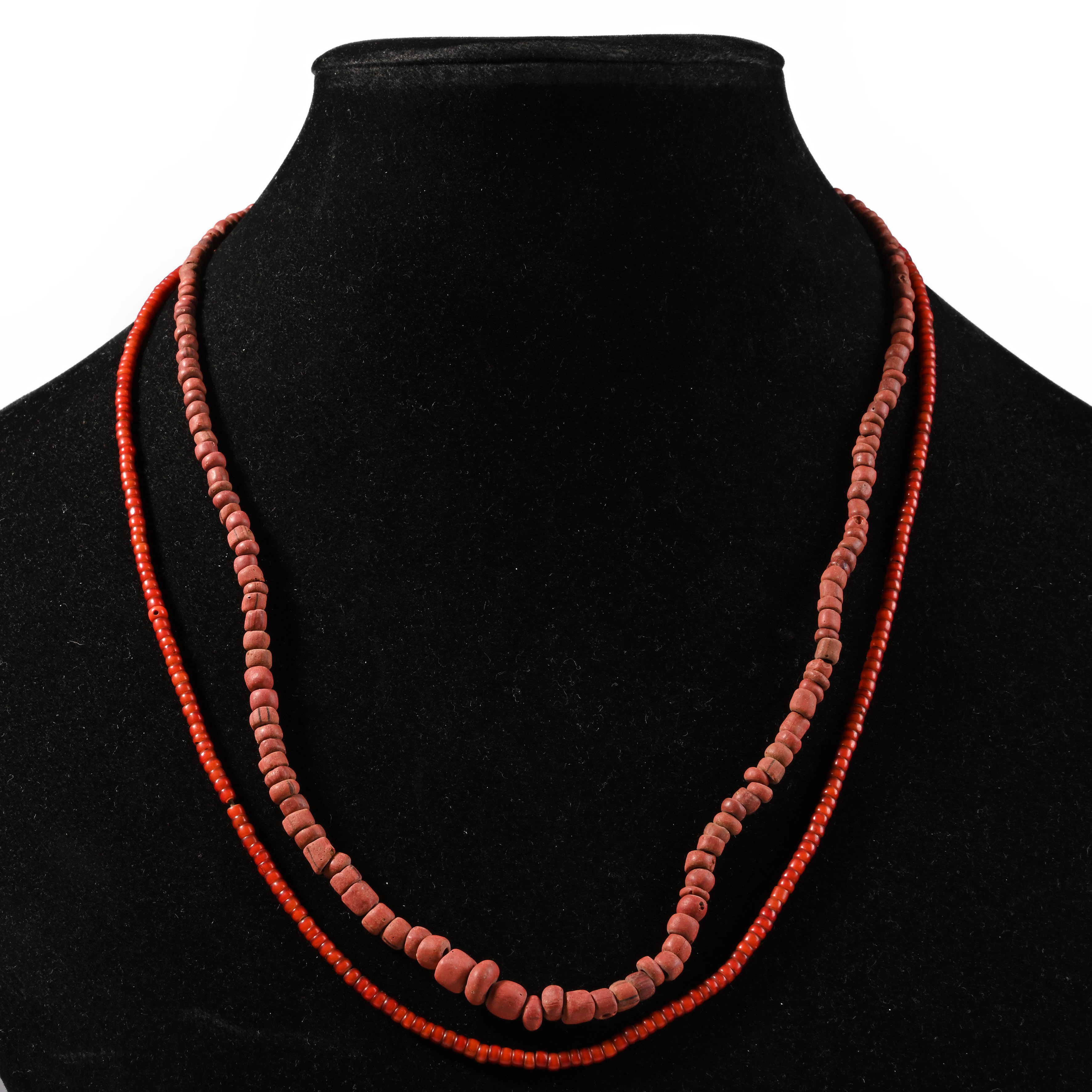
Javanese Trade Beads
Majopahit, circa 13th century A.D.Estimate: £20 - 30 (+bp*)
Opening Bid: £5
Two strings of red glass beads; old collector's cards: 'Majopahit 13th c. opaque red glass beads. Java 1293-1520 and its maritime empire. Beads used trading in E. Indies' and 'Majopahit 1293-1520 Kingdom of East Java (Sumatra, S. Malaysia = coastal Borneo.) These 13 c.' 23.7 grams total, 58-59 cm
From a specialised collection of trade items and money formed in the 1970s. -
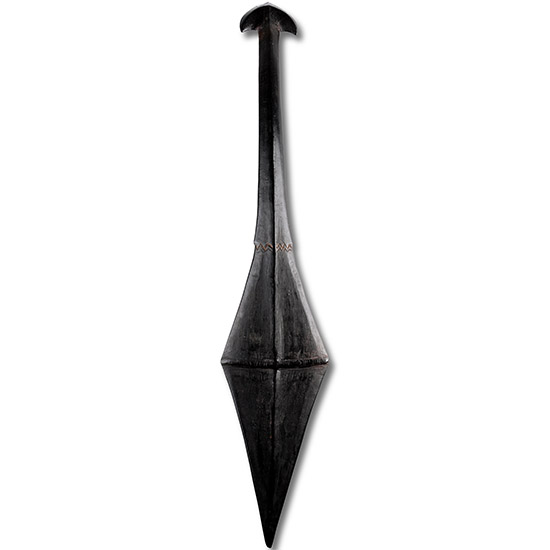
Oceanic Malaita Island Wooden War Club Supe
Solomon Islands, Melensia, early-mid 20th century A.D.Estimate: £400 - 600 (+bp*)
Opening Bid: £100
The blade with a raised medial cross, zig-zag carving above and a tapered handle ending in a fish-tail terminal; a collection sticker: 'MHMC-169'. 925 grams, 86 cm
From the collection of Mr Carlos Bahamonde, Manchester, UK.
These weapons come from Malaita Island and originally had a coir string binding on the handle. Hundreds of these were made for sale and barter to servicemen in World War II. Old ones are quite rare, but World War II examples are very common. -
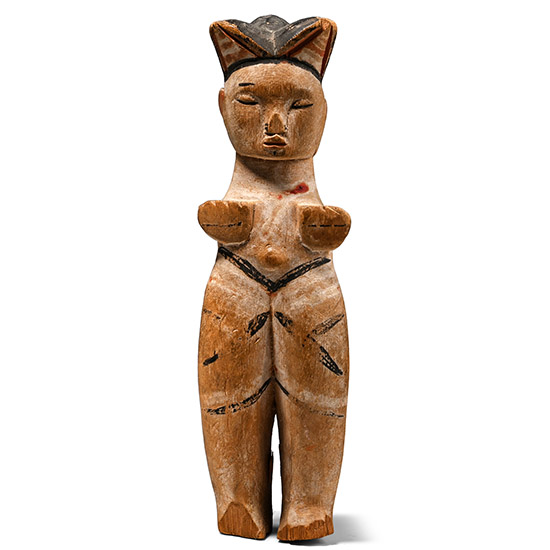
African Wooden Ibibio Doll Figurine
19th century A.D.Estimate: £40 - 60 (+bp*)
Opening Bid: £5
Carved in the round with three-lobed headdress, painted hatched detailing to the body. 105 grams, 20.3 cm
Acquired on the UK art market. Property of a Suffolk, UK, gentleman. -
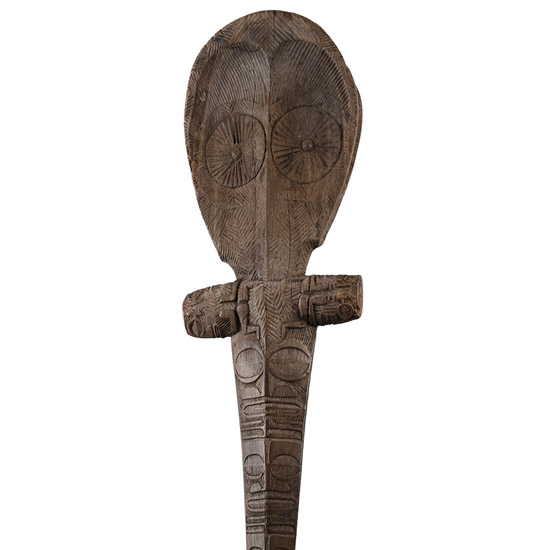
Oceanic Wooden Marquesas Islands U'u War Club
French Polynesia, South Pacific, late 19th-early 20th century A.D.Estimate: £400 - 600 (+bp*)
Opening Bid: £200
Heavy striking club with a saddle-shaped head with ancestral faces, the lateral extensions with two seated figures back-to-back. 1.46 kg, 81 cm
From the collection of Mr Carlos Bahamonde, Manchester, UK.
The striking club was designed for heavy impact in tribal warfare and territorial disputes, also serving as an emblem of leadership, an ancestral guardian, and a vessel for spiritual power.
