
Ancient Art, Antiquities, Books, Natural History, Stamps & Coins

-
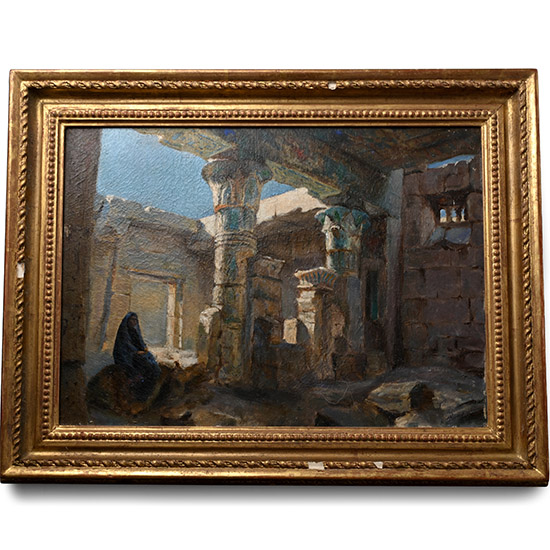
Framed Oil Painting on Canvas of a Temple at Thebes by Dimitri Gnedko
1993 A.D.Estimate: £80 - 100 (+bp*)
Opening Bid: £5
Showing the inside of the temple with papyrus-topped columns, elaborate polychrome decoration visible on the ceiling; in the foreground, a woman dressed in blue robes, set in a gilt frame, old collector's notes on the reverse. 2.7 kg, 69 x 53.5 cm
From the private collection of a Knightsbridge gentleman. -
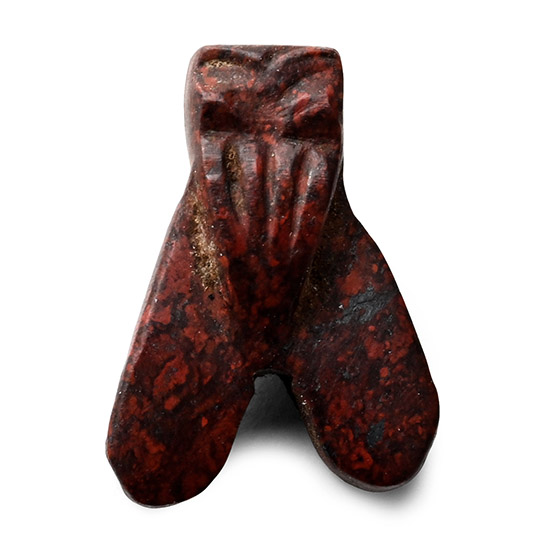
Egyptian Hardstone Fly Amulet
Late Period, circa 664-332 B.C.Estimate: £80 - 100 (+bp*)
Opening Bid: £5
With stylised detailing to the body and head, longitudinally pierced for suspension. 0.37 grams, 11 mm
London gentleman's collection by descent 1980s. -
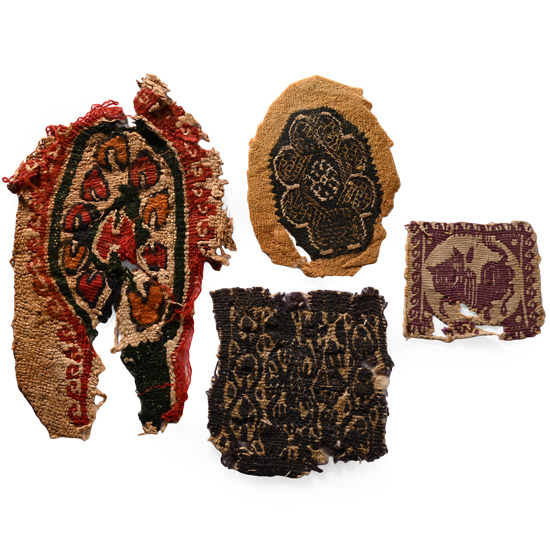
Egyptian Coptic Tunic Textile Fragments of Orbiculi, Tablia and Segmenta with Vegetation, Animals and Geometric Ornament
Circa 6th-7th century A.D.Estimate: £80 - 100 (+bp*)
Opening Bid: £5
Comprising a tablion in purple and blue wool over white linen, with floral ornaments featuring ivy leaves; another smaller tablion in purple wool over white linen, the borders meander decorated, featuring a bull inside a medallion; an orbiculus with lozenge decoration, featuring a vegetal ornament inscribed in a polilobated flower; and a very large foliate ornament in red, green, yellow, orange and red wool on white linen, with vegetal decoration, the borders meander decorated, tapestry work (S-twist). 10.56 grams total, 5.8-15.5 cm
Acquired 1970s-1996. Property of a North American collector. London collection, 2016.
The fragments are decorative parts of tunics. These are fabrics of great decorative finesse, with some elements displaying an unusual and extremely well-preserved colour palette. -
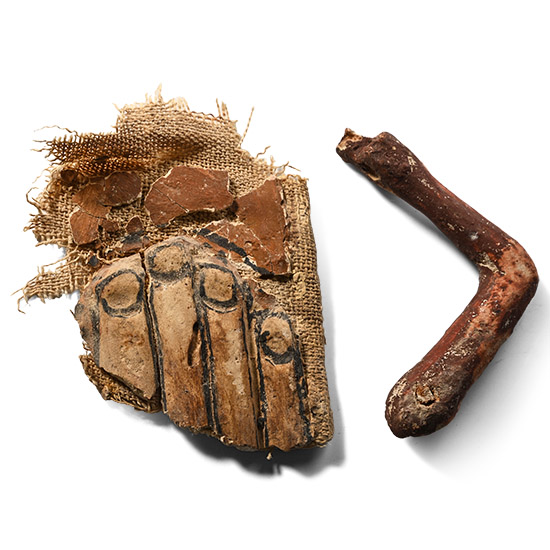
Egyptian Cartonnage Hand Fragment and Wooden Model Arm
Late Period-Ptolemaic Period, circa 664-30 B.C.Estimate: £30 - 40 (+bp*)
Opening Bid: £5
The arm modelled in bent pose with hand pierced to accept the handle of a tool; cartonnage fragment with finger detailing. 18 grams total, 73-82 mm
with a privately curated collection, 1980s-early 2000s. From the private collection and estate of Christine Simons (1943-2025), West Midlands, UK. -
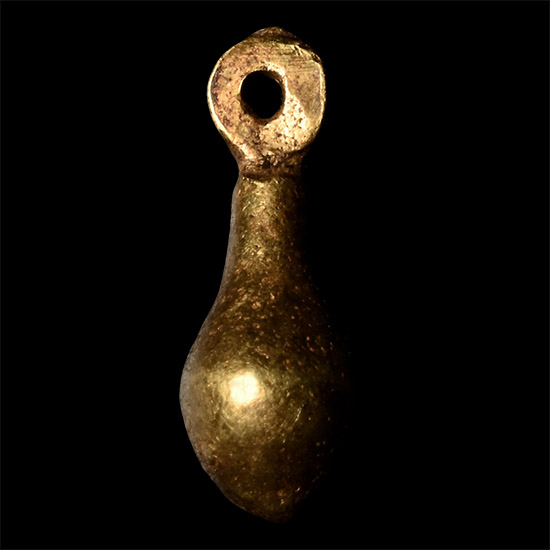
Egyptian Gold Pendant Amulet
Late New Kingdom-Third Intermediate Period, circa 1069-900 B.C.Estimate: £100 - 140 (+bp*)
Opening Bid: £50
Formed as a bulbous seed with a tapering stalk, a ribbed suspension loop above. 0.56 grams, 9 mm
Ex early 20th century French collection. -
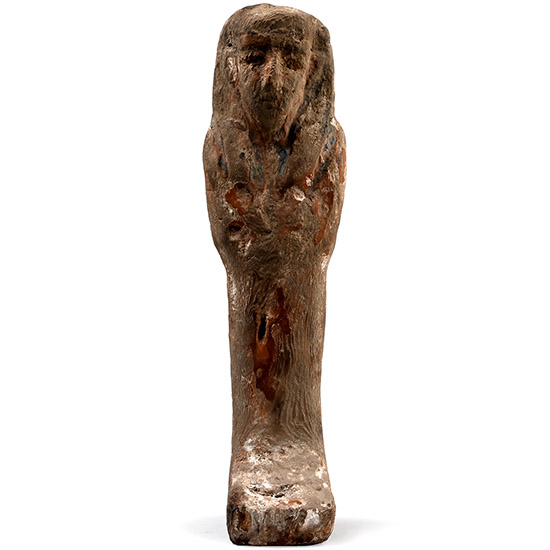
Large Egyptian Painted Wooden Ptah-Sokar-Osiris Figure
New Kingdom, circa 12th century B.C. or laterEstimate: £800 - 1,000 (+bp*)
Opening Bid: £400
Mummiform figure wearing a long lappet wig, with traces of blue and white pigment; a hole in the top of the head, likely to accept a separately fashioned headdress. 460 grams, 34.5 cm
with a privately curated collection, 1980s-early 2000s. From the private collection and estate of Christine Simons (1943-2025), West Midlands, UK.
Initially representing Osiris, this statuette type gradually merged with the Memphite deity Ptah-Sokar. It became a common grave good in the Late Period and the Graeco-Roman era. It was typically depicted standing on a long, rectangular base, wearing a tall, distinctive crown of two large, opposing feathers, with a sun disc on the lower front and ram's horns beneath. The recess in the crown of the present example was likely intended to accommodate this crown. -
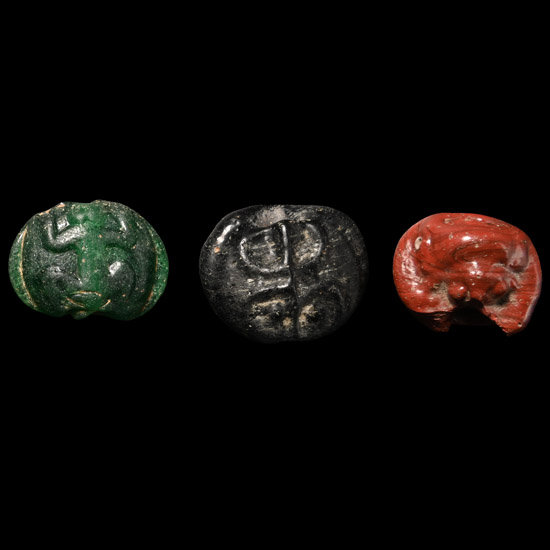
Phoenician Glass Amuletic Bead Group
Mid 1st millennium B.C.Estimate: £60 - 80 (+bp*)
Bids: 1 | Current Bid: £5
Including a grotesque mask, a squatting figure and a scorpion. 5.32 grams total, 14-16 mm
From the private collection of a European gentleman (1942-2024), formed since the 1970s. -
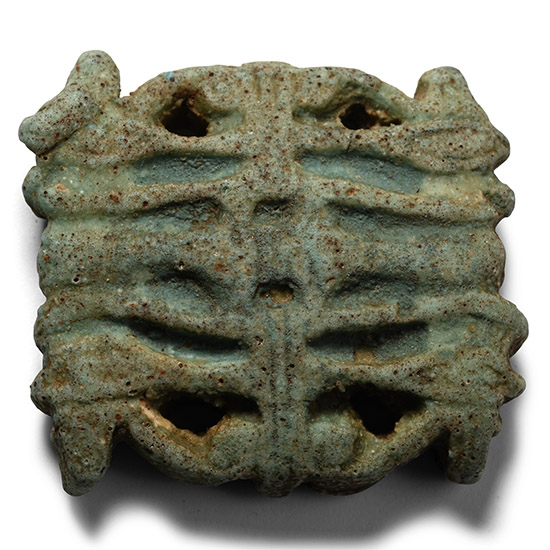
Egyptian Faience Multiple Eye of Horus Amulet
New Kingdom-Late Period, 1550-332 B.C.Estimate: £180 - 240 (+bp*)
Opening Bid: £90
Green-glazed amulet with two wedjat eyes at the top and a mirror image below, pierced longitudinally through the centre for suspension. 11.83 grams, 33 mm
From an early 20th century UK collection. Accompanied by a previously illustrated catalogue card with provenance. -
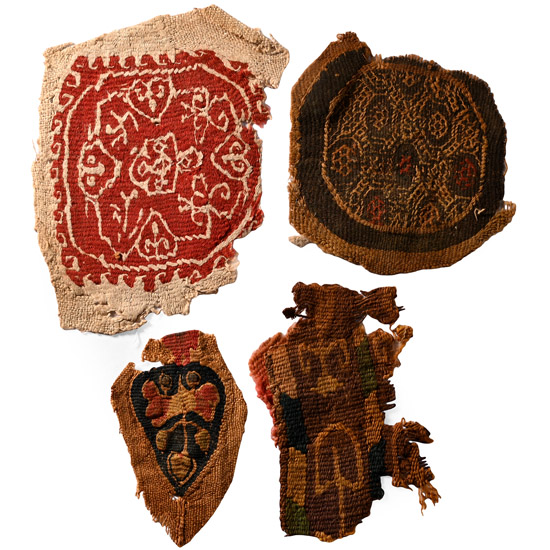
Egyptian Coptic Tunic Textile Fragments of Orbiculi and Segmenta with Geometric Ornament
Circa 6th-7th century A.D.Estimate: £70 - 90 (+bp*)
Opening Bid: £5
Comprising: an orbiculus, in red-purple wool and coarse linen, with geometric decoration; a heart-shaped bud in red, dark blue, green, and yellow wool; a fragment of a clavus with plant ornaments, in brown, yellow, green and dark blue purple wool; and a further orbiculus, with a deep blue-violet background and geometric decorative motifs outlined in raw wool, featuring fine honeycomb work and left-hand twist in red, blue, and yellow wool. 9.75 grams total, 7.5-13.4 cm
Acquired 1970s-1996. Property of a North American collector. London collection, 2016.
The fragments are decorative parts of tunics. These are fabrics of great decorative finesse, with some elements displaying an unusual and extremely well-preserved colour palette. The plant designs are related to the so-called Nilotic decorative pattern. -
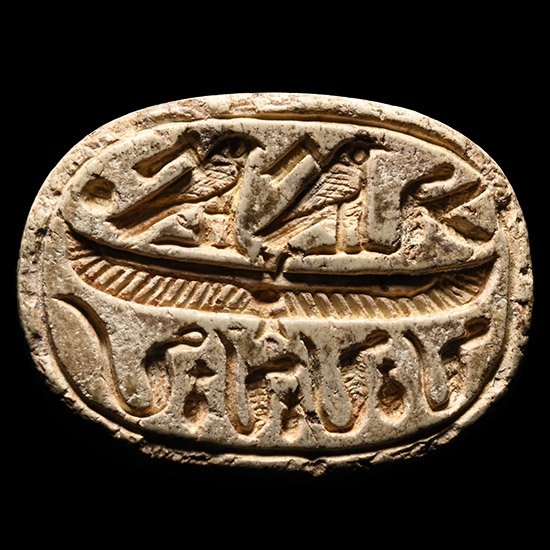
Egyptian Steatite Scarab with Religious Motifs
Late Period, 664-332 B.C.Estimate: £200 - 300 (‡+bp*)
Opening Bid: £100
Plano-convex in section, with a segmented upper face; the underside features an incuse design of a winged scarab, two perching Horus falcons, and a winged uraeus above, with a frieze of four cobras interspersed with three nefer signs below; supplied with an impression. 3.53 grams, 19 mm
Acquired from Derek Content, 24 June 1975. Private collection of Kal Noselson, New York, acquired between 1976 and the late 1990s; thence by descent. Accompanied by an original handwritten invoice from Derek Content, dated 24 June 1975. -
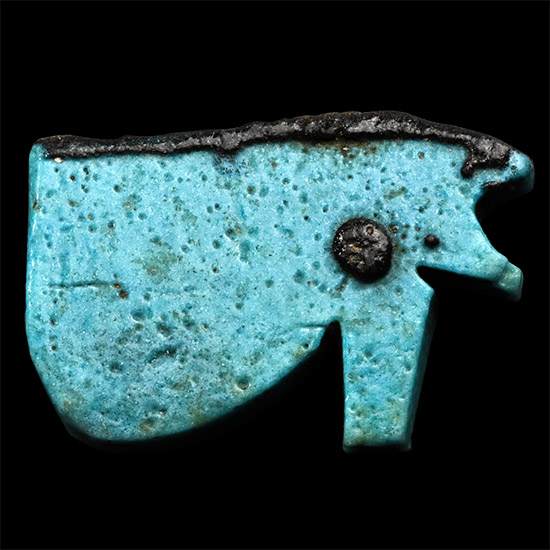
Large Egyptian Blue Glazed Faience Eye of Horus Amulet
New Kingdom-Late Period, circa 1550-332 B.C.Estimate: £500 - 700 (+bp*)
Opening Bid: £250
The body displaying the characteristic shape combining human and falcon ocular imagery, the brow and pupil detailed in black faience, pierced longitudinally for suspension. 8.34 grams, 41 mm
Early 20th century UK collection. Accompanied by a previous catalogue information page.
The wedjat-eye amulet depicts Horus’s healed eye, blending human and falconine features. Its ancient Egyptian name means ‘the one that is sound’. According to myth, Seth wounded or took the eye, and Thoth later restored it. Believed to offer protection, healing, and regeneration, the popular amulet was worn by the living and the dead. -
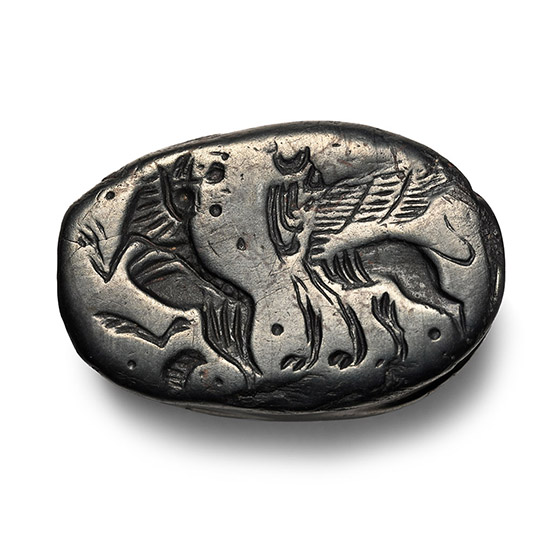
Egypto-Phoenician Haematite Scaraboid Seal
Circa 5th century B.C.Estimate: £1,800 - 2,400 (‡+bp*)
Opening Bid: £950
The upper side is modelled as a scarab with a stylised head, prothorax, elytra, and legs; the underside bearing a rampant lion and a statant winged gryphon. 8.35 grams, 21 mm
Acquired in the mid 1980s-1990s. Private collection, Switzerland, thence by descent. Private collection, since the late 1990s. Accompanied by a copy of an Art Loss Register certificate, no.3095.WW. This lot has been checked against the Interpol Database of stolen works of art and is accompanied by a search certificate no.12715-234628.
