
Ancient Art, Antiquities, Books, Natural History, Stamps & Coins

-
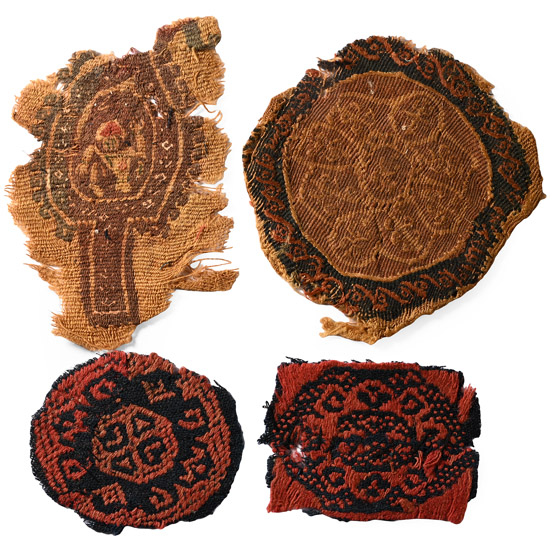
Egyptian Coptic Tunic Textile Fragments of Orbiculi with Vegetation, Figures and Geometric Ornament
Circa 6th-7th century A.D.Estimate: £80 - 100 (+bp*)
Opening Bid: £5
Comprising a tablion and an orbiculus featuring floral and geometric decoration in black and red wool (Z-twist); an orbiculus with floral and geometric decoration in yellow, brown, red, and black wool; and a heart-shaped bud in green, red, and yellow wool featuring a human figure at the centre. 11.1 grams total, 8.1-12.5 cm
Acquired 1970s-1996. Property of a North American collector. London collection, 2016.
The fragments are decorative parts of tunics. These are fabrics of great decorative finesse, with some elements displaying an unusual and extremely well-preserved colour palette. -
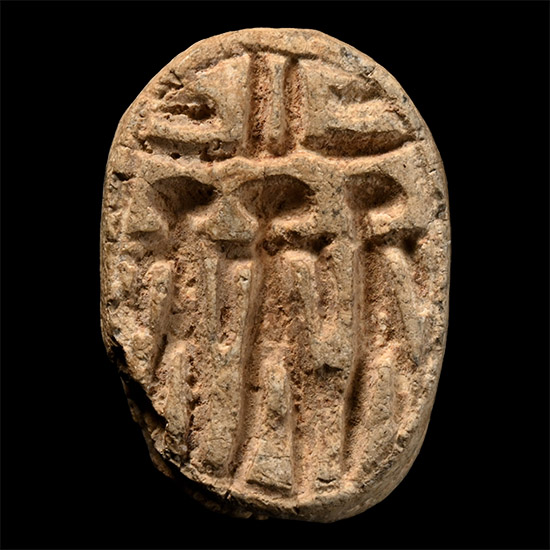
Egyptian Steatite Scarab with Three Figures
Second Intermediate Period, circa 1782-1550 B.C.Estimate: £50 - 70 (+bp*)
Opening Bid: £5
With incised anatomical detailing on the body and legs, underside with three standing figures. 4.26 grams, 20 mm
Acquired from various London-based UK, antiquity dealers. From a Derbyshire gentleman's private museum, formed from the late 1970s-early 1980s. -
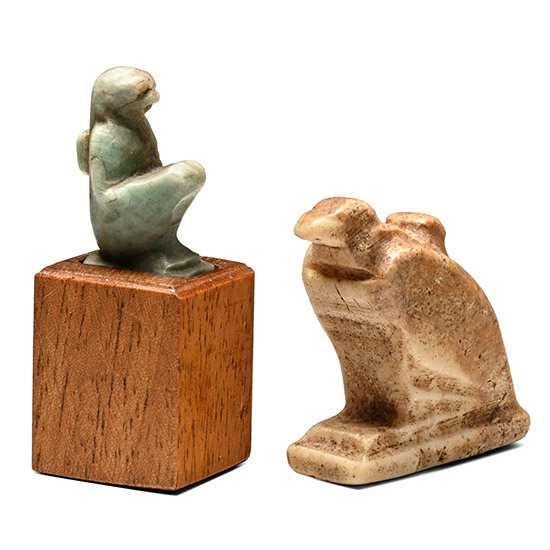
Egyptian Stone Amulet Collection
New Kingdom-Late Period, circa 1100-500 B.C.Estimate: £700 - 900 (‡+bp*)
Opening Bid: £365
Comprising: a feldspar amulet of the crouching god Sokar with falcon head and human body, custom-made display stand; a carved vulture amulet on a rectangular base; suspension loop on the back. 19.5 grmas total, 28-41 mm
Sokar: Ex Roger Liechti (1934-2010), Petit-Lancy, Switzerland (inv.no. E.601); acquired from Galerie Elsa-Bloch Diener, Bern. Thence by family descent. Vulture: Ex Roger Liechti (1934-2010), Petit-Lancy, Switzerland (inv.no. E. 772); acquired in 1984 from Mr Cohen, Galerie La Reine Margot, Paris. Thence by family descent, Switzerland.
Vulture representations are among the oldest amulet types, found in burials dating to the late Third millennium B.C. They provide apotropaic protection for the deceased. The vulture is associated with various Egyptian deities, especially with the goddess Nekhbet. Sokar, the hawk-god originally of the Memphite necropolis and deity of fertility and artisans, became closely linked with Osiris and Ptah, forming the syncretic deity Ptah-Sokar-Osiris. -
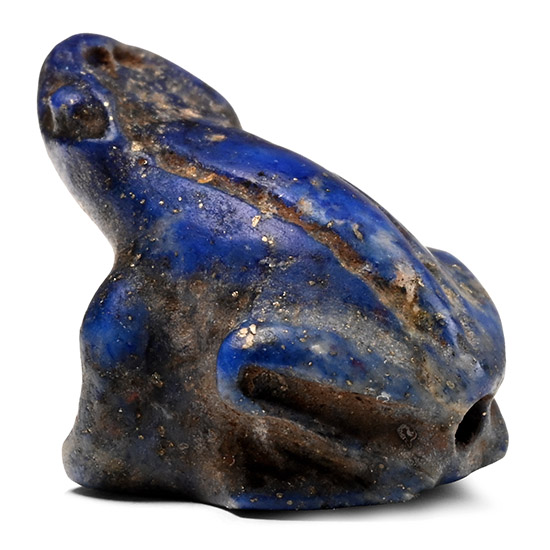
Egyptian Lapis Lazuli Frog Amulet
Late Period, 664-332 B.C.Estimate: £200 - 300 (+bp*)
Opening Bid: £60
Carved in the round in a crouched pose, with hind legs folded behind the body, pierced through the stomach for suspension. 1.02 grams, 14 mm
From a mid 20th century collection.
Frog amulets in ancient Egypt symbolised fertility, rebirth, and renewal. Associated with the goddess Heqet, linked to childbirth and life-giving forces, they were especially popular for fertility and protection during pregnancy and labour. Their association with the annual Nile flood, which brought new life to the land, further emphasised their symbolism of revival and abundance. -
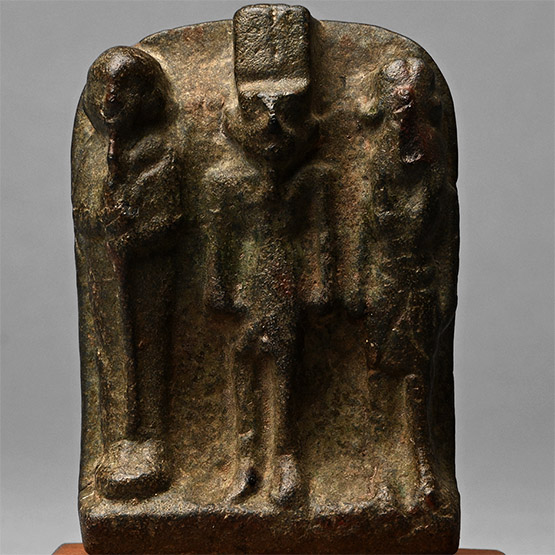
Egyptian Faience Ptah, Amun-Ra and Ra-Horakhty Triad Amulet
Ptolemaic Period, 332-30 B.C.Estimate: £2,500 - 3,500 (‡+bp*)
Opening Bid: £1,444
Rectangular plaque with a ledge along the lower edge, featuring the half-round figures of Ptah, Amun-Ra, and Ra-Horakhty; each invoked in offering formulae written in three vertical columns on the back; a fragmentary suspension loop at the rear; mounted on a wooden display stand. 88.8 grams total, 85 mm including stand
From a deceased American estate, 1970-1989. with Bonhams, London, 28 October 2009, no.81. Private collection, Europe. Accompanied by a copy of an Art Loss Register certificate, no.S00066707. This lot has been checked against the Interpol Database of stolen works of art and is accompanied by search certificate number no.13190-249206.
Amun, Ra-Horakhty, and Ptah. Amun evolved from a primordial god to a nationally worshipped deity, merging with Ra to become Amun-Ra, while Ra-Horakhty symbolises the sun and is depicted with a falcon's head. Ptah is recognised as the creator god and patron of craftsmen, originally worshipped in Memphis and later throughout Egypt. -
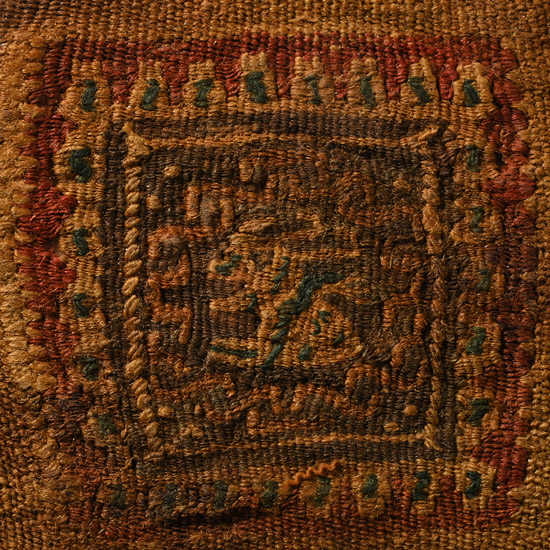
Egyptian Coptic Textile Fragment of a Tunic Tablion with Hare
Circa 6th-7th century A.D.Estimate: £40 - 60 (+bp*)
Opening Bid: £5
Comprising a tablion in coarse wool of red, green, yellow, violet and blue over white linen, scalloped borders, tapestry work (S-twist), featuring an animal (hare?) inside a square, surrounded by vegetal ornaments. 5.59 grams, 10.5 cm
Acquired 1970s-1996. Property of a North American collector. London collection, 2016.
The tabula, or tablion, was a square embroidery used to decorate tunics or mantles. The theme of rabbits or hares, in association with other characters and animals of the Dionysian Thiasos, has notable parallels. Such representations are linked to narratives of the Dionysian cycle. -
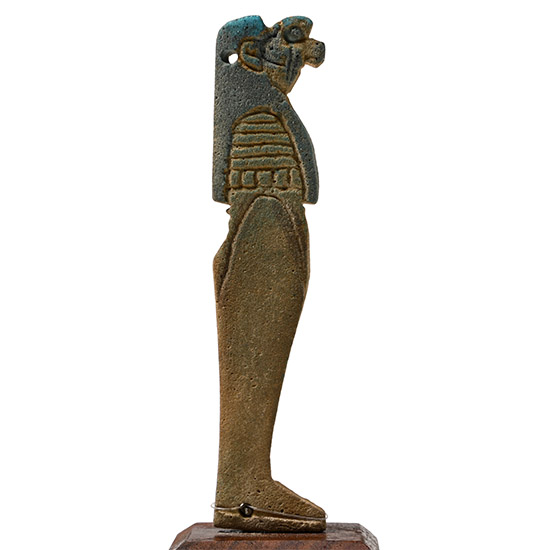
Egyptian Blue Glazed Faiance Qebehsenuef Appliqué
Late Period, 664-332 B.C.Estimate: £500 - 700 (‡+bp*)
Opening Bid: £275
Flat appliqué of the mummiform, falcon-headed Qebehsenuef, one of the Four Sons of Horus in profile, with a human ear, wearing a tripartite wig and multi-row collar around the shoulders, and hanging straps on lower body; face, decorative collar and belt indicated by fine incisions; mounted on a stand. 6.91 grams total, 80 mm high including stand
Ex Roger Liechti (1934-2010), Petit-Lancy, Switzerland (inv. no.E.494, written on the underside of the wooden mount); acquired in 1973 from the art dealer Mr. Wagner Terrassière, Geneva. Thence by descent in the family, Switzerland.
The applique belonged to a set of four depicting the Four Sons of Horus with their differently shaped heads (human, baboon, jackal and falcon). These four gods, Imsety, Hapy, Duamutef, and Qebehsenuef, were already mentioned in the Pyramid Texts of the Old Kingdom and were believed to accompany and protect the deceased from the time he or she was embalmed and buried up to the judgment of the dead. Their main function was to guard the viscera during and after mummification. The group of four objects was part of a mummy's elaborate jewellery, which also included a mummy net, a winged scarab and a broad shoulder collar. Two small holes through the back of the head and feet, which were used to sew the figure onto a textile base. Traces of yellow and blue paint. Intact. -
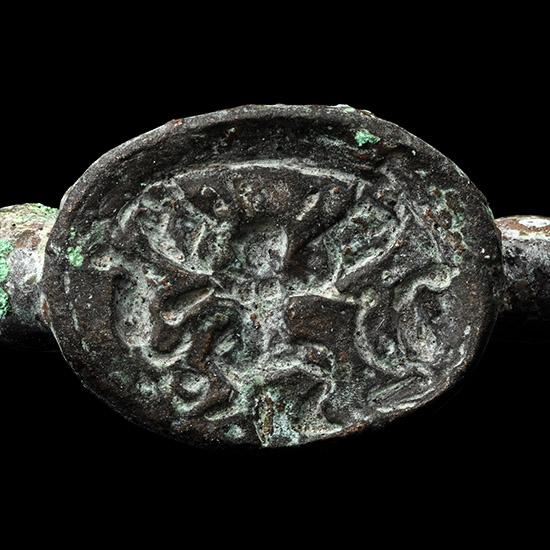
Phoenician Bronze Scarab Seal Pendant
Late 1st millennium B.C.Estimate: £150 - 200 (+bp*)
Opening Bid: £75
Ellipsoid plaque with recurved lateral arms and ribbed loop, the underside depicting an advancing winged figure flanked by uraei. 25.6 grams, 33 mm
London gentleman's collection, 1970-1990s, by descent. -
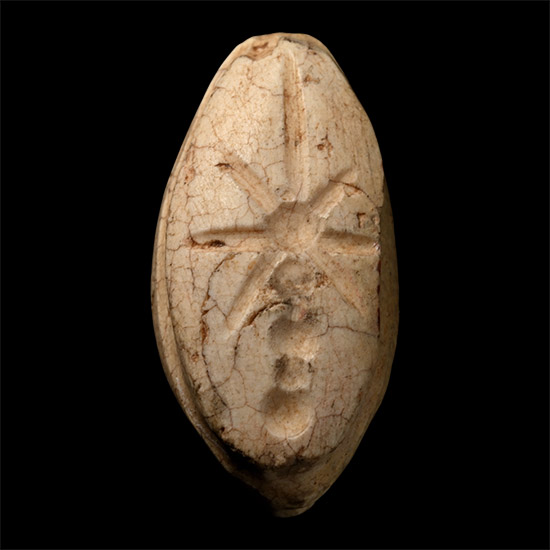
Phoenician Cream Stone Scaraboid Stamp Seal with Star on Sceptre
2nd-1st millennium B.C.Estimate: £60 - 80 (+bp*)
Opening Bid: £5
Lentoid in plan with ribbed suspension loop, incuse motif of a scintillation; supplied with a museum-quality impression. 3.48 grams, 20 mm
From the private collection of a European gentleman (1942-2024), formed since the 1970s. -
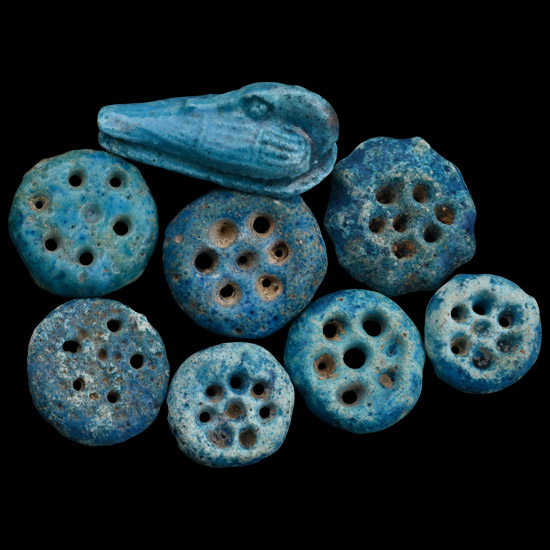
Egypto-Phoenician Faience Amulet Group
4th-2nd century B.C. and laterEstimate: £200 - 300 (+bp*)
Opening Bid: £100
Comprising flat discs with perforations and a modern trussed duck with its head laid along its spine. 18.74 grams total, 15-30 mm
From the collection of a gentleman, acquired on the London art market in the 1990s. -
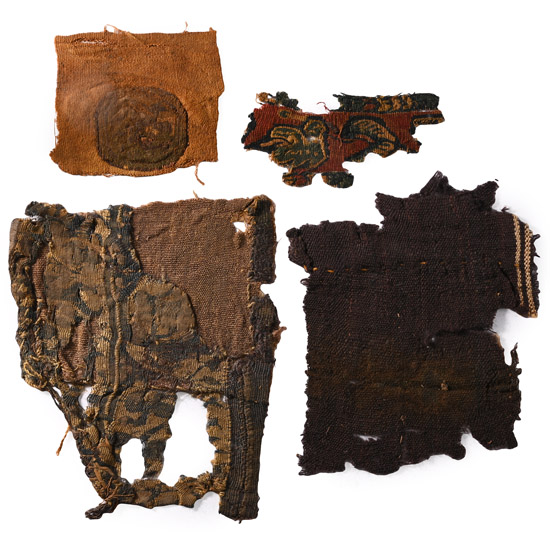
Egyptian Coptic Tunic Textile Fragments of Segmenta and Orbiculus with Geometric Decoration
Circa 4h-8th century A.D.Estimate: £60 - 80 (+bp*)
Opening Bid: £5
Comprising: a fragment of a tapestry or a fabric in brown linen; a small orbiculus, with vegetal decoration; fragment of a clavus, in red, yellow, green wool, s-torsion, with plant ornaments; a large fragment of cloak or tapestry, with slingers inside orbiculi, sewn edges and wide border with vegetal ornaments. 27 grams total, 9.8-19 cm
Acquired 1970s-1996. Property of a North American collector. London collection, 2016.
The fragments are decorative parts of tunics. These are fabrics of great decorative finesse, with some elements displaying an unusual and extremely well-preserved colour palette. Some designs recall Iranian motifs. -
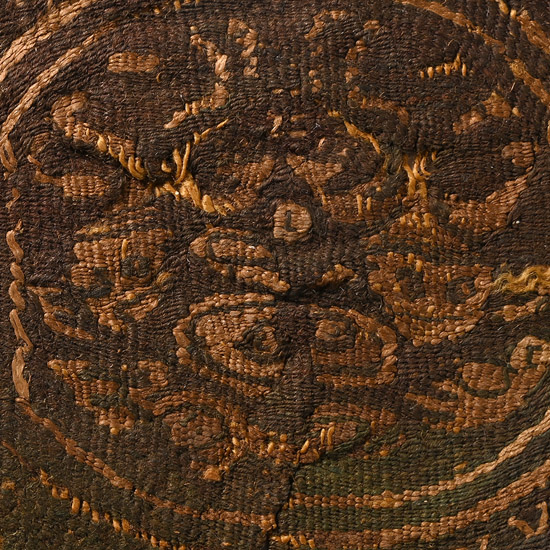
Egyptian Coptic Tunic Textile Fragment of an Orbiculus with Facing Military Horsemen
Circa 7th century A.D.Estimate: £70 - 90 (+bp*)
Opening Bid: £5
Featuring a large central floral motif, divided into sections containing rhomboid patterns and bordered by meander designs, executed in a tapestry weave using raw wool in reddish-purple, yellow, and dark brown, with an S-twist. 4.15 grams, 10.7 cm
Acquired 1970s-1996. Property of a North American collector. London collection, 2016.
In the Late Roman Period, round orbiculi decorated the shoulders and the lower part of tunics and inner tunics. These fabrics were of great decorative finesse, displaying an unusual and extremely well-preserved colour palette. When the tunic came to the end of its life, these embroideries could be recycled and patched onto another garment. The motif of the opposed horsemen could be related to a military tunic.
