-
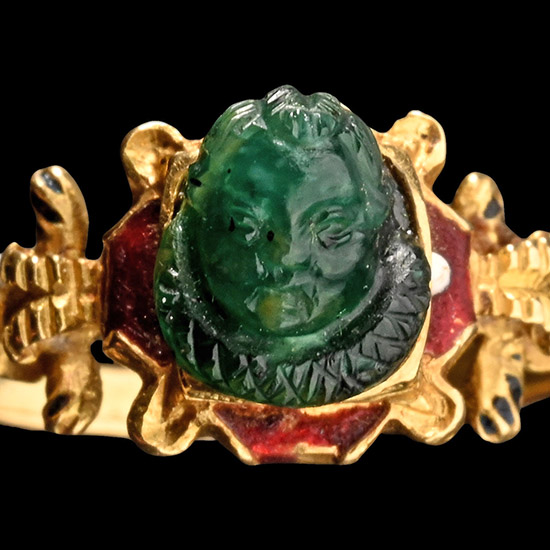
Roman Chrome Chalcedony Cameo of Eros in Renaissance Gold and Enamel Ring
Circa 1st-2nd century A.D., ring circa 1570-1580 A.D.Estimate: £18,000 - 24,000 (+bp*)
Opening Bid: £9,000
The cameo carved in high relief with the head of a child, probably Eros, with a later adaptation of a ruff-like collar around the neck, set in an ornate gold mount decorated with white, red and black enamel, the shoulders pierced with side lugs, while the underside of the setting incorporates X-shaped ribs, fine striations enriching the sides of the projecting collet. 3.70 grams, 29.54 mm overall, 18.55 x 16.53 mm internal diameter (approximate size British O, USA 7, Europe 14.98, Japan 14)
Acquired on the European art market. UK, private collection. This lot has been checked against the Interpol Database of stolen works of art and is accompanied by search certificate no.13504-263463.
Eros was the god of love, and his image was an appropriate token to give to one's beloved, though he could be a symbol of much more, especially in Dionysiac context where he stood for the young Bacchus and was a symbol of salvation. -

Roman Gold Ring with Engraved Agate Gemstone
1st century A.D.Estimate: £1,500 - 2,000 (‡+bp*)
Opening Bid: £750
Hollow-formed with inset banded agate cloison, intaglio vine-leaf motif. 3.26 grams, 23.66 mm overall, 18.15 x 14.73 mm internal diameter (approximate size British J 1/2, USA 5, Europe 9.32, Japan 9)
Private collection, acquired on the German art market in 1993; thence by descent. This lot has been checked against the Interpol Database of stolen works of art and is accompanied by search certificate no.13184-249301.
These rings were characterised by an oval opening with a flat rim for a banded agate gem, which tapered towards the top. -
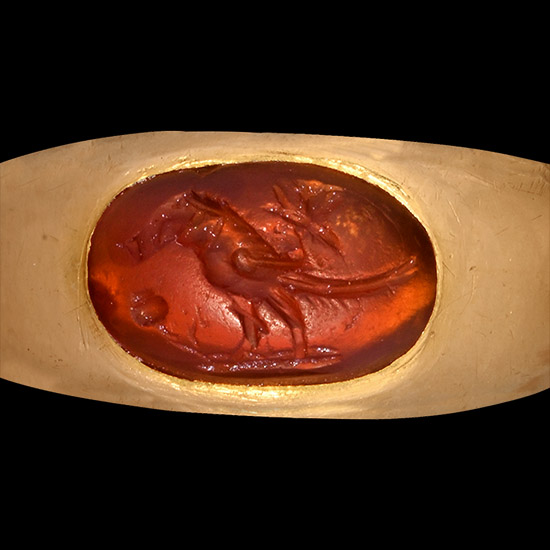
Roman Carnelian Gemstone with Bird in Gold Ring
1st century A.D.Estimate: £1,000 - 1,400 (+bp*)
Opening Bid: £500
With inset cabochon engraved with a perching bird on a baseline with a flower. 4.67 grams, 21.13 mm overall, 16.42 x 17.95 mm internal diameter (approximate size British M, USA 6, Europe 12.46, Japan 12)
Private collection, 1980s. Acquired on the UK art market. Private collection, London, UK. -
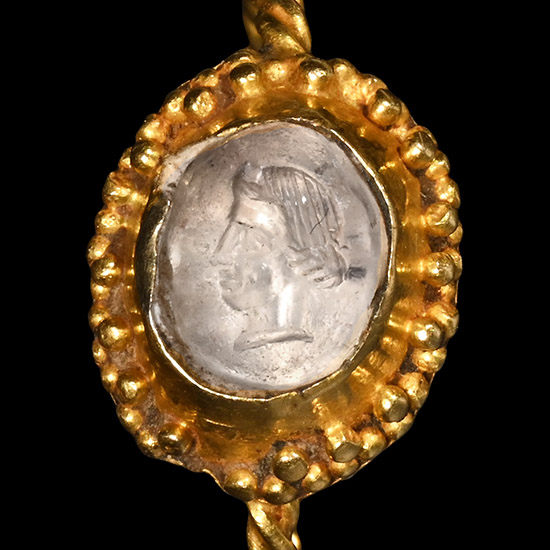
Roman Gold Ring with Quartz Gemstone with Portrait of a Noble Lady
1st century A.D.Estimate: £1,200 - 1,700 (+bp*)
Opening Bid: £600
Twisted hoop with cell to the bezel, granulated collar, inset cabochon with profile bust. 1.78 grams, 22.69 mm overall, 16.36 x 17.11 mm internal diameter (approximate size British N, USA 6 1/2, Europe 13.72, Japan 13)
Private collection, 1980s. Acquired on the UK art market. Private collection, London, UK. -

Roman Gold Ring with Sardonyx Gemstone
1st-2nd century A.D.Estimate: £1,500 - 2,000 (‡+bp*)
Opening Bid: £833
Hollow-formed shank with inset cabochon, flattened top. 6.41 grams, 27.10 mm overall, 18.42 x 15.45 mm internal diameter (approximate size British M, USA 6, Europe 12.46, Japan 12)
Private collection, acquired on the German art market in 1993; thence by descent. This lot has been checked against the Interpol Database of stolen works of art and is accompanied by search certificate no.13182-249298.
The heavy proportions of the ring can date it to the late 1st century A.D. The gem could be contemporary, considering the wide use of sardonyx in the Roman rings of the first two centuries of the Empire. -
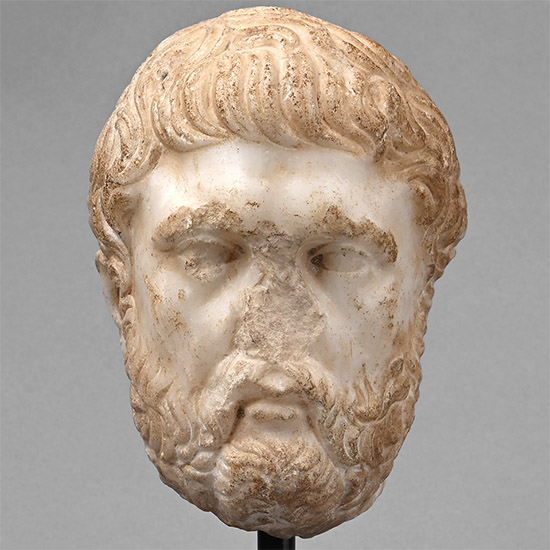
'The Kenzo' Roman Marble Head of the Philosopher Hermarchus
Circa 1st-2nd century A.D.Estimate: £14,000 - 19,000 (+bp*)
Opening Bid: £7,000
A finely carved marble portrait head of a middle-aged bearded male, possibly Hermarchus, with short, softly modelled wavy hair, deep-set and defined eyes, the lips almost hidden among the details of the beard; the facial expression appears stern but thoughtful, perhaps derived from the tradition of Roman Imperial portraiture; mounted on a custom-made stand. 2.34 kg total, 22.8 cm high including stand
Kenzo collection, the late fashion designer, acquired in the early 1980s. Ex French private collection. Charles Ede, 12 June 2008. Accompanied by an academic report by Dr Raffaele D’Amato. This lot has been checked against the Interpol Database of stolen works of art and is accompanied by search certificate no.13436-262427.
The philosopher represented here must have been very important, and it can be assumed we can recognise one of the valuable copies, known in different variants, of the portrait of Hermarchus, successor of Epicurus at the head of the Epicurean School, who lived at Mytilene between 325 and 250 B.C., for its similarity with the portrait of the same philosopher at the Ny Carlsberg Glyptotek (inv. no.2689). -
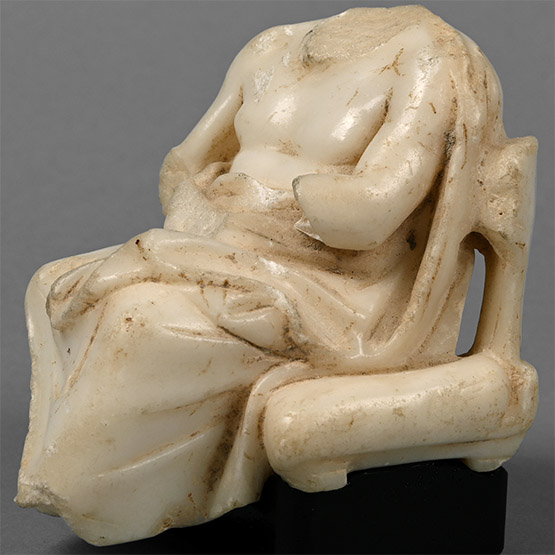
Roman Marble Figure of a Seated Philosopher
Roman Imperial, 1st century A.D.Estimate: £12,000 - 17,000 (‡+bp*)
Opening Bid: £6,500
Carved in the round as a male figure in a seated pose wearing a loosely draped pallium on the shoulders and lower body, legs crossed at the knees; openwork frame to the chair with deep undercuts; mounted on a custom-made stand. 563 grams total, 86 mm high including stand
Formerly in a private collection, London. European private collection, acquired in 2002. Accompanied by a copy of an Art Loss Register certificate, 8 June 2004. This lot has been checked against the Interpol Database of stolen works of art and is accompanied by search certificate no.13210-249309.
The statuette could represent Zeus or Chronos, based on similarities with two statues in the Vatican Museums and two statues in the Thebes Museum. The god is depicted seated, with his torso exposed, and his left hand, which normally holds the sceptre in statues of seated Zeus, is instead stretched out across his legs. -
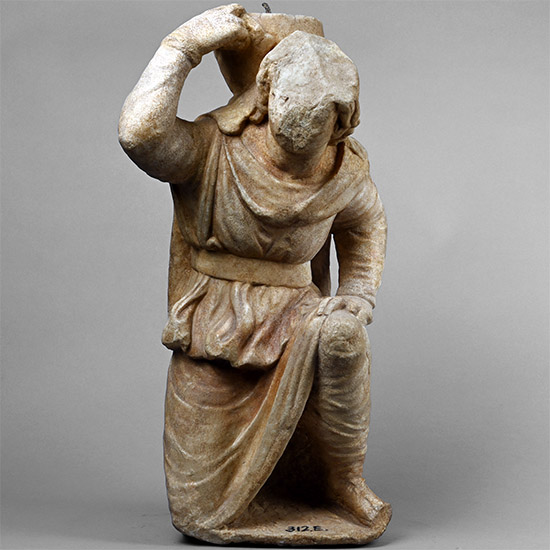
Roman Marble Figure of Persian Water Carrier
2nd century A.D.Estimate: £40,000 - 60,000 (‡+bp*)
Opening Bid: £20,000
Depicted kneeling on his right knee, his left hand resting on his left knee, his right arm raised to support the water jar on his shoulders, shown wearing a Phrygian cap over his curling hair, dressed in a belted tunic falling in thick folds, the lower drapery stretched over the knees, and strapping on the legs, with a long cloak over the top, pinned at his right shoulder and falling down his back, set on an integral base. 39.45 kg, 59.7 cm
Ex private collection, Europe. Ex Australian collection, 1960s. On loan to La Trobe University, Melbourne, Australia, 1981-1986. Bonhams, London, 28 April 2010, no.139. Private collection, Europe. Accompanied by a printed copy of the Spanish cultural export licence no.1775-3178156. Accompanied by a copy of the Graham Geddes, Antiques & Antiquities invoice, 17 April 2007. Accompanied by a copy of an Art Loss Register certificate, no.2709AM. Accompanied by copies of the relevant Bonhams catalogue pages. Accompanied by an academic report by Dr Raffaele D’Amato. This lot has been checked against the Interpol Database of stolen works of art and is accompanied by search certificate no. 10272-168595.
The image of the subjected foreigner (‘barbarian’) became particularly prevalent in the late 1st and early 2nd centuries A.D. as a reflection of increased Roman expansion and part of an iconography of empire and triumph. The clean-shaven face of this figure indicates that it represents a so-called 'Oriental', i.e., a Persian, instead of a bearded European. -
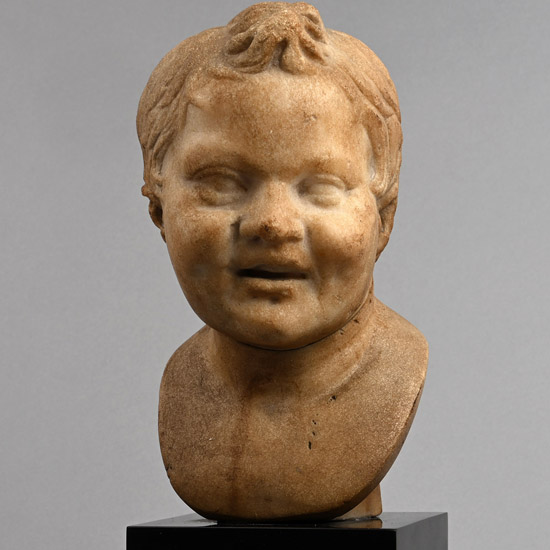
Roman Marble Head of Cupid on Georgian Pedestal
1st-2nd century A.D.Estimate: £15,000 - 20,000 (‡+bp*)
Opening Bid: £7,000
Carved in the round as a bust of a child with short hair combed into a peak, fleshy features, lips slightly parted in a smile, fitted to an 18th-century marble pedestal; mounted on a display stand with collection note 'Buste d'Enfant / Epoque Romaine / 1er Siècle'. 6.12 kg total, 30 cm including stand
Collection of B. Poindessault (1935-2014), France, acquired before October 1975. Oger & Blanchet Enchères, Paris, 2014. German private collection, Cologne. Private collection, acquired in 2015. Accompanied by an academic report by Dr Marina Mattei. Accompanied by a copy of an Art Loss Register certificate, no.S000104583. Accompanied by a copy of French passport no.167453. This lot has been checked against the Interpol Database of stolen works of art and is accompanied by search certificate no.12931-246329.
The finely sculpted head represents a young child, probably intended as Eros (Cupid). Such depictions were produced in numerous variations to illustrate the stages of childhood and the capacity of children to undertake meaningful or symbolic actions. The softly modelled features and gentle expression recall the celebrated work of Boethos, The Boy Strangling the Goose, as well as the widespread images of Eros and the Erotes found throughout Graeco-Roman sculpture and painting. In Graeco-Roman art, representations of children occupied an important and evolving role. Initially, youthful figures were portrayed as miniature adults, but from the 4th century BC onwards - particularly during the Hellenistic and Roman periods - artists began to study children’s anatomy more closely, reproducing their characteristic proportions and expressions with naturalistic sensitivity. The figure of Eros, the constant companion of Aphrodite, became the quintessential model of the child in ancient art, identifiable by his traditional attributes of wings and bow. As evidenced by numerous statuettes and wall paintings unearthed at Pompeii, scenes of childhood were among the most popular subjects for adorning the gardens and interiors of wealthy Roman villas. These figures appear in lively and varied activities - playing, working, performing, or interacting with animals such as birds, hares, and dolphins - celebrating both the charm and vitality of early life within an idealised artistic vision. -
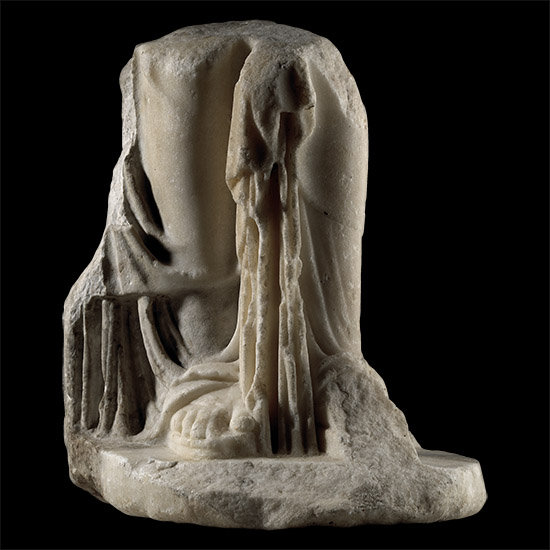
Large Lower Section of a Roman Marble Figure of the Goddess Isis
2nd century A.D.Estimate: £6,000 - 8,000 (+bp*)
Opening Bid: £3,333
Statue fragment of a woman or goddess, including floor-length robe and right foot with sandal; modelled standing with the foot slightly advanced, wearing sandals, chiton and himation. 66.65 kg, 50 cm
American private collection, acquired in the 1980s-1990s. Acquired on the American art market in 2016. with Sotheby's, London, 11 December 2020, no.88. This lot has been checked against the Interpol Database of stolen works of art and is accompanied by search certificate no.13078-249667.
Both the stance and folds of the himation suggest an Archaistic statue, perhaps the goddess Isis. -
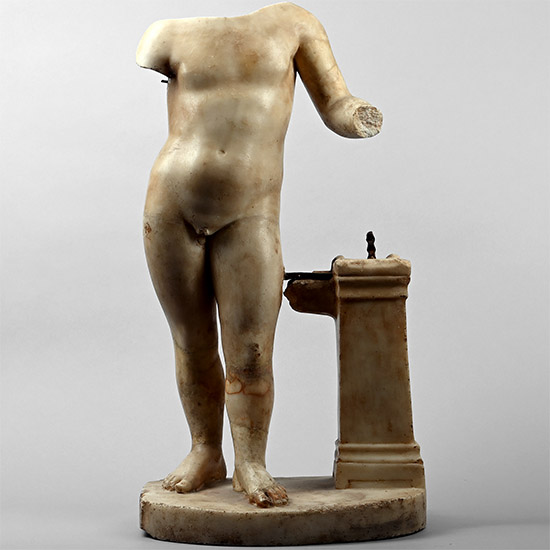
Roman Marble Torso of Young Boy
1st century A.D.Estimate: £50,000 - 70,000 (‡+bp*)
Opening Bid: £25,000
Statue of a young naked boy, in Parian or Carrara marble, shown in a contrapposto stance, with his right hip raised and his left leg extended slightly forward; chest and upper abdomen with subtle muscular definition, narrow torso and slim arms, rounded belly and chubby thighs; professionally repaired. 34.7 kg, 66 cm
European private collection, 19th century (based on restoration techniques). Ex Sotheby's, London, 8 December 1986, no.287. Ex private collection, Melbourne, Australia, prior to 2001. Private collection, Europe. Accompanied by a printed copy of the Spanish cultural export licence no.1775-3178156. This lot has been checked against the Interpol Database of stolen works of art and is accompanied by search certificate no.13456-260917.
During the Roman imperial period, children were widely represented in the art of both the public and private spheres. Images of both mortal and divine children appeared in the artworks and furnishings of the home, on the tomb monuments and burial containers associated with the funerary realm, and on imperial state art. This statue of a nude young boy, which is made of Parian or Carrara marble, exemplifies the Roman interest in the subject of children. This shift in movement is echoed in the tilt of the boy’s head downward and to his right, suggesting that he has fixed his gaze on something in this direction. -
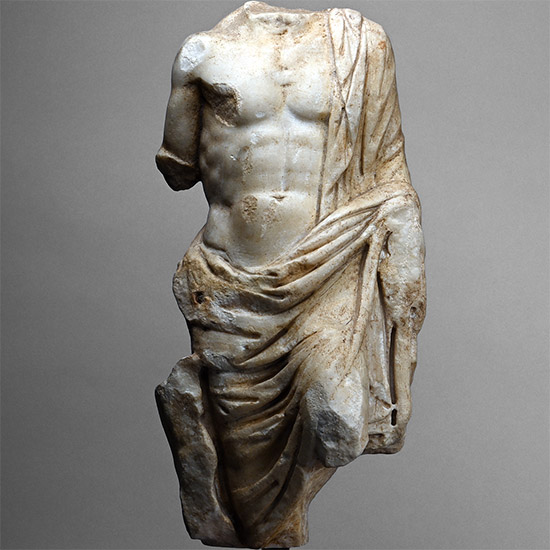
Roman Marble Figure of Asclepius, The God of Medicine
1st-2nd century A.D.Estimate: £20,000 - 30,000 (‡+bp*)
Opening Bid: £10,000
Depicted in a contrapposto stance, detailed torso with well-defined musculature, indicative of the idealised human form, carefully rendered drapery cascading over the figure's left shoulder and wrapping around his lower body, the folds of the garment deeply carved; mounted on a custom-made display stand. 33 kg total, 71 kg including stand
Ex Nicolas Koutoulakis (1910-1996), Paris and Geneva, thence by descent. Private collection, Europe. Accompanied by a printed copy of the Spanish cultural export licence no.1775-3178156. Accompanied by a copy of a French passport, no.134277. This lot has been checked against the Interpol Database of stolen works of art and is accompanied by search certificate no.13459-260915.
Asclepius, the god of medicine, is a pivotal figure in Greek mythology and was later adopted by the Romans. According to myth, Asclepius was the son of Apollo and the mortal Coronis. Trained by the centaur Chiron, he became a skilled healer, so proficient that he could even bring the dead back to life. His abilities eventually led to his demise at the hands of Zeus, who struck him down with a thunderbolt to maintain the balance between mortals and gods. The Pio-Clementino Museum houses a marble statue of Asclepius in the Octagonal Courtyard. This statue, similar in pose and drapery, provides an excellent comparative study. The National Museum in Athens (Room 28) displays a marble statue of Asclepius, highlighting his characteristic bearded face and draped garments. The British Museum's Greek and Roman Antiquities collection includes a statue of Asclepius (Room 69), illustrating the common attributes and stylistic elements. The Louvre Museum, Paris, in the Department of Greek, Etruscan, and Roman Antiquities, contains a marble statue of Asclepius in Room 17, showcasing the classical drapery and posture similar to the piece in question.

