
Ancient Art, Antiquities, Books, Natural History, Stamps & Coins

-
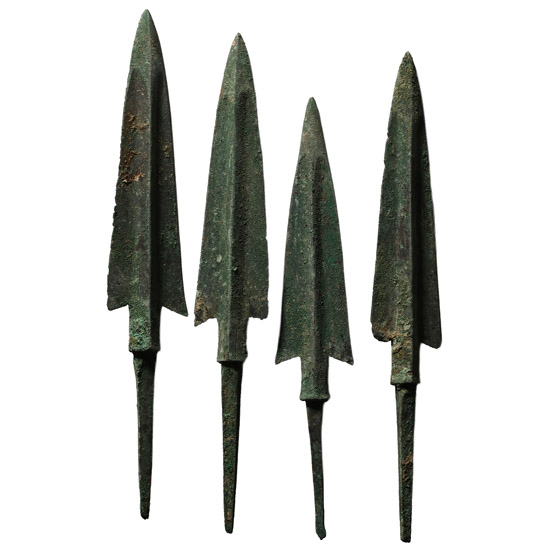
Western Asiatic Bronze Arrowhead Collection
2nd-1st millennium B.C.Estimate: £100 - 140 (+bp*)
Opening Bid: £50
Barbed and tanged type with thick square-section neck and long tang. 179 grams total, 15-17 cm
Ex Abelita collection, 1980-2010. -
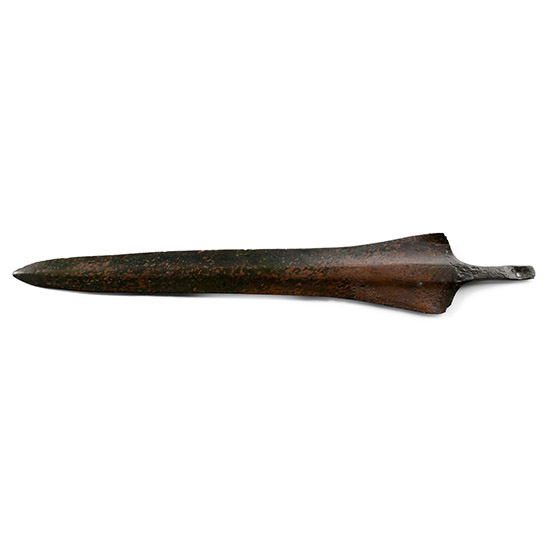
Western Asiatic Bronze Dagger
1800-1600 B.C.Estimate: £150 - 200 (+bp*)
Opening Bid: £83
The blade expanding towards the shoulders, a pierced rectangular-section tang. 174 grams, 29.2 cm
Ex Abelita family collection, 1990s. -
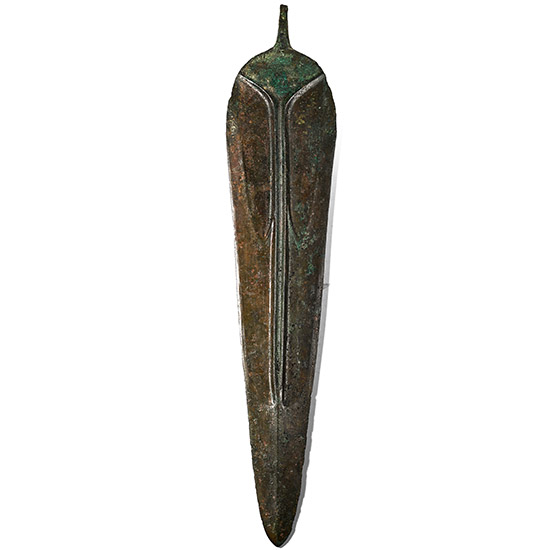
Caananite Bronze Short Sword Blade
2nd millennium B.C.Estimate: £500 - 700 (+bp*)
Opening Bid: £150
Broad double-edged blade with raised gusseted midrib, rounded tip and short tang. 381 grams, 37.7 cm
Ex West Country, UK, collection, 1990s. -
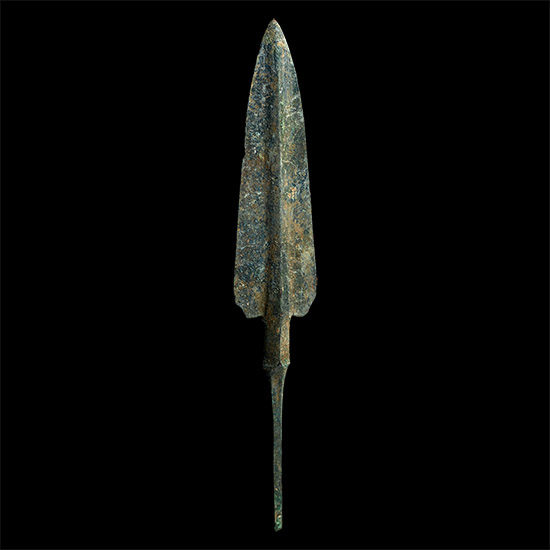
Large Luristan Bronze Arrowhead
2nd-1st millennium B.C.Estimate: £30 - 40 (+bp*)
Bids: 1 | Current Bid: £5
With lanceolate head, square-section neck and rounded shoulders. 50.6 grams, 16.6 cm
From a UK collection formed in the 1980s. Property of an Essex, UK, gentleman. -
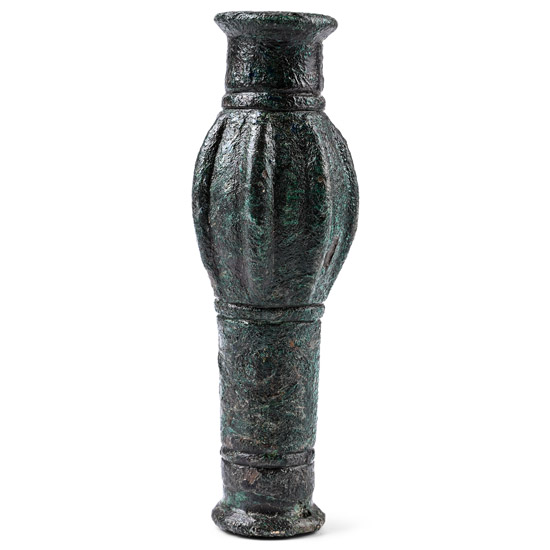
Western Asiatic Bronze Macehead
2nd-1st millennium B.C.Estimate: £150 - 200 (+bp*)
Opening Bid: £83
Comprising a cylindrical shaft with flared mouth, rounded flanges around the bulb, and horizontal stepped collars. 263 grams, 13.4 cm
Ex Abelita family collection, 1980s-2000s. -
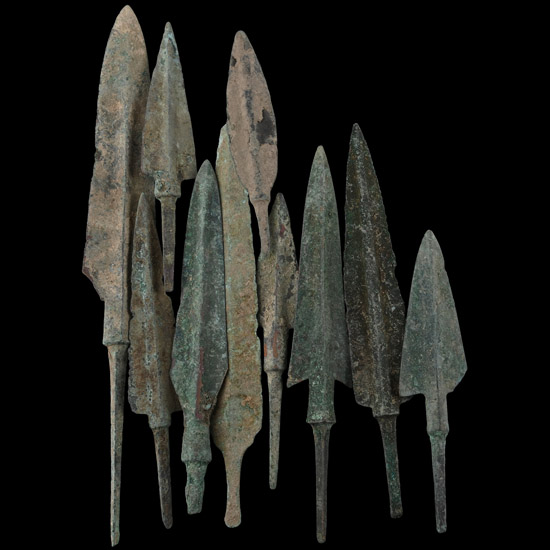
Western Asiatic Bronze Arrowhead Collection
2nd-1st millennium B.C.Estimate: £100 - 140 (+bp*)
Opening Bid: £50
Comprising leaf-shaped and triangular tanged arrowheads, most with a raised midrib. 238 grams total, 8.1-18.7 cm
London, UK, collection, 1990s.
All these bronze typologies of arrowheads were cast in moulds. Similar specimens have been found in Northwest and West Iran, Azerbaijan, Luristan and Amlash. Most of these blades are bipartite, but the definition of the bipartite type is not absolute, as it brings together weapons of very different and unrelated designs. In fact, some weapons do not have a sufficiently characteristic shape to be interpreted as a javelin or long arrowhead. -
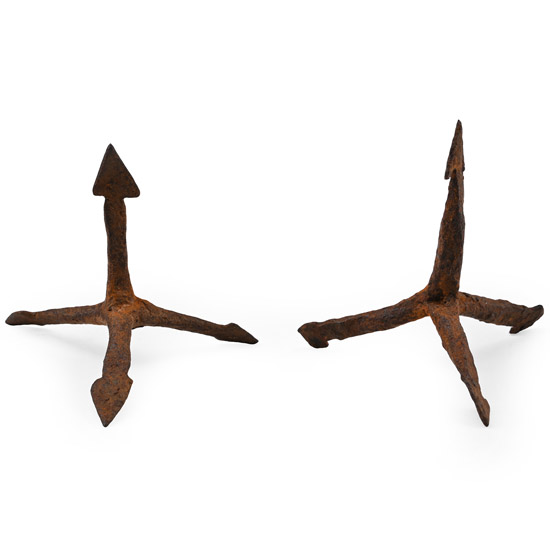
Medieval Iron Anti-Cavalry Caltrop Pair
11th-14th century A.D.Estimate: £100 - 140 (+bp*)
Opening Bid: £50
Each with four arms tipped with triangular spikes. 30 grams total, 60-62 mm
Acquired on the German art market before 2000. Property of a Surrey, UK, collector.
Caltrops were scattered on battlefields in an effort to stop or slow advancing enemy cavalry or foot soldiers; regardless of how a caltrop lands, one spike is always facing upwards. Caesar used them widely at Alesia (Caes., BG 7.73; 82): 'Stakes a foot long, with iron hooks attached to them, were entirely sunk in the ground before these, and were planted in every place at small intervals; these they called spurs'. -
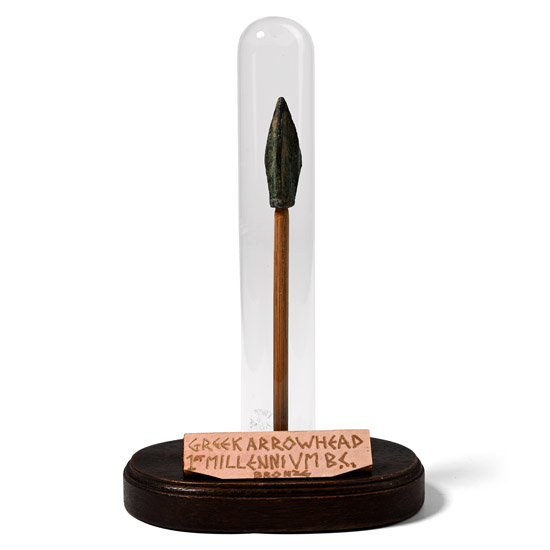
Greek Bronze Arrowhead
Circa 5th-3rd century B.C.Estimate: £30 - 40 (+bp*)
Opening Bid: £5
A triangular bronze arrowhead on a display stand with a glass cover. 113 grams total, 16.6 cm including stand
Purchased on the European art market. Property of a Norfolk, UK, collector. -
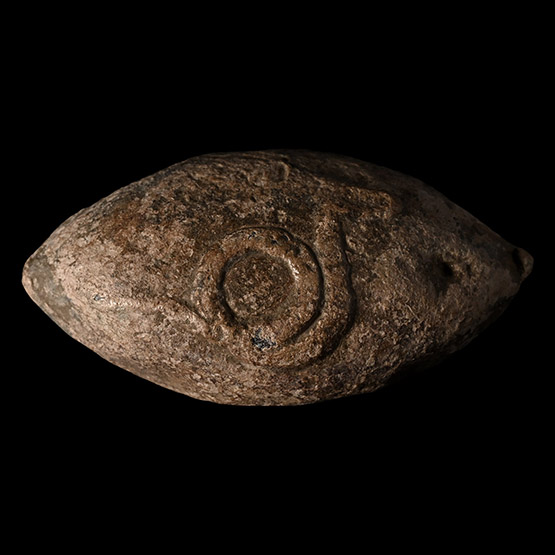
Greek Slingshot with Snake
4th-1st century B.C.Estimate: £200 - 300 (‡+bp*)
Opening Bid: £100
Lentoid in form with raised figure of a coiled snake to one face, possible legend to reverse. 31.2 grams, 31 mm
Private collection, Austria. Private collection, Europe. -
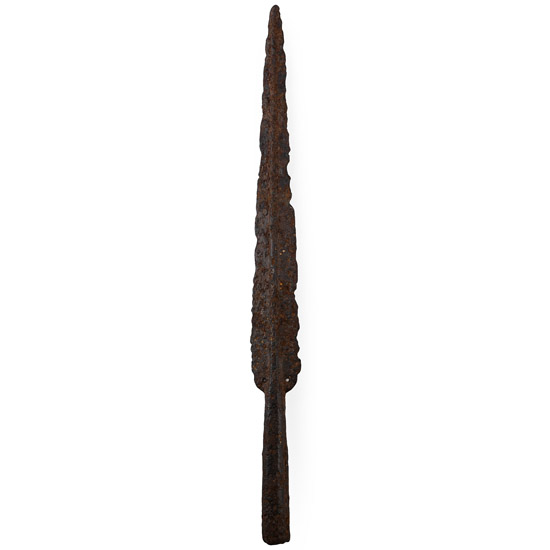
Large Viking Age Iron Pierced Socketted Spearhead
Circa 9th-11th century A.D.Estimate: £120 - 170 (+bp*)
Opening Bid: £5
Slender, triangular blade with rounded, pierced shoulders, a raised triangular midrib extending to a tubular socket. 310 grams, 40 cm
Acquired on the UK art market since the 1960s. From the private collection of Mr J.P.H., a Woolwich, UK, collector, his collection formed since the 1960s. -
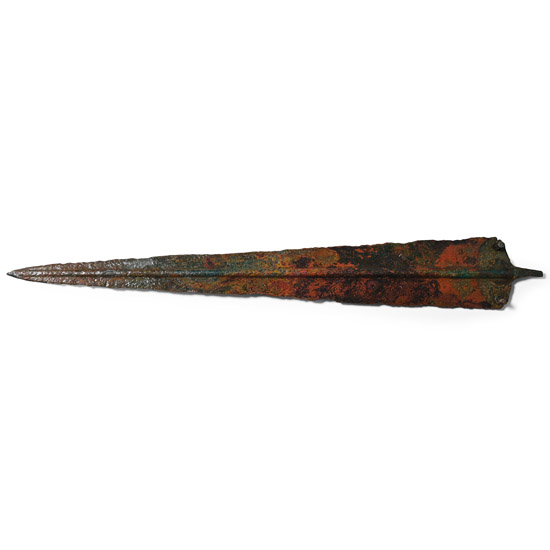
Luristan Bronze Tanged and Rivetted Spearhead
1st millennium B.C.Estimate: £150 - 200 (+bp*)
Opening Bid: £80
Comprising a triangular blade with a narrow midrib, a short tang with two attachment studs in situ. 184 grams, 32 cm
Ex Abelita family collection, 1980s-2000s. -
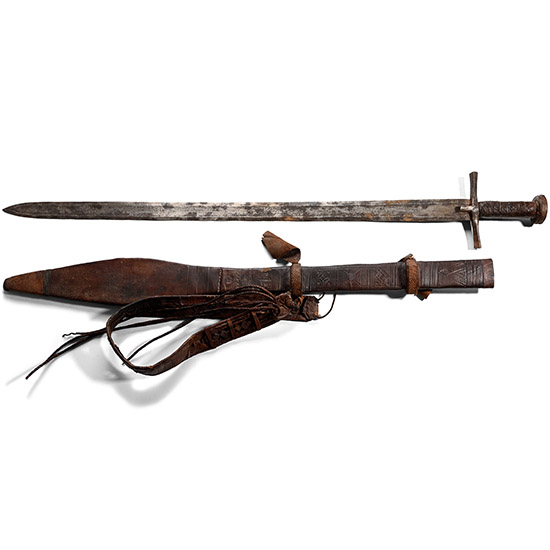
Sudanese Kaskara Sword with Scabbard
Late 19th-early 20th century A.D.Estimate: £150 - 200 (+bp*)
Opening Bid: £5
Comprising a two-edged straight-sided blade with shallow point, square-section crossguard with two vertical clips to grip the scabbard, columnar leather-bound grip and disc pommel; the wooden scabbard covered with leather decorated with heavily tooled bands, crocodile-skin panels to the chape and attachment collars, flared leaf-shaped lower body; broad tooled leather belt with securing laces. 1.25 kg, 10.5.5 cm
From the private collection of Peter Clayton, FCILIP, Dip, Arch, FSA, FRNS, Hemel Hempstead, Hertfordshire, UK; formed since the late 1950s.
